Role of Batteries in Grid Services: Optimizing European Energy
- Feb 8
- 7 min read

Managing supply and demand across complex European grids is a daily challenge for energy managers aiming for stability and cost control. Batteries have become indispensable for reliable grid service applications, offering rapid response and modular installation that traditional systems struggle to match. This introduction clarifies how advanced battery technologies, especially Lithium-ion, deliver flexible solutions for frequency regulation, peak shifting, and renewable integration—helping commercial and utility leaders build smarter, more resilient energy strategies.
Table of Contents
Key Takeaways
Point | Details |
Battery energy storage systems are essential for grid management. | They provide critical functions such as frequency regulation, peak demand management, and renewable energy integration. |
Lithium-ion batteries dominate the market. | Their high energy density and efficiency make them suitable for rapid response applications in grid services. |
Economic and regulatory factors play a significant role in battery deployment. | Understanding initial investment costs and compliance with evolving regulations is crucial for successful implementation. |
Selecting the right battery technology requires careful assessment. | Performance metrics, cost structures, and safety parameters must be evaluated to optimize grid service solutions. |
Defining Batteries in Grid Service Applications
Batteries have emerged as transformative technologies in modern electricity networks, enabling sophisticated grid service applications that address complex energy management challenges. Battery energy storage systems play a critical role in managing supply and demand dynamics across European power infrastructure.
At their core, grid service batteries represent sophisticated energy storage solutions designed to provide multiple critical functions within electrical networks. Their primary capabilities include:
Frequency Regulation: Rapidly adjusting power output to maintain grid stability
Peak Demand Management: Storing energy during low-demand periods for release during high-consumption times
Renewable Energy Integration: Smoothing intermittent generation from solar and wind sources
Grid Reliability Enhancement: Providing backup power and reducing transmission stress
Modern battery technologies, particularly Lithium-ion variants, demonstrate exceptional performance in these applications. Advanced battery storage systems enable rapid response mechanisms that traditional grid infrastructure cannot match, creating unprecedented flexibility in energy management.
Grid service batteries operate through sophisticated power conversion systems that transform stored chemical energy into usable electrical power precisely when needed. This capability allows utility operators to balance generation and consumption dynamically, mitigating potential blackouts and optimizing overall network efficiency.
Pro tip: Implement advanced battery management systems with real-time monitoring capabilities to maximize grid service battery performance and longevity.
Key Battery Technologies and Their Distinctions
Grid-scale energy storage demands diverse battery technologies that can address complex performance requirements across different applications. Battery energy storage technologies represent a critical frontier in modern electricity infrastructure, offering multiple solutions tailored to specific operational needs.
The primary battery technologies for grid services include:
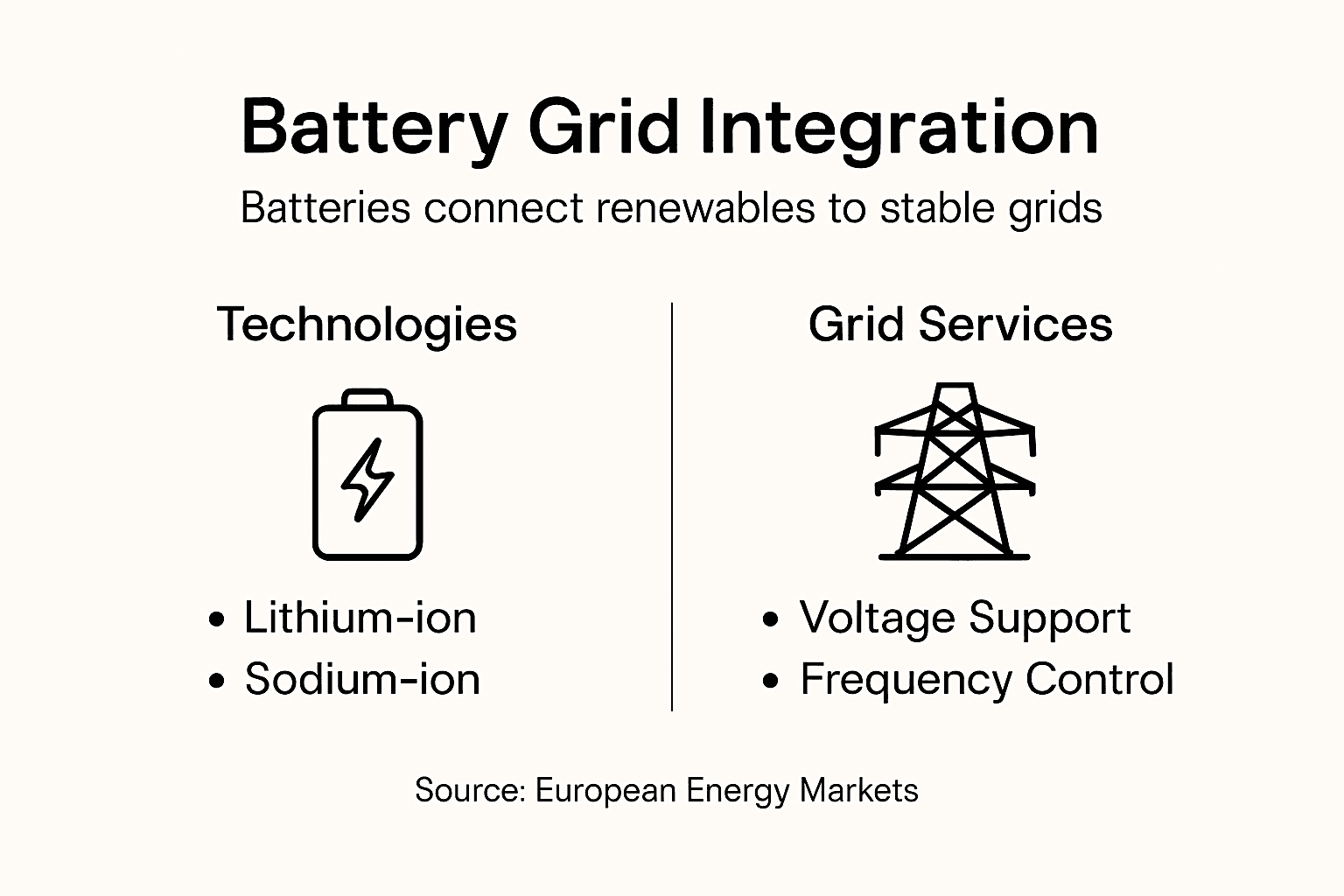
Lithium-ion Batteries: Highest energy density and market dominance
Sodium-ion Batteries: Lower cost and improved sustainability
Redox Flow Batteries: Enhanced safety and extended lifecycle
High-Temperature Batteries: Specialized grid stabilization capabilities
Aqueous Zinc Batteries: Environmentally friendly alternative
Lithium-ion batteries currently lead grid storage applications due to their exceptional energy efficiency and rapid response times. Advanced battery technologies demonstrate remarkable performance variations across different chemistries, with each technology offering unique advantages for specific grid management scenarios.

The selection of battery technology depends on critical performance metrics including energy density, safety, lifecycle duration, environmental impact, and economic feasibility. Utility operators must carefully evaluate these parameters to design optimal energy storage solutions that balance technical requirements with financial constraints.
To help clarify optimal battery type selection for grid-scale deployment, here’s a concise comparison of major technologies:
Battery Type | Ideal Use Case | Key Advantage | Typical Limitation |
Lithium-ion | Rapid response, high-density | Excellent efficiency | Cost, resource dependency |
Sodium-ion | Large-scale stationary storage | Enhanced sustainability | Lower energy density |
Redox Flow | Long-duration backup | Exceptional cycle life | Lower power density |
High-Temperature | Grid stabilization | Thermal resilience | Complex safety demands |
Aqueous Zinc | Eco-friendly applications | Reduced environmental impact | Emerging, less proven |
Pro tip: Conduct comprehensive performance assessments of multiple battery technologies before implementing grid-scale energy storage systems to ensure maximum operational efficiency.
Core Grid Services Enabled by Batteries
Battery energy storage systems have revolutionized grid infrastructure by providing critical services that enhance electricity network performance and reliability. Ancillary grid services represent sophisticated mechanisms that stabilize and optimize electrical networks through advanced battery technologies.
The primary grid services enabled by batteries include:
Frequency Regulation: Maintaining consistent electrical frequency
Load Shifting: Balancing energy consumption across different time periods
Renewable Energy Integration: Supporting intermittent generation sources
Power Quality Management: Reducing voltage fluctuations
Peak Demand Reduction: Minimizing strain during high-consumption periods
Voltage stability emerges as a critical function where battery energy storage systems provide rapid response capabilities that traditional infrastructure cannot match. These systems can instantaneously inject or absorb reactive power, effectively smoothing out potential grid disturbances and maintaining consistent electrical performance.
Utility operators leverage battery technologies to create more resilient and flexible electrical networks. By providing multi-service support, batteries enable smoother integration of renewable energy sources, reduce operational costs, and enhance overall grid reliability through intelligent energy management strategies.
Pro tip: Implement comprehensive battery management systems that can dynamically adjust to real-time grid requirements for maximum operational efficiency.
Integration With EMS and Renewable Assets
Advanced energy management systems (EMS) have transformed battery integration with renewable energy infrastructure, creating sophisticated networks that optimize power generation and consumption. Grid-connected battery systems provide critical coordination mechanisms that enable seamless renewable energy deployment.
Key integration strategies involve:
Dispatch Optimization: Coordinating battery release during peak demand
Renewable Output Balancing: Smoothing intermittent generation fluctuations
Grid Stability Management: Maintaining consistent power quality
Economic Performance Maximization: Reducing operational costs
Real-time Energy Routing: Dynamic power distribution across network
Hierarchical control architectures enable advanced battery management through intelligent inverter technologies. These systems can instantaneously adjust power flow, providing multiple ancillary services while enhancing renewable energy integration capabilities.
The convergence of battery storage, renewable generation, and energy management systems represents a technological breakthrough in electricity infrastructure. By creating adaptive, responsive networks, utilities can dramatically improve grid reliability, reduce carbon emissions, and optimize economic performance through intelligent energy management strategies.
Pro tip: Implement multi-layer control algorithms that enable real-time battery dispatch and renewable generation synchronization for maximum grid efficiency.
Financial, Regulatory, and Safety Implications
Battery energy storage technologies face complex challenges at the intersection of financial investment, regulatory compliance, and safety standards. Battery deployment economics require sophisticated analysis of capital expenditures, operational costs, and long-term performance metrics.
Key financial and regulatory considerations include:
Initial Capital Investment: Balancing upfront costs with long-term returns
Operational Expense Management: Minimizing maintenance and replacement expenditures
Regulatory Compliance: Meeting evolving European energy storage standards
Market Participation Rules: Navigating ancillary service market requirements
Safety Certification: Ensuring thermal management and risk mitigation
Regulatory frameworks increasingly shape battery storage deployment through complex policy mechanisms. European regulations are progressively creating supportive environments that incentivize safe, economically viable battery integration while establishing stringent safety and performance standards.
Safety remains a paramount concern, driving continuous improvements in battery chemistry, thermal management, and design protocols. Utility operators and energy storage developers must navigate a complex landscape of technical requirements, financial constraints, and evolving regulatory expectations to successfully implement grid-scale battery solutions.
Financial and regulatory challenges impact grid battery deployments. Here’s a summary for quick reference:
Challenge | Impact on Deployment | Mitigation Strategy |
High Capital Costs | Slows adoption, less ROI | Leverage incentives, long-term models |
Regulatory Changes | Requires compliance updates | Monitor policy, flexible planning |
Safety Requirements | Increases design complexity | Invest in advanced thermal controls |
Pro tip: Conduct comprehensive financial modeling that includes potential regulatory incentives and safety upgrade costs when evaluating battery storage investments.
Choosing Battery Solutions for Specific Needs
Selecting the optimal battery technology requires a nuanced understanding of application-specific performance requirements and system constraints. Battery technology selection demands comprehensive evaluation of technical, economic, and operational parameters.
Key selection criteria for battery solutions include:
Power Capacity: Matching energy output to specific grid service needs
Cycle Life: Assessing long-term performance and durability
Response Time: Evaluating rapid deployment capabilities
Cost Structure: Analyzing capital and operational expenditures
Safety Parameters: Ensuring thermal stability and risk mitigation
Grid-scale battery technologies offer diverse performance characteristics tailored to specific infrastructure requirements. Lithium-ion batteries excel in high-density applications, while alternatives like redox flow and sodium-ion batteries provide unique advantages for specialized storage scenarios.
Utility operators must conduct comprehensive technical assessments that balance performance metrics, economic constraints, and long-term strategic objectives. This holistic approach enables the selection of battery solutions that optimize grid service efficiency, reliability, and sustainability across different operational contexts.
Pro tip: Develop detailed performance modeling that incorporates multiple battery technologies to identify the most cost-effective and technically appropriate solution for specific grid service requirements.
Empower Your Grid Services with Advanced Battery Solutions from Belinus
The article highlights critical challenges in balancing grid stability, renewable energy integration, and cost-efficient energy storage within European electricity networks. If you are looking to overcome issues like frequency regulation, peak demand management, and real-time energy arbitrage, Belinus offers cutting-edge battery storage technologies and intelligent energy management systems designed specifically to meet these complex demands. Our solutions support diverse battery chemistries and scalable capacities, ensuring you maximize reliability and economic performance.

Unlock the full potential of your grid infrastructure with scalable utility storage modules and dynamic EMS optimization that expertly coordinate renewable inputs and battery dispatch. Take control now by exploring our comprehensive residential and commercial battery storage options, power conversion systems, and EV charging solutions at Belinus. Discover how to integrate smart energy management that adapts instantly to real-world grid conditions and regulatory environments. Start your journey towards smarter, more resilient energy systems today.
Frequently Asked Questions
What are the primary functions of batteries in grid service applications?
Batteries in grid service applications primarily perform frequency regulation, peak demand management, renewable energy integration, and enhance grid reliability through backup power and stress reduction.
How do different battery technologies compare for grid services?
Lithium-ion batteries offer high energy density and efficiency, while sodium-ion batteries are more cost-effective and sustainable. Redox flow batteries provide extended lifecycle and safety, while high-temperature batteries specialize in grid stabilization. Aqueous zinc batteries are an eco-friendly alternative but are less proven.
What benefits do battery energy storage systems provide for renewable energy integration?
Battery energy storage systems help smooth out the intermittent generation of renewable sources like solar and wind, enabling more reliable energy supply and better management of the grid’s overall performance.
What factors should be considered when selecting battery solutions for grid services?
Key factors include power capacity, cycle life, response time, cost structure, and safety parameters, ensuring that the selected battery technology aligns with specific operational needs and long-term strategic objectives.
Recommended
Comments