Battery Modules vs Packs: Choosing the Right System
- 2 days ago
- 7 min read

Choosing the right energy storage system can feel complex when every property’s needs differ. For energy managers across Central Europe, understanding the structural hierarchy from battery modules to packs is the foundation for reliable and efficient solutions. By exploring the hierarchical system of cells, modules, and packs, you can better match system design to your facility’s demands while ensuring flexibility, safety, and cost-control for years to come.
Table of Contents
Key Takeaways
Point | Details |
Battery Structure Hierarchy | Battery systems are organized into cells, modules, and packs, each serving distinct functions to optimize energy management. |
Importance of Modular Design | Modular designs improve scalability, serviceability, and maintenance, allowing for adaptability in various applications. |
Role of Battery Management Systems | A robust Battery Management System is crucial for ensuring safe operation, thermal control, and performance optimization. |
Cost and Risk Considerations | Comprehensive evaluation beyond initial purchase price is essential for understanding the lifetime costs and risks associated with battery investments. |
Defining Battery Modules and Packs
Battery systems represent a complex hierarchy of energy storage components, organized from individual cells to comprehensive power units. At the most fundamental level, a battery consists of electrochemical cells designed to convert chemical energy into electrical energy during discharge and recharge cycles. Electrochemical cell structures enable the fundamental energy transformation process that powers modern technological systems.
The organizational structure of battery systems follows a precise progression:
Battery Cells: The smallest individual units containing anode, cathode, and electrolyte
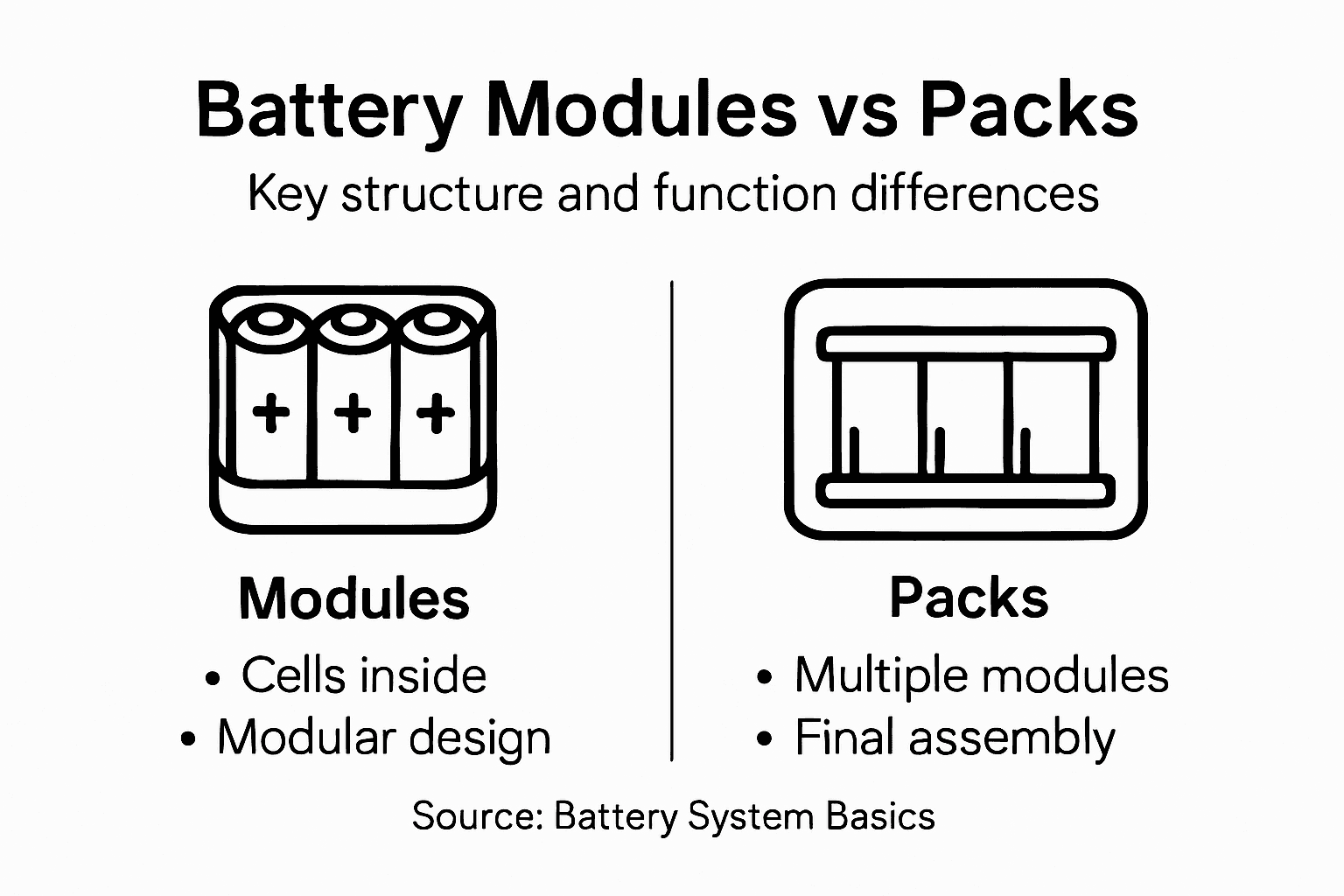
Battery Modules: Groups of interconnected cells organized for improved performance
Battery Packs: Complete assemblies of multiple modules creating a comprehensive power system
Typically, lithium-ion technology dominates modern battery design due to its superior energy density and rechargeability. These cells are systematically arranged into modules, which provide several critical advantages:
Improved thermal management
Enhanced voltage regulation
Simplified maintenance and replacement
Standardized design for scalable configurations
Battery modules act as intermediate building blocks, transforming individual cells into more robust and manageable energy storage units. Each module contains multiple cells electrically connected to achieve specific voltage and capacity requirements. This modular approach allows engineers to design flexible systems adaptable to diverse applications, from small consumer electronics to large-scale industrial energy storage.
Battery packs represent the final stage of battery system design, integrating multiple modules into a complete, functional power unit. These comprehensive assemblies incorporate additional critical components like:

Here’s a summary highlighting the key differences between battery cells, modules, and packs:
Level | Core Purpose | Typical Components | Used In |
Cell | Basic energy conversion | Anode, cathode, electrolyte | All battery types |
Module | Intermediate energy aggregation | Multiple cells, housing, connectors | EVs, backup systems |
Pack | Complete system integration | Modules, BMS, enclosure, cooling | Vehicles, grid storage |
Battery management systems
Cooling mechanisms
Protective enclosures
Electrical connection interfaces
Pro tip: When evaluating battery systems, always consider the modularity and scalability of the design to ensure future adaptability and potential system upgrades.
Structural Differences and Hierarchy
Battery systems are engineered with a precise hierarchical structure that enables complex energy storage and management. Battery pack architecture involves strategic arrangements of cells, modules, and interconnection systems designed to optimize electrical performance, thermal management, and overall system reliability.
The structural hierarchy of battery systems comprises multiple critical levels:
Cells: Basic electrochemical units
Modules: Grouped cells with shared electrical and thermal characteristics
Packs: Comprehensive assemblies integrating multiple modules
Electrical Configurations play a crucial role in determining battery system performance. Cells can be connected in series or parallel arrangements to achieve specific voltage and capacity requirements. Series connections increase total voltage, while parallel connections enhance current capacity and overall energy storage potential.
Mechanical Design is equally important in battery system architecture. Battery system design must account for several critical mechanical considerations:
Thermal management strategies
Structural integrity under mechanical stress
Space optimization
Cooling system integration
Protection against environmental factors
Modular design offers significant advantages by enabling:
Easier maintenance and component replacement
Scalable system configurations
Simplified manufacturing processes
Enhanced fault tolerance
Flexible adaptation to different application requirements
Battery system design represents a complex engineering challenge balancing electrical performance, mechanical reliability, and operational efficiency.
Pro tip: When evaluating battery systems, carefully assess the modularity and design flexibility to ensure long-term adaptability and potential future upgrades.
Safety, BMS, and Thermal Management
Battery management systems represent the critical neural network ensuring safe and efficient battery operation. Battery management system design encompasses complex monitoring and control mechanisms that protect battery systems from potential hazards.
The primary functions of a Battery Management System (BMS) include:
Voltage monitoring and regulation
Temperature tracking and control
State of charge estimation
Cell balancing
Overcharge/overdischarge protection
Fault detection and prevention
Thermal Management is a crucial aspect of battery safety and performance. Thermal characterization techniques reveal that non-uniform heat distribution can significantly compromise battery longevity and operational reliability. Heat generation during charging and discharging cycles must be carefully managed to prevent thermal runaway and potential system failure.
Key thermal management strategies involve:
Liquid cooling systems
Air cooling mechanisms
Phase-change material technologies
Advanced heat dissipation designs
Intelligent temperature monitoring
Effective thermal management represents the difference between a reliable battery system and a potential safety hazard.
Safety considerations extend beyond thermal management. Comprehensive BMS designs incorporate multiple protective layers:
The following table compares key functions of the Battery Management System (BMS) and Thermal Management in modern battery packs:
Aspect | Battery Management System (BMS) | Thermal Management |
Main Objective | Safety and performance optimization | Temperature regulation |
Key Functions | Monitoring, balancing, protection | Heat dissipation, cooling |
Impact on Lifetime | Prevents early degradation | Extends cell life |
Typical Technologies | Sensors, control algorithms, software | Liquid cooling, phase-change tech |
Electrical isolation mechanisms
Short circuit prevention
Mechanical stress monitoring
Integrated emergency shutdown protocols
Real-time performance diagnostics
Pro tip: Always prioritize battery systems with robust and transparent battery management system architectures that provide comprehensive safety and performance monitoring.
Scalability and Serviceability in Energy Storage
Battery modularity creates flexible energy storage solutions adaptable across multiple application scales. Battery system scalability represents a critical design consideration enabling seamless expansion from residential to utility-level installations.
Key scalability attributes include:
Standardized module dimensions
Consistent electrical interfaces
Parallel and series connection capabilities
Uniform thermal management protocols
Integrated communication frameworks
Serviceability emerges as a fundamental design principle in modern battery systems. Modular architectures allow engineers to:
Quickly replace individual components
Minimize system downtime
Reduce overall maintenance costs
Extend battery system lifecycle
Simplify diagnostic procedures
Battery lifetime simulation tools enable precise performance predictions by modeling complex interactions between modules. These advanced technologies help engineers optimize design strategies, anticipate potential failure modes, and develop more resilient energy storage solutions.
Effective scalability transforms battery systems from static components into dynamic, adaptable energy resources.
Advanced serviceability strategies involve:
Standardized module form factors
Hot-swappable battery units
Integrated diagnostic interfaces
Predictive maintenance algorithms
Comprehensive performance monitoring
Pro tip: Design battery systems with modularity as a core principle, ensuring future adaptability and cost-effective maintenance strategies.
Cost, Risks, and Choosing the Right Solution
Battery investment decisions require comprehensive evaluation beyond initial purchase price. Battery storage cost projections demonstrate critical factors extend well beyond simple capital expenditure into long-term performance and reliability metrics.
Key cost considerations include:
Initial system procurement expenses
Installation and integration costs
Ongoing maintenance requirements
Expected performance degradation
Potential replacement timelines
Energy efficiency factors
Lifecycle carbon footprint
Risk assessment involves multiple strategic dimensions. Global battery transition challenges highlight several critical evaluation parameters:
Supply chain reliability
Manufacturing quality control
Technology obsolescence potential
Material sustainability
Geopolitical mineral availability
Selecting the appropriate battery solution demands a multifaceted approach. Stakeholders must balance technical performance with economic constraints, considering factors such as:
Specific energy requirements
Power density needs
Environmental operating conditions
Expected utilization patterns
Regulatory compliance
Effective battery selection represents a nuanced decision balancing technological capability, economic feasibility, and long-term strategic objectives.
Advanced risk mitigation strategies involve:
Comprehensive performance modeling
Rigorous testing protocols
Diversified technology portfolios
Flexible upgrade pathways
Continuous monitoring systems
Pro tip: Develop a holistic evaluation framework that considers not just upfront costs, but total lifecycle economics and strategic adaptability.
Unlock the Full Potential of Battery Modules and Packs with Belinus
Choosing the right battery system means understanding the crucial differences between battery modules and battery packs for scalable, safe, and efficient energy storage. If you value modularity, thermal management, and a flexible battery management system (BMS) that grows with your energy needs, Belinus offers tailored solutions designed to meet those exact challenges. Whether you require residential or utility-scale storage, our advanced Energy Management System ensures your setup is optimized for longevity and performance.

Explore how our innovative products, like the Energy Wall G1 and future G2 models, combined with scalable utility storage modules, can transform your energy strategy today. Visit Belinus to learn more about integrating intelligent battery packs and modules designed with safety, serviceability, and scalability in mind. Take action now to secure a system that adapts to evolving energy demands and safeguards your investment for the long term.
Frequently Asked Questions
What is the difference between battery modules and packs?
Battery modules are intermediate units that consist of interconnected battery cells, designed to improve performance and thermal management. Battery packs, on the other hand, are complete systems that integrate multiple modules into a functional power unit, including additional components like battery management systems and cooling mechanisms.
What advantages do battery modules offer over individual cells?
Battery modules provide improved thermal management, enhanced voltage regulation, and simplified maintenance by grouping multiple cells together. This modular approach also allows for greater scalability and flexibility in designing energy storage systems for various applications.
How important is thermal management in battery systems?
Thermal management is crucial for ensuring the safety and performance of battery systems. Effective thermal management prevents overheating and thermal runaway, which can lead to system failure. Strategies include liquid and air cooling systems, phase-change materials, and intelligent temperature monitoring.
What factors should I consider when choosing a battery system?
When selecting a battery system, consider factors like energy requirements, power density needs, installation costs, expected performance degradation, maintenance requirements, and scalability. It’s essential to balance technical performance with economic feasibility for long-term success.
Recommended
Comments