Community solar setup guide Benelux: step-by-step 2026
- Mar 10
- 8 min read

Community solar projects in Benelux appear daunting due to complex incentives, eligibility rules, and lengthy permitting timelines. Yet a permissive community solar policy boosts PV installations by 21% by 2035, proving that structured approaches unlock substantial opportunities. This guide breaks down the entire setup process into manageable steps, helping homeowners and property managers across Belgium, Netherlands, and Luxembourg navigate legal, financial, and technical requirements confidently for successful community solar adoption.
Table of Contents
Key takeaways
Point | Details |
Financial management | Revenue durability depends on modeling subscriber churn, reacquisition costs, and balanced portfolios proactively. |
Regulatory compliance | Understanding Benelux-specific legal frameworks prevents costly delays and ensures smooth project approval. |
Stepwise planning | Structured permitting, financing, and installation sequences reduce risks and accelerate operational readiness. |
Active communication | Ongoing subscriber engagement maintains retention rates above 85%, stabilizing long-term revenue streams. |
Realistic expectations | Typical payback periods range 6 to 9 years, with operational timelines spanning 6 to 12 months. |
Introduction to community solar in Benelux
Community solar enables multiple properties to share a single solar array’s output, providing energy access without individual rooftop installations. Benelux countries are rapidly expanding solar capacity driven by supportive energy policies and climate commitments. This collective approach connects homeowners, property managers, local authorities, and utilities around shared renewable energy goals.
Policy flexibility in Benelux encourages larger projects by allowing participants within 100-meter radius to join community solar schemes. Belgium, Netherlands, and Luxembourg each offer distinct regulatory frameworks but share common elements promoting renewable adoption. Understanding these nuances positions you for success.
Typical stakeholders include:
Homeowners seeking lower energy bills and carbon footprints
Property managers coordinating multi-building or neighborhood installations
Local authorities providing permits and grid connection approvals
Utilities managing grid integration and metering
Financial institutions offering project funding and incentive structures
Community solar delivers social and financial benefits exceeding individual rooftop systems. Shared infrastructure reduces per-participant costs while enabling economies of scale. Participants without suitable roofs gain solar access, democratizing renewable energy across diverse housing types.
The key advantage lies in collective bargaining power and risk distribution. Multiple subscribers stabilize revenue even when individual circumstances change. This resilience makes community solar attractive for property managers overseeing tenant turnover or homeowners seeking predictable energy savings without upfront capital expenditure.
Prerequisites: what you need before starting
Successful community solar demands careful preparation across legal, financial, technical, and community engagement dimensions. Benelux countries impose specific administrative requirements varying by municipality and national policy. Research local zoning laws, building codes, and energy regulations before proceeding.
Financial models must extend beyond nominal rate calculations. Revenue modeling should account for subscriber churn and balanced portfolios to ensure long-term cash flow stability. Reacquisition costs for replacing departing subscribers impact profitability significantly. Include these variables in projections from day one.
Early community engagement builds support and identifies potential subscribers. Host information sessions explaining benefits, costs, and timelines. Transparent communication channels reduce misunderstandings and foster trust. Property managers benefit from tenant surveys gauging interest levels before committing resources.
Secure funding sources early:
National and regional grants for renewable energy projects
Municipal subsidies targeting community-scale installations
Green loans from financial institutions with favorable terms
Crowdfunding platforms connecting local investors to projects
Feed-in tariffs and net metering arrangements stabilizing returns
Technical assessment determines site suitability and equipment needs. Evaluate roof or ground space, structural integrity, sun exposure, and proximity to electrical infrastructure. Align system capacity with anticipated subscriber demand and grid connection limits. Templates and planning guides in 24 languages help structure initial assessments.

Pro Tip: Complete a comprehensive solar power checklist addressing site evaluation, financial modeling, and subscriber recruitment before approaching authorities for permits. This preparation accelerates approval timelines and demonstrates project viability to funding sources.
Stepwise project setup and implementation
Methodical execution transforms planning into operational community solar projects. Follow these sequential steps to navigate the Benelux regulatory landscape effectively while maximizing financial returns and subscriber satisfaction.
Evaluate regulations and community interest: Contact municipal authorities to understand specific permitting requirements for community solar in your jurisdiction. Survey potential subscribers to confirm demand levels justify project scale. Belgium, Netherlands, and Luxembourg each impose distinct eligibility criteria and participant proximity rules.
Model financials factoring churn and incentives: Build detailed spreadsheets incorporating subscriber acquisition costs, monthly revenue per participant, anticipated churn rates, and reacquisition expenses. Balanced subscriber portfolios considering churn prevent revenue volatility. Include available incentives and feed-in tariffs to calculate realistic payback periods.
Secure funding and size project sustainably: Apply for grants and subsidies matching your project timeline. Right-size solar capacity to meet subscriber demand without overbuilding. Clear definitions of sizing and financing ensure long-term sustainability and optimal benefits.
Obtain permits with regulatory compliance: Submit building permits, electrical connection approvals, and environmental assessments as required by local authorities. Allow 2 to 4 months for permit processing in most Benelux jurisdictions. Address any regulatory concerns promptly to avoid delays.
Install PV systems integrating battery storage and EMS: Select solar system components matching project capacity and subscriber needs. Consider battery storage for enhanced grid services optimization and peak demand management. Energy Management Systems maximize home energy systems savings through intelligent load balancing.
Engage subscribers continuously: Launch communication programs including monthly updates, energy production reports, and billing transparency. Proactive engagement maintains retention rates above 85%, directly supporting revenue stability. Address subscriber questions quickly to build lasting trust.
Project Phase | Typical Duration | Key Activities |
Planning | 2-3 months | Regulations research, community surveys, site assessment |
Financing | 1-2 months | Grant applications, loan negotiations, incentive confirmations |
Permitting | 2-4 months | Permit submissions, regulatory reviews, approvals |
Installation | 1-2 months | Equipment procurement, system installation, grid connection |
Subscriber onboarding | Ongoing | Contract signing, billing setup, communication launch |
Pro Tip: Schedule permit applications to overlap with financing negotiations. This parallel processing reduces overall project timelines by 4 to 6 weeks, accelerating cash flow initiation and improving financial returns.
Common implementation mistakes and how to avoid them
Even well-planned community solar projects encounter pitfalls undermining financial performance and subscriber satisfaction. Recognizing these errors early enables corrective action before problems escalate.
Misaligned subscriber eligibility with incentive requirements causes costly reacquisition cycles. Misunderstanding incentives and eligibility leads to participant disqualification after onboarding. Verify eligibility criteria match available subsidies before recruiting subscribers. Clear documentation prevents disputes and revenue loss.
Poor communication strategies increase churn rates significantly. Subscribers lacking regular updates or production reports feel disconnected from projects. Implement automated monthly emails, annual meetings, and transparent billing portals. Consistent engagement reduces turnover by 30% or more.
Underestimating permitting timelines disrupts financing and installation schedules. Municipal authorities in Benelux countries process applications at varying speeds. Budget 3 to 5 months for permitting rather than optimistic 6-week estimates. Early applications compensate for unexpected delays.
Common mistakes include:
Failing to model balanced subscriber portfolios across income levels and usage patterns
Neglecting reacquisition cost projections in financial models
Skipping community engagement before formal project announcements
Choosing equipment without considering long-term maintenance requirements
Ignoring grid connection capacity constraints during planning
Preventive strategies involve comprehensive solar power checklists covering legal, financial, and technical dimensions. Regular project audits identify emerging issues before they impact operations. Establish contingency plans addressing subscriber departures, equipment failures, and regulatory changes.
Early identification matters. Address subscriber concerns within 48 hours to prevent escalation. Monitor churn metrics monthly and adjust communication strategies when retention dips below 85%. Proactive management converts potential failures into learning opportunities strengthening long-term project viability.
Expected results, outcomes, and success metrics
Realistic expectations guide effective planning and resource allocation for community solar projects. Benelux projects typically take 6 to 12 months from initial planning to operational status depending on regulatory complexity and financing arrangements. Larger projects serving 50+ subscribers require longer timelines.
Financial returns depend on incentive structures and energy prices. Payback periods of 6 to 9 years are typical across Benelux when accounting for current subsidies and feed-in tariffs. Net present value calculations should incorporate subscriber churn, reacquisition costs, and equipment replacement schedules over 25-year project lifespans.
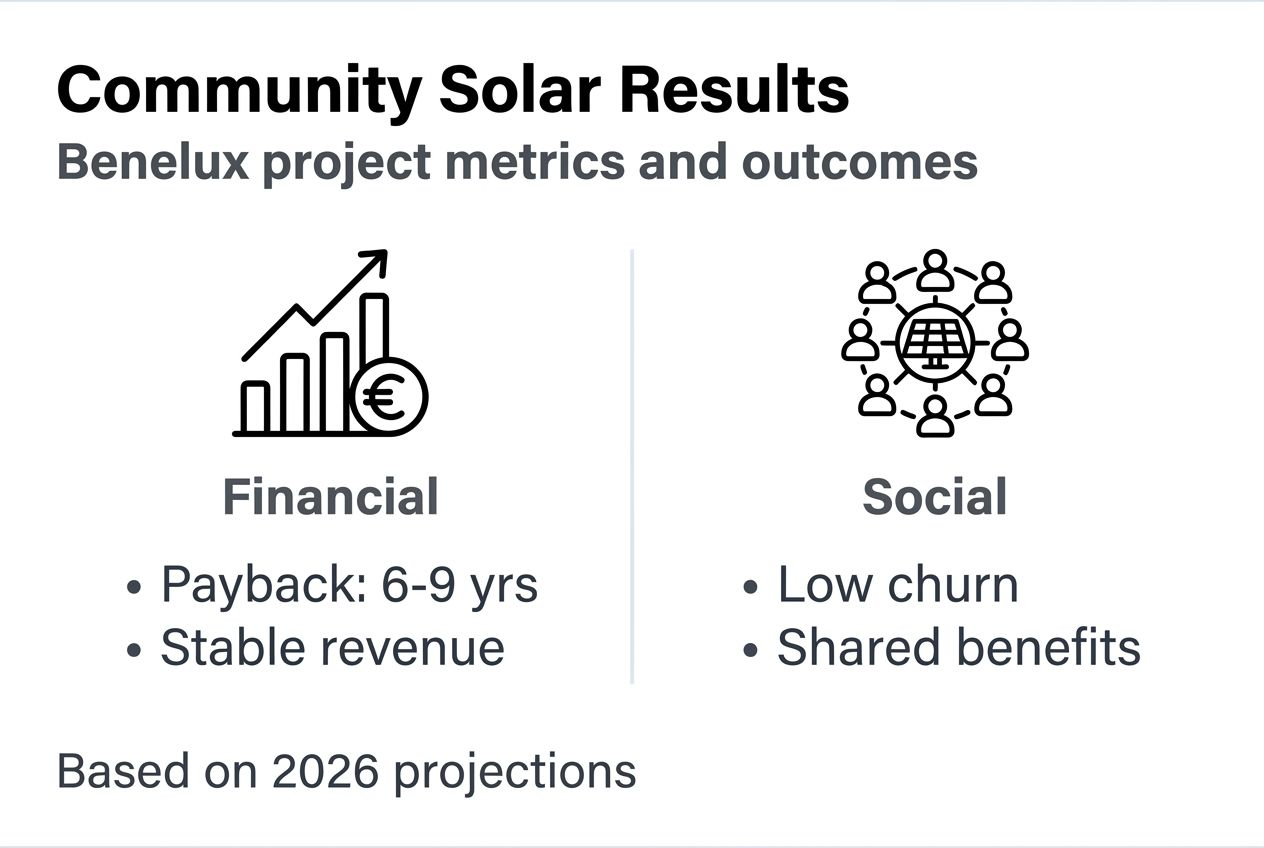
Subscriber retention directly impacts revenue stability. Projects maintaining 85% or higher retention rates experience consistent cash flows supporting debt service and operational expenses. Balanced subscriber portfolios mixing residential, commercial, and institutional participants reduce volatility from individual departures.
Key success metrics include:
Monthly energy production meeting or exceeding projections
Subscriber satisfaction scores above 8 out of 10
Churn rates below 15% annually
Cash flow positive within 12 months of operation
Payback achievement within projected timelines
Metric | Target Range | Impact on Success |
Project timeline | 6-12 months | Faster launches improve early cash flow |
Payback period | 6-9 years | Shorter periods increase investor attractiveness |
Subscriber retention | 85%+ annually | Higher retention stabilizes revenue |
Energy production variance | Within 10% of projections | Accurate forecasting prevents financial shortfalls |
Communication frequency | Monthly minimum | Regular updates maintain subscriber engagement |
Expect a stabilization period spanning 3 to 6 months post-launch as billing systems mature and subscriber behaviors normalize. Initial churn may reach 10% to 15% as early participants adjust expectations. Proactive communication during this phase prevents cascading departures.
Long-term success requires adaptive management responding to energy market changes and regulatory updates. Integrate insights from solar payback calculations and Belgium solar ROI analyses to refine financial models annually. Continuous improvement positions projects for sustained performance across decades.
Discover expert support for your community solar project
Navigating community solar setup in Benelux becomes significantly easier with expert guidance tailored to local regulations and market conditions. Belinus offers comprehensive support covering legal frameworks, technical system design, financial modeling, and subscriber management strategies specific to Belgium, Netherlands, and Luxembourg.
Access specialized resources addressing permitting complexities, incentive optimization, and equipment selection for community-scale installations. Professional consultation accelerates project timelines by identifying potential obstacles before they cause delays. Expert advice ensures your financial models incorporate subscriber churn, reacquisition costs, and balanced portfolio strategies maximizing long-term returns.
Explore how Belinus integrates solar PV, battery storage, and energy management systems to enhance community solar performance. Intelligent EMS platforms optimize energy distribution across subscribers while enabling grid services revenue opportunities. These integrated solutions deliver superior returns compared to standalone solar installations.
FAQ
What permits are required for community solar projects in Benelux?
Permit requirements vary significantly among Belgium, Netherlands, and Luxembourg, with additional municipal variations. Common requirements include building permits for structural installations, electrical connection approvals from grid operators, and environmental assessments for larger projects. Starting permit applications 3 to 4 months before planned installation dates reduces project delays.
How can I minimize subscriber churn in my community solar project?
Maintain consistent communication through monthly energy production reports, quarterly newsletters, and annual subscriber meetings. Align eligibility criteria with available incentive requirements during recruitment to prevent later disqualifications. Transparent billing practices and responsive customer service addressing concerns within 48 hours build trust reducing churn below 15% annually.
What financial incentives are available for community solar in the Benelux region?
Incentive structures differ across Belgium, Netherlands, and Luxembourg but commonly include national renewable energy grants, regional subsidies for community projects, feed-in tariffs guaranteeing minimum energy prices, and tax reliefs for green investments. Check municipal and provincial programs early in planning phases to incorporate specific incentives into financial models. Many programs require applications before installation begins.
Recommended
Comments