Energy Data Analytics in 2025: What Professionals Need to Know
- 1 hour ago
- 8 min read
TL;DR:
By 2025, energy data analytics shift focuses on utilizing existing data through AI, synthetic datasets, and real-time optimization instead of merely collecting more information. Organizations that integrate these technologies across operational workflows and overcome governance and organizational barriers will unlock the full potential of predictive energy management. Effective implementation depends on closing the loop between analysis and action, fostering AI literacy, and addressing security concerns in sensitive data environments.
Energy data analytics in 2025 is not about collecting more data. Most organizations already drown in it. The real shift is in what you do with it. AI-powered models, synthetic datasets, and real-time optimization platforms are redefining how energy managers, analysts, and policymakers extract value from operational data. This guide breaks down the market forces, technologies, and implementation realities that separate organizations still reporting on energy use from those actively controlling it.
Table of Contents
Key Takeaways
Point | Details |
Market is scaling fast | The energy analytics market hit USD 35.14 billion in 2025, with AI and regulation driving growth. |
AI changes prediction accuracy | Foundation models and machine learning cut grid computation time and improve solar forecasting by up to 33%. |
Synthetic data solves privacy gaps | AI training no longer requires exposing sensitive operational records, enabling faster deployment. |
EaaS models lower barriers | Subscription-based energy optimization now delivers real-time results without large upfront capital. |
Implementation gaps are organizational | The biggest obstacles to analytics value are governance and integration, not technology. |
Energy data analytics in 2025: market size and drivers
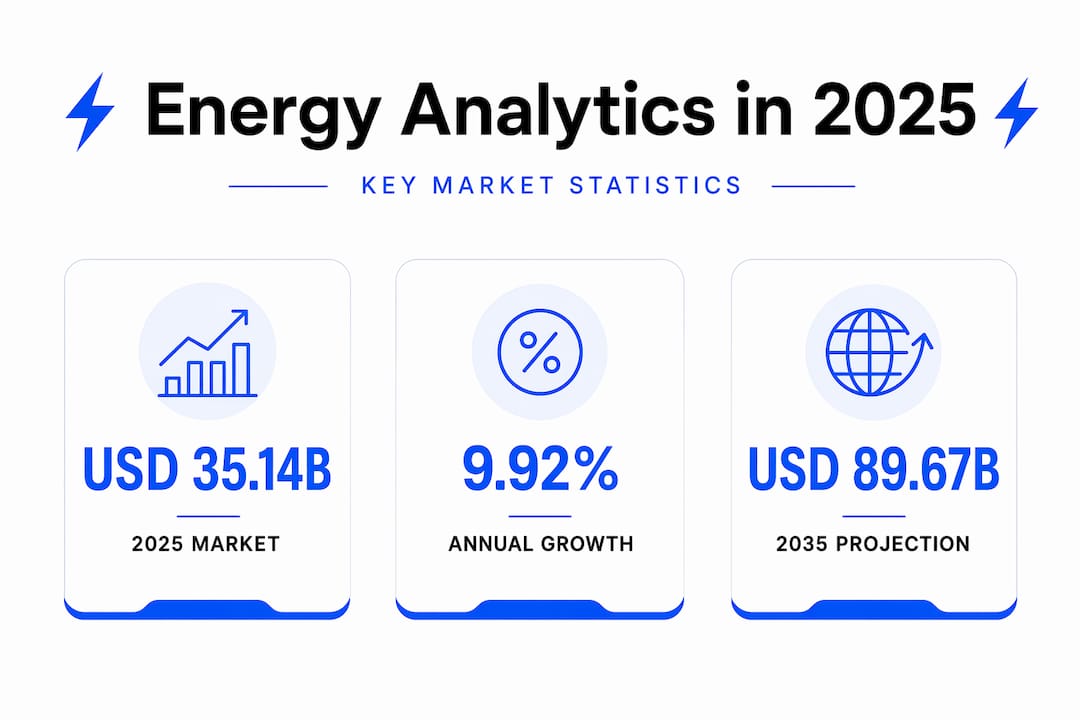
The scale of the opportunity is hard to overstate. The big data analytics market in energy was valued at USD 35.14 billion in 2025 and is projected to reach USD 89.67 billion by 2035, growing at a compound annual rate of 9.82%. That trajectory is not being driven by curiosity. It reflects regulatory pressure, grid complexity, and the commercial cost of getting energy decisions wrong.
Three forces are accelerating adoption:
Digital transformation. Grid sensors, smart meters, and connected industrial equipment now generate operational data at a resolution that was impractical to process five years ago.
Emissions regulation. Carbon reporting mandates in the EU, UK, and increasingly the U.S. require organizations to do more than estimate. Regulators want precision at the asset level.
Renewable integration. Solar and wind introduce variability that deterministic planning cannot handle. Analytics fills the gap between generation forecasts and dispatch decisions.
Data availability is improving, but not uniformly. The U.S. EIA’s open data API offers access to 1.3 million time series across 13 energy categories, which is genuinely useful for macro modeling. The limitation is resolution. Regional monthly data cannot train the substation-level forecasting models that real-time grid management requires. That gap between what public data provides and what AI models actually need is one of the defining tensions in energy data analytics right now.
Commercial sensitivity compounds the problem. Utilities and grid operators hold high-resolution operational data but face strong disincentives to share it. Competitive exposure, security concerns, and regulatory constraints all push against the open data ideal. Understanding this constraint is not pessimism. It is the context that makes synthetic data and federated learning genuinely important tools.
How AI is transforming energy analytics workflows
AI is not a feature you bolt onto an existing analytics platform. In 2025, it is the core engine for the workflows that matter most: grid balancing, asset maintenance, and demand forecasting. The performance gains are quantifiable and growing.
Consider what machine learning already delivers at scale:
Improved solar forecasting. In a well-documented UK National Grid ESO case, AI improved solar power predictions by 33% using 80 input variables. That improvement directly supports real-time grid balancing decisions.
Faster power flow computation. Microsoft’s GridSFM foundation model can predict AC optimal power flow in milliseconds, generalizing across more than 150 grid topologies and cutting solve time in half versus standard methods.
Predictive maintenance at scale. AI-driven maintenance programs reduce unplanned outages by 40% and extend equipment lifespan by up to 20%, with self-healing grid architectures cutting power outage duration by 40% to 50%.
AI Application | Performance Gain | Primary Use Case |
Solar forecasting (ML model) | +33% accuracy | Grid balancing and dispatch |
GridSFM power flow | Milliseconds vs. hours | Real-time scenario evaluation |
Predictive maintenance | 40% fewer outages | Asset lifecycle management |
Self-healing grid | 40–50% outage reduction | Grid resilience and reliability |
Synthetic data is the piece most organizations have not factored into their AI roadmap yet. Synthetic energy datasets allow AI model training without exposing sensitive operational records. These datasets preserve the statistical properties of real data while eliminating confidentiality risk, and deployment timelines have dropped to weeks rather than months. For energy managers working in regulated environments, this is a practical path to advanced modeling that does not require negotiating data-sharing agreements with competitors or regulators.

Pro Tip: When evaluating AI vendors for energy analytics, ask specifically whether their models were trained on synthetic data, real operational data, or both. The answer tells you a great deal about how the model will perform on your specific asset profiles.
Emerging trends and application areas
The organizations getting the most from data-driven energy solutions are not focused on a single use case. They are building analytics capabilities across multiple application areas simultaneously.
Energy as a Service (EaaS). The EaaS subscription model is maturing fast. Over 50% of new offerings now deliver real-time performance improvements through IoT and AI integration, with no upfront capital required from the customer. For commercial buildings and industrial facilities, this removes the traditional budget barrier to advanced analytics.
AI-enabled microgrids. Decentralized energy management is growing more capable. AI models now handle supply-demand balancing within microgrids in real time, adjusting dispatch decisions as generation and load shift. This is particularly relevant for industrial campuses and data centers looking to reduce grid dependency.
Real-time carbon tracking. Scope 2 and Scope 3 reporting requirements are pushing organizations toward continuous emissions monitoring rather than annual estimates. Analytics platforms that link meter-level consumption data to marginal grid emissions factors are becoming compliance tools, not just sustainability reporting tools.
Energy market forecasting. Electricity price volatility creates arbitrage opportunities for organizations with storage assets. Analytics platforms that combine weather, grid frequency, and market price data into short-term price forecasts are driving grid flexibility and real revenue for battery-equipped facilities.
Data center energy management. Electricity demand from data centers surged by 17% in 2025, far outpacing global electricity growth of 3%. AI workloads are the primary driver, and AI is also the primary tool being deployed to manage the resulting energy cost pressure.
Pro Tip: If your organization operates battery storage, real-time price forecasting analytics should be a budget line, not an afterthought. The financial payback on arbitrage optimization can be measured in months, not years.
Challenges and what successful implementation looks like
Technology capability is not the binding constraint in most organizations. Governance, integration, and organizational readiness are. Knowing where the actual barriers sit helps you prioritize correctly.
The most common implementation gaps include:
Data access and governance. Grid telemetry, market data, weather inputs, and equipment sensor streams often sit in separate systems with different owners. Getting clean, integrated data into a single analytics environment requires data governance frameworks, not just technical connectors.
Model validation. AI models trained on historical data can underperform during unusual events. Extreme weather, demand spikes, and grid emergencies are precisely the conditions where accuracy matters most. Models that have not been stress-tested against these scenarios fail at the worst moments.
Operationalization. Generating an insight is not the same as acting on it. The organizations that create real value from industrial energy monitoring have connected analytics outputs to automated control systems. A dashboard that requires a human to manually execute every optimization is a bottleneck.
Skill gaps. Energy data teams increasingly need Python, machine learning literacy, and domain knowledge simultaneously. Building or sourcing that combination is genuinely difficult, and outsourcing analytics entirely creates its own risks around model interpretability and institutional knowledge.
Pro Tip: Start integration projects by mapping your data assets against the specific decisions you want to automate. If you cannot draw a direct line from a dataset to a dispatch or maintenance decision, that dataset is not yet ready for AI modeling.
The U.S. Energy Security Index tracks rising geopolitical risks, mineral supply vulnerabilities, and cybersecurity threats through 2025. Those risk dimensions apply directly to analytics infrastructure. Energy data systems are operational technology targets, and security architecture deserves the same attention as model performance.
My take on where energy analytics is actually headed
I’ve watched a lot of organizations build elaborate analytics programs and then fail to change a single operational decision because of them. The problem is almost never the algorithm. It’s the gap between what the model produces and what the people running the facility actually trust and act on.
What I’ve found is that the organizations moving fastest are not necessarily the ones with the most data or the most sophisticated models. They are the ones who closed the loop between analysis and action quickly, even imperfectly, and then iterated. Synthetic data and foundation models like GridSFM are genuinely exciting because they lower the cost of that first loop. You no longer need years of proprietary data collection to build a working model. You can generate realistic training data, deploy a lightweight model, and start learning from real operational feedback within weeks.
The harder challenge is what comes after. Most teams I’ve seen are not yet equipped to validate AI outputs critically. They treat the model as a black box and either trust it completely or dismiss it. Neither posture works. The organizations that will lead on energy prediction trends in 2025 and beyond are the ones investing in AI literacy across their engineering and operations teams, not just in their data science function. That is the gap worth closing now.
— Marc
How Belinus supports your energy analytics strategy

If you are moving from static energy reporting toward real-time, AI-driven optimization, the architecture underneath your analytics matters as much as the software on top. Belinus integrates solar PV, battery storage, and EV charging infrastructure through a centralized Energy Management System that runs 15-minute dynamic tariff optimization and real-time battery arbitrage. That is not a reporting layer. It is an operational platform built for the data-driven decisions described throughout this guide.
Belinus works with commercial and industrial clients across the Benelux and Central Europe, from small CNI installations to utility-scale deployments. If you want to understand how modern energy storage analytics connects to grid services and cost control, the Belinus energy solutions platform is worth exploring as your next step.
FAQ
What is energy data analytics?
Energy data analytics is the process of collecting, integrating, and analyzing energy consumption, generation, and grid data to support operational decisions, cost optimization, and regulatory compliance. In 2025, it increasingly includes AI-powered forecasting, real-time control, and predictive maintenance.
How big is the energy analytics market in 2025?
The energy analytics market reached USD 35.14 billion in 2025 and is projected to grow to USD 89.67 billion by 2035 at a 9.82% compound annual growth rate, driven by digital transformation and renewable integration.
How does AI improve energy data analytics?
AI improves forecasting accuracy, reduces power flow computation time from hours to milliseconds with tools like Microsoft’s GridSFM, and enables predictive maintenance that cuts unplanned outages by up to 40%.
What is synthetic data in energy analytics?
Synthetic energy data is artificially generated datasets that replicate the statistical properties of real operational data without exposing sensitive information. It enables AI model training in regulated or commercially sensitive environments and can now be deployed in weeks.
What are the biggest barriers to energy analytics implementation?
The main barriers are data governance, siloed systems, lack of model validation against extreme events, and the shortage of teams that combine energy domain knowledge with machine learning skills. Technology is rarely the primary obstacle.
Recommended
Comments