Energy Management Explained: Save Costs with Smart Solutions
- 10 hours ago
- 8 min read

TL;DR:
Active energy management optimizes energy flow, significantly reducing costs and increasing self-consumption.
Integrating solar, batteries, and smart EV charging through a centralized system maximizes savings.
Challenges include grid congestion, inaccurate forecasting, and unreliable data, requiring tailored strategies.
Even households and businesses that have already invested in solar panels or EV chargers are often leaving serious money on the table. Suboptimal battery use and grid congestion remain common problems across the Benelux, even as solar adoption climbs. The reason is almost always the same: people treat energy management as basic monitoring when it is actually something far more powerful. This guide breaks down what energy management really means, which technologies drive the biggest results, and how homes and businesses in Belgium, the Netherlands, and Luxembourg can stop wasting what they generate.
Table of Contents
Key Takeaways
Point | Details |
Active energy management | True savings require more than monitoring; automation and integration drive results. |
Integrated solutions | Solar plus batteries and smart controls are far more effective than solar alone. |
Benelux grid realities | Accurate forecasting and grid-aware strategies are critical for local success. |
Biggest wins | Optimize existing assets and fix internal inefficiencies before major new investments. |
Understanding energy management: More than monitoring
Energy management is the coordinated monitoring, control, and optimization of how energy flows through your property. That definition sounds simple, but most people stop at the first word: monitoring. Watching your solar output on an app is not energy management. It is energy awareness, and it captures almost none of the financial value available.
The distinction that matters is passive versus active management. Passive systems show you what is happening. Active systems do something about it, automatically. They shift loads to cheaper grid windows, charge your battery when tariffs are low, and redirect solar surplus to your EV charger instead of letting it export at low feed-in rates. These are not manual decisions you make each morning. They happen in milliseconds, based on real-time data.
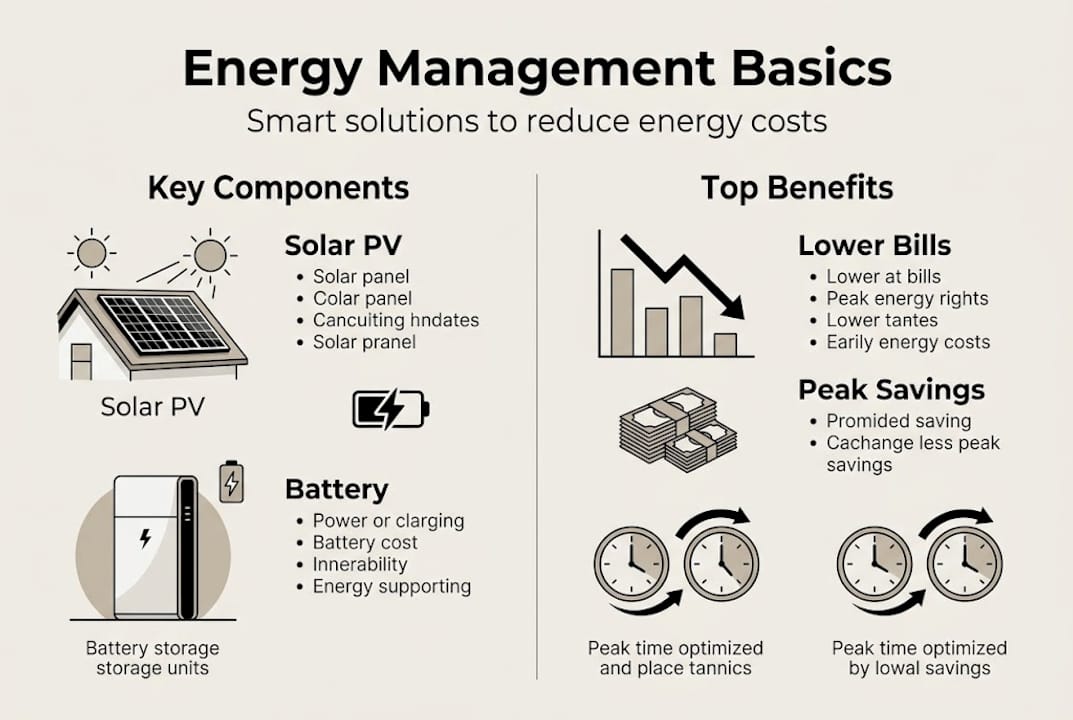
Modern energy management pulls together three main elements:
Solar PV as the primary generation source
Battery storage as the buffer that smooths supply and demand
Smart EV charging as a flexible load that can absorb or release energy on demand
When these three work through a centralized Energy Management System (EMS), the results are dramatically better than any one of them alone. Why choose energy management for your home or business becomes obvious once you see the numbers.
The most important misconception to drop is that buying good hardware is enough. Hardware without intelligent coordination is like having a high-performance engine without a transmission. Systems that go beyond monitoring to take autonomous action deliver up to 40% energy cost reductions, a figure passive monitoring simply cannot reach.
“Most savings come from systems that go beyond monitoring to take autonomous action—real optimization, not just observation.”
Key technologies: From PV to batteries and EV charging
With a working definition in place, the next step is understanding the technology mix that unlocks these benefits. Each component plays a specific role, and the magic happens in how they interact.
Solar PV generates electricity when the sun shines, which often does not align with when you actually need power. Without a way to store or redirect that surplus, much of it exports to the grid at low rates. Solar alone can’t handle peak demand without storage and intelligent management working alongside it.
Battery storage solves the timing mismatch. It absorbs surplus solar during the day and releases it during evening peaks, when grid electricity is most expensive. With a 15-minute dynamic tariff optimization cycle, a well-configured EMS can arbitrage price differences that most users never even notice.
Smart EV charging is the wildcard that many Benelux businesses overlook. A fleet of company cars sitting in a parking lot represents a significant flexible load. An EMS can charge those vehicles during cheap or solar-rich periods and pause charging when demand spikes.
Feature | Traditional setup | Integrated EMS setup |
Solar self-consumption | 25-35% | 70-90% |
Peak demand management | None | Automatic |
EV charging optimization | Manual | Automated |
Battery arbitrage | Not possible | Real-time |
Grid export income | Minimal | Optimized |
The concrete advantages of full integration include:
Peak shaving: cutting demand charges on commercial energy bills
Higher self-consumption: using more of what you generate
Backup power: maintaining supply during short grid outages
Load flexibility: shifting non-essential consumption to low-tariff windows
For more on how these components work together, see integrating solar with storage and why investing in solar storage pays off in practice.
Benefits of energy management: Savings and beyond
Now that the main technologies are clear, let’s look at what you gain, financial and beyond, by managing your energy intelligently.
For residential users, the core benefit is lower electricity bills. Benelux households face some of Europe’s highest grid tariffs, with dynamic pricing becoming more common under current energy policy. Dynamic tariffs increase the value of smart management significantly, but only if your system can respond in real time. Without an EMS, dynamic pricing is more risk than opportunity.

For businesses, the calculus goes further. Peak demand charges can represent 20-40% of a commercial electricity bill. Reducing those peaks through battery discharge and load shifting cuts costs immediately, without reducing operations. There is also the grid support angle: businesses that can respond to grid signals may qualify for demand-response incentives in Belgium and the Netherlands.
Setup | Estimated annual savings (household) | Estimated annual savings (SME) |
Solar only | €300-600 | €1,000-2,500 |
Solar + battery | €700-1,200 | €2,500-5,000 |
Solar + battery + EMS | €1,200-2,000+ | €5,000-12,000+ |
Beyond cost, there are three additional layers of value that rarely appear in a standard ROI calculation:
CO2 reduction: maximizing self-consumption means less fossil-fuel grid electricity consumed
Battery lifespan: intelligent charge/discharge cycles protect your battery investment over time
Grid contribution: coordinated local demand response supports the broader energy transition
Real-world data backs this up. Cutting energy use by 36% is achievable with active real-time management, a number that holds across multiple Benelux case studies. For businesses looking deeper into the numbers, commercial energy planning provides scenario-specific modeling tools.
Pro Tip: Before investing in new hardware, audit your current energy behavior. Fixing standby loads, scheduling high-consumption appliances, and addressing heating inefficiencies can generate quick wins that improve the ROI of any future EMS investment.
Challenges, limitations, and smart strategies
While the potential is substantial, energy management has real-world constraints that are worth addressing honestly. Knowing them in advance helps you invest smarter.
Inaccurate load forecasting and grid congestion can undermine EMS value significantly, particularly in the Benelux where distribution grids in some areas are already under stress from high solar penetration. An EMS that cannot access reliable grid data or accurate consumption forecasts is making decisions with one hand tied behind its back.
The three most common challenges are:
Poor load forecasting: underestimating or overestimating consumption patterns leads to suboptimal battery behavior
Grid congestion: in areas with high renewable penetration, curtailment rules can limit what your system can export or import
Unreliable data feeds: some smart meters and inverters provide delayed or inconsistent data, reducing optimization accuracy
Here are four practical strategies to work around these limitations:
Choose an EMS with local weather integration so solar forecasting is built into dispatch decisions, not added as an afterthought
Use a RESTful API-compatible system that can pull real-time grid pricing and congestion signals automatically
Stage your investment: start with an EMS and monitoring before committing to large battery capacity
Work with a provider who understands Benelux grid conditions rather than generic European averages
“Dynamic tariffs and grid realities make accurate data more important than ever for anyone managing energy in the Benelux.”
Pro Tip: Before spending on expensive storage upgrades, tackle the free wins first. Fixing air leaks, eliminating phantom loads, and scheduling heavy appliances overnight can reduce your base consumption by 10-15%, which shrinks the battery size you actually need.
For practical guidance on combining technologies effectively, see solar-plus-storage integration and the broader central Europe energy guide.
Why most energy management advice falls short
Most guides on energy management either focus on products or produce a generic checklist of tips that ignore local conditions entirely. That is a serious gap, especially for Benelux users navigating one of Europe’s most complex grid environments.
The uncomfortable truth is that buying an inverter, a battery, and an EV charger from three different vendors and expecting them to work together is wishful thinking. Without a single, centralized layer of intelligence, those components optimize for themselves rather than for your energy bill. You end up with an expensive system that performs like a cheap one.
Tariff structures in Belgium and the Netherlands change frequently, and grid access rules for prosumers are evolving fast. Any ROI calculation that ignores these local realities is built on sand. Providers who offer PV and storage flexibility with genuine EMS integration are not selling a luxury feature. They are solving the core problem that makes all the other technology worth owning.
What should you demand? An EMS that updates dispatch decisions at 15-minute intervals, handles battery arbitrage automatically, and connects to real-time tariff data. Anything less is monitoring dressed up as management.
Optimize your energy with Belinus solutions
Understanding energy management is the first step. Applying it with the right system is where real savings begin. Belinus integrates solar PV, battery storage, and smart EV charging through a centralized EMS built specifically for Benelux homes and businesses. From the Energy Wall G1’s 16 kWh graphene supercapacitor to scalable commercial storage and fleet-ready EV charging, every solution connects through one intelligent platform.
Visit Belinus to explore the full range of energy solutions designed for your specific situation. Whether you are a homeowner looking to cut bills or a business ready to optimize at scale, our guides and tools give you a clear path forward. Start with the maximize your savings resource to see what an integrated approach could mean for your bottom line.
Frequently asked questions
How does an energy management system (EMS) actually work?
An EMS monitors, controls, and optimizes your home or business energy use by automatically shifting loads, storage, or charging based on real-time data. Modern EMS delivers up to 40% energy cost savings through automated action, not manual input.
Is solar power enough for optimal savings without storage or EMS?
No. Without batteries and energy management, solar cannot control peak demand or maximize self-consumption. Solar alone can’t manage peaks, which means much of your generated energy exports at low rates instead of powering your home.
What are the biggest challenges of energy management in the Benelux?
The main challenges are grid congestion, inaccurate load forecasting, and inconsistent data quality. Grid congestion and forecasting limits still hinder EMS performance across parts of the Benelux region.
Can energy management really cut costs for both homes and businesses?
Yes. Real-time energy management can reduce energy costs by up to 36% in typical Benelux scenarios, with businesses seeing the largest absolute savings through peak demand reduction and load flexibility.
Recommended
Comments