Enterprise Energy Strategies for European Sustainability Officers
- 3 hours ago
- 9 min read

TL;DR:
Effective enterprise energy strategies align infrastructure, risk management, and portfolio planning to reduce costs and emissions.
Implementing board-level governance, continuous risk reassessment, and innovative technologies like AI optimizations are critical for success.
Enterprise energy strategies are systematic frameworks that align procurement, infrastructure planning, and operational controls to deliver measurable cost reductions and sustainability outcomes across complex corporate portfolios. For European sustainability officers, the stakes have never been higher. Grid instability, evolving EU regulatory mandates, and the rising cost of inaction are forcing a shift from passive energy planning to active corporate energy management. The difference between the two is not semantic. It is financial. Organizations that treat energy as a strategic variable rather than a utility line item consistently outperform peers on both cost and carbon metrics. This article gives you the architecture to do the same.

What makes an effective enterprise energy strategy?
An energy plan tells you what you want to use. An enterprise energy strategy tells you what you can realistically access, at what cost, under which conditions, and what happens when those conditions change. That distinction matters because grid capacity constraints are now a primary driver of project delays, not regulatory approvals or capital availability.
The core pillars of an effective corporate energy management framework are:
Infrastructure alignment: Know your facility’s grid capacity and interconnection queue position before committing capital. Enterprises that skip this step routinely discover 12 to 24 month access delays after contracts are signed.
Energy risk assessment: Integrate energy risk into your Enterprise Risk Management framework alongside supply chain, financial, and operational risks. A 5 to 10 year horizon is the minimum planning window for meaningful exposure mapping.
Strategic procurement: Move beyond price per kilowatt-hour. Evaluate contract structure, tariff exposure, flexibility clauses, and counterparty reliability. Bespoke contracts and behind-the-meter generation are replacing traditional utility tariff models, and the risk of underestimating exposure in the transition is significant.
On-site generation: Solar PV, battery storage, and combined heat and power assets reduce grid dependency and create price certainty. Behind-the-meter solutions are particularly valuable for sites with high daytime consumption or peak demand charges.
Demand-side controls: Occupancy sensors, building management systems, and load scheduling reduce consumption without capital-intensive infrastructure changes.
Pro Tip: Before your next procurement renewal, request a formal grid capacity study from your distribution network operator. The results will almost certainly reshape your infrastructure investment timeline.
The organizations that execute this well treat energy not as a facilities function but as a board-level risk category. That governance shift is the single most important structural change a sustainability officer can drive.
How can AI and occupancy-driven controls improve energy efficiency?
Artificial intelligence is reshaping what is possible in energy optimization strategies, but the gains are not automatic. They depend on data quality, system integration, and a clear understanding of where AI adds value versus where it adds complexity.
The evidence on occupancy-based HVAC control is particularly compelling. Occupancy-based intelligent HVAC controls cut baseline energy consumption by 76%, with an additional 7% reduction achievable through genetic algorithm optimization. That is not a marginal improvement. It fundamentally changes the economics of building operation for any enterprise with significant office or industrial floor space.
Technology | Energy saving | Additional benefit |
Occupancy-based HVAC control | 76% baseline reduction | Improved occupant comfort |
Genetic algorithm optimization | Additional 7% reduction | Automated schedule refinement |
Learning-driven simulation | 9.6% operating cost reduction | 15.8% reliability improvement |
Learning-driven operation simulation and hierarchical boundary optimization deliver a 9.6% reduction in operating costs alongside a 15.8% improvement in system reliability compared to conventional control methods. For a multi-site European enterprise, that reliability gain translates directly into fewer unplanned outages and lower emergency procurement costs.
The carbon paradox of AI deserves honest attention. AI systems generate significant carbon emissions, which means deploying AI for energy optimization without accounting for its own footprint can undermine your net sustainability position. The practical response is to prioritize low-carbon AI models, run inference workloads during periods of high renewable grid penetration, and track AI energy consumption as a separate line in your carbon accounting.
Pro Tip: Pair your AI energy management platform with real-time energy analytics to validate that optimization gains are materializing in actual meter data, not just model outputs.
The energy-saving technologies that deliver the fastest payback are rarely the most technically complex. Occupancy sensors, smart thermostats, and demand response integration consistently outperform more elaborate deployments when implementation quality is high.
Why portfolio-level modernization outperforms site-by-site upgrades
The reactive model of energy modernization, where you fix the worst-performing site when the budget appears, is expensive in ways that rarely show up in a single project’s business case. Deferred upgrades compound. Equipment failures at aging sites create emergency costs. And the opportunity cost of delayed savings across a portfolio is substantial.
Portfolio-wide energy modernization allows you to prioritize site investments based on operational criticality and energy intensity, capturing economies of scale and reducing exposure faster than discrete upgrades allow. The contrast between the two approaches is stark:
Approach | Cost profile | Risk profile | Speed to savings |
Reactive, site-by-site | High emergency costs, unpredictable | High: single-site failures unmitigated | Slow, sequential |
Portfolio-wide modernization | Planned capital, economies of scale | Lower: risk distributed and prioritized | Faster, parallel |
A structured portfolio approach follows four steps:
Audit and rank: Score every site by energy intensity, equipment age, grid reliability, and operational criticality. This creates a defensible investment priority list.
Segment by intervention type: Group sites by the type of upgrade needed, whether lighting, HVAC, generation, or storage, to enable bulk procurement and standardized installation.
Sequence for cash flow: Front-load high-return, low-capital interventions to generate savings that fund deeper infrastructure investments.
Integrate funded models: Explore energy-as-a-service contracts, power purchase agreements, and performance-based financing to reduce upfront capital requirements and transfer technology risk to the provider.
The funded modernization model is particularly relevant for European enterprises operating under capital allocation pressure. When a third party owns and operates the generation or storage asset, your balance sheet stays clean while your energy costs fall. The trade-off is long-term contract exposure, which brings you back to procurement strategy and risk assessment.
What regulatory and market risks must your 2026 energy strategy address?
The external environment for energy strategy has become materially more complex since 2023. Sustainability officers who built their frameworks on stable tariff assumptions and predictable supply chains are now managing a different reality.
Key risks to address in your current planning cycle:
Tariff volatility and trade policy: Increased tariffs on energy infrastructure components, particularly solar panels and battery storage, are raising project costs and extending payback periods. Geopolitical risks now merge energy strategy with supply chain management, requiring executive-level scrutiny of sourcing decisions.
Grid reliability deterioration: Power outages lengthened by 60% between 2022 and 2025, with annual business costs from power quality events approaching $60 billion. European enterprises face analogous pressures as aging grid infrastructure strains under electrification demand.
Cybersecurity mandates: The EU’s NIS2 Directive and the forthcoming Critical Entities Resilience Directive impose new compliance obligations on energy infrastructure operators. If your enterprise operates behind-the-meter generation or participates in demand response programs, you are likely in scope.
Incentive landscape shifts: EU state aid rules, national renewable energy incentives, and carbon pricing mechanisms are all in active revision. Locking in PPA structures or on-site generation contracts without accounting for incentive changes can erode projected returns.
“Energy risk assessments need integration into Enterprise Risk Management frameworks alongside other strategic risks, using horizon planning over 5 to 10 years for a comprehensive corporate risk profile.”
Annual updates to your energy risk assessment are not optional in this environment. The assessment that was accurate in 2024 is already partially obsolete. Build the review cadence into your governance calendar, not your to-do list.
For enterprises with significant community-facing energy projects, winning stakeholder support early in the development process reduces regulatory friction and accelerates permitting timelines.
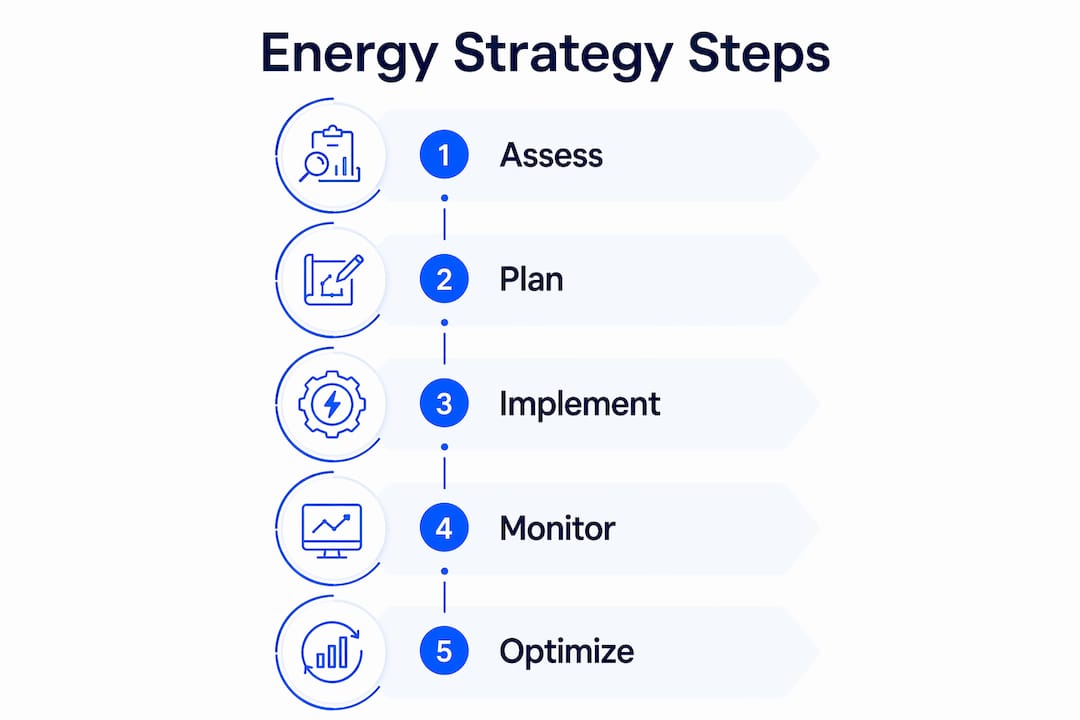
How to build and maintain an effective energy strategy: a practical framework
Implementation is where most energy strategies fail. The analysis is thorough, the ambitions are credible, and then the organization reverts to business as usual because no one owns the outcome at a level where it affects capital allocation decisions.
Establish governance at CFO or COO level. Energy strategy must connect to capital planning, operational risk, and financial reporting. A sustainability officer without a seat at that table cannot drive the infrastructure decisions that strategy requires.
Stress-test your plan against realistic failure scenarios. Model what happens if grid access is delayed by 18 months, if a key PPA counterparty defaults, or if a major regulatory incentive is withdrawn. Plans that only work under optimistic assumptions are not strategies. They are wishes.
Deploy smart data analytics for real-time management. Industrial energy monitoring gives you the visibility to detect consumption anomalies, validate savings from interventions, and make procurement decisions based on actual demand patterns rather than estimates.
Renegotiate procurement contracts on a rolling basis. Market conditions change faster than most contract cycles. Build break clauses, price review mechanisms, and volume flexibility into every new agreement.
Evaluate on-site generation options continuously. The economics of solar PV and battery storage shift with equipment costs, grid tariffs, and incentive structures. A project that was marginal two years ago may be compelling today.
Pro Tip: Use energy management system insights to build a monthly energy performance dashboard that your CFO and COO can read in under five minutes. Visibility at that level changes how quickly decisions get made.
The organizations that sustain energy strategy gains over time are the ones that treat it as an iterative management discipline, not a one-time project. Continuous improvement cycles, quarterly performance reviews, and annual risk reassessments are the operational backbone of a strategy that actually delivers.
Key takeaways
Effective enterprise energy strategies require infrastructure alignment, integrated risk management, and portfolio-level planning to deliver sustained cost and carbon reductions.
Point | Details |
Infrastructure first | Verify grid capacity and interconnection queue position before committing to any capital project. |
Risk integration | Embed energy risk into your Enterprise Risk Management framework with a 5 to 10 year planning horizon. |
AI with accountability | Occupancy-based controls and AI optimization deliver major savings, but track AI’s own carbon footprint. |
Portfolio over projects | Portfolio-wide modernization reduces costs faster and builds more resilience than site-by-site upgrades. |
Annual risk reassessment | Regulatory, tariff, and market conditions change fast enough to require a formal review every 12 months. |
What I’ve learned from watching energy strategies succeed and fail
The most common failure mode I see is not technical. It is organizational. A sustainability officer produces a rigorous energy strategy, presents it to the board, receives approval in principle, and then watches it stall because no one with capital authority owns the implementation. Energy strategy without CFO-level sponsorship is a document, not a program.
The second failure mode is optimism about infrastructure. I have seen enterprises design entire electrification programs around grid connections that turned out to be 18 months away from availability. The project economics collapse, the capital gets reallocated, and the organization loses two years of savings. Knowing your interconnection queue position is not a technical detail. It is a strategic prerequisite.
What actually works is treating energy the way the best-run enterprises treat supply chain risk: with dedicated governance, scenario planning, and a clear owner for every material exposure. The enterprises that do this well are not necessarily the ones with the largest sustainability teams. They are the ones where energy decisions sit close to the CFO and get the same analytical rigor as any other capital allocation choice.
The AI opportunity is real, but it requires discipline. Deploying AI optimization tools without tracking their own energy consumption is a credibility risk as much as a carbon risk. The enterprises that get this right are running low-carbon AI models, scheduling compute workloads around renewable availability, and reporting AI energy use transparently.
Portfolio modernization is the lever most European enterprises are underusing. The funded model, where a third party finances and operates the asset, removes the capital barrier that kills most projects at the approval stage. If your organization is still waiting for the perfect capital cycle to begin modernization, the funded model is worth a serious look.
— Marc
How Belinus supports your enterprise energy goals

Belinus delivers the infrastructure and intelligence that enterprise energy strategies require. The Belinus Energy Management System operates on 15-minute dynamic tariff optimization, integrating solar PV, battery storage, and EV charging across multi-site portfolios. For sustainability officers managing complex European operations, the platform provides real-time visibility, battery arbitrage, and grid services through a single interface. Utility-scale storage modules scale from 400 kWh to MW capacity, and the RESTful API connects to existing enterprise systems without disruption. If you are ready to move from energy planning to smarter energy management, Belinus has the technology and the team to get you there. Visit belinus.com to start the conversation.
FAQ
What is the difference between energy planning and enterprise energy strategy?
Energy planning sets consumption targets and procurement goals. Enterprise energy strategy incorporates infrastructure constraints, risk assessment, procurement structure, and operational controls into a single governance framework tied to capital and operational decision-making.
How much energy can occupancy-based HVAC controls save?
Occupancy-based intelligent HVAC controls reduce baseline energy consumption by 76%, with genetic algorithm optimization delivering an additional 7% reduction, according to peer-reviewed research published in MDPI Energies.
How often should enterprises update their energy risk assessment?
Annual updates are the minimum given current regulatory and market volatility. Enterprises with significant capital programs or PPA exposure should review risk assessments whenever a material regulatory, tariff, or infrastructure change occurs.
What is the fastest way to improve energy efficiency across multiple sites?
Portfolio-wide auditing and prioritization, combined with occupancy-based controls and demand response enrollment, delivers the fastest payback. These interventions require minimal capital and generate savings that fund deeper infrastructure investments.
How does AI optimization affect a company’s carbon footprint?
AI energy optimization tools reduce consumption and costs, but AI systems themselves generate carbon emissions. The net benefit depends on using low-carbon AI models and scheduling compute workloads during periods of high renewable grid penetration.
Recommended
Comments