Graphene Supercap Applications: 2026 Engineer's Guide
- Jul 15
- 8 min read

TL;DR:
Graphene supercapacitors offer ultra-fast charging, high power density, and long cycle lives for energy storage. They mainly serve high-power applications like electric vehicle braking, grid stabilization, and industrial peak shaving. The technology relies on innovations in material design and hybrid system integration to maximize performance and cost-effectiveness.
Graphene supercapacitors are electrochemical energy storage devices that use graphene-based electrodes to deliver ultra-fast charge and discharge cycles, exceptional power density, and cycle lives measured in the tens of thousands. The industry term is “electrochemical double-layer capacitor” (EDLC) with graphene electrodes, though engineers and researchers widely use “graphene supercap” as shorthand. Graphene supercap applications now span electric vehicle regenerative braking, grid stabilization, industrial UPS systems, and emerging wearable electronics. This guide covers the material science, integration strategies, and real-world deployment patterns shaping the field in 2026.
What are the main graphene supercap applications today?
Graphene supercapacitors are primarily deployed in high-power, rapid charge/discharge applications where conventional batteries fall short on response speed and cycle durability. The core advantage is not energy density. It is the ability to absorb and release large power bursts without degradation.
The leading deployment sectors break down as follows:
Electric vehicle regenerative braking. Graphene supercaps capture kinetic energy during deceleration and release it instantly during acceleration. This reduces stress on the main lithium-ion pack and extends overall battery life.
Logistics and opportunity charging. Warehouse forklifts and automated guided vehicles use graphene supercaps for short, frequent charge cycles between tasks. Reduced downtime is the measurable operational benefit.
Industrial peak shaving. Manufacturing facilities with high-draw equipment use supercaps to absorb demand spikes, cutting peak tariff charges and protecting grid connections.
Data center UPS systems. Graphene supercaps replace lead-acid batteries in uninterruptible power supply units, delivering faster backup response and significantly lower maintenance requirements.
Grid stabilization. Renewable energy sources like solar and wind create frequency fluctuations. Graphene supercaps respond in milliseconds to balance these swings, a task that batteries handle too slowly.
The grid stabilization use case is particularly significant. As solar and wind penetration increases across European and North American grids, the need for millisecond-response storage grows with it. Graphene supercaps fill that gap precisely because their charge transfer mechanism is physical, not chemical.
Industrial scaling confirms this demand. Production expansions in the supercapacitor manufacturing sector reflect a 20–40x capacity increase at major facilities, backed by investments in the range of €220 million. That level of capital commitment signals that the market for graphene energy storage solutions has moved well past the research phase.
Pro Tip: When evaluating graphene supercaps for UPS applications, compare cycle life specifications rather than energy capacity. A unit rated for 60,000+ cycles will outlast lead-acid alternatives by a factor of 10 or more in high-frequency switching environments.
How does graphene material innovation enhance supercapacitor performance?
The central challenge in graphene electrode design is re-stacking. Graphene sheets are one atom thick, which gives them extraordinary surface area in theory. In practice, those sheets clump together during fabrication, burying active surface area and blocking ion transport. Re-stacking of graphene reduces the surface area critical for ion storage, so structural modifications like curved graphene prevent this and maintain high capacitance.

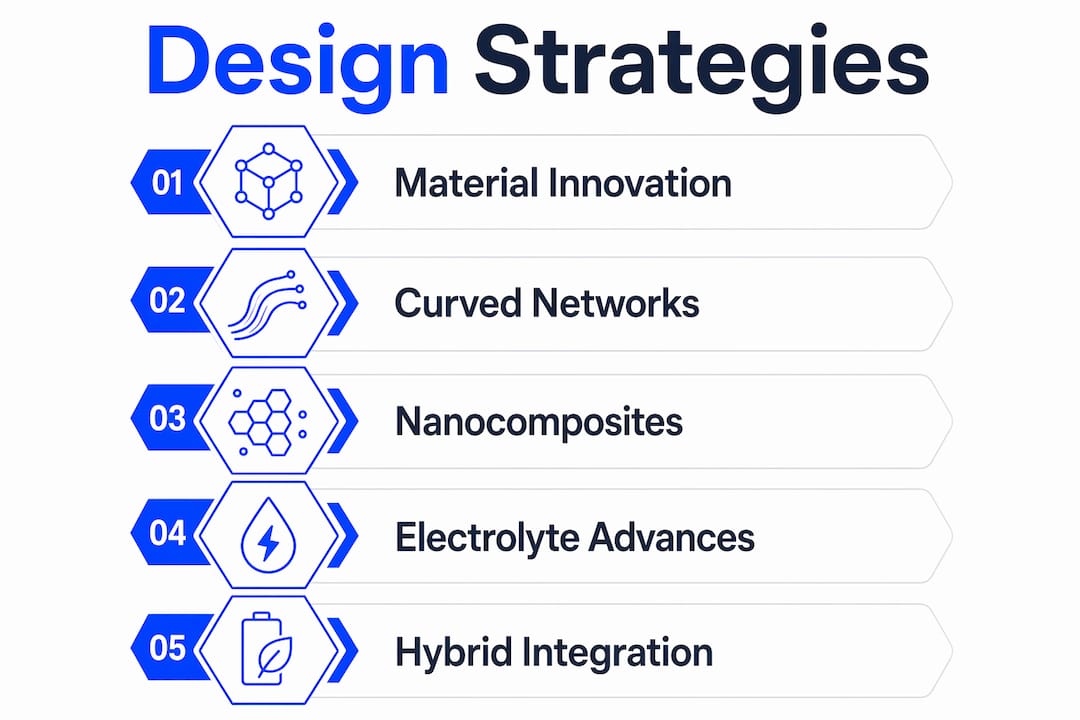
Two architectural approaches have proven effective. First, curved graphene networks create a porous, three-dimensional structure that keeps sheets separated. Second, multiscale reduced graphene oxide (M-rGO) combines graphene layers of different sizes to create a hierarchical pore structure. Both methods increase the ion-accessible surface area and improve rate capability at high charge/discharge speeds.
Nanocomposite designs take this further. Integrating graphene with metal oxides such as manganese dioxide or ruthenium oxide introduces pseudocapacitance, a Faradaic charge storage mechanism that adds energy density on top of the double-layer capacitance. Current R&D focus has shifted to graphene-based nanocomposites to synergize conductivity and pseudocapacitance for better energy densities. The practical result is a device that behaves more like a battery in energy terms while retaining the power characteristics of a supercapacitor.
The electrolyte side of the equation has seen equally significant progress. Researchers have demonstrated a graphene-based device using nano-confined water as the electrolyte. Nano-confined water in graphene supercaps allows voltages up to 1.6 V, surpassing traditional aqueous electrolyte limits while maintaining stability. The mechanism relies on nanometer-scale channels formed by graphene and clay minerals, where water behaves differently than it does in bulk. No chemical additives are required. The device demonstrated stable operation over 60,000+ cycles, which removes two of the most persistent objections to aqueous electrolytes: low voltage ceiling and decomposition risk.
Architecture | Key benefit | Primary application |
Curved graphene | Prevents re-stacking, maintains surface area | High-rate EDLCs |
M-rGO (multiscale reduced graphene oxide) | Hierarchical pore structure, improved ion transport | Industrial supercaps |
Graphene/metal oxide nanocomposite | Adds pseudocapacitance, higher energy density | Hybrid storage systems |
Nano-confined water electrolyte | Chemical-free, 1.6 V stable, 60,000+ cycles | Sustainable device design |
What are the design strategies for hybrid graphene supercapacitor systems?
Graphene supercapacitors are not direct battery replacements. They are complementary fast-response units in hybrid energy systems, and the distinction matters for system architects. A graphene supercap handles the power layer. A lithium-ion or LFP battery handles the energy layer. Combining both gives you a system that is faster, safer, and longer-lived than either technology alone.
Effective hybrid integration follows a clear design logic:
Size the supercap for peak power, not total energy. The graphene unit absorbs and delivers high-current transients. The battery runs at a steady, lower C-rate, which extends its calendar life.
Use active power management to route loads correctly. A centralized energy management system (EMS) monitors demand in real time and directs peak loads to the supercap bank while the battery handles baseline supply.
Design for mechanical compatibility in flexible applications. Graphene hybrid fiber supercapacitors combine graphene with metal oxides and conductive polymers to deliver high energy density, flexibility, and durability for wearable and textile electronics. Four distinct fabrication methods govern fiber architecture and performance under mechanical deformation.
Account for thermal behavior at the system level. Graphene supercaps generate less heat than batteries under high-rate cycling. This changes the thermal management requirements for the enclosure and cooling system.
Plan for asymmetric degradation rates. The supercap will outlast the battery by a significant margin. Design the system so the supercap bank can be retained when the battery is replaced.
The wearable electronics case is worth examining in detail. Hybridization of graphene fibers with functional materials is essential for combining high electrical performance with mechanical robustness in flexible supercapacitors. Graphene fiber devices can maintain capacitance under bending, stretching, and compression, which makes them viable for smart textiles, medical monitoring patches, and flexible displays. The fabrication challenge is controlling interfacial charge transfer between the graphene fiber and the metal oxide or polymer coating.
Belinus addresses the hybrid integration challenge directly through its Energy Management System, which supports multi-technology storage configurations including graphene supercap, LFP, pre-lithiated LFP, and hybrid ultracapacitor (HUC) chemistries. The EMS applies 15-minute dynamic tariff optimization and real-time battery arbitrage, which is exactly the control layer that makes hybrid graphene systems perform as designed rather than as specified on paper.
What future trends are shaping graphene supercapacitor technology?
The near-term trajectory for graphene supercapacitor technology points in three directions: production scale, new electrolyte chemistries, and application diversification into computing and biosensing.
Production scale. Major manufacturing investments confirm that graphene supercaps are moving from specialty components to volume products. Facilities scaling production 20–40x create the cost curves that make grid-scale and automotive deployment economically viable.
Water-based and sustainable electrolytes. The nano-confined water research represents a broader shift toward environmentally benign electrolyte materials. Eliminating organic solvents reduces toxicity, simplifies end-of-life handling, and removes flammability risk from the device.
Smart grid buffering. As renewable penetration increases, grid operators need storage that responds in milliseconds. Graphene supercaps are the only commercially viable technology that meets this response requirement at scale. Deployments tied to solar and wind farms will grow as grid codes tighten.
Biosensors and medical devices. The combination of biocompatibility, flexibility, and fast charge/discharge makes graphene supercaps attractive for implantable and wearable medical devices. Research groups are exploring integration with glucose sensors and neural interfaces.
Neuromorphic computing. This is the most speculative but technically grounded application. Graphene supercap junctions can mimic synaptic behavior, storing and releasing charge in patterns that analog computing architectures can exploit. Early demonstrations exist at the laboratory scale.
Flexible and printed electronics. Roll-to-roll fabrication of graphene electrodes is advancing. Printed graphene supercaps on flexible substrates could power smart packaging, electronic labels, and thin-film IoT sensors.
The graphene energy storage field is moving fast enough that specifications published in 2024 are already outdated. Engineers evaluating systems in 2026 should treat electrode architecture and electrolyte chemistry as active variables, not fixed parameters.
Key Takeaways
Graphene supercapacitors deliver their greatest value as high-power, long-life components in hybrid systems where fast response, cycle durability, and low maintenance outweigh the need for maximum energy density.
Point | Details |
Primary application domains | EVs, grid stabilization, UPS systems, and industrial peak shaving are the strongest current markets. |
Material innovation drives performance | Curved graphene and M-rGO architectures prevent re-stacking and unlock usable surface area. |
Hybrid design is the right framework | Graphene supercaps complement batteries; they do not replace them in energy-intensive applications. |
Lifecycle cost favors graphene | Lower maintenance and longer cycle life produce better total cost of ownership despite higher upfront cost. |
Emerging applications are real | Wearables, biosensors, and neuromorphic computing are moving from lab demonstrations to engineering prototypes. |
Why I think engineers underestimate the integration challenge
The performance numbers for graphene supercapacitors are genuinely impressive. What gets underestimated is the integration work required to realize those numbers in a deployed system.
Lifecycle cost metrics favor graphene supercapacitors over traditional batteries when you factor in maintenance, longevity, and efficiency. That math is correct. But the calculation only holds if the EMS is configured to actually route loads through the supercap bank at the right moments. I have seen hybrid systems where the control logic was never tuned, and the supercap sat mostly idle while the battery absorbed every transient. The hardware was right. The integration was not.
Electrolyte choice is the second underestimated variable. Organic electrolytes give you higher voltage windows but introduce flammability and handling complexity. Aqueous systems are safer but historically limited in voltage. The nano-confined water research changes that calculus, but it is not yet a commercial product. Engineers specifying systems today need to make that tradeoff explicitly, not default to whatever the datasheet recommends.
My honest view is that the teams getting the most out of graphene supercaps are the ones treating the EMS as a first-class engineering deliverable, not an afterthought. The hybrid system design question is not which chemistry wins. It is which control architecture extracts the most value from both.
— Marc
Belinus and advanced graphene energy storage
Belinus builds energy storage systems that put graphene supercapacitor technology to practical use. The Energy Wall G1 is a 16 kWh graphene supercapacitor unit designed for residential and light commercial deployment, priced at €7,000 per unit and scheduled for Q1 2026 release. For larger installations, Belinus offers utility storage modules starting at 400+ kWh, scalable to MW capacity, with a Power Conversion System (PCS) targeting a two-week delivery window for commercial and industrial applications.

The Belinus EMS ties these hardware options together through 15-minute dynamic tariff optimization, real-time arbitrage, and multi-chemistry support across graphene supercap, LFP, and HUC configurations. Engineers and developers can explore the full Belinus product range to find the right storage architecture for their specific power and energy requirements.
FAQ
What makes graphene supercapacitors different from standard supercapacitors?
Graphene electrodes provide a far higher surface area per gram than activated carbon electrodes used in standard supercapacitors. That translates directly into higher capacitance, faster charge transfer, and longer cycle life.
Are graphene supercaps suitable for replacing lithium-ion batteries?
Graphene supercaps are not direct replacements for lithium-ion batteries. They excel as fast-response complements in hybrid systems, handling power bursts while batteries manage bulk energy storage.
How long do graphene supercapacitors last?
Research devices using nano-confined water electrolytes have demonstrated stable operation over 60,000+ cycles. Commercial units vary by design, but cycle life consistently exceeds lead-acid and most lithium chemistries.
What is the role of graphene supercapacitors in grid stabilization?
Graphene supercapacitors respond to frequency fluctuations in milliseconds, making them the preferred technology for balancing renewable energy input on grids with high solar and wind penetration.
How do engineers evaluate the total cost of graphene supercapacitor systems?
Lifecycle cost analysis should include maintenance intervals, replacement frequency, and efficiency losses over time. Graphene supercaps carry higher upfront costs but lower total cost of ownership in high-cycle applications.
Recommended
Comments