Graphene vs Lithium Batteries: Which Powers a Sustainable Future?
- Apr 22
- 8 min read

TL;DR:
Graphene batteries offer higher energy density, faster charging, and improved safety than lithium.
Lithium batteries are more affordable and widely available, but face safety and resource limitations.
Future energy storage will likely involve hybrid systems combining both technologies for optimal performance.
Lithium batteries have long been treated as the only serious option for energy storage, but that assumption is showing cracks. Graphene technology is advancing fast, offering higher efficiency, better safety, and a smaller environmental footprint. Yet most buyers still default to lithium without understanding what they’re giving up. This article breaks down both technologies side by side, covering real performance data, cost trade-offs, safety differences, and which technology fits which situation. Whether you’re powering a home solar setup or managing commercial energy loads, making the right battery choice in 2026 matters more than ever.
Table of Contents
Key Takeaways
Point | Details |
Graphene’s rapid rise | Graphene batteries offer higher energy density and faster charging than lithium but are not yet widely available. |
Lithium’s steady reliability | Lithium batteries remain the most practical choice for most homes and businesses in 2026. |
Choosing the right fit | Your best battery depends on safety, cost, and sustainability priorities unique to your situation. |
Technology trends matter | Stay flexible, as combinations of technologies may serve your needs better than any single solution. |
How battery technologies power modern energy needs
Batteries are no longer just backup devices. They’re the core of any serious energy strategy, whether you’re a homeowner with solar panels or a facility manager balancing demand charges. Without storage, solar and wind energy becomes wasted potential. You generate more than you use at noon and have nothing left at 8 PM when demand peaks.
Batteries in renewable energy systems solve this by storing excess generation and releasing it when the grid or your load needs it most. This shifts energy use away from expensive peak-rate periods and reduces dependence on grid imports. The result is lower bills, better resilience, and fewer carbon emissions tied to your consumption.
For commercial users, the stakes are even higher. Grid-connected battery storage can participate in demand response programs, provide frequency regulation services, and offset costly peak demand charges. A well-designed system doesn’t just store power. It actively earns revenue.
Here’s why battery selection is a strategic decision, not just a technical one:
Energy independence: Reducing grid reliance during outages or high-tariff periods
Solar optimization: Capturing surplus PV generation instead of exporting it at low rates
Grid services: Providing ancillary services that generate income for commercial sites
Scalability: Matching storage capacity to growing loads or expanded solar arrays
Technology longevity: Choosing a battery that performs well over a 10 to 20 year horizon
Stat to know: Battery storage is playing a growing and decisive role in balancing renewables for homes and businesses across Europe, with installed capacity expected to rise sharply through the late 2020s.
Demand for both lithium and graphene-based storage is accelerating. The question isn’t whether you need a battery. It’s which chemistry gives you the best return on that investment.
Lithium batteries: Pros, cons, and real-world performance
Lithium-ion batteries work by moving lithium ions between a cathode and anode through an electrolyte during charge and discharge cycles. It’s a well-understood process, refined over three decades of commercial development. That maturity is lithium’s biggest advantage.
Lithium battery types like LFP (lithium iron phosphate) are now the go-to choice for residential and commercial energy storage. They offer solid energy density, proven cycle life (typically 3,000 to 6,000 cycles), and a manufacturing supply chain that keeps costs competitive. LFP chemistry also removes cobalt from the equation, reducing some of the ethical supply chain concerns tied to earlier lithium formats.
Key advantages of lithium batteries:
High energy density relative to physical size and weight
Wide availability and a competitive, mature market
Well-tested in real-world solar and backup applications
Multiple sub-chemistries (LFP, NMC, pre-lithiated LFP) for different use cases
Strong integration with existing inverters and energy management systems
But lithium is not without its problems. Thermal runaway, a condition where heat triggers a chain reaction that can lead to fire, is a real and documented risk in poorly managed systems. Disposal and recycling remain imperfect. And future energy storage in Europe research consistently flags raw material scarcity as a long-term pressure on lithium supply and cost.
Key drawbacks:
Fire risk if damaged, overcharged, or thermally mismanaged
Finite cycle life and gradual capacity fade
Environmental cost of lithium mining and incomplete recycling infrastructure
Performance degradation in extreme temperatures
Pro Tip: If you’re evaluating home energy storage options, prioritize LFP chemistry over older NMC formats. LFP runs cooler, lasts longer, and doesn’t use cobalt.
“Lithium-ion batteries remain dominant for residential and commercial energy storage but face real safety and environmental challenges that buyers should factor into long-term decisions.”
For most buyers in 2026, lithium is still the practical default. But “default” doesn’t always mean “best.”
Graphene batteries: Breakthroughs, benefits, and challenges
Graphene is a single layer of carbon atoms arranged in a hexagonal lattice. It’s one atom thick, extraordinarily conductive, and mechanically stronger than steel. When applied to battery electrodes or used in supercapacitor designs, it changes what energy storage can do.

Graphene energy storage research has demonstrated that graphene-based batteries can achieve up to 10 times the energy density of standard lithium-ion cells, with charge times that shrink from hours to minutes. These aren’t theoretical limits. They reflect measurable outcomes from commercial and semi-commercial systems now entering the market.
Graphene supercap energy density tests show that graphene supercapacitors can reach up to 200 Wh/L, a figure that puts them in direct competition with lithium-ion for many real-world use cases.
What makes graphene storage stand out:
Ultra-fast charge and discharge cycles without significant degradation
Longer cycle life, often exceeding 10,000 cycles before meaningful capacity loss
Better thermal stability with dramatically lower fire risk
No toxic heavy metals in the core chemistry
Strong performance across a wide temperature range
The graphene battery impact on sustainability is significant. Fewer replacement cycles mean less waste over a system’s lifetime, and the absence of cobalt or manganese reduces mining pressure.
Pro Tip: Don’t confuse graphene batteries with graphene supercapacitors. Both use graphene, but they store energy differently. Supercapacitors excel at fast charge/discharge, while graphene-enhanced batteries balance high capacity with speed.
The honest challenge? Cost and manufacturing scale. Producing high-quality graphene at commercial volume remains expensive. Most graphene battery products in 2026 carry a price premium, and the supply chain is still maturing. That’s not a reason to dismiss graphene. It’s a reason to plan strategically.
Stat to note: Graphene-based systems reaching 200 Wh/L energy density represent a real leap forward, offering more usable energy per physical unit than most lithium alternatives currently on the market.
Graphene vs lithium: Side-by-side comparison
With both technologies clearly defined, a direct comparison helps clarify which fits your situation. Neither technology wins across every category.
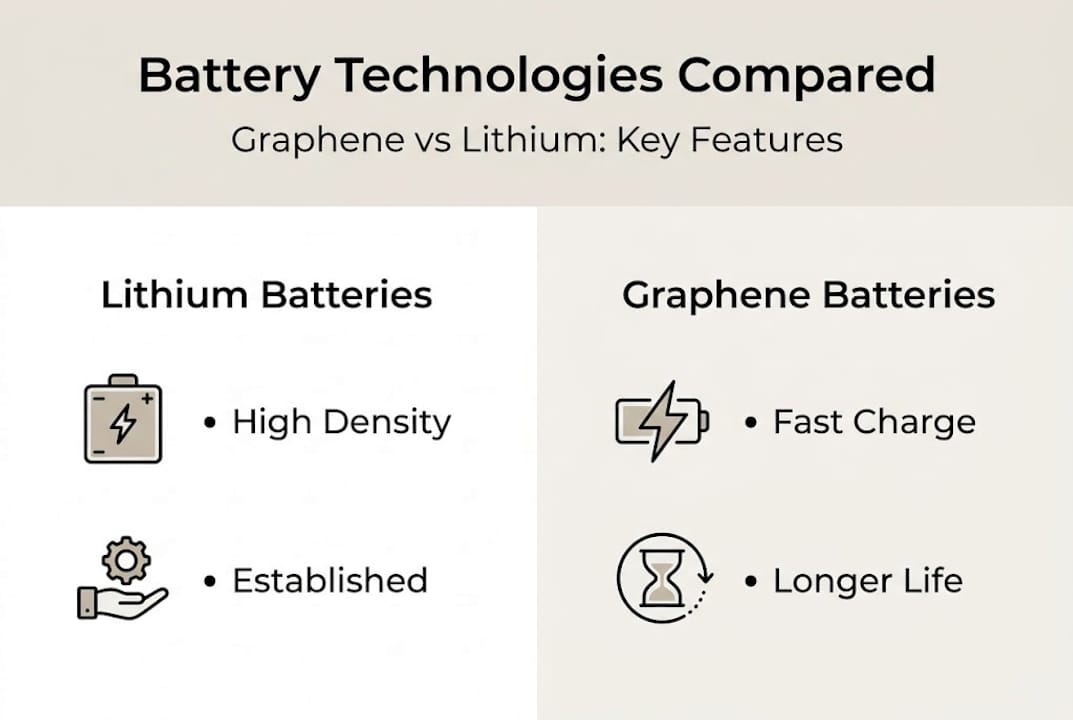
Factor | Lithium-ion (LFP) | Graphene/Graphene supercap |
Energy density | High | Very high (up to 10x potential) |
Charge speed | Moderate (hours) | Very fast (minutes) |
Cycle life | 3,000 to 6,000 cycles | 10,000+ cycles |
Safety | Moderate (fire risk exists) | High (lower thermal risk) |
Environmental impact | Moderate (mining, recycling) | Lower (no heavy metals) |
Cost in 2026 | Competitive | Premium |
Commercial availability | Widespread | Limited but growing |
Temperature performance | Moderate | Strong across ranges |
Graphene-based storage offers greater sustainability, safety, and efficiency compared to current lithium-ion alternatives. But availability still shapes what’s practical for most buyers today.
Here’s a simple decision framework to help you choose:
If upfront cost is your primary constraint: Lithium-ion LFP delivers proven performance at a competitive price point.
If you prioritize long-term cycle life and lower replacement cost: Graphene systems repay their premium over time.
If safety and fire risk are non-negotiable: Graphene’s thermal stability is a meaningful differentiator.
If fast charging is critical (EV integration, commercial load shifting): Graphene’s charge speed advantage becomes a real operational benefit.
If you want mainstream support and supply: Lithium remains the easier system to install and service today.
For commercial storage comparison purposes, graphene systems are becoming more viable as project scales increase and long-term operational costs factor more heavily into the investment case. On the residential side, solar battery trends point toward graphene becoming a mainstream option within the next few years as manufacturing scales up.
The smartest move right now is to build flexibility into your system design, choosing hardware and software that can adapt as technology costs shift.
The real-world future: What most buyers and experts miss
Most of the debate around graphene vs lithium gets framed as a winner-takes-all contest. That framing misses the point entirely. The future of energy storage is not about one chemistry replacing another. It’s about matching the right tool to the right job, sometimes within the same installation.
A commercial site might use graphene supercapacitors for rapid response grid services while running LFP batteries for longer-duration storage behind the meter. A homeowner might start with lithium today and upgrade modularly as graphene costs normalize. Hybrid architectures are already appearing in advanced energy management systems, and they’re not a compromise. They’re often the optimal design.
Market hype inflates expectations in both directions. Graphene won’t solve every storage problem overnight, and lithium won’t stay dominant by default forever. What matters is staying informed, choosing systems with software that adapts to new hardware, and working with partners who understand the full technology spectrum rather than pushing a single product line. Flexibility isn’t a weakness in your energy strategy. It’s the sharpest edge you have.
Find the right battery solution with Belinus
Choosing between graphene and lithium isn’t just a technical question. It’s a financial and operational one that depends on your site, your goals, and your timeline. Getting it wrong costs you more than money.
At Belinus, we work across the full technology spectrum, including graphene supercapacitors, LFP, pre-lithiated LFP, and hybrid configurations. Our Energy Wall G1 brings 16 kWh graphene supercapacitor storage to residential users, with commercial and utility-scale solutions scaling to megawatt capacity. Our intelligent Energy Management System ties it all together with 15-minute dynamic tariff optimization. Whether you’re evaluating your first battery or redesigning a commercial energy setup, our team can help you find what actually fits your situation.
Frequently asked questions
Are graphene batteries available for homes in 2026?
Graphene systems are entering the residential market in 2026, but most homes still run on lithium-ion. Graphene adoption is growing, with limited rollouts now becoming more accessible through providers like Belinus.
Do graphene batteries last longer than lithium-ion batteries?
Yes. Graphene’s structural stability supports longer cycle life with less degradation per charge cycle than conventional lithium-ion systems.
Which battery is safer: graphene or lithium-ion?
Graphene batteries carry a lower fire risk thanks to better thermal stability. Graphene’s safety profile is a genuine advantage over lithium-ion, especially for enclosed residential installations.
How fast do graphene batteries charge compared to lithium batteries?
Graphene enables ultra-fast charging that can reduce charge times from several hours to minutes, a meaningful advantage for EV integration and commercial load management.
What is the main barrier to graphene battery adoption?
Cost and manufacturing scale remain the primary obstacles. Graphene manufacturing challenges in 2026 keep prices above lithium alternatives, though costs are falling as production volumes increase.
Recommended
Comments