How mobile apps transform your home energy savings
- May 13
- 10 min read

TL;DR:
Mobile energy apps help homeowners and small businesses cut electricity bills by up to 30% through automation and real-time management. They optimize solar self-consumption, battery use, and load shifting, driving significant cost savings when properly implemented. However, real-world integration challenges and user engagement are crucial factors impacting the actual effectiveness of these systems.
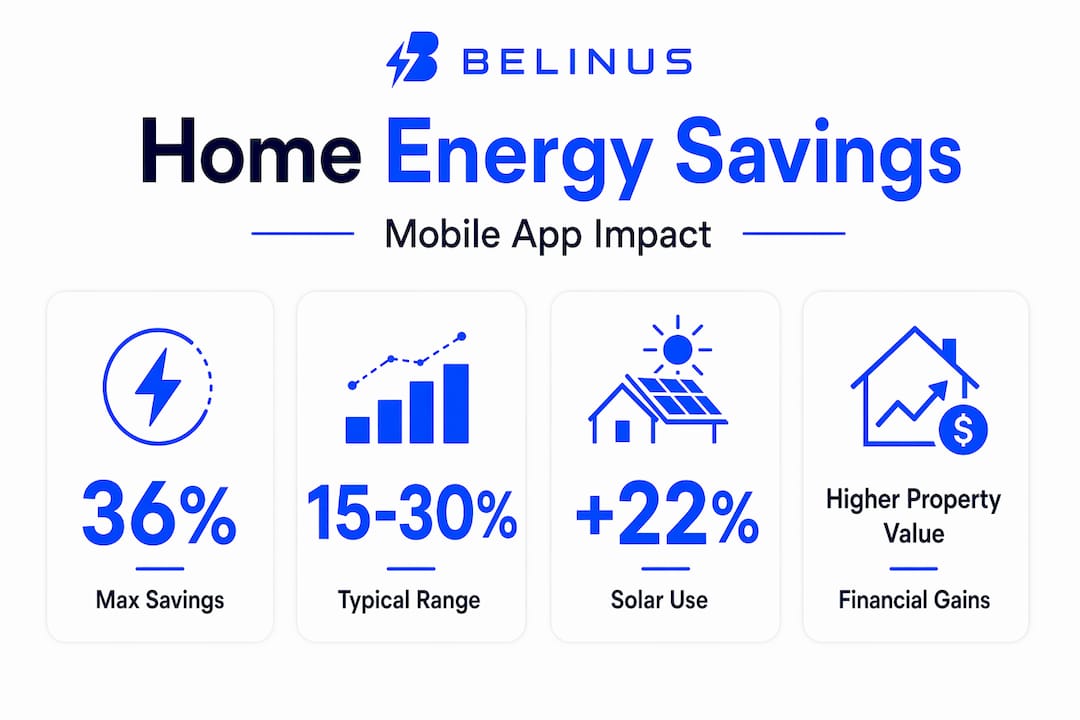
Mobile energy apps enable typical homeowners and small business managers to cut electricity bills by up to 30% while boosting green energy self-use by as much as 25%. Most people still don’t realize that figure is within reach using tools already available on their smartphones. If you have solar panels, a battery, an EV charger, or even just a few smart plugs, you are almost certainly leaving money on the table every single month. This article will show you exactly how these apps work, what the numbers really look like, and how to pick the right tool for your specific setup.
Table of Contents
Key Takeaways
Point | Details |
Cut costs, boost renewables | Energy apps let you save 15-30% and use more of your own green energy. |
Smart features drive savings | Automations like ‘Run on Solar’ and dynamic pricing shift device use to the most optimal times. |
Choose apps for your setup | Multi-device homes or businesses need unified apps, while tariff models affect app ROI. |
Policy and behavior matter | EU rules favor app use and encourage new habits for long-term efficiency. |
Integration still evolving | Real-world gains can lag behind simulations, but policy and technical advances keep closing the gap. |
Why energy management needs a digital upgrade
Managing your energy used to be simple. You paid a fixed bill, maybe turned off a few lights, and that was that. Today it’s a completely different game. Solar panels send power back to the grid at one rate, your EV needs charging at a specific time, battery storage charges and discharges based on pricing windows, and your tariff can shift every 15 minutes. Without a digital tool pulling all that together, you’re essentially flying blind.
European policy is accelerating this shift. EU directives like EED and EPBD now mandate smart metering and real-time consumption feedback across member states, which means your supplier is already collecting granular data about your usage. The question is whether you’re using that data to your advantage or just letting it sit unread in a utility portal. Mobile energy apps close that gap by turning raw meter data into clear, actionable decisions you can act on today.
Understanding smart energy management basics is the first step toward realizing why digital tools have become essential rather than optional. When you combine dynamic tariffs with renewable generation and flexible loads like dishwashers, heat pumps, and EV chargers, the optimization problem becomes genuinely complex. Here are the main pain points driving homeowners and small businesses toward apps:
Fixed habits meet variable pricing: Most people run appliances on a fixed schedule that ignores whether electricity is cheap or expensive at that moment.
Solar generation goes unused: Without active management, excess solar energy gets exported at low feed-in rates instead of being stored or consumed on-site.
EV charging is untimed: Plugging in an EV at peak evening hours can be one of the most expensive energy decisions you make daily.
No visibility, no control: Without real-time data, you can’t identify which devices are driving your highest costs.
Key stat: Homes with solar and storage but no digital energy management export an estimated 40% more energy than necessary, receiving low export rates instead of using that power themselves.
Pair that with cost-cutting energy strategies and you start to see how much room there is for improvement before you ever upgrade a single piece of hardware.
Core features: What energy apps actually do
Let’s get specific. Energy management apps are not just dashboards showing you a live graph of your consumption. The best ones actively automate decisions and respond to conditions in real time.
Apps provide mechanics such as “Run on Solar” to maximize self-consumption by activating devices during excess solar production, and “Run on Price” to shift usage to low-tariff hours using dynamic pricing and forecasts. In plain terms: your washing machine turns on automatically when your panels are producing more than your home is using, and your battery charges when grid electricity is cheapest at 2 a.m. rather than during the expensive evening peak.
Here’s a practical comparison of the core features you’ll find in leading energy management apps:
Feature | What it does | Who benefits most |
Run on Solar | Activates devices when solar exceeds current demand | Solar panel owners |
Run on Price | Schedules loads during cheapest tariff windows | Dynamic tariff subscribers |
Autopilot mode | AI-driven automation using weather and price forecasts | Busy households, small businesses |
Real-time feedback | Live consumption and generation dashboard | All users |
Device automation | Smart plug and inverter control via app | Multi-device setups |
EV charge scheduling | Charges EVs at optimal low-cost or solar windows | EV owners |
Battery arbitrage | Charges battery cheap, discharges during peak prices | Battery storage owners |
Device compatibility is a real factor. Quality apps connect with smart plugs, solar inverters, home battery systems, EV chargers, and heat pumps. Some also integrate with smart meters directly. The broader the compatibility, the more automation opportunities you unlock.
Learning to save energy with mobile apps doesn’t require a technical background. The interfaces have become genuinely user-friendly, and setup typically takes less than an afternoon if your devices are already smart-enabled.
Pro Tip: Before choosing an app, list every connected device in your home or business. Cross-reference that list with the app’s compatibility page. An app that doesn’t “see” your inverter brand is dead weight, no matter how polished the interface looks.
For a broader look at how solar, storage, and EV charging interact within a managed system, the solar, storage, and EV efficiency guide is worth reading before you commit to any single app or platform.
How much can you really save? Data and outcomes
Numbers matter. Here’s what the research actually shows.
Empirical benchmarks show 15-30% electricity cost savings for property owners using energy management apps, with solar self-consumption increases of 10-25%. A Portuguese randomized controlled trial (RCT) with 101 households used app-based nudges and real-time feedback on consumption and indoor air quality, producing measurable behavioral change within weeks.

Here’s how those numbers break down by user type:
User type | Expected bill reduction | Solar self-consumption gain | Key driver |
Homeowner, solar only | 10-18% | 10-20% | Run on Solar automation |
Homeowner, solar + battery | 20-30% | 18-25% | Arbitrage + self-consumption |
Small business, flexible loads | 12-22% | 8-18% | Price-based scheduling |
Small business, full system | 22-30% | 20-25% | Full EMS integration |
What drives the variability? Four factors matter most:
Tariff structure: Dynamic tariffs unlock the biggest gains. If you’re on a fixed-rate contract, “Run on Price” delivers less value until you switch.
System completeness: Solar alone gives moderate results. Solar plus battery plus smart EV charging is where the top-end savings stack up.
User engagement: Apps with autopilot modes reduce the engagement requirement, but users who actively review weekly reports consistently outperform passive users.
Load flexibility: Do you have loads you can actually shift in time? Heat pumps, dishwashers, washing machines, and EV chargers are ideal. A server rack running 24/7 is not.
“The gap between what’s theoretically optimizable and what households actually achieve comes down almost entirely to engagement and system completeness.”
The smart energy investment impact is increasingly recognized by financial analysts too, with property valuations starting to reflect the presence of integrated energy management systems.
Applying maximum energy savings strategies means combining app automation with conscious decisions about which loads to make flexible. And for solar owners specifically, a focused solar optimization guide breaks down exactly how to increase the percentage of your own generation you actually consume.
Choosing the right energy app for your setup
The data is promising, but not every app works for everyone. Getting this wrong costs you both time and money.
The first question to ask is whether you have a single-vendor or multi-vendor setup. If all your hardware comes from one manufacturer, that brand’s native app often performs best because it has direct API access to all your devices. However, most homes and small businesses in Europe end up with a mix: one brand of inverter, another brand of battery, and a third for the EV charger. In those cases, you need a unified platform.
Multi-vendor setups require unified apps to avoid gaps in visibility and control. Dynamic tariffs work best with apps designed specifically for providers like Tibber, while results vary significantly based on user engagement, tariff structure, and setup complexity. Policy gaps in certain markets also affect ROI, particularly for small businesses that would benefit from demand response programs that aren’t yet available in their region.
Here’s what to prioritize when selecting your app:
Device compatibility list: Does it natively support your inverter, battery, and EV charger brands?
Tariff integration: Can it pull live prices from your energy supplier automatically?
Automation depth: Does it offer autopilot features, or just dashboards?
API and third-party support: If you plan to expand your setup, can the app grow with it?
User interface quality: Will you actually use it weekly, or will it collect digital dust?
Data privacy: Where is your consumption data stored and who has access?
Real-time energy management is most valuable when the app can react in minutes, not hours. A 15-minute optimization cycle, like what Belinus EMS uses, keeps your system aligned with dynamic tariff windows throughout the day without you needing to intervene.
Pro Tip: Run a free trial with your app of choice for two full billing cycles before committing. Compare your bills directly to the same two months in the prior year, adjusted for any generation differences. That comparison is your real ROI signal, not an in-app projection.
For those ready to go deeper on automation specifically, automating your energy management walks through practical steps for building a setup that largely runs itself.
App-driven behavioral change and policy factors
Apps do something that hardware alone cannot: they change how people think about energy. That behavioral layer is where much of the long-term value actually lives.
EU directives like EED and EPBD mandate metering and real-time information access for consumers, which means apps now align perfectly with regulatory requirements rather than working around them. Forward-thinking property owners and business managers who adopt apps today are building compliance into their routine rather than scrambling to catch up later.
The behavioral mechanisms that work best include:
Real-time feedback: Seeing your consumption spike when you turn on the kettle creates an immediate and lasting awareness that abstract monthly bills never do.
Goal-setting features: Apps that let you set weekly or monthly reduction targets show consistent outperformance compared to passive monitoring apps.
Social comparison: Some platforms show anonymized benchmarks from similar households in your area. That simple feature drives competitive reduction behavior that often produces the biggest engagement-driven savings.
Push notifications: A timely alert that solar production is running high and the dishwasher could run free for the next two hours is far more effective than a weekly summary email.
Key stat: Households using apps with goal-setting and social comparison features reduce consumption by an additional 8-12% compared to those using dashboards alone.
And real-time savings through energy management can reach 36% under the right conditions, which tells you the behavioral layer isn’t a small bonus. It’s a major contributor to the total outcome.
What most guides miss: Real-world integration challenges
Here’s an uncomfortable truth: most articles about energy apps oversell the plug-and-play story. The technology is genuinely impressive, but the gap between a simulation and a real home or business can be significant.
AI-based automation shows simulation-to-real gaps of 25-40%, and the need for policy subsidies around long-duration storage continues to limit what small businesses can actually deploy. An autopilot feature that promises to optimize your battery arbitrage strategy performs beautifully in lab conditions. In a real building with unpredictable occupancy, equipment failures, and grid instability, the results are less tidy.
This doesn’t mean apps aren’t worth using. It means you need honest expectations. Here’s our view after working with hundreds of residential and commercial clients: the biggest gains come not from the AI features but from the basic automations. Running the washing machine when solar is high and scheduling EV charging for off-peak hours are simple rules that reliably deliver savings, every single time. The sophisticated AI forecasting layers add value, but they’re the icing, not the cake.
For small businesses specifically, the ROI story depends heavily on supportive policy. Demand response programs that pay businesses to reduce load during grid stress events can dramatically accelerate payback. In markets where those programs exist and apps can participate directly, the business case is strong. In markets where those programs are still developing, the financial model is more modest.
The practical advice from the tips for app-driven efficiency we share with our customers is consistent: start with the fundamentals, automate the obvious wins, review your results monthly, and layer in more sophisticated features once you’ve confirmed your baseline is solid. Chasing the most complex setup from day one is how people get frustrated and disengage, which wipes out all the gains.
Sometimes the most powerful move is a simple rule you set and forget. That’s not a failure of ambition. That’s good engineering.
Ready to level up your energy management?
Belinus builds the kind of integrated energy systems where mobile apps deliver their full potential. When your solar inverter, battery storage, EV charger, and energy management system are all designed to communicate with each other, the apps stop being dashboards and start being command centers.
Our native mobile app and web dashboard work directly with the Belinus EMS to run 15-minute dynamic tariff optimization cycles, manage battery arbitrage, and give you complete visibility across your entire energy setup. Whether you’re a homeowner looking to maximize your solar investment or a business managing fleet charging and commercial storage, we’ve built the tools to make it work in the real world, not just in a simulation. Start with our guide to mobile energy efficiency, then explore our solar and EV optimization insights to see where your biggest opportunities lie.
Frequently asked questions
How do energy management apps lower my electric bill?
Apps automate device usage to maximize low-tariff and solar power windows, while real-time nudges and consumption data help you identify and reduce wasteful habits over time.
Which households or businesses benefit most from energy apps?
Homes or businesses with solar, storage, or EV chargers see the largest gains, but anyone with flexible loads like washing machines or heat pumps can benefit. Electricity cost savings of 15-30% are achievable across a wide range of setups.
Are these apps required under European regulations?
They aren’t legally required yet, but EU EED and EPBD directives now mandate real-time metering and consumer feedback across member states, making apps the simplest and most practical route to staying compliant.
What are the main challenges or limitations with energy apps?
Integration is the biggest hurdle in complex setups, and results depend heavily on user engagement and device compatibility. Multi-vendor environments need unified platforms, and for small businesses, simulation-to-real performance gaps of 25-40% mean realistic expectations are essential for good outcomes.
Recommended
Comments