How to assess your site for renewables in Benelux

TL;DR:
Skipping key steps in a renewable energy site assessment often leads to oversized systems and delayed project timelines in the Benelux region. A comprehensive assessment includes demand analysis, efficiency opportunities, physical site measurements, and grid connection reviews, which together optimize investment and performance. Proper preparation and professional review are essential, especially for larger projects, to ensure reliable, cost-effective renewable energy deployment.
Skipping key steps in a renewable energy site assessment is one of the costliest mistakes property owners in Belgium, the Netherlands, and Luxembourg make. Many projects get designed around optimistic generation numbers that ignore demand-side inefficiencies, leaving real savings on the table. A structured, multi-measure approach, covering everything from your baseline energy consumption to grid connection timelines, is what separates a project that pays back in eight years from one that barely breaks even. Energy assessments can yield measurable savings and environmental benefits when handled correctly from the start.
Table of Contents
Key Takeaways
Point | Details |
Assess demand first | Start your site assessment by identifying ways to reduce demand and increase efficiency before sizing renewables. |
Gather high-quality data | Accurate energy, site, and grid data prevent costly missteps and speed up your renewable project. |
Follow a structured process | Work through a step-by-step assessment to catch hidden issues and maximize both savings and sustainability. |
Watch out for planning barriers | Coordinate early with grid and spatial planning authorities to avoid delays in Benelux renewable projects. |
Verify before implementing | Double-check your assessment results or use professional help for the most successful renewable rollout. |
Understanding what a site assessment for renewables involves
A renewable energy site assessment is not simply a question of how many solar panels fit on your roof. Done properly, it is a structured review of your property’s energy demand, efficiency gaps, physical characteristics, and connection to the grid. Skipping any one of these components can result in an oversized or undersized system, unexpected permitting hurdles, or a return on investment that never materializes.
Core components of a complete site assessment:
Physical site survey: roof orientation, shading, structural load capacity, and available ground space
Energy usage analysis: at least 12 months of consumption data, broken down by time of day where possible
Efficiency opportunity review: insulation, lighting, HVAC, and process loads that could be reduced before sizing renewables
Grid connection review: available capacity, connection voltage, lead times, and utility requirements
Regulatory and spatial planning overview: local zoning, building permits, and grid operator rules
This scope matters enormously. Portfolio owners should begin with an integrated energy assessment that combines demand reduction, efficiency improvements, and renewables rather than treating generation yield as the only variable. A building that consumes 20% less energy after efficiency upgrades needs a smaller, cheaper solar or battery system to hit the same net-zero target.
The difference in scope between an individual homeowner’s assessment and a commercial portfolio review is mainly one of scale and complexity. Homeowners typically have a single meter, a straightforward roof, and one utility contract. Commercial portfolio owners face multiple buildings, sub-metering, different tariff structures, and often separate planning authorities for each site.
Factor | Residential assessment | Commercial/portfolio assessment |
Energy data sources | Monthly utility bills | Sub-metering, BMS, invoices |
Grid complexity | Single connection | Multiple connections, HV possible |
Permitting layers | Municipal permit | Municipal + grid operator + spatial plan |
System sizing range | 5 to 25 kW | 25 kW to MW scale |
Typical timeline | 4 to 8 weeks | 3 to 12 months |
Understanding which category you fall into shapes every subsequent step. If you own a commercial building or several properties, investing in solar, storage & EV efficiency analysis early prevents expensive redesigns later.
What you need before starting your assessment
Gathering the right inputs before you begin saves time and avoids situations where you have to pause mid-assessment to chase down a missing document. Think of this stage as setting the table before the meal.
Essential documents and data to collect:
At least 12 months of energy bills (electricity and gas), ideally with hourly or 15-minute interval data if available from your smart meter
Building plans or floor plans showing roof dimensions, orientation, and any structural constraints
Electrical single-line diagram or a description of your current panel and main connection capacity
Information about your grid connection: connection voltage, fuse size, and the name of your distribution system operator (DSO)
Any existing permits, covenants, or planning restrictions on the property
Shading reports or Google Maps satellite imagery to identify nearby trees, chimneys, or buildings
Data quality is not a minor detail. Data quality and dataset availability are critical to accurate site assessments and to expediting the permitting process for renewables across the EU. Inaccurate or incomplete consumption data leads to poorly sized systems. Outdated building plans can cause installation delays when contractors discover unexpected structural issues on-site.
For physical prerequisites, check that your roof has safe and code-compliant access for surveyors, that your electrical panel has room for additional circuits or an inverter connection, and that your property does not have active planning restrictions that would block renewable installations.

Pro Tip: Create a clearly labeled digital folder with subfolders for energy bills, building documents, grid information, and regulatory items. Share this folder with any external advisors at the start of the project. It eliminates back-and-forth emails and keeps the assessment on schedule.
A useful starting point for organizing this process is the solar power checklist that walks through the specific documents and decisions relevant to Benelux homeowners step by step.
Step-by-step guide: Performing your site assessment
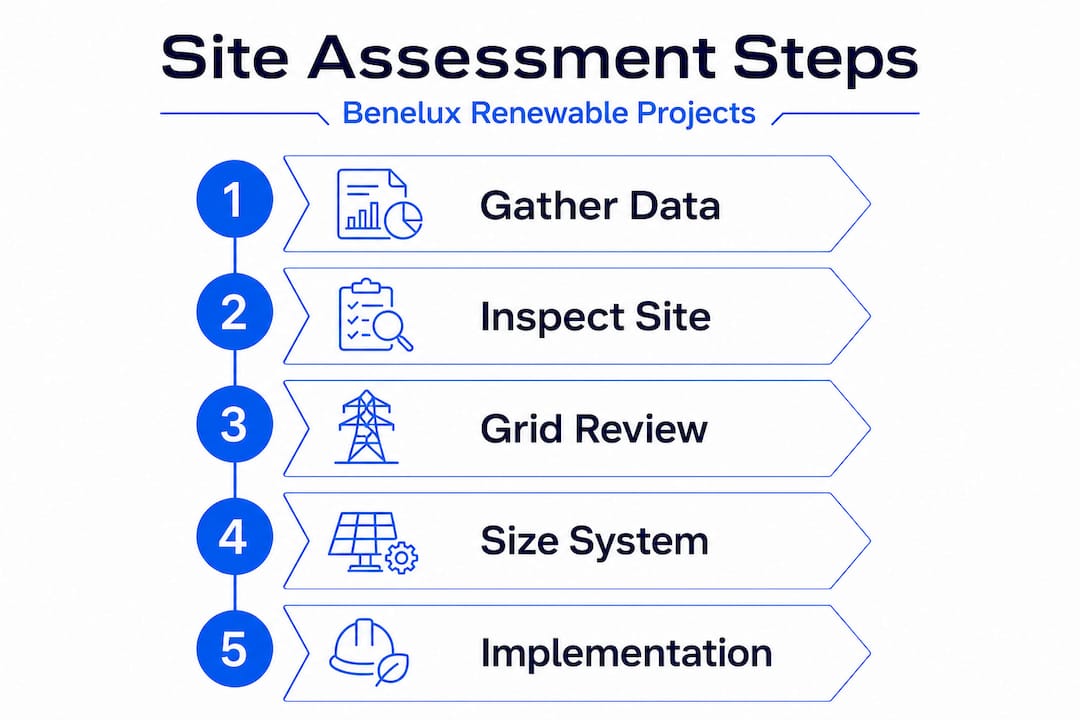
With your data in hand, you are ready to move through the assessment process. Here is how to break it down, step by step.
Review historical energy usage to establish baseline demand. Pull your 12-month consumption data and calculate your average monthly and peak daily consumption in kilowatt-hours. Look for seasonal patterns and any unusually high periods. This baseline is the foundation for every system sizing decision that follows.
Conduct a walkthrough to identify efficiency opportunities. Before calculating how much energy to generate, identify how much you can stop wasting. Walk through the property and note aging lighting, poor insulation, inefficient HVAC, or always-on equipment. Reducing demand by even 15% can shrink the required solar array and battery by a proportional amount, saving thousands on installation.
Measure available sunlight and wind, and document shading and orientation. Use a compass and a shading tool or app to record your roof or land orientation and any obstacles. South-facing roofs in the Benelux typically generate 10 to 15% more annually than east-west facing installations. Shade from a single chimney or neighboring building can reduce output by 20% or more if panels are not positioned carefully.
Evaluate grid connection and spatial planning requirements. Check with your DSO on available injection capacity and lead times for a new or upgraded connection. Coordination with spatial planning and grid development is a necessary step in assessing renewable energy potential in Benelux. Grid lead times in Belgium and the Netherlands can run from several months to over a year for larger connections. Also review local zoning rules that govern panel placement or battery storage locations. Learning more about grid services for renewables can help you understand what your grid connection options look like in practice. For properties that may benefit from shared infrastructure, community solar setup arrangements are worth investigating at this stage.
Compile findings and outline next steps. Bring all your data together in a summary document that lists: current baseline demand, identified efficiency savings, available generation potential, grid constraints, and any regulatory flags. This document becomes the brief for your installer, energy adviser, or internal team to develop a detailed technical design.
Pro Tip: Document every physical or planning obstacle you encounter during the walkthrough and grid review, including tree cover, roof pitch limitations, and local planning restrictions. Flagging these early prevents expensive surprises during design or permitting.
Common pitfalls and how to avoid them
Even with a solid process, certain barriers repeatedly derail renewable projects in the Benelux region. Being aware of them in advance puts you ahead of most property owners.
Frequent mistakes and how to sidestep them:
Overestimating site potential by ignoring demand reduction. Many owners jump straight to calculating how many kilowatts of solar their roof can hold. Without first reducing consumption through efficiency measures, the system gets oversized and the payback period extends unnecessarily.
Underestimating permitting and utility approval timelines. A grid connection upgrade in Flanders or Noord-Holland can take 6 to 18 months. Build this into your project schedule from day one, not after you have already signed an installation contract.
Failing to coordinate with grid and spatial planning authorities. Fragmented planning, structural weaknesses, and overlooking demand-side management are leading barriers to accelerating renewables projects. Submit preliminary inquiries to your DSO and local planning office before finalizing your system design.
Skipping a professional review for larger or complex projects. A 50 kW commercial rooftop installation is not a scaled-up version of a residential system. Structural engineering, fire safety, and grid protection requirements differ significantly.
Relying on a single quote or assessment. One assessment from one provider gives you one perspective. Cross-checking outputs against online tools or a second opinion adds confidence and sometimes uncovers errors.
“Grid lead times and fragmented planning create hidden delays. Factor them in from the start, not after the panels are already ordered.”
Understanding the solar inverter features relevant to your grid connection requirements is one practical way to avoid specification mismatches that only surface at installation time.
Verifying results and preparing for implementation
Once you have gathered and reviewed your assessment data, it is time to verify your findings and get ready for action.
Cross-check your energy baseline with an independent tool. Several free online platforms allow you to input your address and consumption data to generate estimated solar yields for Benelux locations. Compare these estimates against your own calculations. If they differ by more than 10 to 15%, revisit your shading analysis or consumption data.
Quantify your projected savings and carbon impact. Convert your efficiency and generation findings into euros and tons of CO2 per year. These numbers are important not just for your own decision-making but also for applying for subsidies, green financing, or corporate sustainability reporting. A well-documented energy assessment can identify large cost and carbon savings, as one tech company example showed $310,000 per year in savings and 1,250 avoided tons of carbon through a comprehensive multi-measure approach. That scale of outcome starts with exactly the kind of systematic assessment described here.
Prepare permitting documentation in parallel. Do not wait until your technical design is finalized to start gathering permitting documents. Municipality application forms, grid connection requests, and structural reports all take time. Running these in parallel with design work can shave weeks off your overall project timeline.
Arrange a detailed technical survey before signing any installation contract. Your self-conducted assessment provides an excellent baseline, but a qualified installer or independent energy auditor should physically verify roof load capacity, electrical compatibility, and grid protection requirements before any money changes hands.
Define a clear handover package. Prepare a folder containing your verified assessment summary, efficiency recommendations, proposed system specifications, grid inquiry response, and permitting status. This becomes the reference document for your installer and for your own ongoing tracking of the project.
Reviewing the solar system components that will form the core of your installation helps you ask better questions during this verification stage and avoid accepting a design that does not fully match your site’s needs.
Why most site assessments fall short and how to get it right
Here is a candid observation from working with property owners across the Benelux region: the majority of site assessments that cross our desk are really just shading analyses dressed up in professional language. They tell you how much your roof can generate. They rarely tell you how much energy you should have already stopped wasting before sizing that system.
The conventional framing of a site assessment, measured in kilowatt-peak capacity and annual yield, creates a structural bias toward selling generation equipment. A larger solar array means a larger invoice. An honest assessment starts somewhere different. It starts with the question: what is this building actually consuming, and why?
Portfolio owners should begin with an integrated energy assessment that treats demand reduction and efficiency as the first layer of a renewable strategy. This is not just good theory. It is the approach that consistently produces the best financial outcomes. When you reduce demand first, every subsequent technology decision, from inverter sizing to battery capacity, gets recalibrated around a leaner, more accurate baseline. The result is a smaller system that costs less, pays back faster, and performs more predictably over its 25-year life.
For Benelux property owners specifically, this matters because energy prices here respond to dynamic tariffs in 15-minute intervals. A Belinus Energy Management System is built around exactly that reality. But even the best EMS cannot compensate for a fundamentally oversized or poorly sited system that was designed before anyone asked whether demand could come down first.
The advice we give consistently: treat efficiency as phase one, renewables sizing as phase two, and technology selection as phase three. Properties that follow this sequence, whether they are residential homes in Ghent or commercial warehouses in Rotterdam, consistently outperform those that jump straight to panel counts. Exploring energy efficiency strategies before locking in a system design is the single highest-leverage action you can take.
Ready for your professional site assessment?
Taking the assessment process into your own hands is a smart first move. But at a certain point, especially for commercial properties or systems above 25 kW, the complexity justifies bringing in experienced professionals who have navigated Benelux grid operators, municipal planning offices, and installer networks hundreds of times.

At Belinus, we combine technical site analysis with integrated system design across solar PV, battery storage, and EV charging, all managed through our centralized Energy Management System. Whether you are sizing a residential setup or planning a utility-scale installation, our team and our affiliated companies, Solarimex for PV wholesale and SolarPlus for installation, can take your project from assessment to commissioning. Visit Belinus renewable solutions to start the conversation and get a detailed view of what a professional assessment looks like for your specific property and goals.
Frequently asked questions
What is included in a renewable energy site assessment?
A site assessment typically covers energy demand analysis, efficiency opportunities, physical site characteristics, grid connection review, and regulatory considerations. Portfolio owners should begin with an integrated approach that treats demand reduction and renewables as a combined strategy rather than separate exercises.
How can a site assessment help me save money?
By identifying the most cost-effective energy upgrades and preventing overspending on mis-sized systems, site assessments reveal both immediate and long-term savings. Energy assessments can yield measurable savings and environmental benefits when they cover the full range of demand and generation measures.
Are there common mistakes to avoid during a site assessment?
Yes. Avoid skipping demand-reduction steps, underestimating permitting times, and not reviewing grid or planning requirements. Fragmented planning and long grid lead times are documented barriers in the renewable energy process across Benelux and the wider EU.
Do I need professional help for my site assessment?
For complex or commercial projects above roughly 25 kW, a professional can help avoid costly design mistakes and ensure compliance with DSO and municipal requirements. Residential projects can often start with a self-assessment, provided the findings are verified before installation.
What data do I need to start my assessment?
You need recent energy bills, property and building plans, grid connection details, and any existing permits or planning restrictions. Data quality and dataset availability are critical to accurate assessments and help speed up the permitting process considerably.
Recommended
Comments