How to reduce energy costs: a Benelux property guide
- 10 hours ago
- 11 min read
TL;DR:
Energy bills in Benelux have surged recently, making energy efficiency skills essential for property owners. Conducting comprehensive audits and leveraging regional subsidies can significantly reduce costs by prioritizing upgrades like insulation and renewable systems. A holistic, professionally guided approach ensures maximum savings and long-term energy resilience in residential and commercial properties.
Energy bills in Belgium, the Netherlands, and Luxembourg have climbed sharply over the past three years, and many homeowners and commercial property managers are still paying far more than they need to. Knowing how to reduce energy costs is no longer a nice-to-have skill. It is the difference between a property that drains your budget and one that works for it. This guide covers the exact steps, financial tools, and renewable technologies that deliver real savings in the Benelux context, from your first energy audit all the way to long-term monitoring.
Table of Contents
Key Takeaways
Point | Details |
Start with efficiency first | Reducing your home’s energy losses lets you buy smaller, more affordable renewable systems. |
Use regional grants | Benelux offers generous subsidies that can cover a large share of renewable installation costs. |
Plan comprehensive renovations | Combining insulation, heat pumps, and solar maximizes cost savings and unlocks extra bonuses. |
Optimize solar with storage | Adding batteries improves self-consumption and reduces grid fees, boosting solar savings despite longer payback. |
Monitor and maintain systems | Smart meters and energy management help verify savings and detect issues for lasting benefits. |
Identifying energy cost drivers and preparing your property
Before spending a single euro on panels or heat pumps, you need to know where your energy actually goes. In the Benelux region, the average household uses between 3,500 and 4,500 kWh of electricity per year, but poorly insulated older properties, which make up a large share of housing stock in Belgium and the Netherlands, can run two to three times that figure.
The biggest culprits are usually invisible. Vampire loads, meaning devices left on standby (TVs, routers, phone chargers, office equipment), can account for 10 to 15% of total household electricity use. Air leaks around window frames, roof joints, and basement ceilings bleed heat in winter and cool air in summer. These are not dramatic failures. They are small, chronic losses that compound into major bills.
Common sources of energy waste in Benelux properties:
Poor roof and cavity wall insulation (pre-1990 buildings are most at risk)
Single or double glazing without low-emissivity coating
Old gas boilers running at low efficiency
Uncontrolled ventilation systems without heat recovery
Appliances left on standby around the clock
Oversized HVAC systems that short-cycle instead of running efficiently
An energy performance certificate (EPC) is your starting point. In Flanders, Wallonia, and the Netherlands, EPCs are legally required for property sales, but they are also useful as a planning tool even when you are not selling. A certified energy auditor will map your heat losses, identify the highest-impact upgrades, and give you a sequenced renovation plan.
Why does sequencing matter? Because fixing air leaks first saves 10 to 20% on bills before you invest in renewables, and it also means your heat pump or solar system can be sized smaller and cheaper. Similarly, reducing electricity use through efficiency measures allows you to install a smaller, less expensive renewable system without sacrificing comfort or coverage.
Audit action | Time required | Typical cost (€) | Potential savings |
EPC assessment | Half day | 150 to 300 | Baseline for grants |
Blower door test (air tightness) | 2 to 4 hours | 300 to 500 | Identifies 10 to 20% bill reduction |
Thermal imaging scan | 1 to 2 hours | 200 to 400 | Maps insulation gaps precisely |
Full energy audit | Full day | 500 to 1,000 | Prioritized renovation roadmap |
Pro Tip: Ask your auditor to provide an ordered list of measures ranked by cost per kWh saved, not just a list of everything that could be improved. That single change in framing will save you thousands in misplaced renovation spending.
Leveraging regional grants and subsidies for renewable installations
One of the most underused energy cost reduction tips in the Benelux is stacking subsidies. Each region has its own program, and many allow you to combine grants for different measures in a single application, which increases your total support significantly.

Luxembourg’s Klimabonus 2026 provides up to €12,000 for heat pump installations and offers bonus incentives when you combine three or more renovation measures. That stacking bonus alone can cover a significant portion of your insulation or ventilation upgrade at no extra administrative effort.
In Belgium, support varies sharply by region. Belgium’s regional premiums reach up to €4,000 for combined solar and battery installations, and Flanders specifically offers the Mijn VerbouwPremie for lower-income households, which can cover up to 50% of renovation costs. Brussels and Wallonia operate separate programs with different income thresholds and eligible measures, so cross-checking your region before applying is essential.
The Netherlands has taken a different approach. For housing corporations, heat pump installation costs have dropped to around €6,000 per well-insulated home in 2026, roughly 50% below the previous market rate, thanks to collective procurement programs. Private homeowners can access the ISDE subsidy for heat pumps and solar thermal systems, and zero-interest loans through banks partnered with the national government.
Benelux subsidy comparison overview:
Region | Key program | Max grant (approximate) | Notable feature |
Luxembourg | Klimabonus 2026 | €12,000 (heat pump) | 15% bonus for ≥3 measures |
Flanders | Mijn VerbouwPremie | Up to 50% of costs | Income-scaled support |
Wallonia | REPower Wallonie | Variable by measure | Includes battery storage |
Brussels | Bruxelles Environnement | Variable | Older buildings prioritized |
Netherlands | ISDE + loan programs | €3,000 to €5,000 | Zero-interest loan options |
Key steps to maximize your grant income:
Obtain your EPC before applying, as most programs require it
Confirm which installer certifications are required for subsidy eligibility
Check whether you can combine regional and federal support (often possible)
Apply before starting work, since retroactive claims are rarely accepted
Keep all invoices and technical specifications, as audits do happen
For a full breakdown of what is available in your area, the solar, storage, and EV incentives guide for Benelux 2026 covers current programs in detail.
Implementing renewable energy systems efficiently in Benelux properties
With financing secured, execution matters more than most buyers expect. The most common and costly mistake in Benelux renewable installations is installing a heat pump into a home that has not been prepared for it. Heat pumps are highly efficient, but they are designed to run at low temperatures for long periods. If your radiators are undersized or your home leaks heat, the system will struggle, your bills will stay high, and you will blame the technology instead of the planning.
How to implement renewables the right way:
Complete insulation and air sealing upgrades before installing any heat source
Commission a heat load calculation (this is different from just measuring floor area) to size the heat pump correctly
Replace undersized radiators or add underfloor heating circuits where needed
Install the heat pump with a properly configured buffer tank and heating curve
Add solar PV sized to cover the heat pump’s annual electricity demand plus your other loads
Integrate battery storage if your grid tariff structure rewards self-consumption
Fully electric heat pumps deliver meaningful bill reductions and lower CO2 emissions even in moderately insulated Benelux homes, but the return per euro invested rises sharply when the building envelope is addressed first. For properties that cannot be heavily insulated quickly (heritage buildings, rented properties with sitting tenants), hybrid heat pump systems with optimal controls can minimize electricity use while keeping a gas backup for the coldest days, enabling smaller, cheaper systems without sacrificing resilience.
What to look for when vetting installers:
Certification recognized by regional subsidy bodies (e.g., Certibeau in Wallonia, REScheck or equivalent in the Netherlands)
Experience with heat load calculations, not just standard sizing rules of thumb
References from similar building types in your area
Written guarantee that the installation qualifies for the grants you have applied for
Pro Tip: Ask for a detailed yield simulation, not just a headline figure. A credible installer will show you month-by-month generation estimates, consumption offset projections, and assumptions used. If they cannot produce this, find someone who can.
Combining measures also unlocks better savings in Benelux home energy systems, because each upgrade amplifies the others. Insulation reduces heating demand. A smaller heat pump runs more efficiently. Solar covers the pump’s electricity. Storage avoids peak tariff charges. The system as a whole outperforms the sum of its parts.
Optimizing solar power and storage for maximum savings
Once your system is installed, the work of optimization begins. Ways to save on energy do not stop at the meter. How you use your solar generation, and when, determines a large part of your actual savings.
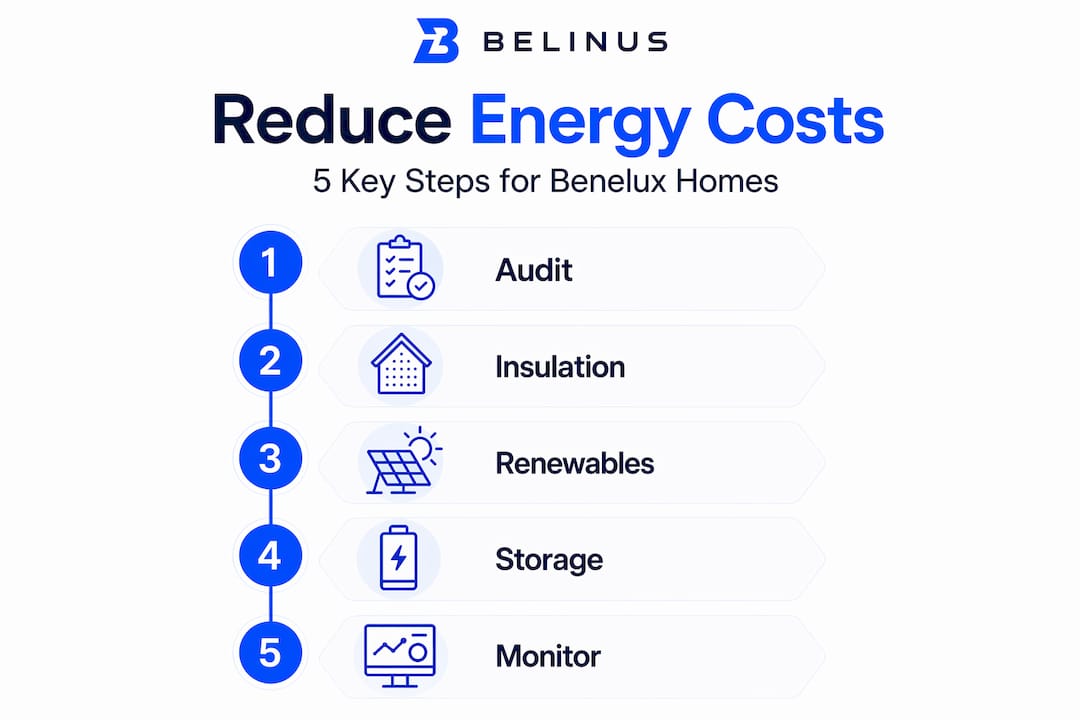
Solar installations in Benelux typically pay back in 6 to 9 years, with incentives reducing upfront costs by 20 to 40%. After payback, the system generates essentially free electricity for the remainder of its 25-year-plus lifespan. Electricity price inflation accelerates this: every 5% annual tariff increase shortens your effective payback by roughly six months.
System type | Typical payback | Self-consumption rate | Notes |
Solar PV only (no storage) | 6 to 8 years | 30 to 40% | Best for low daytime absence |
Solar PV + battery storage | 8 to 12 years | 60 to 80% | Better for peak tariff regions |
Solar + storage + EV charging | 7 to 10 years | 70 to 85% | Vehicle acts as flexible load |
Commercial solar + grid services | 5 to 8 years | Variable | Grid arbitrage adds revenue |
Battery storage extends payback by 2 to 4 years, but it improves overall ROI by shifting your consumption away from expensive peak hours and reducing grid import costs. In Flanders, the prosumertarief (a grid fee charged to solar owners who net-meter) makes battery storage more financially attractive than in most other European regions, because higher self-consumption directly reduces the fee impact.
How to get the most from your solar and storage investment:
Set your energy management system (EMS) to charge batteries during solar peak hours (10am to 2pm typically)
Schedule high-draw appliances like dishwashers and washing machines during midday generation windows
Use dynamic tariff integration if your provider offers hourly pricing
Connect your EV charger to the EMS so the car charges when solar surplus is highest
Review your inverter and battery performance data quarterly, not just annually
Pro Tip: Before investing in a larger battery, check your solar power checklist to confirm your current self-consumption rate. Many homeowners buy oversized storage when behavioral changes and EV integration would deliver the same result at a fraction of the cost.
Monitoring, verifying savings, and common pitfalls to avoid
Installing the system is not the end of the process. It is the beginning of a long-term cost reduction program that requires active management to sustain results.
Steps to verify your savings are real:
Record your actual meter readings before installation as a baseline
Compare year-one generation and consumption data against the installer’s projections
Identify any months where actual use significantly exceeds the projection
Cross-reference with weather data (a cold spring will affect heat pump figures)
Contact your installer if under-performance exceeds 10% from the projection
Smart meters and home energy management systems let you shift consumption to off-peak hours, and many Benelux utilities now offer time-of-use tariffs that reward this behavior with direct bill reductions. Understanding your tariff structure is as important as the hardware you install.
“The homeowners who see the best long-term savings are the ones who treat their energy system like a financial instrument. They check the data, adjust their habits, and ask questions when numbers drift. The technology is only as good as the attention you give it.”
Common mistakes that reduce long-term savings:
Skipping the energy audit and oversizing the renewable system to compensate
Installing a heat pump without replacing undersized radiators first
Ignoring panel soiling, which can reduce output by 5 to 10% over a dirty season
Not registering for available feed-in tariffs or prosumer compensation schemes
Assuming the inverter display is sufficient monitoring (it is not: use a full EMS dashboard)
For ongoing management of your system, the energy management essentials guide walks through how to use smart controls and dashboards to keep your property performing at its best.
Why comprehensive planning outperforms piecemeal upgrades in Benelux energy savings
Here is something the industry rarely admits openly: a single efficiency measure, installed in isolation, almost never delivers the savings the brochure promises. Not because the technology is faulty. Because buildings are systems. Change one variable without accounting for the others, and the benefit leaks away through the unchanged parts.
We see this repeatedly. A homeowner installs solar panels on a poorly insulated roof. The generation numbers look fine on paper, but the house still bleeds heat through the walls, the boiler still burns gas at night, and the actual bill reduction is a third of what was projected. The solar system was not the problem. The problem was that it was designed in isolation.
The 15% renovation bonus in Luxembourg for combining three or more works is not just a financial incentive. It is a policy acknowledgment that comprehensive renovations produce better outcomes than isolated upgrades. The grant designers understood that insulation plus heat pump plus ventilation together deliver disproportionately better results than any one of those three measures alone.
The same logic applies to smart controls and battery storage. Adding a Belinus EMS after the fact works, but integrating it during the design phase means the system is built around dynamic tariff optimization from day one, not retrofitted onto a setup that was never designed for it. You get better performance, fewer compatibility issues, and a tighter feedback loop between generation, storage, and consumption.
Regional complexity in the Benelux makes professional guidance genuinely valuable, not just convenient. The subsidy rules differ between Flanders, Wallonia, Brussels, Luxembourg, and the Netherlands. Installer certification requirements differ. Tariff structures differ. A plan that works perfectly in Ghent may require significant adjustment in Rotterdam or Luxembourg City.
The holistic approach to energy efficiency is not a luxury for large renovation budgets. It is the only approach that consistently produces the savings people expect when they sign the installation contract.
Explore Belinus solutions to cut your energy costs with renewables
If you have worked through this guide, you already know more than most property owners about how to reduce energy bills effectively in the Benelux. The next step is putting that knowledge into a concrete plan built around your specific property, your region’s grant structure, and your financial targets.
Belinus brings together solar PV, battery storage, heat pump integration, and EV charging under one coordinated energy management system, purpose-built for Benelux conditions. The team provides transparent 25-year financial modeling, subsidy navigation across all five Benelux regions, and end-to-end support from initial audit through installation and long-term monitoring. Whether you manage a single home or a portfolio of commercial properties, Belinus renewable energy solutions give you the tools to reduce costs and keep them down.
Frequently asked questions
What are the easiest first steps homeowners can take to reduce energy costs?
Start with an energy audit to identify air leaks and inefficient appliances. Simple fixes like sealing drafts and using smart power strips to eliminate standby loads can lower bills immediately, and efficiency measures first mean any renewable system you add later can be sized smaller and cheaper.
How do regional subsidies in the Benelux improve renewable energy affordability?
Programs like Luxembourg’s Klimabonus 2026, which provides up to €12,000 for heat pumps plus bonuses for combined works, can cover a substantial portion of your total renovation cost, making renewables accessible even for mid-range budgets.
Is battery storage worth the extra cost in the Benelux?
Battery storage extends payback by 2 to 4 years, but in high-tariff areas like Flanders, where the prosumertarief applies, higher self-consumption from storage reduces grid fees enough to improve your overall return meaningfully when paired with solar.
Can commercial property managers benefit from the same energy cost reduction strategies as homeowners?
Yes, and often at greater scale. In the Netherlands, housing corporations now access heat pumps at around €6,000 per well-insulated home, and commercial managers can pair scalable battery storage with energy management systems to reduce both consumption costs and peak demand charges across entire portfolios.
Recommended
Comments