How to size battery systems for European properties efficiently

Choosing the right battery capacity for your property can mean the difference between optimal savings and wasted investment. Many European property owners struggle to determine how much storage they actually need, risking either insufficient energy autonomy during peak hours or overspending on excess capacity that extends payback times beyond a decade. This guide walks you through a practical, step-by-step approach to sizing battery systems that match your consumption patterns, integrate seamlessly with solar PV, and maximize cost savings through intelligent energy management.
Table of Contents
Key takeaways
Point | Details |
Balance capacity with actual needs | Optimal battery sizing matches consumption, solar output, and chosen technology to avoid under- or over-investment. |
Account for future loads | Including EV charging and seasonal variations prevents costly system redesigns later. |
Leverage intelligent EMS | Dynamic tariff optimization and grid services boost savings by 15-20% and shorten payback periods. |
Choose modular designs | Scalable battery architectures adapt to changing energy demands without replacing entire systems. |
Avoid common sizing mistakes | Under-sizing reduces savings by 25%; over-sizing extends payback beyond 10 years. |
Introduction to battery system sizing
Battery sizing determines the storage capacity needed to match your property’s energy consumption patterns throughout the day and across seasons. Getting this calculation right enables higher energy autonomy, reduces grid dependence during expensive peak hours, and maximizes return on investment from solar PV integration.
Correct sizing enhances benefits when you add EV charging to your energy ecosystem. Properties with properly sized batteries can shift charging to off-peak periods, capturing cheap overnight electricity or surplus solar generation during sunny afternoons. This strategic load management cuts costs while supporting renewable energy goals.
Inaccurate sizing carries real consequences. Undersized systems force frequent grid purchases during peak tariff windows, eroding savings and leaving you vulnerable to price spikes. Oversized batteries lock capital into unused capacity, pushing payback periods beyond reasonable investment horizons and reducing overall financial efficiency.
European property owners gain unique advantages from precise battery sizing due to widespread dynamic tariffs and renewable incentives. Time-of-use pricing structures reward strategic storage deployment, while feed-in tariffs and grid service programs create additional revenue streams. Properties across residential and commercial sectors can capitalize on these opportunities when battery capacity aligns with actual energy flows and regulatory frameworks.
Key sizing considerations include:
Daily and seasonal consumption variability
Solar PV generation profiles and self-consumption targets
Current and projected EV charging demands
Local tariff structures and grid service opportunities
Technology tradeoffs between cycle life and upfront cost
Prerequisites and key preparations
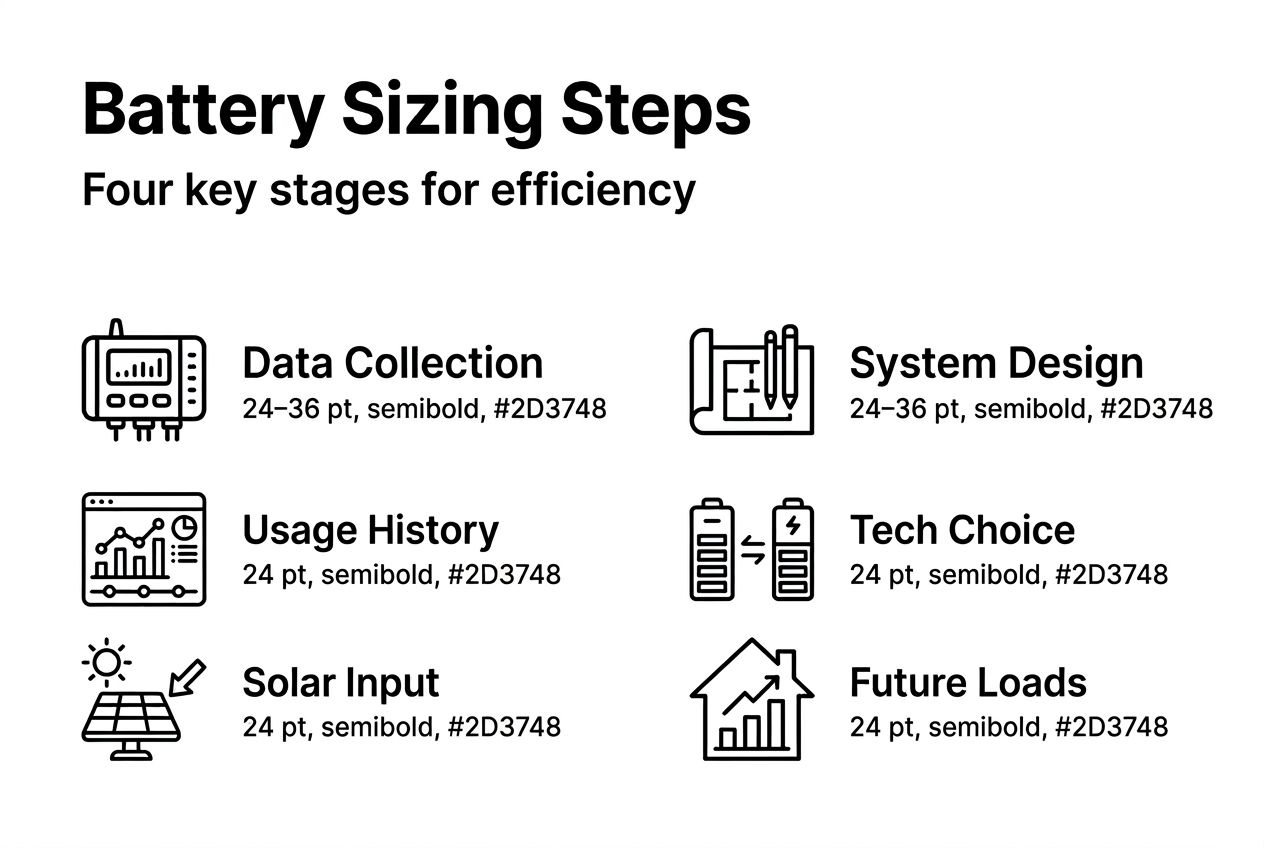
Accurate battery sizing starts with comprehensive data collection covering at least 12 months of hourly energy consumption. This full-year view captures seasonal variations like heating loads in winter and cooling demands in summer, ensuring your system handles peak periods without running dry or sitting idle.
Gather solar PV generation profiles if your property includes photovoltaic arrays. Matching battery capacity to actual solar output patterns helps you store surplus daytime generation for evening use, maximizing self-consumption and reducing grid purchases during expensive peak hours.
Understand your local dynamic tariff structure thoroughly. Document peak and off-peak price differences, time windows for each rate tier, and any seasonal adjustments. This information drives decisions about when to charge batteries from the grid versus when to discharge stored energy for maximum savings.
Forecast current and future loads with special attention to EV charging requirements. A single electric vehicle adds 2-4 kWh daily consumption for typical commuting patterns, scaling up for fleet applications or multiple household vehicles. Collect and analyze energy data systematically to build accurate load profiles.
Review available battery technologies including their costs, cycle lives, and scalability options:
Graphene supercapacitors: Higher upfront investment, 10,000+ charge cycles, excellent performance
LFP batteries: Lower initial cost, 3,000-5,000 cycles, proven reliability
Pre-lithiated LFP: Enhanced energy density, moderate cycle life, emerging technology
Modular architectures: Flexible capacity expansion, future-proof design
Pro Tip: Request detailed consumption data from your utility provider in CSV format for easy analysis. Most European utilities provide this through customer portals, giving you hourly breakdowns that reveal hidden usage patterns and peak demand windows.
Step-by-step battery sizing method and technology considerations
Start by analyzing your average daily consumption and identifying peak usage periods. Calculate baseline capacity by multiplying average daily kWh by your desired autonomy days. Most residential properties target 1-2 days of autonomy, while commercial installations may need 0.5-1 day depending on backup requirements and grid reliability.
Incorporate solar PV generation profiles to enhance self-consumption targeting. Overlay your consumption curve with solar production data, identifying the gap between generation and usage. Size battery capacity to capture surplus solar energy during peak production hours and discharge it during evening consumption peaks when solar output drops to zero.
Add anticipated EV charging loads based on vehicle models and driving patterns. A typical electric vehicle requires 15-20 kWh to replenish 100 kilometers of range. Multiply daily driving distance by vehicle efficiency to calculate additional storage needs, then factor in charging timing preferences and tariff optimization opportunities.

Choose battery technology by balancing cost against cycle life and performance requirements:
Technology | Upfront Cost (€/kWh) | Cycle Life | Efficiency | Best For |
Graphene Supercapacitor | 440 | 10,000+ | 95%+ | Long-term investment, high utilization |
LFP Battery | 200-300 | 3,000-5,000 | 90-95% | Budget-conscious, moderate cycling |
Pre-lithiated LFP | 250-350 | 4,000-6,000 | 92-96% | Balanced performance and cost |
Plan modular, scalable systems that accommodate future capacity growth. Modular designs using 2-3 kWh building blocks allow you to start with minimum viable capacity and expand as energy needs evolve, avoiding over-investment while maintaining upgrade flexibility.
Integrate intelligent EMS for tariff optimization and grid service participation. Using an intelligent Energy Management System (EMS) with dynamic tariff optimization reduces payback times by 15-20% by leveraging battery arbitrage and grid services. Modern EMS platforms analyze 15-minute tariff windows, automatically charging batteries during cheap periods and discharging during expensive peaks.
Calculate final battery capacity using this formula:
Determine daily consumption baseline (kWh/day)
Subtract expected solar self-consumption
Add EV charging loads
Multiply by autonomy target (typically 1-2 days)
Add 20% buffer for seasonal variability and degradation
Round up to nearest module size for modular systems
Pro Tip: Integrating solar with storage requires oversizing battery capacity by 10-15% to account for weather variability and seasonal solar production changes. This buffer prevents running empty during cloudy periods without excessive over-investment. Consider battery technology comparison factors and explore modular battery designs for maximum flexibility.
Common mistakes and failure points with fixes
Under-sizing by over 20% decreases savings up to 25% because your battery runs empty during peak evening hours, forcing expensive grid purchases when tariffs hit maximum rates. Properties with insufficient storage capacity lose the core benefit of energy arbitrage, paying premium prices for power they could have stored during cheap off-peak windows.
Over-sizing by more than 30% increases payback beyond 10 years by locking capital into unused capacity that never cycles. Batteries generate returns through charge-discharge cycles, so excess capacity sitting idle represents wasted investment that could have gone toward other efficiency upgrades or revenue-generating assets.
Ignoring seasonal consumption patterns leads to capacity errors that cause either winter outages or summer waste. Heating loads can triple energy consumption during cold months, while air conditioning spikes summer demand. Size for peak seasonal needs, not just average consumption, to maintain autonomy year-round.
Failing to include future EV loads forces costly system redesigns when you add electric vehicles later. Retrofitting additional battery capacity requires new inverters, updated electrical panels, and modified EMS programming. Plan for EV charging from day one, even if vehicle purchase sits 1-2 years away.
Underestimating inverter size creates power bottlenecks that limit battery utilization and system efficiency. Inverter capacity must handle simultaneous solar generation, battery charging, and property loads during peak production periods. Undersized inverters clip solar output or slow battery charging, wasting renewable energy and reducing financial returns.
Fixes for these common errors:
Gather full-year hourly consumption data covering all seasons
Model EV charging scenarios even if vehicle purchase is pending
Size inverters for peak combined loads plus 20% margin
Run financial models comparing capacity scenarios across 8-10 year horizons
Scale battery capacity properly using modular approaches that allow phased expansion
Pro Tip: Request consumption data broken down by hour and season, not monthly averages. Monthly totals hide critical daily peaks and seasonal swings that drive proper battery sizing. Hourly data reveals actual usage patterns and tariff exposure.
Costs, timelines, and expected outcomes
Residential battery installations typically require 2-4 weeks from contract signing to system commissioning, including permitting, equipment delivery, installation, and grid connection approvals. Commercial projects span 2-3 months due to larger system sizes, more complex electrical integration, and additional regulatory requirements.
Graphene supercapacitors carry higher upfront costs around €7,000 for 16 kWh systems but deliver exceptional cycle life exceeding 10,000 charge-discharge cycles. This longevity translates to 20+ year operational lifespans, making them attractive for properties with high daily cycling and long-term ownership horizons.
LFP batteries offer lower initial investment at €200-300 per kWh but shorter life cycles spanning 3,000-5,000 cycles. These systems work well for budget-conscious installations or properties with moderate cycling patterns where lower upfront cost outweighs reduced longevity.
System Size | Technology | Upfront Cost | Annual Savings | Payback Period |
16 kWh | Graphene | €7,000 | €900-1,100 | 6-8 years |
16 kWh | LFP | €3,200-4,800 | €850-1,000 | 3-5 years |
32 kWh | Graphene | €14,000 | €1,600-2,000 | 7-9 years |
32 kWh | LFP | €6,400-9,600 | €1,500-1,800 | 4-6 years |
Optimized sizing can improve energy self-sufficiency to 70-80% for residential properties with solar PV integration. Commercial installations achieve 60-75% autonomy depending on load profiles and generation capacity. Higher self-sufficiency reduces grid dependence and tariff exposure.
Financial models forecast payback under 8 years for residential graphene systems, varying for commercial applications based on utilization patterns and available grid service revenue. Long-term projections account for 1-2% annual degradation and potential capacity expansion as energy needs grow. Review battery cost savings example scenarios for detailed financial modeling.
Expected outcomes from properly sized systems:
70-80% energy self-sufficiency with solar integration
€850-2,000 annual electricity cost savings depending on capacity
15-20% faster payback through EMS optimization
Reduced carbon footprint through renewable integration
Grid resilience during outages and price spikes
Safety considerations and integration with EMS
Certified battery management systems and proper ventilation reduce thermal runaway risks that can lead to fires or equipment damage. Quality BMS monitors cell temperatures, voltages, and charge states continuously, shutting down systems before dangerous conditions develop. Install batteries in well-ventilated spaces with adequate clearance for heat dissipation.
EMS enables dynamic tariff management and battery arbitrage to beat electricity cost peaks automatically. Modern platforms analyze real-time pricing data, charging batteries when rates drop below thresholds and discharging when prices spike. This autonomous optimization runs 24/7 without manual intervention, maximizing savings through precise timing.
Using an intelligent Energy Management System (EMS) with dynamic tariff optimization reduces payback times by 15-20% by leveraging battery arbitrage and grid services. Grid service programs pay battery owners for providing frequency regulation, peak shaving, and demand response capabilities. These revenue streams stack on top of tariff arbitrage savings, accelerating return on investment.
EMS supports integration with third-party smart systems and EV fleet charging management through RESTful APIs and standard protocols. Connect your battery system to home automation platforms, energy monitoring dashboards, and vehicle charging schedulers for unified control. Fleet managers coordinate charging across multiple vehicles, balancing grid constraints with operational needs.
Safety compliance with European standards is mandatory for installations:
CE marking for electrical safety
IEC 62619 for lithium battery safety
EN 50549 for grid connection requirements
Local building codes and fire safety regulations
“Intelligent EMS transforms batteries from passive storage into active grid participants, creating value through services like frequency regulation and demand response that traditional systems cannot provide. This capability fundamentally changes project economics and system utilization.”
Proper EMS operation extends battery lifespan by preventing deep discharges, limiting charge rates to manufacturer specifications, and balancing cell usage across the pack. Software-managed cycling keeps batteries within optimal state-of-charge windows, avoiding degradation-inducing extremes that shorten operational life. Explore PV and storage integration benefits for comprehensive system design.
Summary and next steps
Accurate battery sizing maximizes energy savings and autonomy while avoiding costly mistakes that waste investment or underdeliver on performance expectations. Properties with properly matched capacity achieve 70-80% energy self-sufficiency, reduce grid purchases during expensive peak hours, and generate returns through tariff arbitrage and grid services.
Plan for future energy demands like EV charging and seasonal consumption variability from day one. Retrofitting capacity later costs significantly more than building flexibility into initial system design. Use modular architectures that allow phased expansion as needs evolve.
Leverage intelligent EMS and modular designs for peak optimization and scalability. Modern energy management platforms deliver 15-20% faster payback through automated tariff arbitrage and grid service participation. Modular battery systems adapt to changing requirements without replacing entire installations.
Consult professional providers like Belinus for customized system sizing and installation support. Expert guidance ensures your battery capacity matches actual consumption patterns, integrates seamlessly with solar PV and EV charging, and complies with all European safety and grid connection standards.
Key actions to take:
Gather 12 months of hourly consumption data
Document solar generation profiles if applicable
Forecast EV charging and future load growth
Compare technology options across lifecycle costs
Engage certified installers for professional system design
Discover tailored battery sizing with Belinus
Sizing your battery system correctly from the start saves thousands in avoided mistakes and optimizes energy savings for decades. Belinus offers expert battery system sizing tailored to your unique consumption patterns, solar generation profiles, and future energy needs across residential and commercial properties.
Benefit from scalable modular battery systems and intelligent EMS integration that delivers maximum savings through automated tariff optimization and grid service participation. Our solutions seamlessly combine solar plus storage integration with EV charging management for comprehensive energy independence.

Explore practical configurations matching your property type and energy goals. Visit Belinus today to start optimizing your energy autonomy and cost efficiency with professional sizing support.
FAQ
How do I calculate the ideal battery size for my home or business?
Combine 12 months of hourly energy consumption data with solar generation profiles and future load forecasts including EV charging. Multiply daily consumption by desired autonomy days, subtract solar self-consumption, add a 20% buffer for seasonal variability, then round to the nearest modular capacity.
What are the risks of under-sizing or over-sizing my battery system?
Under-sizing reduces savings by up to 25% through forced grid purchases during peak tariff periods and insufficient autonomy. Over-sizing inflates upfront costs and extends payback beyond 10 years by locking capital into unused capacity that never cycles.
How does integrating an intelligent EMS improve battery sizing outcomes?
EMS enables dynamic tariff optimization and battery arbitrage, reducing payback by 15-20% through automated charge-discharge scheduling and grid service participation. Modern platforms analyze real-time pricing and optimize battery utilization 24/7 without manual intervention.
Can I expand my battery system if my energy needs grow in the future?
Yes, modular battery designs enable easy capacity expansion using 2-3 kWh building blocks that integrate seamlessly with existing installations. This approach accommodates growing loads like EV charging or increased consumption without replacing entire systems or redesigning electrical infrastructure.
Recommended
Comments