How to Transition to Green Energy: 2026 Guide
- Jun 10
- 9 min read

TL;DR:
Transitioning to green energy involves upgrading appliances and systems in a correct sequence to maximize efficiency and cost savings. An energy audit lays the foundation for system sizing, and stacking federal, state, and utility incentives significantly reduces total costs. Without installing new equipment, consumers in deregulated markets can choose 100% renewable electricity plans backed by verified RECs to go green immediately.
Transitioning to green energy means replacing fossil fuel systems with renewable power sources, such as solar, wind, and geothermal, while electrifying your home or business to cut carbon emissions and lower long-term energy costs. The process is called whole-home electrification or a renewable energy transition, and it follows a clear sequence that most homeowners and businesses can complete in phases. Federal incentives like the Investment Tax Credit (ITC), state rebates, and falling hardware costs make 2026 one of the most financially favorable years to start. This guide walks you through every stage, from your first energy audit to monitoring a fully installed system.
How to transition to green energy: the essential first steps
Before you install a single solar panel or heat pump, you need to understand exactly how much energy your home or business currently uses and where it goes. An energy audit is the foundational first step. A certified auditor, or a DIY audit using your utility bills and a tool like the U.S. Department of Energy’s Home Energy Score, maps your consumption patterns and identifies the biggest inefficiencies.
Efficiency upgrades before installation reduce the size of the renewable system you need, which directly cuts your upfront cost. The most impactful improvements are:
Air sealing and insulation: Attic and wall insulation can cut heating and cooling loads by 20% or more.
LED lighting: Replacing incandescent bulbs with LEDs reduces lighting energy use by roughly 75%.
Programmable or smart thermostats: Devices like the Google Nest or Ecobee let you schedule heating and cooling around occupancy.
HVAC filter maintenance and duct sealing: Leaky ducts waste 20 to 30% of conditioned air in a typical home.
Pull 12 months of utility bills and calculate your average monthly kilowatt-hour consumption. That number becomes your sizing baseline for solar, battery storage, and EV charging. Many utilities, including Pacific Gas and Electric and Duke Energy, offer free online energy use dashboards that break down consumption by appliance category.
Pro Tip: Request a blower door test during your audit. It pressurizes the house to locate air leaks invisible to the naked eye, and fixing those leaks often delivers a better return than any single piece of hardware.

A renewable energy checklist for your property type keeps this phase organized and prevents you from skipping steps that affect system sizing later.
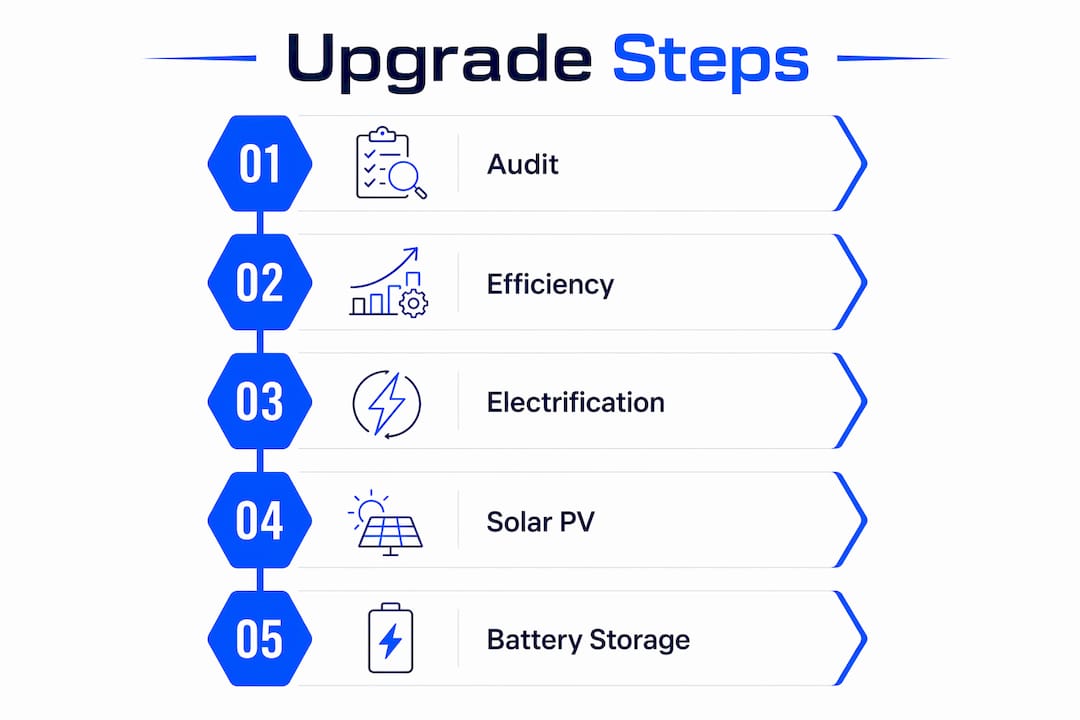
What is the right order for upgrading to renewable energy?
Most homeowners mistakenly install solar panels first, then discover their electrical panel cannot support a heat pump, EV charger, and battery simultaneously. The correct sequence of electrification upgrades avoids premature panel upgrades and oversized renewable capacity.
Follow this order:
Electrical panel upgrade (200-amp minimum): This creates the capacity headroom every subsequent upgrade depends on. Smart panels from brands like Span or Lumin add intelligent load management and can defer a full service upgrade.
Heat pump water heater: Replaces a gas or resistance electric water heater. Models like the Rheem ProTerra or A.O. Smith Voltex use 70% less electricity than standard electric tanks.
Heat pump HVAC: Replaces gas furnaces and central AC with a single system. Brands like Mitsubishi, Bosch, and Carrier offer cold-climate models rated to minus 13°F.
Induction cooking: Eliminates gas combustion indoors. Portable induction burners from Duxtop or GE let you test the technology before committing to a full range.
EV charger installation: A Level 2 charger (240V, 48 amps) adds roughly 25 miles of range per hour. Belinus’s ETAP Pro EV Charger integrates with fleet management for businesses running company vehicles.
Solar PV system: Now sized correctly against your electrified load, not your old gas-heavy baseline.
Battery storage: Added after solar to capture excess generation. Belinus’s Energy Wall G1 delivers 16 kWh using graphene supercapacitor technology, launching Q1 2026.
Technology | Best for | Key limitation |
Solar PV | Most homes and businesses | Requires roof access and sun exposure |
Battery storage | Grid independence and arbitrage | Upfront cost; size to daily load carefully |
Heat pump HVAC | Replacing gas heating and cooling | Performance drops below minus 13°F without backup |
Geothermal heat pump | Maximum efficiency in any climate | High installation cost; requires land or drilling |
Small wind turbine | Rural properties with consistent wind | Zoning restrictions; noise concerns |
Replacing gas appliances at their natural end of life maximizes cost efficiency and reduces waste. You are not throwing away a functioning appliance. You are timing the upgrade to coincide with a replacement you would have made anyway.
Pro Tip: A home electrification plan mapped to your appliance ages lets you predict which upgrade comes next and budget for it 12 to 18 months in advance.
What financing and incentives are available for green energy upgrades?
The federal ITC offsets 30% of total system costs, including equipment, installation labor, and battery storage. That is the single largest financial lever available to most homeowners and businesses, and it applies to the tax year in which the system is placed in service.
Beyond the ITC, the Inflation Reduction Act created two additional programs worth knowing:
HOMES Rebates: Up to $8,000 for whole-home efficiency upgrades based on measured energy savings, administered through state energy offices.
HEAR Rebates (High-Efficiency Electric Home Rebate Act): Point-of-sale rebates up to $14,000 for low and moderate-income households covering heat pumps, water heaters, and panel upgrades.
State and utility rebates: Programs from utilities like Xcel Energy, National Grid, and PSEG stack on top of federal credits. Check the DSIRE database (dsireusa.org) for your state.
Financing option | How it works | Best for |
Solar loan | Borrow to own; you keep all tax credits | Homeowners with good credit |
Solar lease | Pay monthly for system use; no ownership | Those who cannot use tax credits |
Power Purchase Agreement (PPA) | Pay per kilowatt-hour generated | Businesses wanting predictable costs |
PACE financing | Repaid through property tax bill | Homeowners with limited upfront capital |
Professional installation is required for ITC eligibility on most equipment categories. DIY installations typically void manufacturer warranties and disqualify the system from federal and state incentive programs. For a detailed walkthrough of the application process, the solar financing guide from Belinus covers documentation, timelines, and common filing errors.
The 8-step electrification plan typically costs $35,000 to $65,000 before incentives, dropping to $20,000 to $42,000 after federal tax credits and state rebates. Spread across five to seven years, that is a manageable annual investment for most households.
How to execute installation and avoid costly mistakes
Site assessment comes before any contract is signed. Roof condition, shading from trees or neighboring buildings, local zoning rules, and utility interconnection requirements all affect system design and timeline. A shading analysis using tools like Aurora Solar or Solargraf identifies production losses before installation begins.
Permit approval timelines range from under a week to three months depending on your jurisdiction. Clarify early who is responsible for pulling permits, the installer or the homeowner, because ambiguity here is one of the most common causes of project delays.
Key execution steps to follow:
Verify installer credentials: Use NABCEP-certified installers for solar and battery work. For heat pumps, look for ACCA-certified HVAC contractors.
Review warranty terms before signing: Equipment warranties (typically 10 to 25 years for solar panels) are voided by non-certified installation.
Confirm utility interconnection: Your utility must approve grid-tied systems before they can operate. This step alone can add four to eight weeks.
Set up monitoring from day one: Energy monitoring platforms detect underperformance early. Undetected shading or soiling can cause 20 to 30% output loss over time.
“The most expensive mistake in a renewable energy transition is wrong sequencing. Installing solar before electrifying appliances means you size the system against a gas-heavy load that will shrink once you switch to heat pumps and induction cooking. You end up with more capacity than you need and a longer payback period.”
Belinus’s Energy Management System (EMS) handles real-time monitoring with 15-minute dynamic tariff optimization, battery arbitrage, and grid service integration through a native mobile app and web dashboard. That level of visibility turns a passive installation into an active financial asset.
Can you go green without installing anything?
Homeowners in deregulated electricity markets can switch to 100% renewable plans without a single panel on their roof. In states like Texas, Illinois, and Pennsylvania, retail electricity providers offer plans backed by Renewable Energy Certificates (RECs), which verify that the electricity you consume is matched by renewable generation fed into the grid.
When evaluating these plans, check the Electricity Facts Label (EFL) for the renewable content percentage. Only plans showing 100% renewable content qualify as a full green power option. Renewables supplied 36% of electricity on the ERCOT grid by late 2025, which means the infrastructure supporting these plans is real and expanding rapidly.
This option works well for:
Renters who cannot modify their property
Homeowners with shaded or structurally unsuitable roofs
Businesses in leased commercial spaces
Anyone who wants to reduce their carbon footprint immediately while planning a longer-term installation
The trade-off is that you do not build equity in a physical asset, and you remain exposed to retail electricity price fluctuations. Green power plans are a strong starting point or a complement to physical installations, not a permanent substitute for homeowners with the means to own their system.
Key takeaways
A successful renewable energy transition requires efficiency upgrades first, correct sequencing of electrification, and active use of available incentives to keep net costs manageable.
Point | Details |
Audit before you install | An energy audit sets your sizing baseline and identifies efficiency gains that reduce system cost. |
Sequence upgrades correctly | Panel upgrade first, then appliances, then solar and storage, to avoid oversizing and wasted spend. |
Stack every available incentive | The federal ITC, HOMES rebates, HEAR rebates, and state programs can cut total costs by 35 to 50%. |
Monitor from day one | Energy monitoring platforms prevent 20 to 30% output losses from shading and soiling going undetected. |
No roof? No problem | Verified green power plans in deregulated markets let you go 100% renewable without any installation. |
Why efficiency first is the insight most guides skip
I have reviewed dozens of renewable energy transition plans, and the pattern that causes the most financial regret is the same every time: the homeowner installs solar before addressing efficiency or electrification. They size the system against a gas-heavy baseline, then switch to a heat pump two years later and realize their solar array is now undersized for their actual electrical load. They either add panels at a higher per-watt cost or live with a system that does not fully cover their consumption.
The appliance replacement sequencing principle is not just about saving money on disposal costs. It is about designing a system that fits your future energy profile, not your current one. Most homes complete comprehensive electrification over five to seven years, which means you have time to do this right.
The other thing I would push back on is the idea that the transition is overwhelming. It is not, if you treat it as a series of individual decisions spread across a decade rather than a single project. Each appliance replacement is a decision point. Each tax year is a filing opportunity. The phased approach does not require you to have $65,000 ready on day one. It requires you to have a plan and the discipline to follow it.
Act now because the ITC at 30% is not guaranteed indefinitely, and state rebate programs are funded pools that close when the money runs out. The homeowners and businesses that move in 2026 will look back on this window as the most favorable financing environment the sector has seen.
— Marc
Ready to plan your green energy transition with Belinus?
Belinus brings together solar PV, battery storage, and EV charging under one integrated platform, so your system works as a coordinated whole rather than a collection of separate products.

Belinus’s automated quotation software models your 25-year financial return based on your actual consumption data, local tariffs, and available incentives. The Belinus EMS then manages your system in real time, optimizing battery arbitrage and grid services through a mobile app and web dashboard. Whether you are a homeowner planning your first solar installation or a business scaling toward utility-grade storage, explore Belinus solutions to get a personalized plan built around your energy goals and timeline.
FAQ
What is the first step to transition to green energy?
An energy audit is the correct first step. It identifies your current consumption baseline and efficiency gaps, which determine the size and cost of every renewable system you install afterward.
How much does a full home green energy transition cost?
A comprehensive electrification plan typically costs $35,000 to $65,000 before incentives, dropping to $20,000 to $42,000 after the federal ITC and state rebates. Most homeowners spread this investment across five to seven years.
Can I go green without solar panels on my roof?
Yes. In deregulated electricity markets, you can select a 100% renewable electricity plan backed by verified RECs through your retail provider’s Electricity Facts Label, with no installation required.
Does the federal solar tax credit cover battery storage?
The federal ITC covers equipment, installation labor, and battery storage when the battery is charged by the solar system. The credit currently offsets 30% of total eligible system costs.
How long does the permitting process take for solar installation?
Permit approval timelines range from under a week to three months depending on your local jurisdiction. Clarifying permit responsibility with your installer before signing a contract prevents the most common source of project delays.
Recommended
Comments