Hybrid Energy System Benefits for European Operations
- 6 days ago
- 9 min read

TL;DR:
Hybrid energy systems in Europe provide reliable, cost-effective, and environmentally sustainable power solutions. They enhance energy resilience, reduce dependence on fossil fuels, and support EU climate targets through scalable configurations tailored to various operational needs. These systems also offer significant long-term savings and strategic advantages against geopolitical disruptions.
Europe’s energy equation has never been more complicated. Between volatile gas prices, ambitious EU climate targets, and growing demand from AI infrastructure and industrial users, organizations across the continent need power solutions that are reliable, affordable, and clean. Hybrid energy system benefits address all three of those demands simultaneously, which is exactly why interest in hybrid power systems has accelerated sharply across Europe. This article breaks down the key advantages, what to evaluate, and which configurations make the most sense depending on your scale and goals.
Table of Contents
Key takeaways
Point | Details |
Cost parity already achieved | Firm hybrid renewable power now costs USD 54–82/MWh, undercutting coal and gas alternatives. |
Reliability without compromise | Hybrid systems deliver 24/7 power by pairing complementary sources with storage, removing intermittency risk. |
Strategic energy resilience | Reducing fossil fuel dependence protects European organizations from geopolitical price shocks. |
EU climate alignment | Wind, solar, and green hydrogen combinations can cut EU natural gas consumption by more than 60%. |
Scalable for any size | From residential rooftop setups to utility-scale installations, hybrid configurations adapt to your actual load. |
1. Hybrid energy system benefits: what they actually mean in practice
Before evaluating any specific system, you need a clear framework for what “beneficial” actually looks like in a European context. The term gets used loosely. A hybrid energy system combines two or more power generation sources, typically solar PV, wind, or other renewables, with storage technologies like lithium iron phosphate (LFP) batteries or supercapacitors, and often connects to the grid as a backup or export channel.
The five criteria that matter most when assessing hybrid power systems:
Energy reliability. Can the system deliver uninterrupted power regardless of weather or grid disturbances?
Total cost of ownership. What does the system cost over 20 to 25 years, including fuel savings, maintenance, and grid fees?
Environmental performance. Does it meaningfully reduce your carbon footprint relative to your current energy mix?
Scalability. Can it grow as your operations grow, without a full redesign?
Grid integration compliance. Does it meet your national grid code requirements and qualify for EU incentive programs?
These five criteria map directly onto the benefits covered in the sections below, so use them as your scoring rubric when comparing vendor proposals.
Pro Tip: Request a 25-year financial model from any system integrator you consider. Belinus, for example, offers automated financial modeling software that projects costs and savings over that exact timeframe, which lets you compare proposals on a like-for-like basis.
2. Enhanced reliability and continuous power availability
The most persistent knock against renewable energy has been intermittency. Solar does not generate at night. Wind does not blow on demand. The honest answer to that objection is battery and storage integration, which is the core mechanism behind hybrid energy systems.
When you pair solar PV with battery storage, generation peaks during the day charge the batteries, which then discharge during evening demand peaks or overnight. Add wind into the mix and the generation profiles complement each other: wind often picks up at night and during winter months, precisely when solar underperforms. The result is a system that approaches 24/7 coverage without relying on fossil fuel backup.
Firm renewable electricity systems are now reliably serving high-demand users including AI data centers and industrial facilities that simply cannot tolerate outages. That matters enormously for European manufacturers, hospital networks, and tech campuses that treat power continuity as a non-negotiable operational requirement.
“Hybrid renewable systems are no longer just an environmental choice. They are the most rational economic and strategic choice for organizations that cannot afford energy supply uncertainty.” — Adapted from IRENA Director-General Francesco La Camera
Beyond intermittency, hybrid systems reduce exposure to fossil fuel price volatility and geopolitical disruptions. European organizations learned this painfully during the 2022 energy crisis. A hybrid system with substantial on-site generation and storage is structurally insulated from those shocks in a way that grid-only supply never can be.
3. Cost savings that compound over time
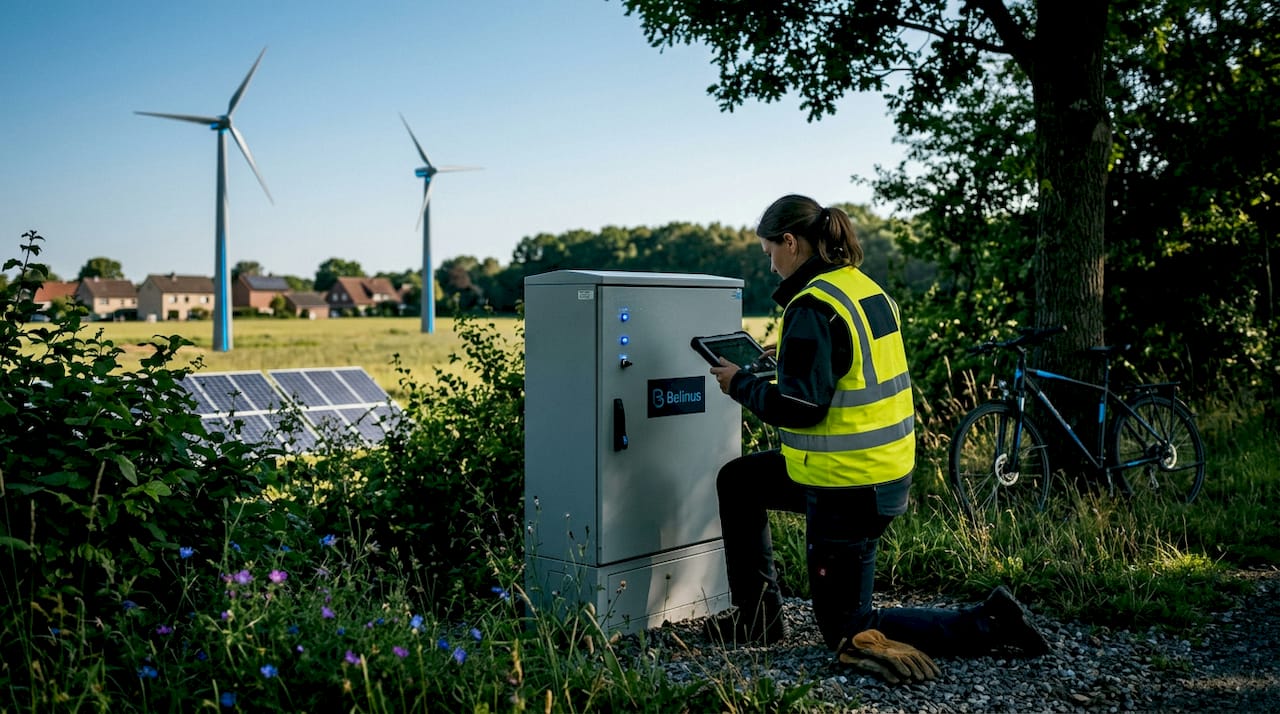
The economics of hybrid energy technology have shifted decisively. Battery storage costs dropped 93% between 2010 and 2025. Solar PV installation costs fell 87% over the same period. Wind came down 55%. These are not marginal improvements. They represent a structural change in the cost of building and operating hybrid power systems.
The practical result: firm hybrid electricity now costs between USD 54 and 82 per MWh, compared to coal and gas alternatives that typically sit above that range once fuel price volatility is factored in. IRENA projects a further 30 to 40% reduction in those costs by 2035.
System type | Current firm cost (USD/MWh) | Projected 2030 cost | Build timeline |
Solar plus battery storage | 54–82 | ~38–57 | 12–18 months |
Wind plus battery storage | 59–94 | 49–75 | 18–30 months |
Wind plus solar plus storage | Lower than individual pairs | Further reduction expected | 18–24 months |
Coal or gas peaker | 80–130+ (fuel-variable) | No decline projected | 36–60 months |
Beyond the headline cost per MWh, hybrid systems generate ongoing savings by optimizing when you draw from the grid. Grid usage optimization shifts your electricity consumption to lower-tariff hours, while stored energy covers peak pricing windows. For large commercial users on dynamic tariff contracts, that alone can represent tens of thousands of euros in annual savings.
Pro Tip: If you are on a dynamic tariff in Germany, Belgium, or the Netherlands, an energy management system (EMS) that optimizes on 15-minute intervals can capture significantly more savings than one that operates on hourly cycles.
4. Environmental performance and EU climate alignment
The environmental case for hybrid systems goes well beyond reducing your own emissions. At a systems level, coordinated expansion of wind, solar, and green hydrogen across the EU can reduce the bloc’s natural gas consumption by more than 60%. For European organizations that need to report Scope 2 emissions to investors or regulators, this is material.
At the operational level, hybrid systems contribute across several environmental dimensions:
Carbon footprint reduction. Replacing grid electricity (which carries an emissions factor) with self-generated renewable power cuts your Scope 2 emissions directly.
Air quality improvement. On-site generation reduces reliance on fossil-fueled backup generators, which are disproportionately polluting.
Noise reduction. Modern battery storage systems are silent. Diesel generators are not.
Spatial efficiency. Floating photovoltaics combined with hydropower, for example, increase PV yield by 2 to 3% due to the cooling effect of water, while using no additional land.
Green hydrogen integration. Surplus renewable generation that cannot be stored in batteries can electrolyze water to produce green hydrogen, providing long-duration storage and a fuel source for hard-to-electrify industrial processes.
For organizations subject to the EU Corporate Sustainability Reporting Directive (CSRD) or setting Science Based Targets, hybrid systems are not just operationally smart. They are increasingly a compliance and reporting requirement.
5. Strategic resilience against geopolitical risk
This benefit does not appear in most system specification sheets, but it is the one that European energy managers discuss in private. Hybrid renewable systems improve resilience and energy security, particularly during geopolitical crises, by reducing dependence on imported fossil fuels.
Germany imported roughly 55% of its natural gas from Russia before 2022. The disruption that followed the invasion of Ukraine produced energy prices that were, in some months, six to eight times their historical averages. Organizations with on-site renewable generation and storage were significantly less exposed.
The strategic logic is straightforward. Once a solar array and battery system are installed, the marginal cost of the energy they produce is near zero. There is no fuel to import, no pipeline to disrupt, and no spot market price to track nervously. For industrial manufacturers, logistics companies, and public sector organizations with long planning horizons, that predictability has genuine strategic value that belongs in your business case alongside the financial projections.
You can explore real-world enterprise storage applications to see how organizations of different sizes have built this resilience into their operations.
6. Comparing common hybrid system configurations for European users
Not all hybrid power systems are built the same. The right configuration depends on your site, your load profile, your grid connection, and your available resources. Here is a practical comparison of the most relevant setups for European conditions.
Configuration | Best suited for | Key advantage | Main trade-off |
Solar PV plus battery | Rooftops, commercial sites, urban | Low upfront for small scale, fast deployment | Limited by roof area and daylight hours |
Wind plus solar plus battery | Rural or peri-urban sites with wind resource | Complementary generation profiles reduce storage need | Higher upfront, requires wind assessment |
Hydropower plus floating PV | Alpine regions, reservoirs | Water cooling boosts PV yield 2–3%, dual land use | Site-specific, regulatory complexity |
Solar plus battery plus green hydrogen | Industrial, long-duration storage needs | Seasonal storage, green fuel production | High initial cost, developing market |
Grid-tied hybrid with EMS | Dense urban, commercial portfolios | Dynamic tariff optimization, arbitrage revenue | Dependent on grid connection quality |
The wind plus solar combination deserves particular attention. Wind combined with solar PV reduces the storage capacity needed to achieve firm power delivery, which directly lowers system cost. In practice, this means a smaller battery bank can cover the same load, improving the economics significantly for medium to large commercial users. You can also explore grid flexibility strategies that build on these configurations.
7. Scalability: hybrid systems that grow with your operations
One underrated hybrid energy technology benefit is the ability to start at a scale that makes financial sense today and expand as your load or budget grows. This is not always possible with conventional generation assets, which often require significant minimum commitments to be viable.
A manufacturing facility might start with a 200 kWh solar plus battery system to cover daytime production loads. As the business adds a shift or expands its floor space, additional PV panels and battery modules can be added to the same inverter and EMS infrastructure. At the utility scale, modular storage systems can be configured in stacked units reaching megawatt-hour capacity with the same underlying technology.
Belinus designs systems across this entire range, from residential Energy Wall installations to commercial and utility-scale storage that scales to MW capacity, all managed through the same centralized EMS platform. That consistency matters because your data, tariff optimization logic, and grid integration settings carry forward as the system grows.
My perspective on what actually matters here
I have spent years watching organizations in Europe approach hybrid energy decisions the wrong way. They start with the technology spec and work backwards to the business case. The organizations that get the best outcomes do the opposite.
The question is not “which system is most efficient?” The question is “what are we trying to protect against?” For a hospital, the answer is outage risk. For a manufacturer, it is margin erosion from energy cost volatility. For a logistics company, it is fleet charging costs rising as EV fleets scale. Once you know what you are protecting against, the right hybrid configuration becomes obvious.
What I have found consistently is that the economics look conservative on day one and significantly better by year five. Battery costs keep falling. Tariff structures keep getting more complex and dynamic, which rewards organizations that invested early in an intelligent EMS. The 30 to 40% projected cost reduction by 2035 is not a distant promise. It is already showing up in current procurement cycles.
The strategic resilience argument also tends to be underweighted in formal business cases because it is hard to put a number on it. But anyone who managed energy procurement in Europe during 2022 and 2023 does not need a number. They lived it. Hybrid systems are not just a sustainability choice. They are a risk management tool that belongs in your operational strategy.
— Marc
How Belinus can help you capture these benefits
Belinus brings together solar PV, battery storage, EV charging, and an intelligent Energy Management System under one platform, designed specifically for the complexity of European energy markets. Whether you are a homeowner looking at a residential Energy Wall, a commercial operator running multiple sites, or an organization exploring utility-scale storage, the team at Belinus builds and manages hybrid energy solutions sized to your actual load and financial targets. The 25-year financial modeling tool launched in January 2026 means you can assess payback periods and savings projections before committing to any hardware.
FAQ
What are the main hybrid energy system benefits for European organizations?
Hybrid energy systems deliver reliable 24/7 power, significant cost savings relative to fossil fuel alternatives, and measurable emissions reductions. They also protect organizations from geopolitical energy supply disruptions, which has proven critical for European energy security.
How do hybrid systems work with the European grid?
Hybrid systems connect to the grid as both consumers and producers. An energy management system optimizes when to draw from the grid (during low-tariff periods), when to discharge stored energy (during peak pricing), and when to export surplus generation. This approach reduces grid costs and can generate arbitrage revenue.
Are hybrid energy systems cost-competitive with fossil fuels today?
Yes. Firm renewable electricity from hybrid solar-plus-storage systems now costs between USD 54 and 82/MWh, which is below or comparable to coal and gas alternatives, with further reductions projected through 2035.
What hybrid system configuration suits small to medium European businesses?
Solar PV combined with battery storage is the most accessible entry point. It deploys quickly, works on most commercial rooftops, and integrates with dynamic tariff programs available in Germany, the Netherlands, Belgium, and other EU markets. Adding wind generation where the site allows it further reduces storage requirements and improves economics.
How do hybrid systems support EU climate and sustainability targets?
Coordinated deployment of wind, solar, and green hydrogen can reduce EU gas consumption by more than 60%, directly supporting the bloc’s energy security and climate goals. At the organizational level, hybrid systems reduce Scope 2 emissions and support compliance with frameworks such as CSRD and Science Based Targets.
Recommended
Comments