Hybrid energy systems explained: smarter power for homes
- Mar 28
- 8 min read

Your solar panels are generating power, the sun is shining, and yet your electricity meter is still spinning because you’re pulling from the grid. Sound familiar? Standard solar-only setups often leave homeowners and businesses exposed to grid dependency, especially at night or during cloudy stretches. Hybrid energy systems change that equation entirely. By combining solar PV, battery storage, EV charging, and intelligent controls into one coordinated setup, you get real flexibility, genuine resilience, and measurable savings. This guide walks you through what hybrid systems are, how they work, how to size them correctly, and what real European installations are actually delivering.
Table of Contents
Key Takeaways
Point | Details |
Maximize self-consumption | Hybrid systems can boost solar self-use to over 65%, reducing bills and reliance on the grid. |
Adapt to climate and usage | Hybrid solutions are flexible, meeting the energy demands of both Southern sunshine and Northern winters with tailored combinations. |
Cut costs, improve resilience | Efficient system design and smart controls deliver up to 60% cost savings and backup power security. |
Real-world results | European homes and businesses report major bill cuts, higher efficiency, and near-zero energy costs in optimized setups. |
What is a hybrid energy system?
A hybrid energy system is not just solar with a battery bolted on. It is a fully integrated platform where multiple energy sources work together under one intelligent controller. Hybrid energy systems combine solar PV, battery storage, wind, or other renewables with optional grid connection and EV charging to provide reliable, sustainable power for homes and businesses.
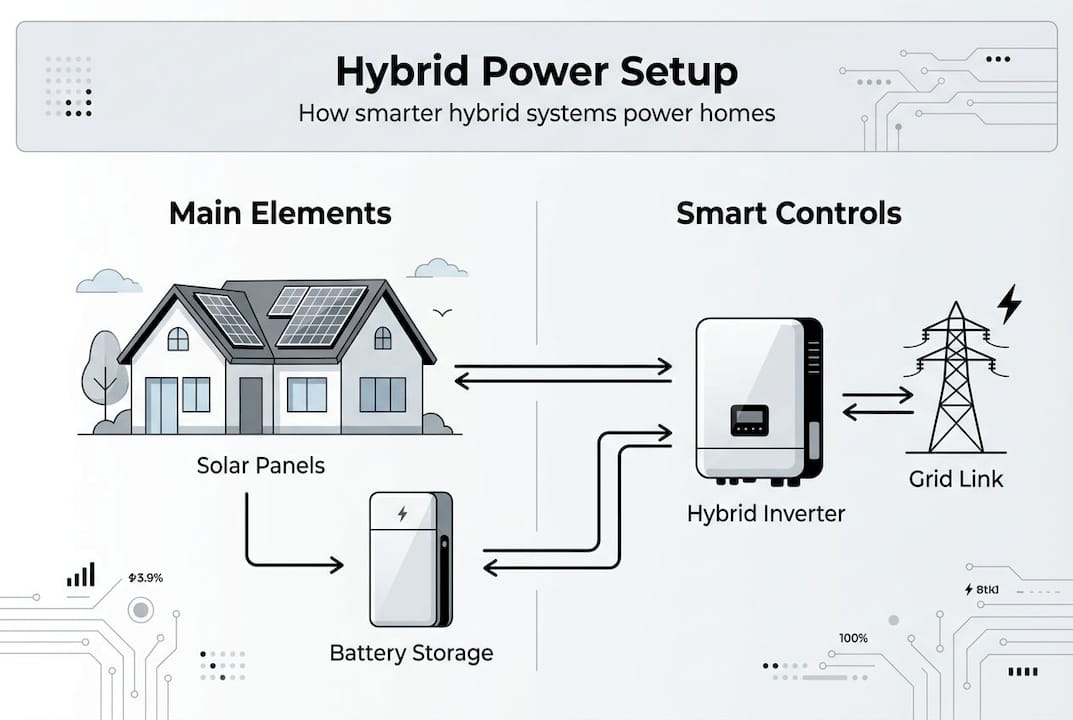
The core components of a typical hybrid system include:
Solar PV panels that capture sunlight and generate direct current (DC) electricity
A hybrid inverter that converts DC to usable alternating current (AC) and manages all energy flows
Battery storage that holds excess energy for use at night or during outages
Grid connection that acts as a safety net or export channel
EV charging as an optional but increasingly common priority load
An energy management system (EMS) that coordinates everything in real time
“The real power of a hybrid system is not any single component. It is the intelligence that connects them all.”
For homeowners exploring solar and battery integration, the shift from a single-source setup to a hybrid one is often the single biggest leap in energy independence. Businesses benefit equally, gaining load flexibility and protection against grid price spikes. If you are just starting out, understanding solar PV for homes is a solid first step before sizing a full hybrid.
How hybrid energy systems work: Key mechanics and flows
Understanding the daily energy flow inside a hybrid system helps you make smarter decisions about sizing and usage. Here is how it works, step by step:
PV panels generate DC power from sunlight throughout the day.
The hybrid inverter converts DC to AC and routes it to your home or business loads first.
Excess power charges the battery bank, storing energy for later use.
EV charging can be set as a priority load, drawing directly from solar before the grid is touched.
At night or during low-generation periods, the battery discharges to cover demand.
Grid export happens last, only when batteries are full and local demand is met.
Smart controllers prioritize self-consumption first, then storage, then grid export, with hybrid inverters achieving conversion efficiencies close to 95% and self-consumption rates up to 80%.

Pro Tip: Most hybrid inverters include an Emergency Power Supply (EPS) mode. During a grid outage, the system automatically islands itself and keeps your critical loads running without any manual intervention.
When you actively work to optimize solar energy use, the combination of smart scheduling and battery dispatch can dramatically reduce what you pull from the grid. Products like the Pixii Home system demonstrate how tightly integrated hardware and software deliver on this promise. For a deeper look at how these technologies interact, the guide on solar, storage and EV efficiency covers the Benelux context in detail.
Design strategies: Sizing, optimization, and control
Getting the sizing right is where most DIY hybrid projects go wrong. Too small a battery and you are back on the grid by midnight. Too large a PV array without adequate storage and you are exporting cheap power instead of using it.
Optimization software like HOMER Pro helps professionals size systems based on load profiles, local renewables potential, and cost targets, calculating metrics like Levelized Cost of Energy (LCOE) and net present value (NPV) before a single panel is installed.
Design factor | What to analyze | Why it matters |
Peak load | Maximum simultaneous demand (kW) | Determines inverter size |
Daily consumption | Total kWh per day | Sizes battery capacity |
Solar irradiance | Local sun hours per year | Sizes PV array |
EV charging load | Charging frequency and kWh/session | Affects battery and grid draw |
Future expansion | EV adoption, heat pumps | Avoids costly retrofits |
Key control strategies that reduce bills and complexity:
Time-of-use (TOU) arbitrage: Charge batteries when grid tariffs are low, discharge when they are high
Peak shaving: Limit demand spikes that trigger higher commercial tariffs
IoT-based real-time management: Respond to live price signals and weather forecasts
Dynamic load balancing: Shift non-critical loads to solar peak hours automatically
Good solar energy management starts with understanding your actual consumption patterns before you commit to hardware. Knowing how to select solar panels that match your roof orientation and shading profile is equally important for maximizing yield.
Practical challenges and edge cases in Europe
Europe is not one climate. A hybrid system designed for southern Spain will underperform badly if installed without modification in Denmark. Here is how regional realities shape design decisions.
Low solar irradiance in Northern Europe during winter means PV alone cannot cover demand. Hybrids in these regions need larger battery banks, wind integration, or combined heat and power (CHP) units to bridge the seasonal gap.
Scenario | Key challenge | Recommended adaptation |
Northern Europe winter | Short days, low irradiance | Larger batteries or wind/CHP hybrid |
Off-grid island property | No grid backup available | Oversized PV plus generator fallback |
High EV usage household | Large daily charging load | DC-coupled EV charging for efficiency |
Grid outage prone area | Reliability critical | EPS mode with dedicated backup circuits |
Pro Tip: DC-coupled EV charging, where solar DC power goes directly to the EV charger before inverter conversion, avoids double conversion losses and can improve overall system efficiency by 5 to 8 percentage points compared to AC-coupled setups.
For businesses with multiple vehicles or high daytime loads, commercial solar for businesses covers how to structure a system that handles both operational demand and fleet charging. Exploring the range of hybrid system options available today shows how modular these solutions have become.
Performance benchmarks and real-world results
Numbers matter. Here is what real European hybrid installations are actually delivering.
Key results from European deployments:
Ireland: Residential PV with a 5.3 kWh battery and EV charger achieved 67% solar self-use
IoT-optimized smart homes recorded a 72% efficiency gain and a 61% reduction in energy bills
Portugal community hybrid projects reached an LCOE of just 0.042 EUR/kWh, one of the lowest recorded for distributed energy
Metric | Standard solar only | Hybrid with battery and EV |
Solar self-consumption | 30 to 40% | 67 to 80% |
Energy bill reduction | 20 to 30% | 40 to 61% |
Grid independence | Low | High |
Backup capability | None | Yes (EPS mode) |
These figures are not outliers. They reflect what well-designed systems consistently achieve when hardware, software, and usage patterns align. Reviewing residential solar options gives you a clearer picture of which configurations deliver the best return for your specific situation. Understanding how to maximize energy savings through active energy management is what separates average results from exceptional ones.
Limitations and common misconceptions
Hybrid systems are powerful, but they are not magic. A few persistent myths are worth addressing directly.
“Set it and forget it”: Hybrid systems need periodic tuning, especially as your consumption patterns or tariff structures change.
“Batteries replace the grid entirely”: Batteries are ideal for day-to-night flexibility and TOU arbitrage. They are not designed for weeks or months of backup.
“My EV can power my house indefinitely”: Vehicle-to-home (V2H) works, but only when the car is parked and charged. Availability is not guaranteed.
“Pure solar is fine in winter”: Pure PV is insufficient in winter across most of Europe without storage or a hybrid source.
“Hydrogen is the easy seasonal fix”: Hydrogen storage involves significant conversion losses and high costs, making it impractical for most residential or small commercial applications today.
“Batteries excel at short-term flexibility and arbitrage. Hydrogen addresses seasonal gaps but comes with high losses and costs that most projects cannot yet justify.”
Hybrids outperform single-source systems in reliability and long-term economics, but they do add complexity and upfront cost. That investment pays off when the system is designed correctly from the start. Navigating solar incentives guidance in your country can significantly reduce that initial barrier.
Get started with smarter hybrid energy solutions
If this guide has shown you anything, it is that the gap between a basic solar setup and a fully optimized hybrid system is where most of the real savings live. The right combination of panels, storage, EV charging, and intelligent control can cut your bills by 40 to 61%, boost self-consumption past 70%, and keep your home or business running even when the grid goes down.

At Belinus, we design and deliver exactly these kinds of integrated systems, from residential Energy Wall storage to commercial-scale utility solutions, all managed through our centralized EMS with 15-minute dynamic tariff optimization. Whether you are starting from scratch or upgrading an existing solar setup, our team can model your full 25-year financial picture before you commit to anything. Start with our solar optimization guide to understand your baseline, then reach out to explore a system tailored to your home or business.
Frequently asked questions
What are the main components of a hybrid energy system?
A hybrid energy system typically includes solar PV panels, a hybrid inverter, battery storage, a grid connection, and optional additions like wind turbines or EV charging. The energy system components work together under a central controller to maximize self-consumption and resilience.
Can hybrid energy systems work off-grid?
Yes, but off-grid hybrid systems require oversized PV arrays, larger battery banks, and often a backup generator to handle periods of low renewable generation reliably.
How much can I reduce my energy bill with a hybrid system?
Well-designed hybrid systems regularly deliver 61% bill reductions in smart home applications and push solar self-consumption to 67 to 80%, depending on your location, system size, and usage habits.
What is the difference between a hybrid and a standard solar system?
A standard solar system exports unused power to the grid. A hybrid system stores it in batteries, uses it for EV charging, and deploys smart energy controls to minimize what you ever need to buy from the grid.
Are hybrid energy systems suitable for businesses as well as homes?
Absolutely. Hybrid systems scale from small residential setups to multi-megawatt commercial installations, offering businesses peak shaving, load flexibility, and reliable energy independence that standard solar simply cannot match.
Recommended
Comments