Optimize Energy Dispatch and Control in Benelux Homes

TL;DR:
Modern Energy Management Systems (EMS) optimize energy use, reducing bills by up to 60 percent.
AI-driven dispatch improves self-consumption and manages edge cases like negative prices and grid congestion.
Retrofitting EMS increases savings, shortens payback periods, and prepares properties for evolving regulations.
Up to 62% lower energy bills — that’s not a marketing claim, it’s a measured result from a Luxembourg household using advanced energy dispatch and control. Most homeowners and business operators in Benelux still rely on conventional energy setups that do nothing more than pass electricity from grid to appliance. No optimization. No intelligence. No savings. This guide breaks down exactly how modern Energy Management Systems (EMS), solar, battery storage, and EV charging work together to put you in control of every watt you produce and consume, and what that means for your bills, your carbon footprint, and your long-term financial returns.
Table of Contents
Key Takeaways
Point | Details |
EMS delivers substantial savings | Advanced dispatch can cut energy bills by up to 62% for Benelux homes and businesses. |
AI-adaptive dispatch outperforms | AI-driven EMS and tariff optimization boost self-consumption and maximize cost efficiency. |
Retrofitting prepares for regulation changes | Installing a brand-agnostic EMS before net metering phase-out ensures ongoing savings and flexibility. |
Edge control is critical | Local edge management handles negative prices, grid congestion, and offline resilience in Benelux. |
Stacked services increase ROI | Combining arbitrage, demand response, and frequency services makes EMS investments more profitable. |
What is energy dispatch and control?
Energy dispatch and control refers to the real-time management of all energy sources and loads in your home or business. Instead of passively consuming whatever the grid delivers at whatever price it charges, a dispatch system actively decides: which source powers which load, when to store energy, when to export it, and when to shift consumption to cheaper hours.
The core tool for this in Benelux is the Energy Management System, or EMS. Think of it as the central brain of your energy setup. It connects your solar panels, battery storage, EV charger, heat pump, and grid connection into one coordinated system. The EMS continuously reads incoming data and makes decisions that your utility company never will.
A modern EMS in Benelux optimizes PV, battery, and EV charging every 15 minutes, responding to live grid signals, day-ahead tariff forecasts, and local weather predictions. That 15-minute cycle matters because dynamic electricity tariffs in Belgium and the Netherlands can swing dramatically within a single day. Without real-time response, you’re leaving money on the table.
Here’s what a well-configured EMS actively manages:
Solar PV output: Decides whether excess generation charges batteries, powers loads, or feeds the grid
Battery state of charge: Charges during cheap or high-generation periods; discharges during expensive or low-generation periods
EV charging schedules: Shifts charging to off-peak hours or when solar surplus is available
Dynamic tariff windows: Tracks hourly and 15-minute price signals to time energy flows
Weather forecasts: Anticipates cloud cover or temperature changes to preposition battery charge
Grid export limits: Respects zero-export regulations where applicable
Solutions like BoltEMS for dispatch demonstrate how flexible these platforms have become, supporting multiple hardware brands under one interface.
Homes and businesses using a well-integrated EMS regularly report 15 to 20% reductions in annual energy costs, with best-case scenarios exceeding 60% when solar and storage are fully stacked.
For smart energy management to work at this level, the EMS must be brand-agnostic. Locking into a proprietary system that only talks to one battery brand or one inverter manufacturer limits your flexibility as the market evolves. Interoperability is not a nice-to-have — it’s essential for protecting your investment. Good energy efficiency strategies always start with hardware-agnostic software at the center.
Key methodologies: Rule-based, AI, and dynamic tariff optimization
Not all EMS platforms work the same way. The control methodology underneath determines how well your system actually performs when market conditions get complicated.
The four core dispatch methodologies used in Benelux today:
Rule-based control: Simple if-then logic. Example: “If battery is above 80%, stop charging.” Fast to configure, but can’t adapt to unexpected events.
AI-adaptive control: Machine learning models that improve over time by analyzing consumption patterns, tariff history, and forecast accuracy.
Model Predictive Control (MPC): Forecasts future conditions and pre-optimizes decisions across a rolling time window. Highly effective for tariff arbitrage.
Peak shaving and load balancing: Reduces grid demand peaks, which cuts capacity charges for commercial users and avoids grid congestion fees.
Feature | Rule-based | AI-adaptive | Hybrid |
Setup complexity | Low | Medium | Medium-High |
Tariff responsiveness | Limited | High | Very high |
Self-learning | No | Yes | Yes |
Best for | Simple setups | Dynamic tariff users | Large commercial sites |
Savings potential | 10-15% | 20-30%+ | 25-40%+ |
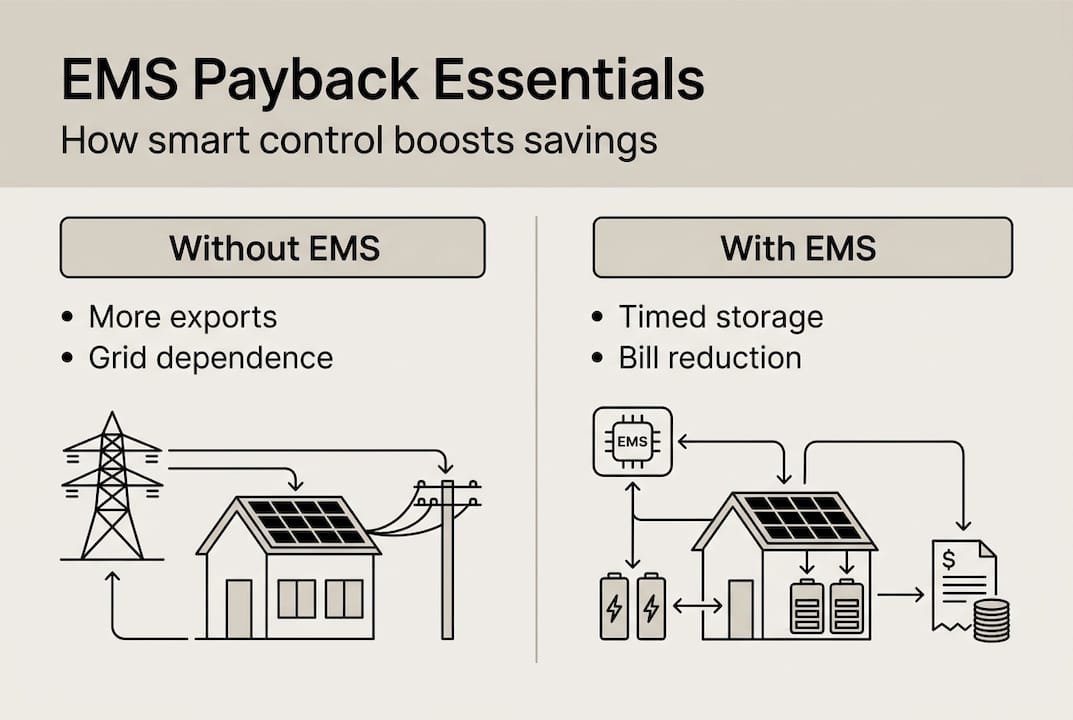
The self-consumption metric is one of the clearest ways to measure EMS effectiveness. A standard home solar setup without EMS typically self-consumes around 30% of its own generation. With AI-driven optimization, self-consumption rises to 60% — meaning twice as much of your solar power stays inside your property rather than being exported at low feed-in rates.
Platforms like iLusmart EMS show how adaptive control translates into practical gains for residential users without requiring a specialist to reconfigure rules every time tariffs change.
Pro Tip: When evaluating EMS platforms, ask specifically whether they use AI or machine learning for forecasting. A rule-based system installed today will struggle to keep up as dynamic tariffs become more volatile in Benelux grids through 2026 and beyond. Check EMS cost savings benchmarks to understand the performance difference before you commit. Also review smart inverter features to ensure your hardware can communicate effectively with whichever EMS you choose.
Edge cases and real-world challenges
Most guides cover the sunny-day scenario. Here’s what actually separates robust dispatch systems from fragile ones.
Advanced edge cases your EMS must handle:
Negative electricity prices: During periods of high renewable generation, grid prices turn negative. A smart EMS triggers battery charging or PV curtailment automatically to avoid paying to export.
Grid congestion: Local network overload can restrict your export capacity. EMS with grid-aware logic reroutes energy to on-site loads or storage instead.
Offline operation: Local gateways must maintain dispatch logic even when cloud connectivity drops. Edge computing matters here.
Zero-export regulation: Some Belgian grid operators enforce strict export limits. EMS must enforce these in real time without manual intervention.
Net metering phase-out: As the Netherlands phases out net metering, storing solar surplus becomes financially essential rather than optional.
Scenario | Without EMS | With EMS | Estimated savings |
Negative price event | Export at loss | Charge battery/curtail | €50-150/event |
Grid congestion period | Forced curtailment | Redirect to storage | 10-20% output recovery |
Net metering phase-out | Revenue loss | Maximize self-consumption | €400-900/year |
Peak demand charge | Full grid exposure | Load shift + shaving | 15-25% demand cost |
The scale of what’s coming makes this urgent. Residential battery capacity in the Netherlands alone is projected to reach 14.6 GWh by 2030, meaning grid-level competition for dispatch value will intensify. Systems without intelligent control will simply be left behind.
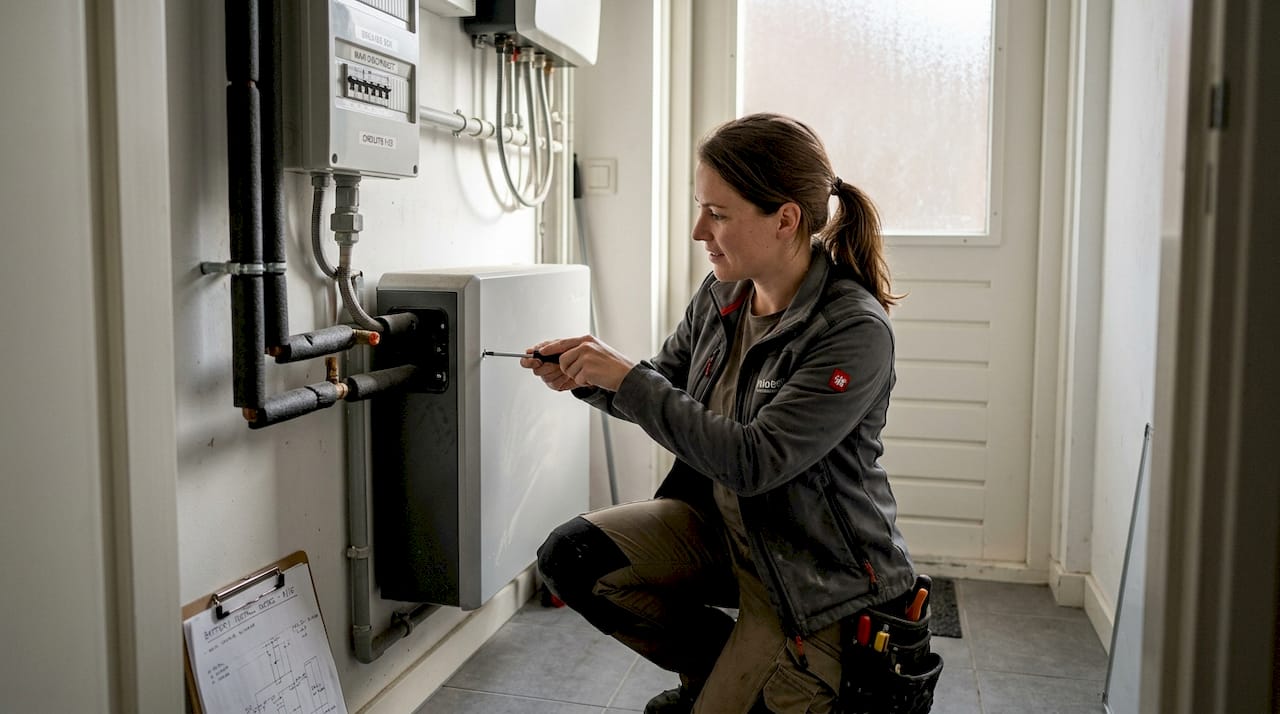
For homeowners reviewing their solar system components or businesses evaluating battery efficiency solutions, retrofitting an EMS to an existing system is often possible and increasingly necessary as Benelux regulations evolve.
Practical benefits and real-world payback
Numbers matter. Here’s what real installations in Benelux are actually delivering.
Documented savings and payback results:
A Luxembourg household with PV, battery, and EMS integration achieved a 62% bill reduction, saving €820 per year
Arvesta in Belgium deployed a 1.5 MW battery system paired with 78 EV chargers and full EMS control, achieving a 5 to 7 year payback period
Typical residential EMS setups deliver 15 to 20% annual cost reductions
Commercial sites stacking arbitrage, demand response, and flexibility services can generate up to €1,750 per year in combined returns
For homes, the math works because EMS removes the inefficiency gap between generation and consumption. Solar panels often produce the most when you’re not home. Without EMS, that surplus goes to the grid at low rates. With EMS and storage, it waits for you.
For businesses, the payback logic is even stronger. Demand charges can account for 30 to 40% of a commercial electricity bill. A well-configured smart EV charging program alone, coordinated through EMS, prevents fleet charging spikes from triggering expensive peak demand fees.
Pro Tip: Don’t evaluate EMS on energy savings alone. Stack the value streams: tariff arbitrage, grid flexibility payments, demand charge reduction, and self-consumption gains. When you add these together, the bill reduction case study numbers that look exceptional become repeatable for your site too.
Payback timelines also compress when you factor in rising energy prices. A system modeled on today’s tariffs will likely outperform projections as prices increase, which makes the financial case more conservative than the actual outcome.
Our perspective: The surprising risks and rewards of dispatch control in Benelux
Most conversations about EMS focus on hardware specs — battery capacity, inverter power, panel efficiency. That’s the wrong lens. The hardware is a commodity. The control layer is where value is created or destroyed.
We’ve seen setups with premium batteries and expensive inverters underperform because the EMS couldn’t communicate across protocols. A system that speaks OCPP to the EV charger but not Matter to the home automation hub is a partially optimized system at best. Protocol interoperability and value stacking are what separate a future-proof installation from an expensive dead end.
The other risk most guides ignore is merchant market exposure. Participating in grid flexibility or energy trading sounds attractive, but in Benelux markets, price volatility cuts both ways. An EMS without robust offline logic and local edge control can execute the wrong dispatch decisions during a connectivity outage and cost you money instead of saving it.
Our honest advice: prioritize renewable grid services compatibility and open protocols over brand names. A brand-agnostic EMS with solid API support will serve you better through regulatory changes than a locked ecosystem, no matter how polished the app looks today.
Explore innovative EMS solutions for Benelux homes and businesses
If the strategies in this guide match what you’re trying to achieve, the next step is finding the right platform and hardware combination for your specific situation. Belinus brings together solar PV, battery storage, EV charging, and an intelligent EMS under one coordinated approach designed specifically for Benelux homes and businesses.
From residential setups with our Solis inverter range and Energy Wall storage to commercial installations with scalable utility storage and grid integration, Belinus energy solutions are built to handle the edge cases, the protocol requirements, and the financial modeling that generic solutions miss. Explore what’s possible for your property and start optimizing your energy dispatch today.
Frequently asked questions
How often does an Energy Management System (EMS) update dispatch decisions?
Most modern EMS in Benelux update every 15 minutes, continuously responding to live tariff signals, weather data, and grid conditions to keep your energy flows optimized.
What is ‘self-consumption maximization’ and why does it matter?
Self-consumption maximization means using more of your own solar and battery power rather than drawing from the grid. An AI-driven EMS can raise self-consumption from 30% to 60%, directly cutting your electricity bill.
How are negative energy prices managed in Benelux?
When grid prices turn negative, a smart EMS automatically redirects energy into battery storage or limits PV export, so you don’t end up paying to send power back to the grid.
Is it better to use rule-based or AI-driven EMS?
AI-driven EMS consistently outperform rule-based systems by using model predictive control to forecast and pre-optimize dispatch decisions. For dynamic tariff environments in Benelux, AI-based optimization delivers noticeably better financial returns.
What payback period can I expect for EMS and battery systems?
Industrial systems like the Arvesta deployment achieve a 5 to 7 year payback while residential setups typically see 15 to 20% annual cost reductions, with best-case scenarios reaching 62% on total energy bills.
Recommended
Comments