Why Optimize Energy Tariffs: A Guide for Homeowners and Businesses
- 3 hours ago
- 8 min read

TL;DR:
Energy tariff optimization involves actively managing rate plans and consumption patterns to minimize electricity costs for households and businesses. Continuous review, automation, and high-resolution data are essential to unlocking substantial savings and adapting to changing tariffs and load profiles. Without proper visibility and ongoing management, organizations miss out on significant financial benefits.
Energy tariff optimization is the practice of actively selecting, managing, and adjusting your rate plans and consumption patterns to pay the lowest possible price for electricity. For homeowners and business managers across Europe, this is not a minor administrative task. Businesses can reduce energy bills by 5–10% through rate reclassification alone, while dynamic tariff users who shift load off-peak save 20–35%. With energy costs representing one of the largest controllable expenses in any household or commercial operation, understanding why you should optimize energy tariffs is the first step toward genuine financial control.
Why optimize energy tariffs: the financial case
The numbers make the argument plainly. Residential users on dynamic tariffs typically save €120 to €350 per year, and some commercial operations report cost reductions of up to 45% after systematic tariff review. These are not theoretical projections. They reflect real load-shifting decisions, rate reclassifications, and consumption timing changes that any organization can replicate.
The financial case becomes even sharper at scale. For a business spending €3 million annually on energy, tariff optimization can save €150,000 to €300,000 every year. That is money that goes directly to margin, not to the grid operator. The mechanism is straightforward: regulated tariffs and ancillary charges make up 33–67% of most energy bills, and network charges alone account for 40–50% of commercial bills. Attacking those components through smarter rate selection and consumption management is where the real savings live.
Here is a snapshot of what tariff optimization typically delivers across different user types:
User type | Optimization method | Estimated annual savings |
Residential | Dynamic tariff + off-peak shifting | €120–€350 |
Small business | Rate reclassification | 5–10% of bill |
Mid-size commercial | Load shifting + demand management | 20–35% of bill |
Large commercial | Full tariff audit + automation | Up to 45% of bill |
Pro Tip: Start with a full audit of your current tariff category before switching rates. Many businesses are billed under the wrong rate class and overpay for years without realizing it.
What are the main types of energy tariffs and how do they compare?
Not every tariff suits every consumption profile. The four main structures you will encounter in European markets each carry distinct advantages and trade-offs.
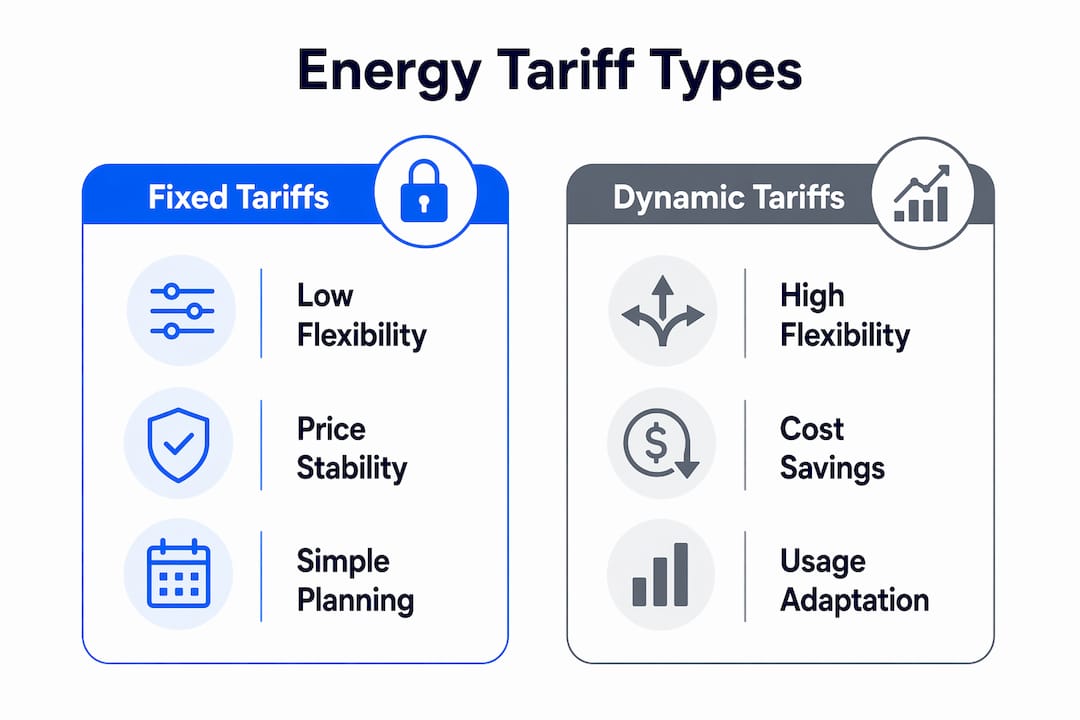
Fixed tariffs lock in a price per kilowatt-hour regardless of when you consume. They offer predictability but eliminate any opportunity to benefit from low wholesale prices. Time-of-use (TOU) tariffs charge different rates at different times of day, typically higher during morning and evening peaks. They reward users who can shift dishwashers, EV charging, or industrial processes to off-peak windows. Dynamic tariffs go further, linking your price directly to real-time or day-ahead wholesale market prices. Dynamic pricing tied to wholesale markets, combined with smart management systems, enables significant cost reductions and supports grid stability. Demand-based tariffs add a charge based on your peak power draw within a billing period, which is common for commercial and industrial users.
Tariff type | Best suited for | Key benefit | Main risk |
Fixed | Low-flexibility households | Price certainty | No savings opportunity |
Time-of-use | Flexible residential, SMEs | Predictable off-peak savings | Requires schedule changes |
Dynamic | Tech-enabled homes, businesses | Maximum savings potential | Requires automation |
Demand-based | Commercial, industrial | Rewards load discipline | Peak spikes are costly |
The right choice depends on how much flexibility you have in when and how you consume energy. A household with a battery storage system and a smart EV charger can extract real value from dynamic pricing. A small office with fixed operating hours and no storage may do better on a well-negotiated TOU rate. The point is that the default tariff your supplier assigned you is almost certainly not the optimal one.
What challenges must be overcome to effectively optimize energy tariffs?
The biggest barrier to tariff optimization is not complexity. It is visibility. Most homeowners and businesses lack access to high-resolution interval data from their meters, which means they cannot see when their consumption peaks, which appliances or processes drive costs, or how their load profile compares to their tariff structure. Without that data, any optimization attempt is essentially guesswork.
Several specific challenges compound this problem:
Peak demand blind spots. Ignoring peak demand charges leads to costly spikes on commercial bills. A single 15-minute period of high demand can inflate your monthly charge significantly, even if your average consumption is modest.
Behavioral overload. Manual participation in price-based demand response imposes cognitive overload on consumers. People cannot realistically monitor wholesale prices and adjust behavior in real time without automated support.
Tariff complexity. European energy bills bundle commodity costs, network charges, taxes, and ancillary services into a single figure. Separating and attacking each component requires expertise most users do not have in-house.
Optimization decay. Savings achieved through a one-time tariff review erode as your load profile changes, tariffs update, and new rate structures become available.
Pro Tip: Install a smart meter or energy monitoring system that captures data at 5 to 15-minute intervals. That granularity is what separates genuine tariff optimization from educated guessing. Belinus’s energy monitoring for homeowners explains exactly what to look for.
How does continuous tariff optimization work and why is it necessary?
Tariff optimization is not a project you complete once and file away. It is an ongoing discipline. One-time tariff reviews are ineffective long-term because tariff structures change, your consumption patterns shift, and new rate options emerge. Without continuous review, savings decay and you drift back toward overpayment.
A practical continuous optimization workflow looks like this:
Establish a baseline. Collect at least 12 months of interval meter data to understand your true load profile across seasons, days, and hours.
Audit available tariffs. Compare your current rate against all available structures from your supplier and the open market, including TOU, dynamic, and demand-based options.
Model the impact. Apply your actual load profile to each candidate tariff to calculate projected costs. This step requires real data, not estimates.
Implement and automate. Switch to the optimal tariff and deploy automation, whether that is a smart thermostat, battery storage, or an energy management system, to capture the savings reliably.
Review quarterly. Tariff updates, seasonal load changes, and new technology integrations all affect your optimal rate. A quarterly review prevents drift.
Flexibility is becoming an economic asset in European energy markets, not just a cost-saving tactic. Organizations that treat tariff management as a continuous process position themselves to benefit from grid services, renewable alignment, and future pricing structures that reward flexible demand. The businesses that review their tariffs once every few years are leaving money on the table every single month.
How can technology and energy management solutions enhance tariff optimization?
Technology closes the gap between knowing your optimal tariff and actually capturing its benefits. Smart meters provide the interval data that makes analysis possible. Energy management systems (EMS) automate the response to price signals, shifting loads and dispatching stored energy without requiring manual intervention. AI-driven systems coordinated with tariff design can optimize energy use at a scale and complexity that manual methods cannot match.
The practical benefits of technology-enabled tariff optimization include:
Automated peak shaving, which prevents demand charge spikes by detecting and curtailing high-draw events before they register on your bill
Battery arbitrage, where stored energy bought at low off-peak prices is used or exported during high-price periods
Renewable alignment, synchronizing consumption with solar generation or low-carbon grid periods to reduce both cost and emissions
Real-time visibility, giving you a live view of consumption, costs, and tariff performance through a mobile app or web dashboard
For homeowners, real-time energy management has been shown to unlock savings of up to 36% by enabling genuinely strategic decisions about when and how to consume. For businesses, the combination of interval data, automated demand response, and flexible energy systems turns energy from a fixed overhead into a manageable, optimizable cost line. HVAC systems, which typically represent 40–60% of commercial energy use, are a prime candidate for tariff-aligned scheduling that reduces peak demand without affecting comfort.
Key takeaways

Optimizing energy tariffs is a continuous, data-driven process that delivers measurable cost reductions for both homeowners and businesses through smarter rate selection, load shifting, and automated demand management.
Point | Details |
Financial impact is immediate | Businesses can save €150,000–€300,000 annually on a €3M energy spend through tariff optimization. |
Tariff type determines strategy | Dynamic and TOU tariffs reward flexible users; demand-based tariffs penalize unmanaged peak loads. |
Visibility is the prerequisite | Without 5 to 15-minute interval data, you cannot identify where savings exist or measure progress. |
Automation makes it reliable | Manual demand response fails at scale; automated systems capture savings consistently without behavioral burden. |
Optimization requires ongoing review | Tariff drift erodes savings over time; quarterly reviews and continuous monitoring preserve the gains. |
The mistake I see most often in tariff management
Most organizations treat tariff optimization as a procurement event. They negotiate a rate, sign a contract, and move on. That approach captures maybe 20% of the available value. The rest sits in the gap between the rate you signed and how you actually consume against it.
What I have found, working with both residential and commercial energy users, is that the behavioral and operational side of optimization is consistently underestimated. A business can switch to a TOU tariff and immediately start paying more if nobody adjusts when the HVAC system ramps up or when the production line runs its highest-draw processes. The tariff is only as good as the consumption behavior behind it.
The other mistake is treating the first optimization as permanent. Load profiles change. A company that adds an EV fleet, installs rooftop solar, or expands its facility has a fundamentally different consumption shape than it did 18 months ago. The tariff that was optimal then is probably not optimal now. I would argue that quarterly tariff reviews should be as standard as quarterly financial reviews for any energy-intensive operation.
The organizations that get this right combine three things: granular data, automated response systems, and a genuine commitment to treating energy as a managed cost rather than a fixed one. That combination is what separates businesses that save 5% on their energy bill from those that save 35%.
— Marc
How Belinus helps you capture real tariff savings
Belinus builds energy management systems designed specifically to make tariff optimization practical and continuous, not theoretical.
The Belinus EMS operates on 15-minute dynamic tariff cycles, automating battery dispatch, peak shaving, and load control in response to live price signals. For homeowners, the Energy Wall G1 integrates directly with the EMS to store cheap off-peak energy and deploy it when rates rise. For commercial users, Belinus scales from small business installations to utility-grade storage with full grid service integration. The native mobile app and web dashboard give you real-time visibility into consumption, costs, and tariff performance. If you are ready to move from reactive billing to active energy cost management, explore Belinus energy solutions and see what continuous optimization looks like in practice.
FAQ
What does it mean to optimize energy tariffs?
Energy tariff optimization means selecting the rate structure that best matches your consumption profile and actively managing when and how you use energy to minimize costs. It includes rate reclassification, load shifting, and demand charge management.
How much can I save by optimizing my energy tariff?
Residential users typically save €120 to €350 per year on dynamic tariffs, while commercial users can reduce bills by 20–45% depending on their load flexibility and the optimization methods applied.
Why is a one-time tariff review not enough?
Tariff structures change annually, and your own consumption profile shifts with new equipment, seasonal patterns, and operational changes. Without continuous review, savings erode through tariff drift and missed rate opportunities.
Do I need smart technology to optimize my energy tariff?
Smart meters and automated energy management systems are not strictly required, but they make optimization significantly more effective. Without interval data, you cannot accurately model tariff performance or automate demand response.
What is the biggest barrier to effective tariff optimization?
The visibility gap is the primary barrier. Most homeowners and businesses lack access to high-resolution interval meter data, which prevents them from understanding their true load profile and identifying where savings are available.
Recommended
Comments