Peer-to-peer energy explained: Unlock trading benefits
- 2 hours ago
- 10 min read

TL;DR:
Peer-to-peer energy trading enables property owners to sell surplus electricity directly to neighbors rather than solely exporting to the grid. It relies on digital platforms that facilitate real-time transactions between prosumers, fostering local energy communities and increased autonomy. However, regulatory, technical, and community management challenges must be carefully navigated to realize its full benefits.
Most property owners with solar panels assume their only option is to use what they generate and ship the rest back to the grid for a modest feed-in payment. That assumption is becoming outdated fast. Surplus renewable electricity can now be sold to nearby consumers rather than just exported to the grid, which means your neighbor’s EV could be charging on energy from your rooftop right now. This article breaks down how peer-to-peer energy trading actually works, what it means for your property, and how to navigate the real barriers standing between you and a smarter energy future.
Table of Contents
Key Takeaways
Point | Details |
Local energy trading enabled | Peer-to-peer energy lets property owners trade electricity directly with neighbors and communities. |
Barriers slow adoption | Regulatory, technical, and grid-related challenges keep most P2P networks in pilot phase across Europe. |
Complement to traditional grid | P2P energy typically supplements, not fully replaces, wholesale grid markets for most users. |
Evaluate platforms carefully | Success depends on robust billing, secure data, and transparent incentives within each P2P system. |
Community benefits matter | Optimizing for both individual and collective gains is key when scaling peer-to-peer energy trading. |
How peer-to-peer energy trading works
Peer-to-peer (P2P) energy is a model where electricity is exchanged directly between participants, coordinated via a digital platform. Think of it as a local marketplace where energy flows between neighbors, businesses, and community facilities rather than routing everything through a centralized utility.
At the core of P2P energy is the concept of the prosumer, someone who both produces and consumes electricity. A homeowner with a rooftop solar array and a battery system is a prosumer. So is a commercial building owner with a large rooftop installation who has surplus output during daylight hours. When prosumers connect through a P2P platform, they can offer their surplus electricity directly to other platform members, often at a price set somewhere between the wholesale rate and the standard retail tariff. Both sides typically benefit compared to the conventional grid arrangement.
The digital platform is the glue that holds the whole system together. It handles real-time or near-real-time metering data, matches buyers with sellers, settles transactions, and communicates with local grid operators. Some platforms operate entirely within a single apartment block or business park. Others span entire neighborhoods or peer-to-peer energy communities across a district. The physical electrons still travel through the conventional grid infrastructure, but the commercial and contractual relationship is between the two participating parties.
Distributed energy in Europe is growing rapidly, and P2P platforms are a natural extension of that trend. Instead of every property owner acting alone, P2P creates a collaborative layer on top of existing infrastructure.
Here is a quick comparison of how energy flows in the traditional model versus a P2P setup:
Feature | Traditional grid export | Peer-to-peer trading |
Who receives surplus energy | Central utility/grid | Nearby prosumers or community members |
Price setting | Fixed feed-in tariff | Negotiated or platform-determined rate |
Settlement speed | Monthly billing | Near real-time or daily |
Community involvement | None | High, by design |
Technology needed | Inverter, smart meter | Inverter, smart meter, P2P platform |
To understand the mechanics clearly, here is how a typical transaction plays out:
A solar homeowner generates more electricity than they need between 10 AM and 2 PM.
The P2P platform detects the surplus via smart metering data.
The platform matches that surplus with a nearby buyer who is currently drawing power.
A transaction is logged, and settlement happens automatically based on pre-agreed pricing rules.
Any unmatched surplus still flows to the main grid under standard export arrangements.
This process can happen within multi-technology energy systems that combine solar, battery storage, and grid connections, which opens up even more sophisticated strategies like storing energy for later peer trades rather than immediate export.
Benefits and challenges for property owners
Now it’s important to weigh the potential benefits for your property against the key challenges to adoption.
The financial case for P2P energy is compelling on paper. Prosumers typically earn more per kilowatt-hour than they would from a standard feed-in tariff, because the trade price sits above wholesale but below retail rates. Buyers pay less than they would to a conventional supplier. The difference gets shared between participants, with the platform taking a small fee. For a residential property owner in Central Europe running a 10 kW solar system, this could mean meaningfully better returns on a system that would otherwise be clipping output or selling cheap.
Beyond pure finances, P2P energy offers something less tangible but equally powerful: energy autonomy. You are no longer just a passive supplier to a faceless utility. You decide who you sell to, at what price range, and under what conditions. That sense of control matters to a growing number of property owners who have invested significantly in solar and storage infrastructure.
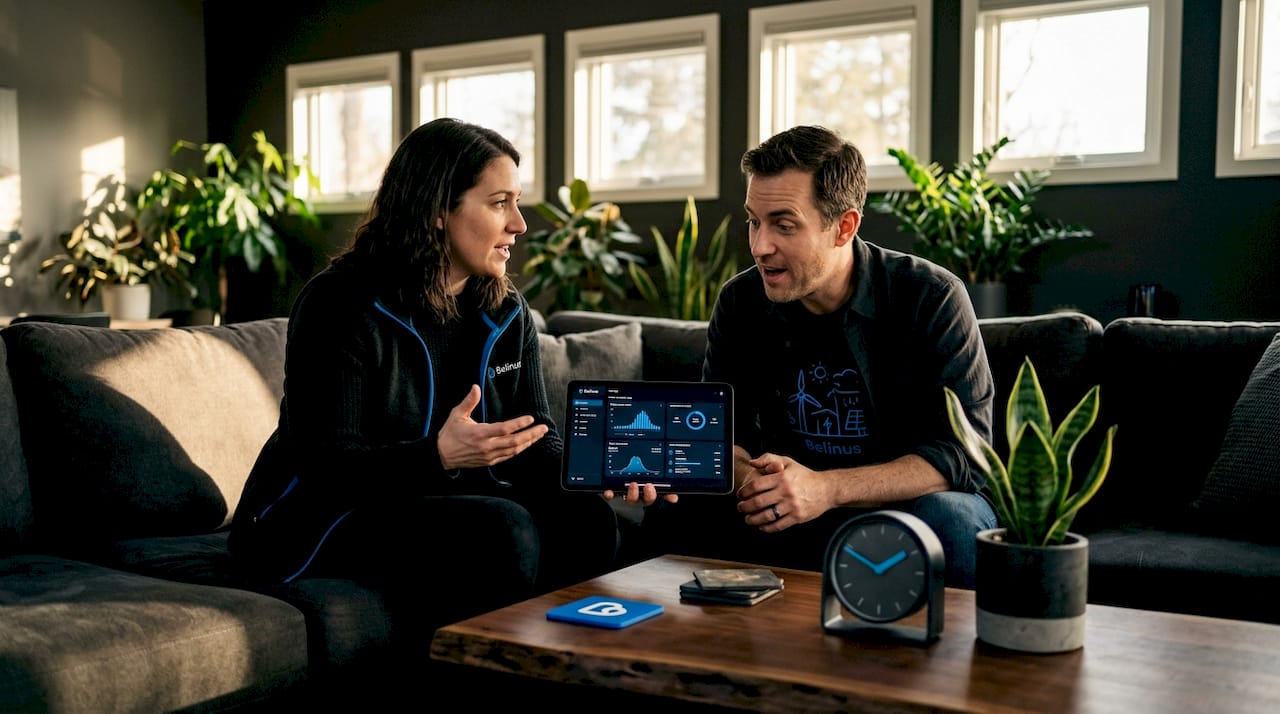
P2P energy is positioned as an enabler for energy communities across Europe, offering empowerment alongside financial reward. Community energy projects built on P2P principles have shown measurable benefits for local resilience and social cohesion, not just energy bills.
However, the barriers are real and should not be dismissed. Most deployments remain trial-based, and development is slow due to political, economic, social, technological, and legal constraints. Regulatory fragmentation across Europe means that what is legally permissible in the Netherlands may be restricted in Spain or France. The rules governing who can sell energy, to whom, and under what licensing conditions differ enormously.
Technical challenges add another layer. Grid congestion, data privacy, and unclear incentives all constrain scaling, and GDPR requirements impose strict rules on how metering data can be collected, stored, and shared. A platform that needs granular 15-minute interval data from thousands of smart meters is treading close to sensitive personal information under European data law.
Optimizing energy trading costs requires a clear-eyed understanding of both platform fees and underlying grid tariffs. It is worth remembering that even in a P2P model, you still pay grid use-of-system charges, because the physical infrastructure is still being used. Those charges can sometimes erode a significant portion of the apparent savings.
Key insight: P2P trading does not eliminate your relationship with the grid. It changes the commercial layer on top of it. Understanding that distinction is essential before committing to any platform.
Fairness is also a legitimate concern. Within a community energy arrangement, prosumers with larger or better-oriented solar installations naturally have more to trade. If platform rules are not designed carefully, wealthier participants with better equipment can capture a disproportionate share of the financial benefits, while lower-income members gain little. Good platform design actively addresses this.
Pro Tip: Before signing up to any P2P platform, ask specifically how settlement is handled when trades do not fully match, how the platform interacts with your grid integration setup, and who is liable if a transaction fails due to a grid event. These questions separate serious platforms from pilot-stage experiments.
Grid flexibility is another area where P2P energy intersects with broader system benefits. Properties with battery storage can participate not just in local trades but also in flexibility services that support grid stability, creating multiple revenue streams from a single installation.
Comparing peer-to-peer energy with conventional grid solutions
To grasp the real impact, it’s useful to see how peer-to-peer energy compares with conventional grid management and trading approaches.
The traditional energy system is built around large, centralized generators selling wholesale electricity to retailers, who then sell it to end consumers at a markup. Prosumers in this model are essentially passive, generating and exporting but having no say in who uses their electricity or at what price beyond a regulated tariff.
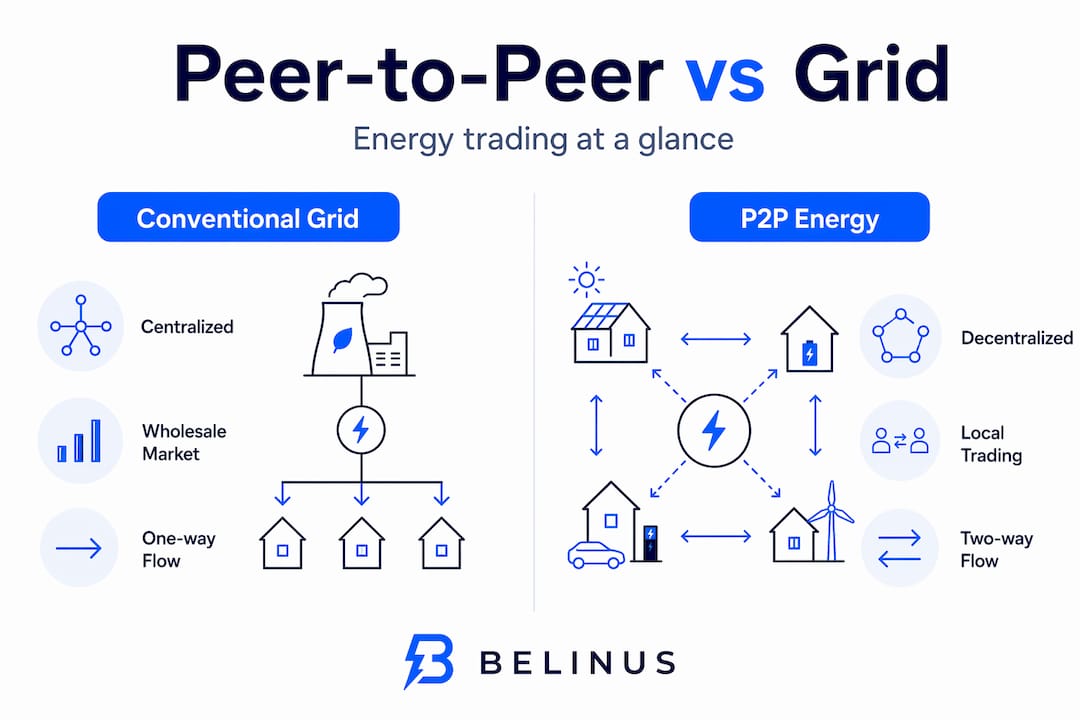
P2P energy operates in a completely different segment. It functions within or alongside existing wholesale structures, not as a replacement for them. Research treats P2P as a complement to organized wholesale markets, with internal community exchanges settling within a regulatory perimeter while still relying on the main grid for balancing.
Dimension | Conventional grid/wholesale | Peer-to-peer energy |
Transaction scale | National or regional | Local or community |
Price mechanism | Market-clearing/fixed tariff | Bilateral or platform-mediated |
Consumer role | Passive buyer or exporter | Active prosumer |
Regulation maturity | Fully established | Emerging, fragmented |
Flexibility services | Utility-managed | Increasingly platform-managed |
Data requirements | Moderate | High, real-time metering essential |
Scaling past pilot projects requires navigating tariff structures and eligibility rules that were designed for the traditional model. Existing network tariffs often treat P2P traders as both generators and consumers simultaneously, which can create double-charging situations that regulators have not yet resolved cleanly.
The practical implication for property owners is that P2P energy works best as a complementary strategy. You maintain your standard grid connection, your feed-in arrangement, and potentially your wholesale electricity supply contracts. On top of that foundation, P2P trading adds a local layer that can improve your overall energy economics without requiring you to exit the conventional system entirely.
Solar wholesale market dynamics also interact with P2P pricing. When wholesale prices are low, P2P prices tend to converge downward too, because buyers will not pay a community premium if grid power is cheap. Understanding these relationships helps you set realistic expectations for P2P returns across different seasons and market conditions. Learning the basics of wholesale PV trading gives you a much clearer frame of reference for evaluating any P2P platform’s pricing promises.
Getting started with peer-to-peer energy trading
If you’re interested in exploring peer-to-peer energy for your property, here are some practical steps to consider.
Settlement mechanics, including metering, data access, and billing, along with grid-integration safeguards and benefit allocation, are the key determinants of whether a P2P arrangement actually delivers. Keep those factors front of mind as you work through the following steps.
Audit your current setup. Know your generation capacity, your consumption patterns, and your existing export/feed-in arrangements. A property generating 8,000 kWh per year with only 40% self-consumption has a very different P2P profile than one with 70% self-consumption.
Confirm your metering infrastructure. P2P platforms require at minimum a smart meter capable of half-hourly or 15-minute interval readings. Many older meters cannot provide this data. Check with your distribution network operator before committing to a platform.
Research local regulatory status. In your country, find out whether P2P energy trading is legally recognized, whether it requires a license, and whether any specific energy community legislation (such as the EU Clean Energy Package’s renewable energy community provisions) applies. This step alone can determine whether P2P is viable for you today or something to plan for in the next two years.
Evaluate available platforms. Look for platforms that clearly disclose their pricing algorithm, their settlement frequency, their data handling practices under GDPR, and their grid balancing responsibilities. A reputable platform will give you a clear answer on all four.
Model the financials honestly. Compare your expected P2P revenue against your current feed-in tariff income, accounting for platform fees and any additional grid charges. A good solar energy management system can provide the historical data you need for this analysis.
Start small and measure. If possible, begin with a pilot arrangement within a small group before committing to a long-term platform contract. Real-world results almost always differ from projections, and an initial test phase lets you identify issues before they have a financial impact.
Pro Tip: Watch for regulatory changes in your country tied to the EU’s Energy Communities directive. Several European governments are actively developing frameworks that will formalize P2P trading rights and potentially unlock government incentives for participating properties. Getting your technical infrastructure ready now means you can move quickly when those rules land.
What most guides miss about peer-to-peer energy
Most articles on P2P energy focus heavily on the technology and the economics, as if the only thing standing between you and a thriving local energy marketplace is a smart meter and the right app. That framing is dangerously incomplete.
The biggest lesson from real-world P2P pilots, including the U2DEMO project in Europe and various university-led trials, is that the social and governance layer is harder to get right than the technical one. Neighbors disagree on pricing fairness. Participants with less solar experience feel confused by settlement statements. Trust breaks down when grid events cause unexpected charges that the platform did not explain in advance. These are not technology problems. They are community problems.
We have seen firsthand how property owners enthusiastically join P2P pilots only to disengage within a few months because the day-to-day management burden exceeded what they expected. A platform that requires you to actively manage bids and offers every day is not suitable for most residential owners. Automation and intelligent grid integration are not optional extras in this context. They are essential infrastructure.
There is also a realism gap between what P2P energy advocates promise and what current grid infrastructure can actually support. Local distribution networks were not designed for bidirectional flows at the scale P2P implies. Until grid operators invest in the monitoring and control systems needed to handle high penetrations of prosumers, congestion will regularly override the best-designed P2P platforms. That is not a reason to avoid P2P. It is a reason to enter it with accurate expectations and a technical setup capable of adapting when conditions change.
The property owners who will do best with P2P energy are the ones who treat it as one component of a broader energy strategy rather than a standalone solution.
Explore innovative energy solutions for your property
Ready to take the next step toward smarter energy trading and management for your property?
Belinus supports residential and commercial property owners across Europe with integrated solar, storage, and energy management solutions designed to work with emerging P2P frameworks. From our intelligent Energy Management System that optimizes at 15-minute intervals to our battery storage and EV charging options, every product is built to help you participate actively in the energy transition.
Explore innovative energy solutions tailored to your property’s unique generation and consumption profile. Whether you are evaluating your first solar installation, expanding an existing system with storage, or actively researching P2P energy community options in your region, our team can help you build a setup that is ready for what comes next. Reach out today to start modeling your options.
Frequently asked questions
What are the main benefits of peer-to-peer energy trading?
Peer-to-peer energy trading offers financial savings, greater energy independence, and the potential to strengthen community ties, with P2P recognized as an enabler for energy communities and local empowerment across Europe.
Are there specific regulatory challenges for peer-to-peer energy in Europe?
Yes, regulatory fragmentation and GDPR data access requirements are major hurdles, with rules varying significantly across countries and regions throughout Europe.
How is peer-to-peer energy trading different from feed-in tariffs?
Unlike feed-in tariffs, P2P trading lets property owners sell surplus renewable energy directly to nearby participants rather than exporting only to the main grid at a fixed, utility-set rate.
What should property owners look for when joining a peer-to-peer energy platform?
They should carefully evaluate settlement mechanics and benefit allocation as key determinants of success, alongside grid integration features and transparent pricing to ensure fair and reliable outcomes.
Recommended
Comments