Role of Battery Technologies in Industrial Energy
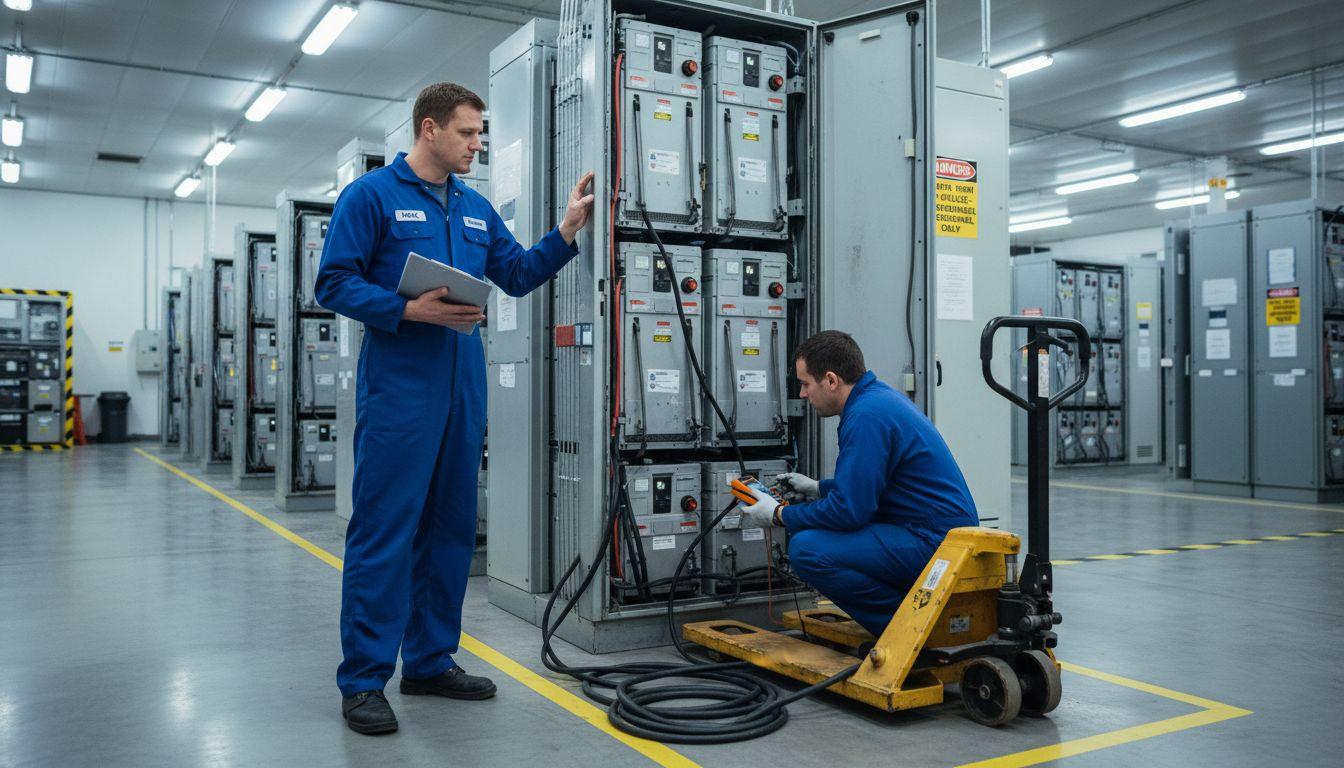
Selecting the right battery technology often feels like a balancing act for energy procurement managers in Central Europe. With increasing pressure for cost efficiency and sustainability, understanding each battery’s unique advantages becomes crucial. This guide explains key industrial battery types and highlights how advanced battery materials now unlock longer lifespans, higher safety, and improved energy efficiency in industrial energy storage applications.
Table of Contents
Key Takeaways
Point | Details |
Advanced Battery Technologies | Industrial battery solutions utilize innovative materials for improved energy density, safety, and lifecycle performance. |
Selection Criteria | Evaluate battery options based on power density, cycle life, and environmental factors to ensure optimal application performance. |
Integration Strategies | Implement comprehensive battery management and design compatibility to enhance energy system efficiency and reliability. |
Risk Management | Address supply chain and regulatory risks through diversification and proactive compliance strategies to ensure stable battery deployment. |
Defining Battery Technologies for Industry
Battery technologies for industrial energy applications represent complex electrochemical systems designed to store and convert electrical energy efficiently. Modern industrial battery solutions leverage advanced materials and chemical architectures to deliver reliable, scalable power storage capabilities across diverse operational requirements. Advanced battery research continues to push the boundaries of energy density, safety, and performance.
Industrial battery technologies fundamentally comprise three core components that enable electrical energy storage and conversion:
Cathode: The positively charged electrode that receives electrons during discharge
Anode: The negatively charged electrode that releases electrons during discharge
Electrolyte: The chemical medium facilitating ionic movement between electrodes
These battery technologies can be categorized into several primary types based on their chemical composition and operational characteristics:
Lithium-Ion Batteries
Lead-Acid Batteries
Nickel-Based Batteries
Flow Batteries
Emerging Graphene Supercapacitor Technologies
Each battery technology offers distinct advantages for industrial applications. Innovative battery materials are enabling longer lifespans, increased safety, and improved energy efficiency across various industrial sectors.
Industrial battery selection requires careful evaluation of specific operational requirements, including power density, cycle life, charging speed, and environmental conditions.
Performance Metrics for evaluating industrial battery technologies include:
Energy density
Power density
Cycle life
Charging efficiency
Temperature tolerance
Cost per kilowatt-hour
Pro tip: Conduct comprehensive performance testing and lifecycle cost analysis before selecting a battery technology for industrial deployment.
Key Types of Batteries and Differences
Battery technologies represent a critical cornerstone of modern industrial energy systems, with each type offering unique performance characteristics and operational advantages. Battery electrode materials fundamentally determine the overall performance, efficiency, and suitability for specific industrial applications.
Industrial battery technologies can be classified into several primary categories based on their chemical composition and performance metrics:
Here’s a comparison of industrial battery types, highlighting key business impacts for each option:
Battery Type | Typical Application | Business Impact | Scalability Benefit |
Lithium-Ion | High-demand manufacturing | Supports rapid expansion | Easily scales for large loads |
Lead-Acid | Stationary storage, backup | Low upfront investment | Suitable for fixed installations |
Nickel-Based | Emergency backup, critical ops | Reliable in harsh environments | Moderate scalability |
Flow Batteries | Grid-level, utility support | Enables long-duration operations | Modular and flexible expansion |
Graphene Supercapacitors | Research, advanced prototyping | Reduces downtime, faster charging | Emerging scalability potential |
Lithium-Ion Batteries
Highest energy density
Rapid charging capabilities
Extensive cycle life
Ideal for high-performance applications
Lead-Acid Batteries
Lower cost
Robust and reliable
Suitable for stationary storage
Limited energy density
Nickel-Based Batteries
Moderate energy density
Good temperature tolerance
Reliable performance
Used in industrial backup systems
Flow Batteries
Scalable energy storage
Long-duration discharge capabilities
Excellent for grid-level applications
Modular design
Performance Differentiators for industrial battery technologies include:
Energy storage capacity
Power output
Charging efficiency
Operational temperature range
Lifecycle durability
Cost per kilowatt-hour
Battery chemistries exhibit nuanced trade-offs between energy density, stability, safety, and operational costs. Modern industrial applications demand sophisticated battery technologies that balance performance, reliability, and economic considerations.
Industrial battery selection requires comprehensive evaluation of specific operational requirements, technological constraints, and long-term performance projections.
Emerging Battery Technologies are continuously expanding the boundaries of energy storage capabilities, introducing advanced materials and innovative chemical architectures that promise improved efficiency and sustainability.
Pro tip: Conduct thorough performance benchmarking and lifecycle cost analysis to select the most appropriate battery technology for your specific industrial energy requirements.
Battery Integration in Industrial Energy Systems
Integrating battery storage into industrial energy systems represents a complex technological challenge that requires strategic planning and advanced engineering capabilities. Utility-scale battery systems play a critical role in optimizing energy infrastructure, providing essential services like peak shaving, load balancing, and grid stability.
Key components of successful battery integration include:
Battery Management Systems (BMS)
Real-time performance monitoring
Health status tracking
Predictive maintenance capabilities
Safety protocol implementation
System Design Considerations
Compatibility with existing infrastructure
Scalability of storage solutions
Thermal management
Power conversion efficiency
Critical Integration Technologies encompass:
Power electronics
Grid synchronization equipment
Thermal regulation systems
Communication and control networks
Battery management systems enable sophisticated monitoring of battery performance, tracking critical metrics such as state of charge, temperature, and operational efficiency. These systems ensure reliable and safe energy storage across diverse industrial applications.
Successful battery integration demands a holistic approach that considers technological, economic, and operational constraints unique to each industrial environment.
Performance Optimization Strategies for industrial battery systems include:
Implementing advanced cooling mechanisms
Developing predictive maintenance protocols
Utilizing intelligent energy management algorithms
Designing modular, scalable storage architectures
Emerging Integration Technologies continue to push the boundaries of battery performance, introducing more sophisticated monitoring, control, and optimization capabilities that promise greater energy efficiency and reliability.

Pro tip: Conduct comprehensive system compatibility assessments and develop detailed integration roadmaps before implementing battery storage solutions in industrial settings.
The following table summarizes how battery integration strategies influence energy system performance:
Integration Strategy | Primary Function | Energy Efficiency Impact | Operational Reliability |
Advanced Battery Management | Real-time monitoring and control | Minimizes losses, improves throughput | Reduces risk of outages |
Modular Storage Design | Flexible, scalable configuration | Optimizes energy use | Simplifies maintenance |
Intelligent Thermal Control | Proactive temperature management | Prevents efficiency drops | Extends battery lifespan |
Predictive Maintenance | Early issue detection | Lowers maintenance costs | Increases long-term stability |
Value Creation: Efficiency, Arbitrage, and Flexibility
Energy arbitrage opportunities represent a transformative strategy for industrial energy management, enabling sophisticated economic optimization through strategic battery storage deployment. By leveraging price differentials and grid dynamics, industrial organizations can create substantial financial value while simultaneously enhancing overall energy system reliability.
Key Value Creation Mechanisms Include:
Electricity Price Arbitrage
Purchase electricity during low-price periods
Store energy in battery systems
Discharge during peak pricing windows
Generate direct economic savings
Grid Flexibility Services
Frequency regulation support
Demand response capabilities
Peak load management
Renewable energy integration
Economic Value Drivers for battery storage systems:
Reduced electricity procurement costs
Enhanced grid stability contributions
Minimized peak demand charges
Improved renewable energy utilization
Industrial battery storage provides multifaceted economic benefits beyond simple energy trading, enabling complex grid services that generate additional revenue streams for forward-thinking industrial organizations.
Strategic battery deployment transforms energy infrastructure from a cost center into a dynamic, value-generating asset.
Performance Monetization Strategies include:
Participating in ancillary service markets
Implementing dynamic pricing arbitrage
Developing advanced forecasting models
Creating multi-revenue stream approaches
Emerging Valuation Models continue to evolve, integrating sophisticated algorithmic approaches that maximize economic potential while supporting broader grid stability objectives.
Pro tip: Develop comprehensive economic models that account for both direct energy arbitrage and indirect grid service values when evaluating battery storage investments.
Financial, Regulatory, and Supply Chain Risks
Battery storage supply chains represent complex ecosystems fraught with multifaceted risks that demand strategic management and proactive mitigation. Industrial energy stakeholders must navigate intricate challenges spanning technological, geopolitical, and economic domains to ensure reliable battery system deployment.
Primary Risk Categories Include:
Raw Material Availability Risks
Limited critical mineral reserves
Geographically concentrated resource extraction
Potential supply chain disruptions
Pricing volatility
Manufacturing Vulnerability Risks
Overreliance on foreign production
Limited domestic manufacturing capacity
Technology transfer constraints
Cybersecurity infrastructure challenges
Key Risk Mitigation Strategies:
Diversifying raw material sources
Developing domestic manufacturing capabilities
Implementing robust cybersecurity protocols
Creating strategic international partnerships
Advanced battery supply chains require comprehensive risk management approaches that integrate technological innovation, policy frameworks, and strategic investment strategies.
Successful risk management in battery storage demands a holistic approach that balances technological capabilities, economic considerations, and geopolitical dynamics.
Regulatory Compliance Considerations:
International trade policy navigation
Safety standard adherence
Environmental sustainability requirements
Technology transfer regulations
Emerging Risk Management Technologies continue to evolve, offering more sophisticated approaches to supply chain resilience and strategic risk mitigation in industrial battery ecosystems.
Pro tip: Develop comprehensive risk assessment models that integrate technological, economic, and geopolitical variables to create adaptive battery storage strategies.
Emerging Trends and Technology Alternatives
Lithium-ion battery technologies continue evolving, with emerging alternatives promising significant improvements in industrial energy storage performance, cost-effectiveness, and sustainability. The current technological landscape demonstrates remarkable potential for transformative advancements across battery chemistry and design approaches.
Emerging Battery Technology Categories:
Next-Generation Chemical Alternatives
Solid-state batteries
Sodium-ion batteries
Flow battery technologies
Lithium iron phosphate configurations
Advanced Material Innovations
Graphene-enhanced electrodes
Silicon-based anode technologies
Ceramic electrolyte systems
Nano-structured battery components
Key Performance Improvement Focus Areas:
Increased energy density
Enhanced charging speeds
Extended operational lifespans
Improved thermal stability
Reduced manufacturing costs
Lower environmental impact
Battery 2030+ innovation roadmap emphasizes transformative research targeting ultra-high-performance, sustainable battery technologies that support clean energy transitions.
Technological innovation in battery systems requires a holistic approach integrating materials science, artificial intelligence, and advanced manufacturing techniques.
Technological Convergence Trends:
AI-driven battery design optimization
Advanced diagnostic and predictive maintenance technologies
Machine learning for performance modeling
Intelligent energy management integration
Emerging Research Domains continue pushing boundaries, exploring revolutionary approaches that could fundamentally reshape industrial energy storage capabilities.
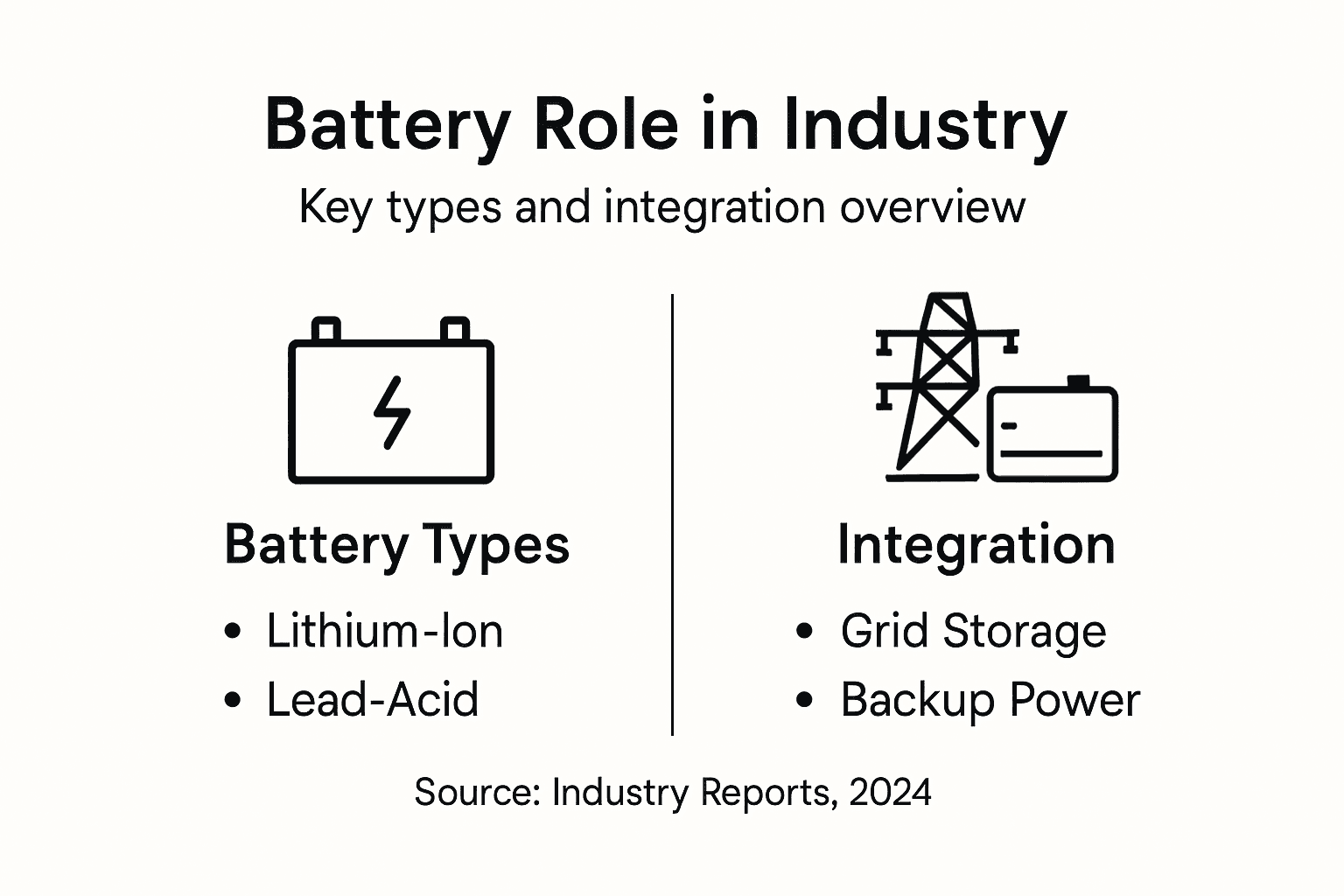
Pro tip: Develop adaptive technology assessment frameworks that continuously evaluate emerging battery alternatives against existing technological benchmarks.
Unlock Industrial Energy Potential with Advanced Battery Integration
The article highlights the essential role of cutting-edge battery technologies like graphene supercapacitors, lithium-ion, and flow batteries in modern industrial energy systems. Key challenges include optimizing energy density, managing lifecycle costs, and integrating battery storage with grid services for peak load balancing and arbitrage. Many industrial operators face complex decisions about battery performance, safety, and scalability while striving to maximize operational reliability and economic value.
Belinus offers comprehensive solutions designed to conquer these challenges head on. Our intelligent Energy Management System seamlessly integrates solar PV, battery storage, and EV charging, delivering:
Scalable utility storage modules exceeding 400 kWh with MW-level expansion potential
Graphene supercapacitor technology for faster charging and longer cycle life
Real-time dynamic tariff optimization paired with battery arbitrage capabilities

Discover how you can transform your industrial energy infrastructure into a flexible, value-generating asset today. Visit Belinus to explore our custom system designs and grid-integrated services. Take the first step to energy resilience and economic efficiency with our fully integrated, intelligent battery solutions.
Frequently Asked Questions
What are the main components of industrial battery technologies?
The main components of industrial battery technologies include the cathode (positively charged electrode), anode (negatively charged electrode), and electrolyte (chemical medium facilitating ionic movement).
How does lithium-ion technology compare to lead-acid batteries for industrial use?
Lithium-ion batteries have higher energy density, rapid charging capabilities, and longer cycle life compared to lead-acid batteries, which are more cost-effective but have lower energy density and limited lifespan.
What performance metrics should be considered when choosing an industrial battery?
Key performance metrics include energy density, power density, cycle life, charging efficiency, temperature tolerance, and cost per kilowatt-hour to ensure the selected battery meets specific operational requirements.
What are the implications of integrating battery systems into industrial energy infrastructure?
Integrating battery systems enhances reliability, supports peak shaving, load balancing, and renewable energy integration, but requires careful planning, system design considerations, and advanced battery management systems.
Recommended
Comments