Smart Home Energy Explained: Savings and Control
- Jan 25
- 14 min read

Choosing smart energy solutions can feel confusing when every device promises savings and control, yet the pieces do not always seem to fit together. For homeowners across Central Europe, connecting solar panels, batteries, and smart meters into one intelligent system does far more than automate your lights. It transforms your house into a responsive home, reducing electricity costs and supporting environmental goals. This article clarifies what smart home energy means, highlighting how integrated energy management delivers lasting benefits through practical technology and smarter consumption.
Table of Contents
Key Takeaways
Point | Details |
Integration is Key | Smart home energy systems maximize efficiency by connecting solar, batteries, and EV charging for coordinated operation. Each component must communicate to optimize energy use and savings. |
Manage Consumption Smartly | Use energy management systems to monitor and analyze real-time data, shifting your consumption to benefit from dynamic pricing and reduce costs significantly. |
Proper System Sizing | Avoid undersizing your solar and battery systems by analyzing seasonal variations and potential growth to ensure long-term viability and savings. |
Understand Dynamic Tariffs | Familiarize yourself with your utility’s dynamic tariff structure to optimize energy use and lower your payback period on investments in smart home energy systems. |
What Smart Home Energy Actually Means
Smart home energy isn’t about gadgets for gadgets’ sake. At its core, it’s about connecting your home’s energy systems so they work together intelligently, responding to real-time conditions and your actual needs. Think of it like upgrading from a manual thermostat you adjust by hand to a system that learns your patterns, checks weather forecasts, and automatically adjusts heating or cooling without you lifting a finger. Digitally connected and automated residences that integrate devices such as lighting controls, heating systems, and energy storage create the foundation for what makes a home “smart.”
The real power comes from three layers working together. First, you have the devices themselves: smart meters that show you exactly how much energy you’re using right now, battery storage systems that hold excess power from your solar panels, and intelligent inverters that decide when to use stored energy versus when to draw from the grid. Second, you need communication between these devices, so a battery knows when solar production is peaking and can charge accordingly. Third, and most importantly, you need advanced energy management systems using predictive algorithms that optimize when you consume energy based on factors like price fluctuations, grid demand, and your household patterns. In Central European homes specifically, this integration becomes critical because of variable renewable generation and dynamic electricity pricing that rewards smart consumption.
For Central European homeowners, the practical value is immediate. Your system learns that charging an electric vehicle during off-peak hours saves 30-40 percent compared to peak timing. Solar energy generated during midday gets stored in batteries instead of being exported at low rates, then used during evening consumption peaks. Smart heating systems understand that your house stays warmer longer if they heat before temperature drops rather than reacting after it falls. The system also adapts to your behavior, recognizing that you’re away on weekends and adjusting expectations accordingly. Understanding these residential energy storage applications and their household impact helps clarify why integration matters more than having individual smart products scattered around your home.
Pro tip: Start by measuring your current energy patterns with a smart meter before adding storage or solar, since understanding your actual consumption profile (not your assumptions about it) prevents oversizing expensive equipment and accelerates payback periods.
Types of Home Energy Systems Compared
Not all home energy systems are created equal, and what works brilliantly for your neighbor might fall flat for your situation. The main division comes down to how your system connects to the grid and what technologies it combines. On one end, you have grid-connected solar systems that send excess power back to the utility and draw from the grid when you need it, offering simplicity but limited independence. On the other end sit off-grid systems with substantial battery backup that disconnect entirely from utility infrastructure, providing autonomy but requiring careful management and larger upfront investment. Most Central European homeowners fall somewhere in the middle with hybrid systems that blend solar generation, battery storage, and grid connection, giving you the flexibility to use stored energy during peak price periods while maintaining a safety net when your battery depletes.

The technical difference matters because it determines your actual savings and control. A basic solar-only system without storage sends midday power to the grid at low wholesale rates, then forces you to buy evening electricity at retail prices. That’s like selling apples for 10 cents and buying them back for a dollar. Adding battery storage transforms how you capture value from your solar investment. Your batteries absorb that midday generation and discharge during expensive evening hours, dramatically improving your return on investment. Beyond storage, home energy management systems optimize every decision, automatically shifting consumption away from peak periods, coordinating when your heat pump runs, and managing electric vehicle charging to minimize costs. Some systems add combined heat and power units that generate both electricity and usable heat simultaneously, which proves especially valuable in colder European climates where heating represents your largest energy expense.
For Central European homes specifically, hybrid systems with integrated management dominate because they address the region’s unique challenge of seasonal variation. Summer generates abundant solar, but winter demands are highest when generation plummets. A properly designed system uses summer overproduction to charge batteries and shift consumption patterns, then draws stored energy strategically through winter. The comparison becomes straightforward: solar-only costs less initially but delivers lower returns; battery storage increases complexity and cost but multiplies your savings; integrated management adds another layer of intelligence that orchestrates everything automatically based on real-time pricing and grid conditions. Your choice depends on your budget, roof space, consumption patterns, and how much control you actually want to exercise versus having automation handle it.
Here’s a quick comparison of major home energy system types and their benefits:
System Type | Upfront Cost | Energy Independence | Complexity Level |
Solar-only | Lowest | Minimal | Simple to operate |
Hybrid (solar+battery) | Moderate to high | Flexible, seasonal | Moderate, some setup |
Off-grid | Highest | Full, grid-free living | Complex, active management |
Hybrid with EMS | High | Optimized, automated | Advanced intelligence |
Pro tip: Compare systems using your actual annual consumption data and local electricity rates rather than generic calculator estimates, since Central European pricing structures and seasonal patterns differ dramatically from broader European averages and can shift your optimal system configuration entirely.
How Energy Management Systems Work
Energy management systems sound complicated until you realize they operate on a simple principle: they watch everything, learn your patterns, and automatically make dozens of small decisions every day to save you money. At their core, these systems gather real-time data from sensors throughout your home, analyzing consumption patterns second by second. A smart meter tracks overall usage, temperature sensors monitor each room, inverters report solar production, and battery monitors display storage levels. This constant stream of information flows into a central intelligence platform that processes it using algorithms to answer one question repeatedly: should we consume energy now, store it, or wait for a better moment?
The actual mechanics involve three interconnected layers working in parallel. First comes real-time monitoring, where intelligent control systems continuously track consumption patterns and adjust heating, lighting, and appliance operation based on immediate conditions. Your heat pump doesn’t just turn on when temperature drops; it preheats during cheap off-peak hours before you need warmth. Second is predictive intelligence, where the system forecasts your consumption for the next hours or days, anticipates solar generation based on weather data, and calculates optimal charging and discharging times for your battery. Third comes dynamic response, where your system automatically reacts to external signals like wholesale electricity prices shifting or grid operators requesting load reductions during peak demand. When electricity prices drop at 2 AM because wind generation peaks, your system can automatically charge your battery or heat water storage without you doing anything.
Energy management systems coordinate consumption, generation, and storage by integrating multiple technologies into a unified decision-making framework. Your solar panels, battery system, electric vehicle charger, heat pump, and traditional appliances stop operating independently and start communicating. When your car arrives home with a depleted battery and solar is generating abundantly, the system charges it immediately. When evening approaches and consumption rises but solar production falls, the system has already shifted loads forward to midday and positioned your battery to discharge strategically. For Central European homes specifically, this coordination becomes critical because of volatile electricity pricing and seasonal challenges. A system without intelligence might charge your battery at expensive evening rates, then discharge it uselessly at midnight. A smart system learns your actual patterns, understands that Tuesday evenings see higher consumption than Sundays, and adapts its strategy accordingly.
The practical result is that you stop thinking about energy management entirely. You set your comfort preferences once, and the system handles optimization continuously, responding to price signals, weather changes, and grid conditions that you never see. Your dashboard shows you what happened, but the algorithm decides what happens next.
Pro tip: Request detailed consumption data from your current utility provider before installing an energy management system, since systems that understand your baseline patterns adapt faster and deliver savings within months rather than requiring a full year of learning.
Integrating Solar, Batteries, and EV Charging
When you integrate solar, batteries, and EV charging into a single coordinated system, something magical happens: your expensive appliances start working together instead of competing for resources. Without integration, your electric car might charge at 7 PM when electricity costs peak, while your solar panels generated free power at noon that you exported to the grid for pennies. Your batteries might discharge uselessly at midnight instead of waiting for tomorrow’s expensive afternoon hours. Integration fixes all of this by creating a unified strategy where every component understands what the others are doing and coordinates timing decisions. Solar combined with battery storage achieves cost optimization by balancing investment costs against generation benefits, but add EV charging into the mix and the equation becomes exponentially more valuable because you suddenly have a massive, controllable load that you can shift to match solar generation.
The mechanics of integration center on intelligent load shifting and storage orchestration. When solar generates peak power at midday, your system faces a decision tree: charge the battery, charge the electric vehicle, heat water for later use, or export to the grid. A smart system evaluates electricity prices, your vehicle’s departure time, battery state, weather forecasts, and upcoming consumption patterns, then makes the optimal choice. If your battery is already full and your car doesn’t need charging until evening, exporting to the grid might be sensible. If your battery is depleted and you plan to drive during expensive peak hours tomorrow, charging immediately becomes logical. The system makes these micro-decisions thousands of times daily, continuously optimizing your energy flows. For Central European homes with volatile pricing and significant seasonal variation, this coordination becomes critical. Summer solar abundance can charge your battery and vehicle simultaneously, while winter requires careful rationing of stored energy across competing needs.
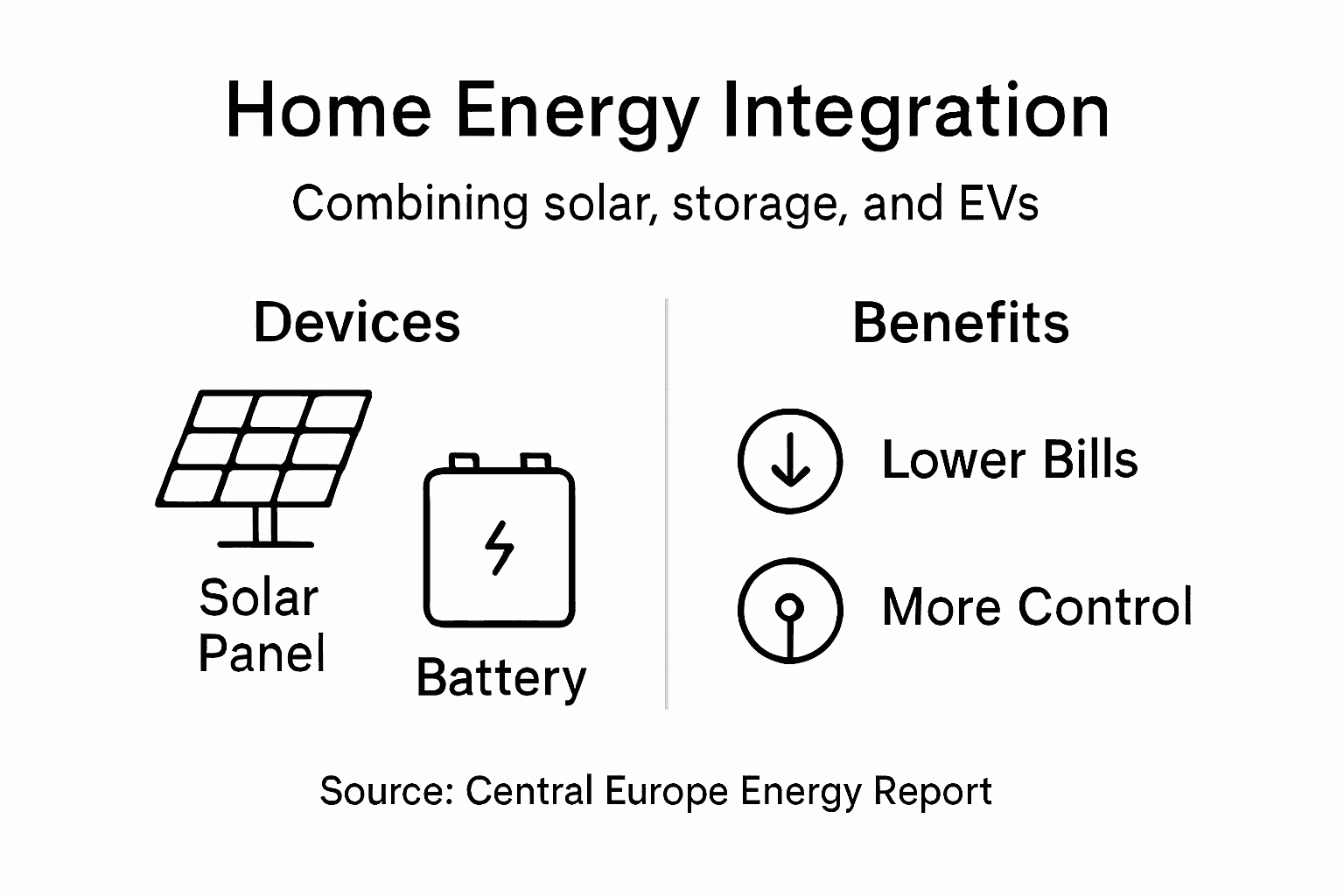
Bi-directional EV chargers unlock a new dimension by allowing your vehicle battery to supply power back to your home during peak demand or high-price periods. Your car becomes a mobile energy storage system that arrives home charged and can discharge power overnight when electricity is expensive, or during grid emergencies when the system needs support. Demonstration projects across Central Europe show this technology reducing household costs while enhancing grid stability. The integration of solar generation, stationary battery storage, and bi-directional EV charging transforms your home from a simple energy consumer into an active participant in the energy market. Your system optimizes self-consumption of solar power, reduces peak demand charges, and positions you to benefit from wholesale price fluctuations that most homeowners never notice.
Pro tip: Ensure your EV charger supports bi-directional charging capability before installation, since retrofitting existing chargers to enable vehicle-to-home functionality proves expensive and disruptive, while selecting the right charger initially unlocks substantially greater long-term savings.
Financial Payback and Dynamic Tariffs in 2026
The math on smart home energy systems used to be simple: divide the cost by annual savings, get your payback period, done. But that calculation broke in 2024 when dynamic electricity tariffs went mainstream across Central Europe. Now the financial picture has become far more complex and far more favorable for homeowners willing to adapt their behavior. Dynamic tariffs mean electricity prices fluctuate hourly based on wholesale market conditions, and the spread between cheapest and most expensive hours has widened dramatically. Early adopters with smart energy management systems have captured substantial portions of that spread, while those using static tariffs missed it entirely.
Understanding how dynamic electricity tariffs fluctuate based on hourly prices transforms your payback calculations completely. In traditional static pricing, your kilowatt-hour costs roughly the same every hour, so timing consumption doesn’t matter much. With dynamic tariffs, the same kilowatt-hour might cost 8 cents at 3 AM when wind generation peaks, but 32 cents at 6 PM when everyone cooks dinner. That 4-fold price difference creates enormous incentives to shift consumption. An automated energy management system that simply charges your EV battery at cheap hours instead of expensive ones can save 25 to 34 percent on transportation electricity alone. Add battery storage that captures cheap midday solar or wind power and discharges during expensive evening peaks, and savings accelerate further. For a Central European household spending 1,200 euros annually on electricity, dynamic tariff optimization with smart management can save 300 to 400 euros yearly, completely changing your payback equation.
Payback periods for integrated systems have compressed substantially because of this dynamic tariff revolution. Five years ago, a residential solar plus battery system might have required 12 to 15 years to pay back through static electricity savings. Today, that same system combined with smart management and dynamic tariff participation achieves payback in 7 to 10 years, with the financial advantage continuing for another 15 to 20 years beyond payback. The difference isn’t that equipment became cheaper, though costs have declined. The difference is that smart systems now capture value streams that didn’t exist before: arbitrage opportunities from price spreads, demand response compensation from grid operators, and optimized self-consumption timing. Your system doesn’t just save money by using less energy; it makes money by using energy at the right moments.
Central Europe’s energy pricing landscape in 2026 presents specific advantages. Countries like Germany, Austria, and Czechia have mandated smart meter installations and launched dynamic tariff offerings through major utilities. Poland and Hungary are transitioning rapidly toward dynamic pricing. This regional focus creates conditions where smart home systems deliver maximum financial benefit. A homeowner in Budapest with a solar plus battery system and smart EV charger operating under dynamic tariffs captures more value than an identical system in a region still using static pricing. Additionally, government incentives across Central Europe for battery storage and solar installation reduce upfront capital requirements, further accelerating payback. These incentives vary by country and year, but they effectively reduce the financial burden you carry through the early years when payback timelines matter most.
See how dynamic tariffs transform financial returns for smart homes:
Era | Payback Period | Main Savings Source | Required Tech |
Static Pricing (2020) | 12-15 years | Self-consumption only | Solar, optional battery |
Dynamic Tariffs (2026) | 7-10 years | Smart shifting, arbitrage | EMS, battery, dynamic metering |
Incentivized Era | 5-8 years | Subsidies plus smart savings | Advanced EMS, solar, storage |
Pro tip: Request a detailed breakdown of your utility provider’s dynamic tariff structure before finalizing system design, since pricing volatility patterns vary significantly by region and season, and systems optimized for your specific tariff curve deliver 15 to 25 percent greater savings than generic designs.
Common Challenges and Real-World Mistakes
Smart home energy systems sound perfect in marketing presentations, but real-world deployment reveals stubborn problems that catch homeowners off guard. The most common mistake is catastrophic undersizing. A homeowner calculates their average daily consumption, divides by peak sun hours, and installs exactly that much solar capacity. Then summer arrives, clouds disappear for two weeks, and suddenly they’re exporting nothing while buying expensive grid power. Meanwhile, their undersized battery can’t store enough to cover evening demand, leaving them dependent on the grid during expensive peak hours. Proper sizing requires analyzing worst-case scenarios, seasonal variation, and growth potential, not just average consumption. Another frequent error involves poor component integration. You buy a solar system from one installer, add a battery from another vendor, then try to add an EV charger later. The three systems speak different languages, can’t communicate, and function independently instead of coordinated. Systems with inadequate integration between components fail to capture the synergies that make smart energy systems economically viable.
User behavior represents a challenge that technology alone cannot solve. Research highlights overreliance on technology without considering actual user behavior, revealing that many homeowners install sophisticated systems then ignore them, continuing consumption patterns identical to before. A heat pump with automated scheduling only saves money if it runs when electricity is cheap. An EV charger that can shift charging to midday solar generation only provides value if you let it control charging times instead of manually charging whenever convenient. Some homeowners resist automation because they distrust algorithms, prefer manual control, or simply lack time to learn new systems. This requires genuine user education before installation, not a quick how-to guide afterward. Data privacy and cybersecurity anxieties also prevent adoption. Connected devices collecting consumption data throughout your home raise legitimate concerns about surveillance, data breaches, and information misuse. Systems require transparent privacy policies, robust encryption, and regular security updates that many providers struggle to deliver consistently.
Interoperability challenges persist despite standardization efforts. Different manufacturers use different communication protocols, cloud platforms, and user interfaces. A smart meter from your utility might not communicate directly with your battery, requiring a separate aggregation platform. Your EV charger may use a different software platform entirely. This fragmentation creates integration costs, complicates troubleshooting, and limits system optimization. Central European homeowners selecting components face a bewildering array of standards: some devices follow KNX protocols, others use MQTT, still others proprietary systems. Getting these to work together often requires custom integration work that adds cost and complexity. Additionally, grid variability and unpredictability create technical challenges. When thousands of homes simultaneously charge EVs or discharge batteries in response to price signals, grid operators struggle to predict and manage those loads. Inadequate system sizing or poor coordination can destabilize local grids instead of stabilizing them.
Pro tip: Hire an integrator experienced with multi-component systems rather than coordinating separate installers yourself, since proper system integration requires technical knowledge of communication protocols and software platforms that most individual installers lack, and integration mistakes often cost more to fix than professional design costs upfront.
Unlock True Savings and Control with Integrated Smart Home Energy Solutions
The challenges outlined in “Smart Home Energy Explained” highlight the need for a truly integrated approach to home energy management. If you struggle with maximizing solar utilization, avoiding expensive peak pricing, or coordinating your EV charging with battery storage, you are not alone. The article emphasizes that smart energy systems must combine real-time monitoring, predictive algorithms, and seamless device communication to achieve meaningful savings and autonomy.
Belinus offers a comprehensive solution tailored for homeowners demanding both financial return and convenience. Our intelligent Energy Management System connects solar PV, advanced battery storage like the Energy Wall G1 graphene supercapacitor, and smart EV chargers such as the ETAP Pro fleet management model. This integration enables your home to automatically optimize for dynamic electricity tariffs and seasonal variations common in Central European markets. Learn more about how our system delivers real-time optimization and long-term financial modeling at Belinus official site.

Take control of your energy future now by exploring our residential solutions that turn smart home energy concepts into everyday reality. Discover how Belinus can help you overcome costly mistakes like undersizing or poor component integration with a unified platform built for peak efficiency. Visit Belinus solutions and start designing your effortless energy-smart home today.
Frequently Asked Questions
What does smart home energy management entail?
Smart home energy management refers to integrating and intelligently coordinating devices in your home, such as smart meters, energy storage systems, and heating controls, to optimize energy usage and savings.
How can I save money with a smart home energy system?
You can save money by using smart energy management systems that shift energy consumption to off-peak hours, utilize stored energy effectively, and capitalize on dynamic electricity pricing to minimize costs.
What are the benefits of integrating solar energy, batteries, and EV charging?
Integrating these systems allows for optimized energy use, where your solar generation can be utilized effectively for charging vehicles or powering your home, reducing reliance on grid energy and lowering overall costs.
How do dynamic electricity tariffs impact residential energy savings?
Dynamic electricity tariffs can significantly lower your energy costs by incentivizing users to shift their consumption to cheaper hours, enabling homeowners to maximize savings through smart energy management systems.
Recommended
Comments