The Role of Automation in Energy: 2026 Guide
- 3 hours ago
- 8 min read

TL;DR:
Automation in energy systems uses AI and real-time control to optimize power production, distribution, and consumption. It enhances operational efficiency by over 20%, reduces outage durations, and delivers significant financial returns, especially in renewable integration. However, reliance on cloud connectivity and energy-intensive AI training pose challenges, which can be addressed through local-first architectures and low-carbon AI solutions.
Automation in energy systems is the integration of AI-driven, real-time control and decision-making technologies that optimize energy production, distribution, and consumption across the full value chain. The industry term for this discipline is automated energy management, and its scope now extends from utility-scale grid operations to residential solar and EV charging. In 2026, the role of automation in energy has moved from pilot programs to core infrastructure. Advanced distribution management systems (ADMS), distributed energy resource management systems (DERMS), and agentic AI are no longer experimental. They are the operational backbone of utilities and energy businesses that intend to remain competitive as renewable penetration accelerates.
What operational efficiencies does automation bring to energy management?
Embedding AI-driven automation into utility workflows improves operational efficiency by more than 20% and drives 30–50% improvements in speed, cost, and quality across the energy value chain. That figure is not a projection. BCG documents it as a current benchmark for utilities that have moved beyond isolated automation pilots to system-wide AI integration.
The operational gains break down into three measurable categories:
Outage management: Automated fault detection and self-healing grid protocols reduce outage duration by 15–30%, cutting both customer impact and regulatory exposure.
Grid coordination: AI-assisted dispatch and scheduling cut manual grid coordination by up to 70%, freeing control room staff to focus on exception handling rather than routine switching.
Compliance and reporting: Automated data pipelines replace manual data collection for regulatory submissions, reducing reporting errors and cycle times.
The financial case is equally clear. Schneider Electric’s Forrester-commissioned study found that advanced distribution management systems deliver a 184% ROI over five years, producing $61.8 million in total benefits against $21.8 million in implementation costs. That translates to $40 million in net benefits, driven primarily by automating manual field tasks and improving control room operations. For any utility evaluating a grid modernization business case, that ratio is a credible floor, not a ceiling.
Pro Tip: Start automation where manual coordination is highest. Grid switching and outage response workflows typically deliver the fastest measurable ROI and build internal confidence for broader rollout.
How does automation support renewable energy integration?
Renewable energy integration is the hardest operational problem in modern grid management. Solar and wind generation is intermittent by nature. Traditional batch-based control systems, which update grid state every 15–30 minutes, cannot respond fast enough to manage the volatility that high renewable penetration introduces.
The solution is an architectural shift. Energy systems must move from batch-based to event-driven, real-time data flows to manage intermittent renewables effectively and reduce balancing costs. Event-driven automation with millisecond-level responses captures grid transients, price spikes, and power quality events that traditional polling methods miss entirely. The practical difference is the gap between a grid that stabilizes itself in seconds and one that relies on operator intervention measured in minutes.
The table below shows how automated grid operations compare to traditional approaches across the dimensions that matter most for renewable integration:
Dimension | Traditional Grid Operations | Automated Grid Operations |
Data update frequency | 15–30 minute batch cycles | Millisecond event-driven triggers |
Renewable balancing | Manual dispatch adjustments | Automated DERMS with real-time DER data |
Peaker plant reliance | High, used for demand spikes | Reduced via storage dispatch and demand response |
Fault response time | Minutes to hours | Seconds via self-healing protocols |
Weather data integration | Periodic manual input | Continuous automated feed into dispatch logic |
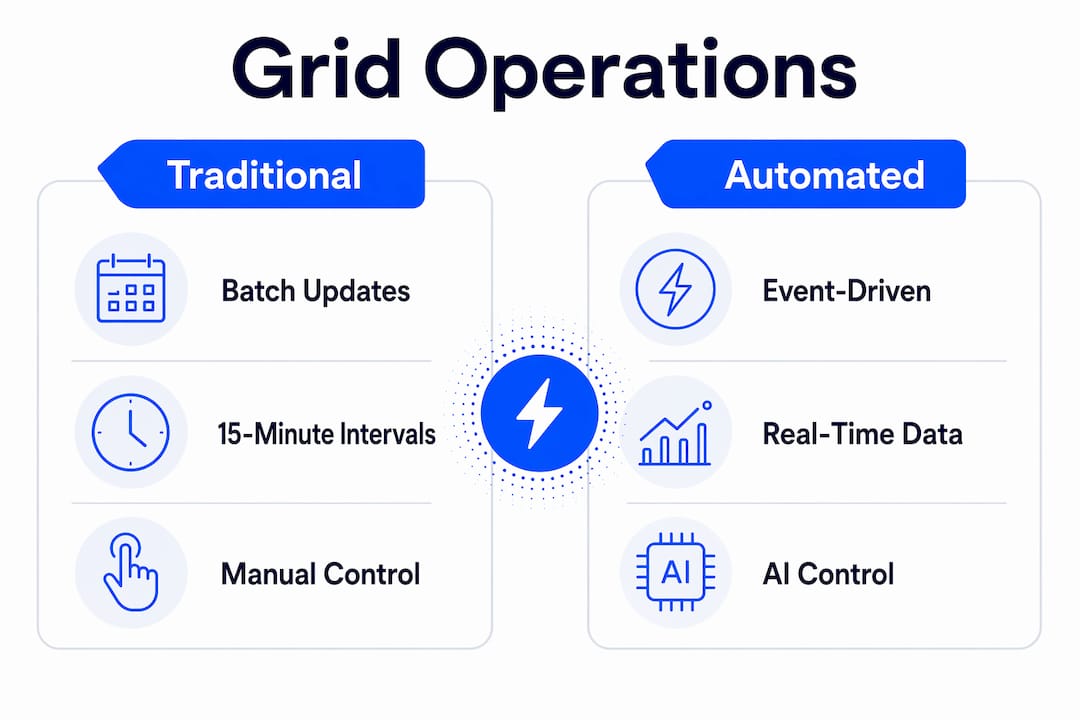
DERMS platforms pull real-time data from distributed energy resources, weather forecasts, and storage systems to automate balancing decisions that previously required human judgment. This is what makes large-scale solar and wind integration operationally viable without proportional increases in balancing costs or fossil-fuel peaker plant capacity.
Pro Tip: Prioritize local-first automation architectures for critical control loops like battery dispatch and load shedding. A system that depends entirely on cloud connectivity will fail at exactly the moment grid stability matters most.
What role do AI and autonomous agents play in energy automation?
Agentic AI represents the next operational tier above conventional automation. Where rule-based systems execute predefined logic, agentic AI systems plan, decide, and act autonomously across multi-step workflows with minimal human input. The energy sector is adopting this capability faster than most industries.

Over 80% of energy business leaders expect AI agents to be integrated into core strategies within 12–18 months. That consensus reflects a specific operational pressure: workforce shortages in grid operations, engineering, and compliance that cannot be solved by hiring alone.
Agentic AI addresses this through autonomous workflow execution across several high-value use cases:
Storage dispatch: AI agents optimize battery charge and discharge cycles against real-time tariff signals, grid frequency data, and forecast demand, without operator input.
Supply chain logistics: Autonomous agents manage procurement, inventory, and logistics for grid components, reducing lead times and manual coordination overhead.
Regulatory compliance: AI agents monitor operational data continuously and generate compliance reports, flagging exceptions for human review rather than requiring manual data assembly.
Digital twins: AI-driven digital twins dynamically optimize power plant performance and anticipate failures, yielding $1 million to $5 million in annual savings per gigawatt.
The sustainability dimension of AI adoption deserves direct attention. Training large AI models consumes significant energy, creating what researchers now call the decarbonization paradox.
“The energy sector faces a decarbonization paradox where AI training is energy-intensive, motivating low-carbon AI approaches to ensure net environmental benefits from automation.” Source: Nature
The practical response is to prioritize inference-efficient models, local processing where possible, and AI workloads powered by renewable energy. The net benefit of AI in energy automation is strongly positive, but only when the AI infrastructure itself is managed with the same efficiency discipline applied to the grid.
How does automation cut energy costs for businesses and end-users?
Automation reduces energy costs by doing three things that manual management cannot: it responds faster than human operators, it never forgets a tariff signal, and it optimizes across multiple devices simultaneously. The result is measurable. Real-time energy management can unlock savings of 36% or more at the consumer and business level.
The practical mechanisms behind those savings follow a clear sequence:
Dynamic tariff optimization: Automated systems read real-time and time-of-use pricing signals and shift flexible loads, including EV charging and battery discharge, to the cheapest available windows.
Peak load management: Automation detects demand peaks before they trigger demand charges and sheds or shifts non-critical loads automatically, protecting businesses from penalty tariffs.
Solar self-consumption maximization: Smart orchestration platforms monitor solar production, battery status, EV charging demand, and household or facility loads simultaneously. The system directs surplus solar to the highest-value use in real time rather than defaulting to grid export at low feed-in rates.
Round-trip efficiency preservation: Intelligent automation avoids unnecessary battery cycling. When cheaper grid power is available, the system charges directly from the grid rather than discharging stored energy and recharging it, minimizing round-trip losses that erode overall system efficiency.
EV charging optimization: Direct solar-to-EV charging, when solar surplus is available, bypasses battery storage entirely and eliminates the conversion losses that accumulate over thousands of charging cycles.
The Belinus EMS applies this logic through 15-minute dynamic tariff optimization cycles, integrating battery arbitrage, grid services, and EV charging control under a single platform. For commercial operators managing multiple sites or fleet vehicles, the ETAP Pro EV Charger extends this automation to fleet-level charge management with full IoT connectivity.
Pro Tip: Integrating solar, battery, and EV charging under one automation platform is not just convenient. It is the only way to capture the full efficiency stack. Siloed devices managed separately leave significant savings on the table.
Key takeaways
Automated energy management delivers measurable gains in efficiency, cost, and renewable integration only when event-driven architectures, AI-powered decision systems, and integrated device control operate together as a unified platform.
Point | Details |
Operational efficiency gains | AI-embedded workflows improve utility efficiency by 20%+ and cut manual grid coordination by up to 70%. |
Financial ROI on automation | Advanced distribution management systems deliver 184% ROI over five years, per Forrester research. |
Renewable integration requires real-time data | Event-driven architectures respond in milliseconds; batch systems cannot manage intermittent solar and wind at scale. |
Agentic AI is arriving fast | Over 80% of energy leaders expect autonomous AI agents in core operations within 12–18 months. |
End-user savings are real | Real-time automated energy management unlocks savings of 36% or more for consumers and businesses. |
Where i think the industry is getting automation wrong
The conversation about energy sector automation focuses almost entirely on what the technology can do. Fewer people talk about where implementations actually fail, and that gap is costing operators real money.
The most common mistake I see is cloud dependency in critical control loops. Utilities and commercial operators build automation architectures that route every decision through a central cloud platform. That works fine in normal conditions. When connectivity drops during a grid event, which is precisely when you need the system most, the automation goes dark. Local-first architectures for battery dispatch, load shedding, and fault response are not optional redundancy. They are the baseline design requirement.
The second issue is the event-driven transition that most organizations are still treating as a future upgrade rather than an immediate operational necessity. Batch-based systems cannot manage high renewable penetration. Every month spent on legacy polling architectures is a month of balancing costs and grid instability that automation could have prevented.
The decarbonization paradox around AI energy use is real, but it is also solvable. The answer is not to slow AI adoption. It is to apply the same efficiency discipline to AI infrastructure that you apply to the grid itself. Run inference workloads on renewable-powered hardware. Choose smaller, task-specific models over general-purpose large language models where the use case allows it.
Automation in energy is a strategic differentiator, not a cost center. The operators who treat it as infrastructure investment rather than IT overhead will hold a structural advantage as renewable penetration continues to rise.
— Marc
How Belinus supports your energy automation goals
Belinus builds the integrated platforms that make automated energy management operational rather than theoretical. The Belinus EMS runs 15-minute dynamic tariff optimization across solar, battery storage, and EV charging assets, with battery arbitrage and grid services managed in real time through a native mobile app and web dashboard. For commercial and utility operators, the platform scales from small commercial and industrial installations to utility-scale deployments with 400+ kWh modular storage.
If you are evaluating how to automate energy management across your portfolio, or looking to quantify the financial return before committing to infrastructure investment, Belinus’s automated 25-year financial modeling tool gives you the numbers you need. Explore the full range of solutions at belinus.com.
FAQ
What is the role of automation in energy systems?
Automation in energy systems integrates AI, real-time control, and event-driven data processing to optimize generation, distribution, and consumption. It replaces manual workflows with autonomous decision-making that responds in milliseconds rather than minutes.
How does automation improve renewable energy integration?
Automated DERMS and event-driven architectures balance intermittent solar and wind output in real time by pulling continuous data from distributed energy resources, weather systems, and storage assets. This reduces reliance on fossil-fuel peaker plants and lowers grid balancing costs.
What savings can businesses expect from automated energy management?
Real-time automated energy management delivers savings of 36% or more at the consumer and business level, driven by dynamic tariff optimization, peak load management, and solar self-consumption maximization.
How soon will agentic AI be standard in energy operations?
Over 80% of energy business leaders expect autonomous AI agents to be integrated into core operational strategies within 12–18 months, according to Microsoft’s 2026 energy sector research.
What is the decarbonization paradox in energy automation?
The decarbonization paradox refers to the tension between AI’s energy-intensive training requirements and its role in reducing grid emissions. The solution is low-carbon AI infrastructure and inference-efficient models that deliver net environmental benefits.
Recommended
Comments