The Role of Digital Twins in Energy: 2026 Guide
- 8 hours ago
- 8 min read
TL;DR:
Digital twins in energy are dynamic virtual models that enable real-time monitoring and prediction of system performance. They reduce planning errors, improve fault detection, and support high levels of renewable energy integration through AI-driven optimization. Successful deployment depends on organizational governance, user-friendly interfaces, and embedded cybersecurity.
Digital twins in energy are defined as dynamic virtual replicas of physical energy assets that enable real-time monitoring, simulation, and predictive analysis to improve system performance. The industry term is “cyber-physical modeling,” though “digital twin” has become the standard working label across grid operators, storage developers, and building energy managers. The role of digital twins in energy now spans everything from fault prediction in transmission networks to 15-minute scheduling in smart homes. Recent research confirms planning error reductions of 15% and fault prediction accuracy reaching 99%, numbers that reframe digital twins from a research concept into an operational necessity.
How do digital twins improve energy grid planning and stability?
Digital twins give grid planners a live, testable model of the entire network. Instead of relying on static load-flow calculations, operators run continuous simulations that reflect actual asset states, weather inputs, and demand patterns. The result is a planning environment that catches errors before they reach the physical grid.

Standards like IEC 61850 and modular architectures are central to making this work. IEC 61850 defines communication protocols between substation devices, and digital twins built on this standard can replicate protection relay behavior, transformer loading, and switching sequences in software. That compatibility is what allows fault prediction accuracy to reach 99%, a figure that would be impossible with disconnected legacy monitoring tools.
Variable renewable energy creates the hardest planning problem in modern grids. Solar and wind output shifts within minutes, and conventional planning tools cannot simulate those transitions fast enough to be useful. Digital twins solve this by running Monte Carlo simulations of generation variability, letting planners test grid stability under hundreds of renewable penetration scenarios before committing to infrastructure investment. AI-driven digital twins now support up to 97% variable renewable energy penetration while increasing ROI by 9.8%. That combination of high renewable share and improved returns is the clearest argument for digital twin adoption at the grid level.
Grid metric | Conventional planning | Digital twin-assisted |
Planning error rate | Baseline | Reduced by ~15% |
Fault prediction accuracy | Variable | Up to 99% |
VRE penetration supported | Limited | Up to 97% |
ROI improvement | Baseline | +9.8% |
Pro Tip: When integrating digital twins with IEC 61850-compliant substations, prioritize bidirectional data exchange from day one. A one-way data feed turns a digital twin into a dashboard. Bidirectional exchange turns it into a planning tool.
What role does AI play in reducing carbon footprints with digital twins?
AI transforms a digital twin from a monitoring tool into a decision engine. Without AI, a twin reflects what is happening. With AI, it predicts what will happen and recommends the lowest-cost, lowest-emission response.
The most documented application is multi-energy storage optimization. In systems combining battery, hydrogen, and thermal storage, an AI-enabled digital twin runs continuous forecasts of generation, demand, and tariff signals. It then dispatches storage assets using optimization algorithms to minimize both cost and emissions simultaneously. Research on smart grid multi-energy storage systems shows ~30% reductions in both carbon footprint and operational costs. That dual reduction matters because it removes the false trade-off between sustainability and profitability that slows adoption.
The optimization strategies used inside these AI twins differ significantly in their computational demands and accuracy:
Model Predictive Control (MPC): Solves a rolling optimization window every few minutes. High accuracy, high computational cost. Best for systems with reliable forecasts and fast processors.
Genetic algorithms: Search large solution spaces for near-optimal dispatch schedules. Slower than MPC but effective for complex multi-objective problems with many constraints.
Heuristic methods: Rule-based shortcuts that run in milliseconds. Lower accuracy but practical for edge devices with limited processing power.
Reinforcement learning: Learns dispatch policies from historical data. Requires significant training time but adapts well to changing system conditions.
Closed-loop architectures tie these strategies together. The digital twin forecasts generation and demand, passes that forecast to the optimizer, executes the dispatch decision, and then updates the twin model with the actual outcome. Each cycle improves forecast accuracy and dispatch quality.
Pro Tip: Match your AI strategy to your hardware. MPC and genetic algorithms need cloud or edge servers with real processing capacity. If your site runs on embedded controllers, heuristic methods or pre-trained reinforcement learning policies are the practical choice.
Digital twins in real-time energy management for buildings
At the building level, digital twins connect sensor data, weather forecasts, occupancy patterns, and tariff signals into a single model that schedules energy use automatically. The performance gains are measurable and consistent. Real-time scheduling at 15-minute resolution saves up to 10% on energy costs compared to static setpoint control. That figure scales significantly across commercial portfolios.
Building Energy Management Systems (BEMS) are the primary deployment environment. A digital twin running inside a BEMS does more than log consumption. It simulates the thermal behavior of the building envelope, predicts HVAC load, and pre-conditions spaces before occupancy to avoid peak tariff periods. Smart home applications extend this logic to residential settings, where mobile apps transform home energy savings by surfacing twin-generated recommendations directly to residents.
The key functionalities digital twins enable in buildings include:
Predictive pre-conditioning: Heats or cools spaces before occupancy using off-peak electricity, reducing peak demand charges.
Tariff-aware scheduling: Shifts flexible loads like EV charging and dishwashers to lowest-cost windows automatically.
Fault detection and diagnostics: Identifies HVAC degradation, insulation failures, or metering errors by comparing twin predictions to actual readings.
Demand response participation: Aggregates building flexibility and responds to grid signals, generating revenue or bill credits.
Continuous model calibration: Updates the building model with real sensor data so predictions stay accurate as the building ages.
Management approach | Scheduling resolution | Typical cost saving |
Static setpoint control | None | Baseline |
Rule-based BEMS | Hourly | Moderate |
Digital twin-assisted BEMS | 15 minutes | Up to 10% |
For professionals managing real-time energy management across multiple sites, the 15-minute resolution is the critical threshold. Below that, the twin can respond to intraday tariff movements that hourly systems miss entirely.
What are the biggest challenges in deploying digital twins for energy?
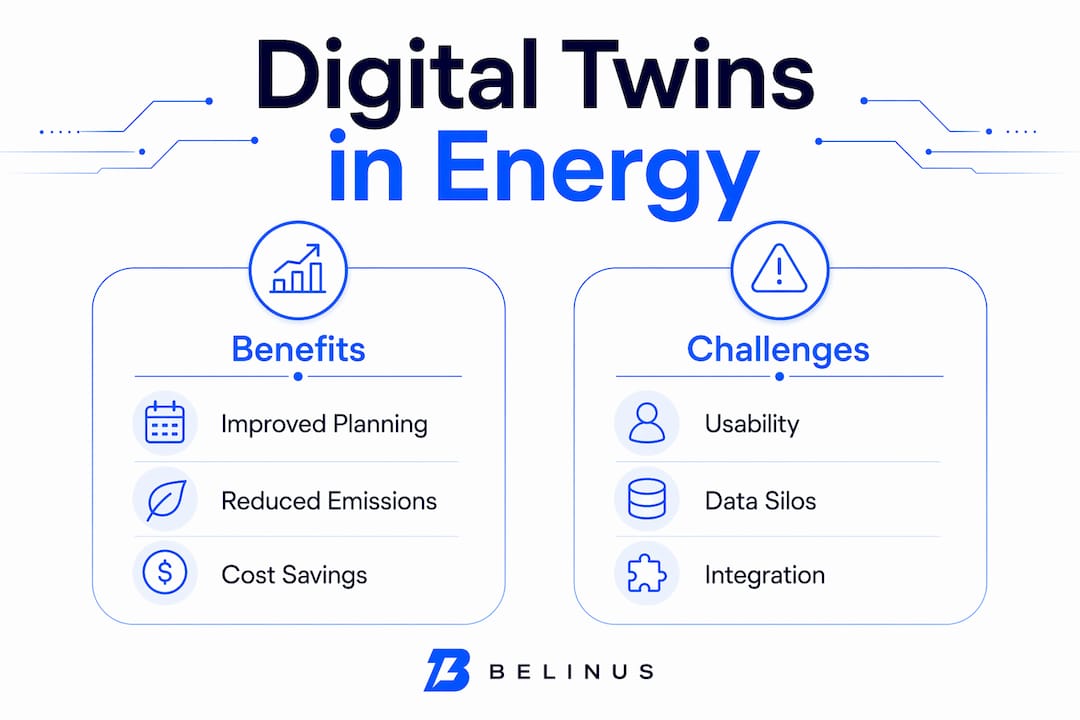
The primary barrier to digital twin adoption is usability, not technology. User interfaces must reduce cognitive load for diverse stakeholders, from grid engineers to facility managers who have no modeling background. A twin that requires a PhD to interpret will not change operational decisions.
The “living mirror” concept captures what a well-deployed twin actually does. Bidirectional data exchange lets operators simulate “what-if” scenarios and see predicted outcomes before applying physical changes. That feedback loop is what separates a digital twin from a standard monitoring dashboard. Without it, you have a display, not a decision tool.
Interoperability is the technical challenge that stops most deployments from reaching full potential. Battery, hydrogen, and thermal storage systems each use different communication protocols and data formats. Digital twins bridge these heterogeneous energy models by acting as a unified integration layer, but building that layer requires deliberate architecture work from the start. The multi-technology energy systems guide for Europe 2026 covers how these integration challenges play out across real deployments.
Common pitfalls and recommended practices for deployment teams:
Organizational data silos: Data siloing causes more digital twin failures than technical issues. Establish cross-functional data governance before writing a single line of integration code.
Incomplete digital thread: Digital thread continuity across procurement, installation, and operation phases is required for predictive maintenance. A twin built only on operational data misses critical asset history.
Cybersecurity as an afterthought: Retroactive security fixes are insufficient once thousands of IoT sensors are deployed. Architectural-layer security must be embedded from day one.
Model complexity vs. response speed: High-fidelity offline models paired with reduced-order AI-surrogate models balance accuracy and real-time performance. Running a full physics model in a 15-minute control loop is not practical.
Neglecting end-user training: A technically sound twin fails if operators revert to manual overrides because the interface is confusing.
Pro Tip: Run a usability audit with actual operators before go-live. The gap between what modelers think is intuitive and what operators find usable is almost always larger than expected.
Key Takeaways
Digital twins deliver measurable performance gains in energy systems only when bidirectional data exchange, AI optimization, and user-centered design are built in from the start, not added later.
Point | Details |
Grid planning accuracy | Digital twins reduce planning errors by ~15% and push fault prediction accuracy to 99%. |
AI-driven sustainability | AI-enabled twins cut both carbon footprint and operational costs by ~30% in multi-energy storage systems. |
Building-level savings | Real-time 15-minute scheduling saves up to 10% on energy costs versus static control methods. |
Deployment risk | Organizational data silos and incomplete digital thread continuity cause more failures than technical issues. |
Cybersecurity | Security architecture must be embedded from day one; retrofitting protection across large IoT networks is not viable. |
The model is only as good as the organization behind it
The research on digital twins in energy is compelling. Fault prediction at 99%, 30% cost reductions, 97% renewable penetration. Those numbers are real, and they come from well-designed deployments. What the papers don’t highlight is how many deployments never get there.
The pattern I see repeatedly is this: an organization invests in a high-fidelity digital twin, integrates it with their SCADA or BEMS, and then watches operators ignore it within six months. The model drifts because no one owns the calibration process. The interface surfaces too much information. The IT team and the operations team never agreed on data ownership. The twin becomes shelfware.
The fix is not technical. It’s organizational. The “digital thread” concept from IEC standards work is the right frame. Every asset decision, from procurement through decommissioning, needs to feed the twin. That requires a named owner, a governance process, and an interface that non-modelers can actually use. Cybersecurity readiness is equally non-negotiable. I’ve seen projects delayed by 18 months because security was treated as a final-stage checklist item rather than a design constraint.
The future of digital twins in energy runs through AI integration and smart grid evolution. But the organizations that will capture that future are the ones solving the governance and usability problems now, not the ones waiting for better algorithms.
— Marc
How Belinus supports energy professionals working with digital twin systems
Belinus builds energy systems designed for the kind of real-time, data-driven management that digital twins depend on. The Belinus EMS runs 15-minute dynamic tariff optimization across solar PV, battery storage, and EV charging assets, the same scheduling resolution that research identifies as the threshold for meaningful cost savings.
The Belinus platform supports multi-technology configurations including LFP, graphene supercapacitor, and pre-lithiated LFP storage, with RESTful API integration for third-party digital twin and BEMS connections. For professionals evaluating home energy storage options or commercial-scale deployments, Belinus provides the physical infrastructure that makes digital twin optimization actionable. Visit belinus.com to review system specifications and integration architecture.
FAQ
What is the role of digital twins in energy management?
Digital twins create virtual replicas of energy assets that enable real-time monitoring, simulation, and predictive control. They reduce planning errors, improve fault prediction, and support AI-driven optimization of storage and grid systems.
How do digital twins reduce energy costs in buildings?
Digital twin-assisted building energy management at 15-minute scheduling resolution saves up to 10% on energy costs compared to static setpoint control, primarily through tariff-aware load shifting and predictive pre-conditioning.
What AI methods work best inside energy digital twins?
Model Predictive Control delivers the highest accuracy for real-time dispatch but requires significant computing resources. Heuristic methods and pre-trained reinforcement learning policies are better suited to edge devices with limited processing capacity.
What are the main challenges in deploying energy digital twins?
Organizational data silos, incomplete digital thread continuity, and poor user interface design cause more deployment failures than technical issues. Cybersecurity must be embedded architecturally from the start, not added after deployment.
How do digital twins support renewable energy integration?
AI-driven digital twins simulate variable renewable energy scenarios and optimize storage dispatch, supporting grid systems with up to 97% variable renewable energy penetration while improving investment ROI by 9.8%.
Recommended
Comments