The Role of EMS in Smart Homes: 2026 Guide
- 44 minutes ago
- 8 min read

TL;DR:
An Energy Management System connects solar, batteries, and appliances to optimize energy use in homes. It reduces bills by shifting loads, prioritizing solar, and responding to utility pricing signals, with advanced features like AI and digital twins improving efficiency. Properly implemented EMS systems can cut household electricity costs by up to 30% and enhance grid resilience during outages.
An Energy Management System (EMS) is the intelligent control platform that monitors, coordinates, and optimizes every watt flowing through your home. The role of EMS in smart homes goes far beyond a programmable thermostat or a single smart plug. A true EMS connect solar panels, battery storage, EV chargers, and household appliances into one decision-making system. The U.S. Department of Energy and ENERGY STAR both recognize coordinated home energy management as a key driver of residential efficiency gains. Done right, it cuts costs, reduces your carbon footprint, and keeps your home running during grid outages.
How does an EMS function within a smart home environment?
A home EMS works by collecting real-time data from sensors, smart meters, and connected devices, then using that data to make automatic control decisions. The system reads your solar production, battery charge level, grid pricing, and appliance load simultaneously. It then shifts energy use to the cheapest, cleanest moments of the day without you lifting a finger.
One critical distinction: not all smart devices form a true EMS. Standalone smart plugs or individual thermostats deliver underwhelming savings when they operate in isolation. A real EMS require coordinated communication between devices and integration with utility pricing signals.
The core functions of a well-configured EMS include:
Real-time monitoring: Tracks consumption and production at the circuit level, giving you a live picture of where energy goes.
Automatic scheduling: Runs dishwashers, EV chargers, and water heaters during off-peak rate windows without manual input.
Load shifting: Moves flexible loads away from peak pricing periods, directly reducing your utility bill.
Renewable integration: Prioritizes self-consumption of solar energy before drawing from the grid.
Grid interaction: Responds to time-of-use pricing signals and, in advanced setups, participates in demand-response programs.
The Belinus EMS, for example, applies 15-minute dynamic tariff optimization to make these decisions continuously throughout the day. That granularity matters because energy prices and solar output both change faster than most homeowners realize.
What technological innovations enhance EMS performance?
Modern EMS technology has moved well past simple scheduling. Three advances are reshaping what these systems can do: artificial intelligence, digital twin simulation, and edge computing.
AI-driven predictive control is the most consequential shift. AI-enabled EMS anticipate energy needs based on weather forecasts, occupancy patterns, and real-time pricing rather than reacting after the fact. That shift from reactive to anticipatory control is what separates a genuinely intelligent system from a fancy timer.
Digital twin technology creates a live virtual model of your home’s energy flows. Digital twin-assisted EMS with 1-minute scheduling intervals achieve higher operational cost savings than conventional 15-minute schedules. That tighter resolution means the system catches short-lived pricing dips and solar surges that a slower schedule would miss entirely.
Deep reinforcement learning takes optimization further still. Flexible load control combined with deep reinforcement learning can reduce electricity bills by up to 31.5% and improve power factor to 0.9. A better power factor means your home draws cleaner, more efficient current from the grid, which reduces waste at the source.
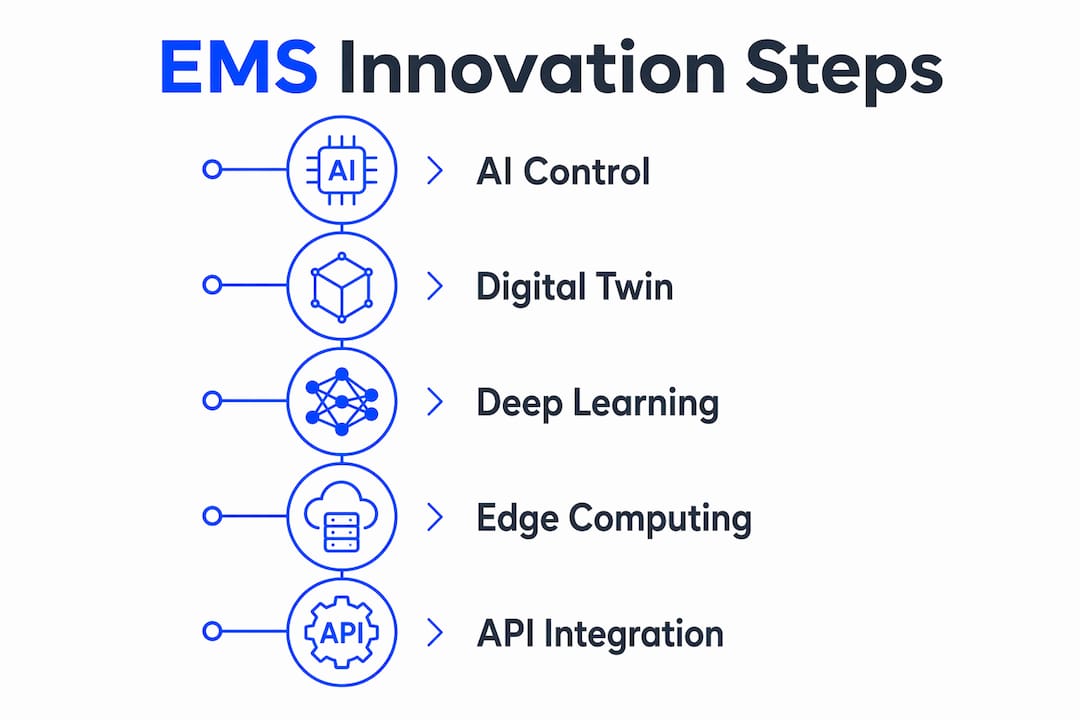
Edge computing keeps processing local rather than routing every decision through a cloud server. That cuts response latency and keeps the system functional even during internet outages. When combined with integrating renewables into your energy system, edge-based EMS can manage solar and battery dispatch in near real time.
Pro Tip: When evaluating an EMS, ask whether it uses predictive scheduling or only rule-based timers. Predictive systems adapt to changing conditions automatically. Rule-based systems require you to update settings manually every season.
The Belinus platform supports RESTful API integration, which means it can connect with third-party IoT devices and utility data feeds. That open architecture is what makes future upgrades possible without replacing the entire system.
What are the practical benefits of EMS for homeowners?
The financial case for smart home energy management is concrete. A properly configured EMS can reduce annual electricity costs by 10% to 30%, saving $150 to $450 for an average U.S. household spending $1,500 per year on electricity. That range reflects real variation in home size, local rates, and how aggressively the system is configured.

Beyond the bill, EMS technology delivers four categories of benefit:
Benefit | What it means for you |
Cost savings | Automatic load shifting and tariff optimization cut monthly utility bills without lifestyle changes. |
Grid resilience | Smart panel-based EMS extends resilient operation by at least 10% during outages by managing battery discharge intelligently. |
Comfort | Adaptive thermostat control and appliance scheduling maintain comfort without manual adjustments. |
Sustainability | Prioritizing solar self-consumption and reducing peak grid draw lowers your household carbon footprint directly. |
Grid resilience deserves special attention. The U.S. Department of Energy confirms that smart electrical panel-based systems serve a dual role: cutting utility costs and keeping critical loads running longer when the grid goes down. That dual function is increasingly valuable as weather-related outages become more frequent.
Comfort improvements are less discussed but equally real. An EMS that learns your schedule pre-cools your home before peak pricing hits, so you never feel the tradeoff between comfort and cost. Appliance scheduling means your laundry runs overnight at lower rates without you setting an alarm. These are the smart home energy tips that compound over months into meaningful savings.
For homeowners with solar panels, the sustainability gains are direct. Every kilowatt-hour consumed from your own roof instead of the grid is one less unit of fossil-generated power purchased. An EMS makes that substitution automatic and continuous.
How can homeowners implement and optimize an EMS?
Choosing the right EMS setup depends on your starting point and how far you want to go. Three tiers cover most homeowners:
Entry-level smart devices: Individual smart thermostats, plugs, and EV chargers with basic scheduling. These deliver some savings but lack coordination. They are a starting point, not a complete solution.
Integrated EMS platforms: A centralized controller that connects solar, battery, and appliances through a single interface. This tier delivers the 10%–30% savings range cited above.
Smart electrical panel systems: Full panel replacement or upgrade that gives circuit-level control, demand-response participation, and bidirectional energy flow for vehicle-to-home (V2H) applications.
When evaluating systems, check for ENERGY STAR certification and confirm compatibility with your utility’s time-of-use rate structure. Not every EMS can read utility pricing signals, and without that integration, load shifting is guesswork rather than optimization. You can review energy management system tips to understand what features matter most before you buy.
Bidirectional systems that support V2H or vehicle-to-grid (V2G) operation require additional attention. These systems are classified as distributed energy resources and must meet grid interconnection certifications before installation. Ask your installer which certifications apply in your state before committing to a bidirectional setup.
The single most common implementation mistake is insufficient visibility. Transparent real-time dashboards prevent homeowner confusion about automated decisions and build trust in the system. When you cannot see why the system made a choice, you start overriding it manually, which erases most of the efficiency gains.
Pro Tip: Run your EMS dashboard for at least 30 days before making any manual overrides. The system needs time to learn your patterns. Early interference resets that learning and delays the savings you are expecting.
Belinus addresses this through a native mobile app and web dashboard that shows real-time energy flows, battery state, and tariff data in one view. That visibility is what keeps homeowners engaged rather than frustrated.
Key Takeaways
A home EMS delivers its full value only when solar, storage, and smart devices operate as one coordinated system rather than separate tools.
Point | Details |
EMS requires coordination | Standalone smart devices without utility integration deliver far less savings than a true EMS. |
AI and digital twins raise the bar | Predictive EMS with 1-minute scheduling outperforms conventional 15-minute systems on both cost and responsiveness. |
Savings are quantifiable | A configured EMS saves $150–$450 per year for an average U.S. household on a $1,500 electricity budget. |
Resilience is a core benefit | Smart panel-based EMS extends battery-backed operation during outages by at least 10% beyond unmanaged systems. |
Visibility drives results | Real-time dashboards prevent user override behavior that undermines automated efficiency gains. |
Why I think most homeowners are still thinking about EMS the wrong way
Most people I talk to treat an EMS like a fancy thermostat. They expect to set it once and forget it. That mindset produces disappointment, because the first 30 days of any EMS installation are a learning phase, not a savings phase.
The shift that actually changes outcomes is moving from monitoring to prediction. Watching your energy use is useful. Letting an AI anticipate your energy use and act before costs spike is where the real gains live. I have seen homeowners with identical solar setups get wildly different results based solely on whether their EMS was reactive or predictive.
The other thing most articles skip: the dashboard matters as much as the algorithm. A system that makes good decisions but hides its reasoning will get overridden constantly. Homeowners are not irrational. They just need to see the logic. When the app shows you that the system delayed your EV charge by two hours to avoid a peak rate, and you can see the $4 you saved, you stop second-guessing it.
The future of smart home energy management is not more automation for its own sake. It is automation that earns your trust by being transparent. The EMS platforms that will win long-term are the ones that make homeowners feel informed, not replaced.
— Marc
Belinus and smart home energy management
Belinus builds energy systems where solar, battery storage, and EV charging work together under one intelligent platform. The Belinus EMS applies 15-minute dynamic tariff optimization, real-time battery arbitrage, and a native mobile dashboard so you always know what your system is doing and why.
The Energy Wall G1, a 16 kWh graphene supercapacitor storage unit, pairs directly with Solis inverters and the Belinus EMS for homeowners who want a complete, coordinated setup. If you are ready to move beyond standalone smart devices and build a system that actually learns and adapts, explore Belinus solutions to see what a fully integrated home energy system looks like in practice.
FAQ
What is an EMS in a smart home?
An EMS (Energy Management System) is a centralized platform that monitors and controls energy flows between solar panels, batteries, appliances, and the grid. It automates decisions to minimize cost and maximize efficiency.
How much can an EMS save on electricity bills?
A properly configured EMS reduces annual electricity costs by 10% to 30%, saving $150 to $450 per year for a typical U.S. household.
Do I need solar panels to use an EMS?
No. An EMS adds value without solar by shifting loads to off-peak rate windows and managing battery storage. Solar integration amplifies the savings significantly but is not required to start.
What is the difference between a smart thermostat and a full EMS?
A smart thermostat controls only heating and cooling. A full EMS coordinates all energy sources and loads, including solar, batteries, EV chargers, and appliances, using utility pricing data to make system-wide decisions.
Are bidirectional EMS systems legal everywhere?
Bidirectional systems classified as distributed energy resources must meet grid interconnection certifications that vary by state and utility. Confirm local requirements with your installer before purchasing a V2H or V2G-capable system.
Recommended
Comments