The Role of Energy Monitoring Systems for Homeowners
- 3 hours ago
- 9 min read

TL;DR:
Energy monitoring systems provide real-time, circuit-level insights that utility bills cannot offer, enabling better energy management and cost savings. They typically reduce energy costs by 10–30% within 6–18 months, with quick deployment using wireless IoT technology. Continuous monitoring reveals hidden losses and supports optimized use of renewables, making proactive energy management accessible and highly effective.
Your monthly electricity bill tells you how much you spent. It tells you almost nothing about why. The role of energy monitoring systems is to close that gap, giving homeowners and facility managers in Europe the real-time, circuit-level visibility that utility bills simply cannot provide. When you can see exactly which equipment is consuming power, when it does so, and how that consumption compares to your production or occupancy patterns, you stop guessing and start managing. This guide covers how these systems work, what they save you, and how to deploy them without disruption.
Table of Contents
Key Takeaways
Point | Details |
Real-time beats monthly billing | Energy monitoring delivers data in minutes or seconds, not weeks, enabling timely decisions. |
Savings are measurable and fast | Facilities typically cut energy costs by 10–30% with payback in 6–18 months. |
Smart meters are not enough | Dedicated monitoring systems provide circuit-level granularity that utility smart meters cannot match. |
Deployment is faster than expected | IoT-based wireless systems can go live in as little as 48 hours with minimal disruption. |
Renewables work harder with monitoring | Intelligent home systems can push solar self-consumption from 60% to over 90%. |
How energy monitoring systems work
Energy monitoring, at its core, is the continuous collection and analysis of power consumption data across your building or facility. Understanding how it works makes it much easier to choose the right system and use it well.
Most modern setups combine three layers:
Hardware sensors installed at the main panel, individual circuits, or directly on equipment. These measure voltage, current, and power factor in real time.
A communication layer that transmits data wirelessly or over existing wiring to a cloud platform. IoT-based sensors have replaced much of the legacy wired infrastructure that made older systems expensive to install.
A software dashboard where all data surfaces as charts, alerts, and reports. Good platforms let you drill down from whole-building consumption to a single circuit or piece of equipment.
One misconception that trips up a lot of homeowners is conflating smart meters with energy monitoring systems. Smart meters and monitoring systems are fundamentally different tools. Your utility’s smart meter records total consumption at the property boundary, usually in 30-minute blocks. A dedicated monitoring system goes much further, mapping consumption by circuit and by device, and updating in seconds rather than half-hours.
The granularity matters because energy waste rarely looks like one giant problem. It shows up as a freezer working harder than it should, a pump running at off-peak hours for no reason, or an HVAC unit cycling too frequently. You cannot see any of that in a utility bill.
Pro Tip: Before buying any monitoring system, list the five pieces of equipment you suspect consume the most energy. Choose a system that supports equipment-level monitoring for those specific assets, not just whole-building totals.
Real-time data delivery arrives minutes or seconds after consumption occurs, versus the weeks of delay baked into standard utility billing. That speed is what makes proactive management possible.
Energy monitoring benefits for efficiency and cost savings
The business case for energy monitoring is not theoretical. The numbers across European commercial and residential installations are consistent enough to plan around.
Real-time monitoring cuts costs by 10–30% in industrial and commercial facilities, with full payback typically reached in 6 to 18 months. For a facility spending €80,000 per year on electricity, that is a €8,000 to €24,000 annual reduction. The payback window shrinks further when demand charge reductions are factored in.

Peak demand charges are a significant but often overlooked part of commercial electricity bills across Europe. Staggering equipment startups and operational adjustments guided by 15-minute interval data can reduce peak demand charges by 15–25%. This alone can justify the cost of a monitoring system in facilities with variable loads.
For homeowners with solar PV, the gains can be even more dramatic. Intelligent home energy systems increase household self-consumption of solar energy from around 60% to over 90%, reducing annual electricity costs by 50–60%. That is the difference between exporting cheap surplus power to the grid and actually using what your panels generate. You can explore how this works in practice through Belinus’s smart home energy guide.
Beyond electricity bills, consider what monitoring does for equipment. Condition-based maintenance enabled by continuous monitoring reduces maintenance costs by 20–40% and extends equipment life by 15–25%. A motor drawing slightly more current than baseline is a warning sign you can act on before it fails entirely.
Other concrete benefits worth calling out:
After-hours waste detection. Monitoring frequently reveals that 20–30% of commercial energy consumption happens outside occupied hours. Lighting, HVAC, and equipment left running overnight add up quickly.
ESG and compliance reporting. Correlating energy use with production or occupancy data gives you the metrics regulators and sustainability frameworks expect, such as energy cost per unit produced or per square meter.
Behavioral change. Making consumption visible changes how people use energy. Teams and households consistently reduce waste once they can see the direct relationship between behavior and cost.
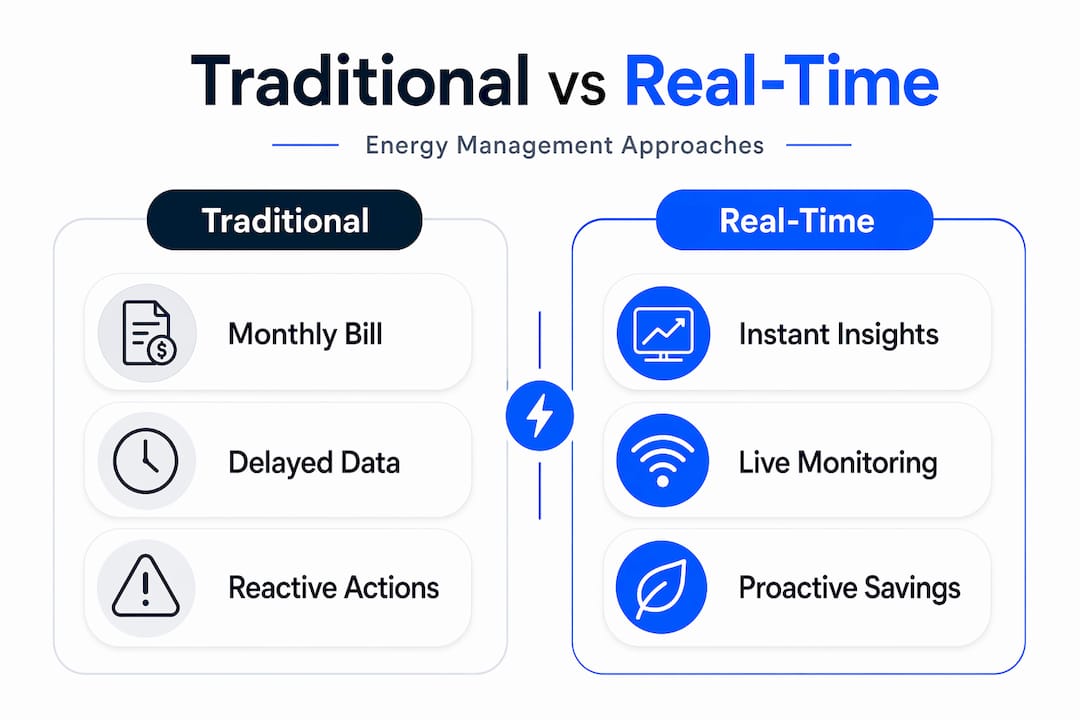
Traditional energy management versus real-time monitoring
Most facility managers rely on two inputs for energy decisions: the monthly utility bill and the occasional professional energy audit. Both have serious limitations that only become obvious when you switch to continuous monitoring.
The utility bill problem is timing. By the time you receive it, the consumption it reports is weeks old. An anomaly, a piece of equipment left on over a long weekend, a tariff threshold crossed because of one unusually warm week, has already cost you money. You cannot intervene after the fact.
Energy audits are more thorough, but periodic audits miss hidden losses from power quality issues or operational patterns that only appear under continuous high-frequency monitoring. Harmonics distortion, abnormal control cycling, and intermittent phantom loads are invisible to a snapshot audit conducted once every two or three years.
Here is a direct comparison:
Aspect | Utility bill or periodic audit | Real-time energy monitoring |
Data speed | Weeks after consumption | Seconds to minutes |
Granularity | Whole-building total | Circuit and equipment level |
Hidden loss detection | Rarely effective | Continuous and automatic |
Peak demand insight | Limited | Full 15-minute interval data |
Cost to implement | None but low insight | Moderate upfront, high ROI |
The shift from reactive to proactive energy management is the real value proposition. You stop responding to costs already incurred and start preventing them before they accrue.
Pro Tip: If your facility has gone through an energy audit in the last three years but has not installed continuous monitoring, assume there are still significant losses the audit did not catch. Harmonics and abnormal equipment cycling are almost never visible in audit snapshots.
Practical steps for implementing energy monitoring
Deployment is simpler and faster than most homeowners and facility managers expect. Here is a clear path from decision to live data.
Audit your starting point. Before purchasing hardware, pull 12 months of utility bills and note your highest-consumption months, peak billing periods, and any equipment you already suspect is inefficient. This gives you a baseline to measure against.
Choose your monitoring depth. Whole-building monitoring costs less and installs in hours. Circuit-level monitoring costs more but reveals far more. For facilities with significant HVAC, refrigeration, or production loads, circuit-level pays for itself quickly.
Select wired or wireless deployment. IoT-based wireless systems deploy in as little as 48 hours without disrupting operations. Wired systems offer higher data reliability but require more installation time. Most mid-sized facilities now start with wireless and wire in permanently later if needed.
Integrate with renewables and storage. If you have solar PV or battery storage, choose a monitoring platform that reads both generation and consumption together. Without this integration, you are managing two separate systems instead of one.
Set alerts before you analyze dashboards. The biggest mistake new users make is spending hours in dashboards without configuring alerts. Set thresholds for unusual overnight consumption, peak demand spikes, and equipment power draw. Let the system come to you.
Review monthly, act weekly. Schedule a 15-minute weekly review of consumption trends. Monthly reviews are too infrequent to catch patterns early. Weekly reviews, paired with automatic alerts, catch problems before they become expensive.
Cost expectations vary by building size and monitoring depth. Residential systems covering a full home typically run €200 to €800 for hardware, with cloud subscription costs of €5 to €20 per month. Commercial systems for a 2,000 to 5,000 square meter facility range from €2,000 to €15,000 depending on the number of circuits monitored.
Pro Tip: Do not start with the most granular system available. Install whole-building monitoring first, run it for 60 days, then use the data to identify which specific circuits or equipment deserve individual sensors. This approach saves money and produces faster early wins.
What is coming next in energy monitoring
The role of energy monitoring systems is already expanding beyond electricity tracking.
AI-driven predictive maintenance is moving from industrial pilot programs into mid-sized commercial facilities. Systems now flag equipment degradation weeks before failure based on power consumption signatures, not just visual inspection.
Multi-utility monitoring that tracks gas, water, and compressed air alongside electricity is becoming standard in European facility management software. A single dashboard covering all utilities simplifies compliance reporting significantly.
Regulatory pressure from the EU’s Energy Efficiency Directive is pushing more building owners toward mandatory metering and reporting, making monitoring a compliance tool as much as a cost tool.
Automation integration is closing the loop between monitoring and control. Systems that detect a peak demand threshold being approached can automatically shift deferrable loads, without any human intervention.
Decentralized energy assets like rooftop solar, community batteries, and bidirectional EV chargers all need monitoring to function efficiently. As these assets multiply across European homes and facilities, monitoring becomes the connective tissue that makes them work together.
My honest take after working in this space
I have seen how the impact of energy management changes once real data replaces assumptions. Facility managers who have been in their buildings for a decade are often the most surprised. They believe they know where the waste is. The data tells a different story almost every time.
The single biggest barrier I keep encountering is not cost or complexity. It is the belief that monthly billing is sufficient oversight. It is not. It is the equivalent of checking your bank balance once a month and wondering why you are overspending. You need transaction-level visibility to change behavior and catch problems early.
What I find genuinely encouraging is how accessible deployment has become. Two or three years ago, getting a mid-sized facility properly monitored meant weeks of installation work and significant capital outlay. Today, a wireless IoT setup can be live in 48 hours, with dashboards accessible on a phone the same day. The barrier to starting has dropped dramatically.
The facilities and homes that get the most from monitoring are the ones that do not treat it as a one-time project. They use it as an ongoing management discipline, the same way you would track any other operational metric that affects your bottom line. Measurement drives improvement. That principle does not change regardless of the technology involved.
— Marc
See how Belinus can help you monitor smarter

If you are ready to move from monthly billing to real-time visibility, Belinus offers integrated energy monitoring and management solutions built for European homes and commercial facilities. The Belinus EMS supports 15-minute dynamic tariff optimization, battery arbitrage, and solar integration, all accessible through a native mobile app and web dashboard. Whether you are a homeowner looking to maximize your solar self-consumption or a facility manager targeting measurable cost reductions, Belinus provides tailored energy solutions designed around your specific load profile. Deployment is fast, support is ongoing, and the financial modeling tools take the guesswork out of your ROI calculation. Reach out to Belinus to get a system matched to your building.
FAQ
What is the role of energy monitoring systems?
Energy monitoring systems continuously track electricity consumption at the building, circuit, or equipment level, providing real-time data that enables homeowners and facility managers to identify waste, reduce costs, and optimize renewable energy use.
How does energy monitoring differ from a smart meter?
A utility smart meter records total consumption at the property boundary in 30-minute intervals. A dedicated energy monitoring system provides circuit-level, real-time visibility that reveals which specific devices or systems are driving your energy bill.
What savings can I realistically expect from energy monitoring?
Commercial and industrial facilities typically achieve energy cost reductions of 10–30% with full payback in 6 to 18 months. Homeowners with solar PV can reduce annual electricity costs by 50–60% through improved self-consumption.
How long does it take to install an energy monitoring system?
Modern wireless IoT systems can be deployed in 48 hours with minimal disruption to daily operations, making them practical for both homes and occupied commercial facilities.
Do energy monitoring systems work with solar panels and batteries?
Yes. Systems like the Belinus EMS integrate solar generation, battery storage, and consumption data in a single dashboard, allowing you to maximize self-consumption and minimize grid draw automatically.
Recommended
Comments