The Role of RESTful APIs in Energy Management

TL;DR:
RESTful APIs are essential for connecting distributed energy resources, enabling real-time control and market participation. They rely on shared ontologies and embedded security to ensure interoperability and safety across energy systems. Most failures occur when semantic and security foundations are improperly implemented early in development.
RESTful APIs are defined as standardized HTTP-based interfaces that enable real-time data exchange and control across distributed energy resources, grid systems, and energy management platforms. The role of RESTful APIs in energy is not peripheral. They form the core digital integration layer connecting home batteries, solar inverters, EV chargers, smart meters, and wholesale energy markets into a single coordinated system. Standards like IEEE 2030.5, ontologies like SAREF and Project Haystack, and regulatory frameworks like the EU Citizens’ Energy Package all depend on REST-based interfaces to function. Without them, distributed energy resources remain isolated devices rather than coordinated assets.
How do RESTful APIs enable integration of distributed energy resources?
RESTful APIs serve as the primary integration layer for distributed energy resources (DERs), managing and coordinating assets from local device control all the way to wholesale market operations. A DER without an API is a closed system. It generates or stores energy but cannot respond to price signals, grid conditions, or operator commands. REST APIs change that by exposing device state, schedules, and control endpoints over standard HTTP, making each device addressable and programmable.

The practical result is the Virtual Power Plant (VPP). A VPP aggregates devices like residential batteries, rooftop solar, and smart appliances into a single dispatchable resource. The aggregator sends REST commands to each device, adjusting charge and discharge cycles in real time based on grid frequency or spot market prices. This is demand response at scale, and it only works because every device exposes a consistent API surface.
Key functions RESTful APIs perform in DER integration include:
Real-time telemetry: Devices push state data (state of charge, power output, fault codes) to a central platform via REST endpoints, enabling continuous monitoring.
Control signals: Operators send HTTP POST or PUT requests to adjust device behavior, such as shifting battery discharge to peak tariff windows.
Identity and scheduling: Under IEEE 2030.5, each device registers as an EndDevice resource with its own identity, operational schedule, and utility enrollment status.
Market participation: APIs translate device-level data into market-ready signals, enabling automated bidding in balancing and ancillary service markets.
Pro Tip: Design your DER API integration around resource state, not just data polling. A device that only reports metrics cannot be controlled. A device modeled as a stateful resource with readable and writable endpoints can participate in automated trading and demand response programs.
What challenges exist in implementing RESTful APIs for energy management?
Interoperability is the central challenge in energy API implementation. Two devices can both speak REST and still fail to communicate meaningfully if they describe the same concept in different terms. A battery’s “state of charge” might be expressed as a percentage in one system and as a watt-hour value in another. Without a shared ontology, the receiving platform cannot interpret the data correctly.
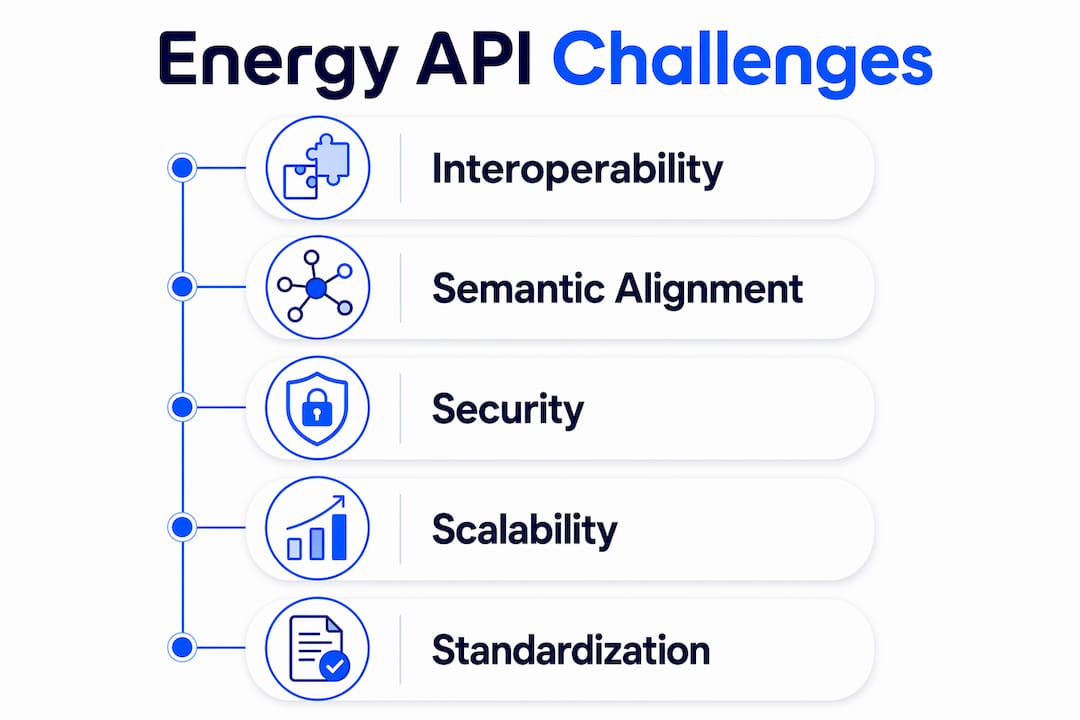
Semantic alignment via ontologies like SAREF (Smart Appliances REFerence) or Project Haystack resolves this by providing machine-readable vocabularies that define energy concepts consistently. APIs that adopt these ontologies produce data that any compliant platform can parse without custom translation logic. APIs that skip this step create integration debt that compounds with every new device type added to the system.
Security presents an equally serious challenge. Energy APIs require factory-level PKI management and X.509 certificate lifecycle handling embedded directly in devices. This is not a configuration step performed at installation. It is a design requirement baked into firmware before a device ships. Devices that lack local certificate rotation capabilities fail compliance checks and create vulnerabilities in distributed energy networks.
The following implementation steps address the most common failure points:
Adopt a resource model, not just a protocol. IEEE 2030.5 functions best as an architectural resource model for device state synchronization, not as a simple data transport layer. Teams that treat it as a protocol often miss the stateful resource requirements that drive successful DER certification.
Embed security at the firmware level. Certificate management must be part of the device’s factory configuration, not an afterthought added during commissioning.
Align data semantics before integration. Map your data model to SAREF or Project Haystack before writing API endpoints. Retrofitting semantic alignment after deployment is expensive.
Plan for cross-border data access. Industry leaders identify uniform cross-border procedures as the primary barrier to scaling energy service ecosystems, not the underlying technology. Regulatory alignment across markets must be part of your integration roadmap.
Pro Tip: Run a semantic compatibility audit before connecting a new device type to your platform. Map every data field the device exposes against your platform’s ontology. Gaps found at this stage cost hours to fix. Gaps found in production cost weeks.
What are practical RESTful API applications in energy trading, smart grids, and consumer energy management?
RESTful APIs operate across three distinct layers of the energy system: the device layer, the grid layer, and the market layer. Each layer has different latency requirements, data volumes, and security profiles, but all three rely on REST interfaces to function.
At the device layer, building management systems use REST APIs to coordinate HVAC, lighting, and battery storage based on occupancy data and tariff signals. A commercial building running a Belinus Energy Management System, for example, uses 15-minute dynamic tariff optimization to shift loads and battery dispatch. The EMS communicates with inverters, storage units, and EV chargers through REST endpoints, adjusting behavior automatically as tariffs change throughout the day.
At the grid layer, smart grid operators use REST APIs to achieve device interoperability across thousands of endpoints from different manufacturers. The table below shows how API application differs across energy system layers:
Layer | Primary API function | Key data exchanged |
Device | Control and telemetry | State of charge, power output, fault status |
Building/site | Load coordination | Tariff signals, schedule commands, meter data |
Grid | Aggregation and dispatch | Frequency response, balancing signals, VPP bids |
Market | Automated trading | Price signals, bid submissions, settlement data |
At the market layer, APIs connect distributed energy to automated trading by translating device-level flexibility into market-ready bids. An aggregator platform pulls real-time state data from a fleet of batteries via REST, calculates available flexibility, and submits bids to a balancing market automatically. This process runs in minutes, a cycle that manual operations cannot match.
Consumer energy management is another high-value application. Open energy data frameworks give customers API access to their own consumption data, enabling third-party apps to provide detailed analysis, automated switching, and personalized efficiency recommendations. API management in energy utilities standardizes data access, manages authentication, and supports compliance, giving energy companies a reliable foundation for customer-facing digital services.
How are regulatory and standardization initiatives shaping energy APIs?
Regulation is accelerating API standardization faster than the market would on its own. The Citizens’ Energy Package accelerates adoption of interoperable REST-based interfaces for household energy data, reducing integration costs and securing customer rights to data sharing across European markets. This is not a future aspiration. It took effect in march 2026 and is already reshaping how energy retailers and aggregators design their platforms.
The Code of Conduct for energy smart appliances promotes semantic interoperability to support smart energy usage and grid flexibility. It sets common communication standards that allow appliances from different manufacturers to contribute to grid stability through coordinated demand response. Appliances that comply can participate in VPPs and earn revenue for their owners.
Key regulatory and standards developments shaping energy APIs in 2026 include:
IEC SRD 63443-1:2026: Provides technical guidance for distributed energy aggregation, establishing requirements for API-based coordination between DERs and grid operators.
EU Citizens’ Energy Package: Mandates cross-border data portability and interoperable interfaces for household energy data, creating a legal foundation for pan-European energy services.
SAREF and Project Haystack: Ontology standards that define shared vocabularies for energy data, enabling machine-readable API responses across heterogeneous device ecosystems.
IEEE 2030.5: The primary resource model standard for DER communication with utility systems in North American and increasingly international deployments.
European energy projects foresee a shift toward distributed semantic interoperability, where systems use common ontologies to discover capabilities and match services automatically without hard-coded endpoints. This architecture eliminates the point-to-point integration work that currently consumes most of a developer’s time on energy projects.
Key Takeaways
RESTful APIs are the foundational integration technology for modern energy systems, connecting distributed devices, grid operators, and energy markets through standardized, stateful HTTP interfaces.
Point | Details |
APIs enable DER coordination | REST interfaces expose device state and control endpoints, making batteries, solar, and EV chargers dispatchable assets. |
Semantic alignment is non-negotiable | Adopting SAREF or Project Haystack ontologies prevents data mismatches that break interoperability at scale. |
Security must be embedded at design time | PKI and X.509 certificate management belong in device firmware, not in post-installation configuration. |
Regulation is driving standardization | The EU Citizens’ Energy Package and IEEE 2030.5 are creating legal and technical floors for API interoperability. |
Market participation requires stateful APIs | Automated energy trading depends on APIs that model device state, not just report metrics. |
Why most energy API projects fail before they reach production
The failure pattern I see most often is not a technology problem. Teams choose REST correctly. They implement HTTP correctly. They even document their endpoints. Then they hit production and discover that two perfectly functional APIs cannot exchange meaningful data because nobody agreed on what “available capacity” means before writing a single line of code.
Semantic alignment is treated as a documentation task when it is actually an architectural decision. The teams that get this right make ontology selection, whether SAREF, Project Haystack, or a domain-specific extension, part of their technical design review, not their integration testing phase. The teams that get it wrong spend months building translation layers that should never have been necessary.
The second pattern is treating security as a deployment concern. I have reviewed projects where certificate management was planned as a commissioning step, something a field technician would handle on-site. That approach fails at scale. When you are managing thousands of devices across multiple sites, certificate rotation needs to be automated and embedded in the device itself. Anything else becomes a maintenance liability that grows with your fleet.
The long-term opportunity is real. Federated learning and semantic interoperability will enable privacy-preserving consumer participation in energy markets at a scale that current architectures cannot support. But that future only arrives for teams that build the semantic and security foundations correctly today. The multi-technology energy systems that will define the next decade of energy infrastructure depend on getting these fundamentals right now.
— Marc
Belinus and API-driven energy integration
Belinus builds energy management systems designed for real API integration, not theoretical compatibility. The Belinus EMS uses RESTful API connections to coordinate solar PV, battery storage, and EV charging across residential and commercial installations, with 15-minute dynamic tariff optimization running continuously in the background.
For developers and energy professionals building on top of distributed energy infrastructure, Belinus provides the technical architecture and integration support to connect devices, platforms, and markets through standards-compliant REST interfaces. The Belinus energy management platform supports third-party integrations across LFP, graphene supercapacitor, and pre-lithiated LFP storage technologies, giving your systems a production-ready foundation for API-driven energy management.
FAQ
What is the role of RESTful APIs in energy management?
RESTful APIs provide the digital integration layer that connects distributed energy resources, grid systems, and energy markets through standardized HTTP interfaces. They enable real-time telemetry, device control, and automated market participation across the full energy value chain.
How does IEEE 2030.5 relate to RESTful APIs in energy?
IEEE 2030.5 defines a resource model for DER communication with utility systems, specifying how devices register identity, manage schedules, and synchronize operational state over REST interfaces. Treating it as an architectural resource model rather than a simple protocol is critical to successful DER firmware integration.
Why does semantic interoperability matter for energy APIs?
Two REST APIs can exchange data without exchanging meaning if they use different vocabularies for the same concepts. Ontologies like SAREF and Project Haystack provide shared definitions that make API responses machine-readable and interoperable across heterogeneous device ecosystems.
What security requirements apply to energy RESTful APIs?
Energy APIs require Public Key Infrastructure management and X.509 certificate lifecycle handling embedded at the device firmware level. Certificate rotation must be automated within the device, not managed manually during field commissioning.
How do RESTful APIs support energy trading?
REST APIs translate real-time device state data into market-ready flexibility signals, enabling aggregators to submit automated bids to balancing and ancillary service markets. This process runs in minutes and supports participation in Virtual Power Plants and demand response programs.
Recommended
Comments