Top features of solar inverters for smart energy in Benelux
- 6 days ago
- 8 min read
TL;DR:
Choosing a solar inverter with high efficiency, robust grid certification, and smart features is crucial in Benelux.
Micro, string, and hybrid inverters suit different roof layouts, shading, and storage plans, impacting performance and cost.
Proper sizing, reliable warranty support, and real-time monitoring are essential for maximizing long-term solar system gains.
Picking the right solar inverter for your Benelux home feels overwhelming. You’re staring at spec sheets full of acronyms, efficiency percentages, and certification codes, and every brand claims to be the best. But the inverter you choose shapes everything: how much solar energy you actually use, how well your system talks to the grid, and whether your investment pays off in 5 years or 15. This guide cuts through the noise, giving you a clear framework for evaluating solar inverter features, comparing your options, and making a confident decision built around real Benelux conditions.
Table of Contents
Key Takeaways
Point | Details |
Efficient energy conversion | Choose inverters with 97-99% efficiency and multi-MPPT for maximum savings. |
Smart energy integration | Features like real-time monitoring and dynamic tariffs boost control and self-sufficiency. |
Right sizing matters | Follow DC:AC recommendations and oversize smartly for Benelux conditions. |
Reliability for the long term | Opt for robust warranties, weatherproofing, and track degradation for peace of mind. |
Key criteria for selecting a solar inverter in Benelux
Now that you’re thinking about upgrading solar, here’s what really matters in Benelux. Not every efficiency claim translates to real-world savings, and not every inverter is built for the Benelux grid.
The first thing to check is conversion efficiency. Solar inverters convert DC from panels to AC for home use, with top models reaching 97 to 99% CEC efficiency using MPPT (maximum power point tracking) for maximum power extraction. MPPT is the technology that continuously adjusts to get the most out of your panels regardless of cloud cover or temperature shifts. In Benelux, where overcast days are common, strong MPPT performance is not optional.
Here are the core criteria you should evaluate before committing to any inverter:
Efficiency rating: Look for CEC-weighted efficiency above 97%. This reflects real operating conditions, not just lab peaks.
MPPT channels: More channels mean better handling of panels facing different directions or affected by partial shading.
Synergrid certification: Required for grid connection in Belgium. Without it, your installer cannot legally connect your system.
IP rating: IP65 or higher protects against dust and water jets. Benelux weather demands it.
Warranty length: Minimum 10 years, ideally 12 to 25 years depending on inverter type.
Smart connectivity: Native app support, dynamic tariff integration, and open APIs for future expansion.
Understanding inverter efficiency and benefits helps you see why a 1% efficiency difference can mean hundreds of euros over a system’s lifetime. And knowing inverter roles in solar systems clarifies how the inverter sits at the center of your entire energy setup.
Stat to know: A 97% vs. 99% efficiency gap on a 10 kW system can cost you roughly 200 kWh per year in lost production. Over 20 years, that adds up fast.
Pro Tip: Always ask your installer for the CEC efficiency figure, not the peak efficiency. Peak numbers are measured under ideal conditions that rarely occur in Belgium or the Netherlands.
Getting these criteria right upfront saves you from expensive retrofits later. The DC to AC sizing relationship also plays a key role here, which we’ll cover in detail shortly.
Advanced smart features: Monitoring, grid support, and energy management
Once you’ve reviewed the basic criteria, modern smart features can set your system apart. The difference between a basic inverter and a smart one is not just convenience. It’s measurable savings.
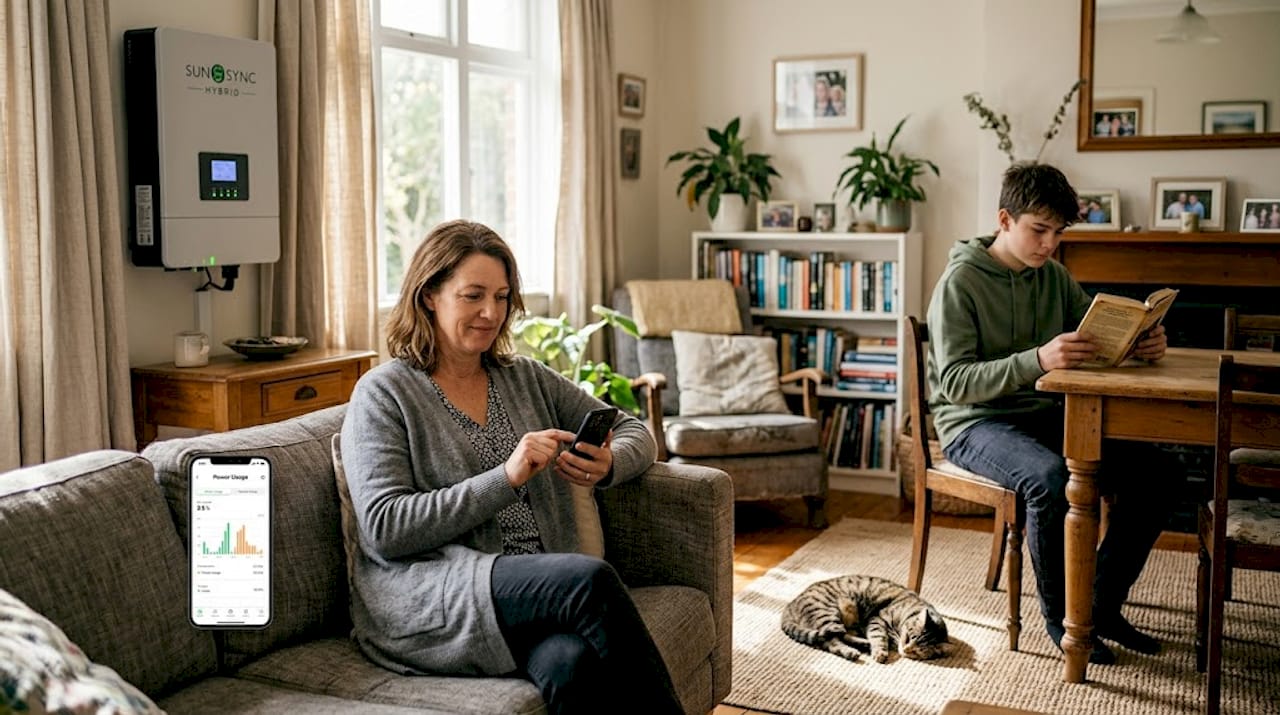
Real-time monitoring apps let you track energy production, consumption, and export from your phone. You can spot underperforming panels, catch faults early, and understand your usage patterns. This matters because degradation monitoring shows that undetected performance drops quietly erode your ROI over years.
Here’s what to look for in smart inverter features:
Real-time monitoring: Live production and consumption data via mobile app or web dashboard.
Dynamic tariff integration: The inverter or connected EMS adjusts when you export or store energy based on 15-minute price signals.
AI optimization: Predictive algorithms that learn your household patterns and adjust accordingly.
Grid support functions: Reactive power control, frequency response, and voltage regulation keep your system grid-compliant.
V2G/V2H readiness: Vehicle-to-grid and vehicle-to-home capability lets your EV battery act as a backup or trading asset.
“Smart features include real-time monitoring apps, AI optimization, dynamic tariff integration, V2G/V2H, and grid support functions that future-proof your solar investment.”
The Benelux grid is evolving fast. Belgium and the Netherlands are rolling out dynamic electricity pricing, meaning the value of your solar export changes by the hour. An inverter without dynamic tariff support leaves money on the table every single day.
Pro Tip: Check whether your inverter supports open communication protocols like Modbus or SunSpec. These allow integration with third-party energy management systems, including the Belinus EMS, without locking you into a single ecosystem.
Understanding energy management essentials shows how these features connect into a whole-home strategy. And if you want to understand the broader context, grid services in Benelux explains why grid support is becoming a financial opportunity, not just a technical requirement.
Comparing inverter types: String vs. micro vs. hybrid
Modern features differ by inverter type, so let’s see how your choices stack up. Choosing the wrong type for your roof layout or energy goals is one of the most common and costly mistakes Benelux homeowners make.
Feature | String inverter | Microinverter | Hybrid inverter |
Typical efficiency | 96 to 98% | 95 to 97% | 95 to 98% |
Lifespan | 10 to 15 years | 15 to 25 years | 10 to 15 years |
Shading tolerance | Low | High | Medium |
Battery integration | Requires add-on | Requires add-on | Built-in |
Cost | Lowest | Highest per panel | Mid to high |
Monitoring granularity | System-level | Panel-level | System-level |
Best for | Simple south-facing roofs | Complex or shaded roofs | Homes adding storage |
String inverter failure rates range from 0.5 to 5% per year, while microinverters tend to fail less frequently per unit but have more components overall. String inverters last 10 to 15 years, microinverters 15 to 25 years with proper maintenance.
Here’s a quick decision framework:
Choose string if your roof is unshaded, south-facing, and you want the lowest upfront cost.
Choose micro if you have multiple roof angles, dormer windows, or significant shading from trees or chimneys.
Choose hybrid if you plan to add battery storage now or within the next few years. This is increasingly the smart default for Benelux homeowners.
For a deeper look at how these fit into the full system, solar system components breaks down every piece of the puzzle. And for efficiency benchmarks across brands, solar inverter efficiencies provides useful comparisons.
Hybrid inverters are gaining ground fast in Belgium and the Netherlands because they position homeowners for battery storage and EV charging integration without a full system overhaul later.
Sizing, installation, and reliability: What to watch out for in Benelux
All that said, the way you size and maintain your inverter determines real-life performance. Even the best inverter underperforms when sized incorrectly.
The DC:AC ratio is the relationship between your total panel capacity (DC) and your inverter’s output rating (AC). DC:AC sizing of 110 to 150% is standard, with European regulations allowing up to 1.7 in some configurations. A ratio of 1.2 (120%) is a common starting point and matches the NEC rule used widely in system design.
DC:AC ratio | Effect | Recommended for |
Below 1.1 | Inverter undersized, clipping risk low but production lost | Rarely recommended |
1.1 to 1.3 | Balanced performance, minimal clipping | Most Benelux homes |
1.3 to 1.7 | More morning/evening harvest, some peak clipping | East-west split arrays |
Above 1.7 | Regulatory limit in most EU configurations | Not recommended |
Key things to watch during installation and over the system’s life:
IP65 or higher rating: Benelux humidity and rain make this non-negotiable.
Warranty terms: Confirm whether the warranty covers parts only or includes labor and on-site service.
Certified installers: In Belgium, Synergrid-compliant installation is required. In the Netherlands, check for NEN 1010 compliance.
Firmware update capability: Inverters that receive over-the-air updates stay grid-compliant as regulations evolve.
Inverter reliability data confirms that degradation is gradual but real. Most inverters lose 0.5 to 1% of output per year. Over 15 years, that compounds into a meaningful production gap if you’re not monitoring it.
Pro Tip: Ask your installer to document the initial baseline output at commissioning. This gives you a reference point to detect degradation early, before it quietly costs you hundreds of euros per year.
For Benelux-specific guidance, inverter sizing in Benelux and the solar power checklist are practical resources to work through before signing any installation contract.
Our perspective: What Benelux property owners often overlook in the inverter hunt
After reviewing all the specs and tables, here’s a hard-won perspective from years in the Benelux energy transition. Most homeowners fixate on peak efficiency numbers and brand names. That’s understandable, but it misses the bigger picture.
The inverters that deliver the best long-term ROI in Benelux are not always the ones with the highest spec sheet. They’re the ones with solid warranty support, active monitoring, and the flexibility to grow with your energy setup. Benelux’s humid climate accelerates component wear faster than drier regions. An inverter with a 10-year warranty from a brand with no local service presence is a risk, not a bargain.
What we see consistently is that homeowners who invest in real-time monitoring recover that cost within two years through early fault detection alone. And those who skip V2G/V2H readiness are already planning expensive retrofits as EV adoption accelerates across Belgium and the Netherlands.
Future grid integration is not a nice-to-have anymore. It’s the baseline for any system installed in 2026 and beyond. The full picture of solar, storage and EV integration makes clear why this connected approach is where the real savings live.
Ready to power up? See the smartest solar solutions for Benelux
If you’re ready to put these insights into action, here’s the next step for your smart energy journey. Choosing the right inverter is just the beginning. The real gains come when your inverter, battery storage, and EV charger work together through an intelligent energy management system.
At Belinus, we integrate Solis inverters (5 to 25 kW residential range) with our centralized EMS for 15-minute dynamic tariff optimization, real-time monitoring, and battery arbitrage. Whether you’re starting with solar only or building a full home energy system, our team helps you size, install, and future-proof your setup for Benelux conditions. Explore Belinus solar solutions and connect with our experts to get a system designed around your home, your grid, and your goals.
Frequently asked questions
What is the most important feature of a solar inverter for Benelux homes?
High efficiency and grid compatibility, including Synergrid certification and support for smart energy management, are critical for optimal results in Belgium and the Netherlands.
How long do solar inverters typically last?
String inverters last 10 to 15 years, while microinverters can reach 15 to 25 years with proper maintenance and monitoring.
How does inverter sizing affect solar system performance?
Proper DC:AC sizing of 110 to 150% ensures maximum energy extraction and prevents system overload, which is especially important for Benelux roof configurations.
What smart features help maximize energy savings?
Real-time app monitoring, AI optimization, and dynamic tariff integration help you extract the most value from your solar investment across changing grid prices.
Recommended
Comments