Top 5 Top Residential Energy Management Systems Alternatives 2026
- 2 hours ago
- 14 min read
Managing home energy use efficiently gets confusing when vendors tie software features to proprietary panels, require professional installation, or limit compatibility with third-party hardware. Most residential energy management software locks automation and device control behind closed ecosystems or bundles expensive hardware with the platform, making it tough for homeowners to find a flexible fit. This comparison lets you weigh price, automation level, and hardware integration across five residential energy management systems so you can match a solution to your home’s technical needs and budget.
Table of Contents
belinus energy

At a Glance
Belinus’s marketing materials advertise the Energy Wall G1 as a 16 kWh graphene supercapacitor priced at €7,000 and slated for a Q1 2026 launch. That product claim is the single most concrete detail the vendor highlights for residential customers.
The company combines panel manufacturing, storage hardware, and an energy management platform, positioning physical products and software as a single offering for homes and small businesses.
Core Features
Solar photovoltaic modules designed for high efficiency and long life, backed by the vendor’s stated extended warranty program.
Energy storage that emphasizes lithium-free approaches, including graphene supercapacitors and multiple battery chemistries for different use cases.
AI-powered energy management that optimizes consumption and supports energy trading and arbitrage at short intervals.
Residential hardware and services: Solis Inverters (5–25 kW), the ETAP Pro EV Charger with fleet features, and a quotation tool for long-term financial modeling.
Belinus also advertises commercial products such as utility-scale storage modules and a Belinus-branded power conversion system for critical infrastructure.
Key Differentiator
Belinus positions lithium-free supercapacitor storage together with a security token investment platform as core differentiators. That combination links physical storage hardware to an alternative financing route aimed at retail investors and project participants.
Pros
The vendor advertises extended warranties, citing up to 35 years for panels and 20 years for storage, which reduces long-term replacement risk for homeowners.
The mix of graphene supercapacitor options and traditional chemistries gives installers flexibility: fast-response storage for tariff arbitrage and higher-capacity units for daily self-consumption.
Native hardware lineup covers core residential needs: inverters, storage modules, and an EV charger that can be managed together through the EMS.
The company reports an AI-driven EMS that supports short-interval tariff optimization and real-time battery arbitrage, useful in markets with time-of-use pricing.
A quotation tool advertised for 25-year financial modeling helps households compare payback scenarios without manual spreadsheets.
Cons
Public technical documentation is limited; the website contains missing pages and sparse compatibility data, which makes system design and third-party integration unclear.
Who It’s For
Homeowners and small to medium enterprises in Europe who want a single vendor for panels, storage, and an AI energy manager and who are curious about non-lithium storage and tokenized investment models. Good for buyers willing to engage with a vendor-centric solution rather than assembling parts from multiple suppliers.
Unique Value Proposition
A centralized EMS that optimizes against 15-minute dynamic tariffs reframes how households use storage. By matching fast-response storage to sub-hourly price signals, Belinus aims to convert short price swings into measurable savings and faster payback for households with variable tariffs.
Real World Use Case
A homeowner installs rooftop PV with a lithium-free storage cabinet and a Solis inverter, links the setup to the Belinus EMS, and lets the AI shift charging and discharging around 15-minute price signals. Meanwhile the homeowner reviews a 25-year projection in the quotation tool and can opt to participate in a security token offering for part of the project.
Pricing
Public price lists are limited. Product pages are largely informational only, though the €7,000 figure for the Energy Wall G1 was advertised by the vendor and noted above. Many project costs will depend on site design, inverter sizing, and installer quotes.
Website: https://belinus.com
Emporia Energy Management Platform
At a Glance
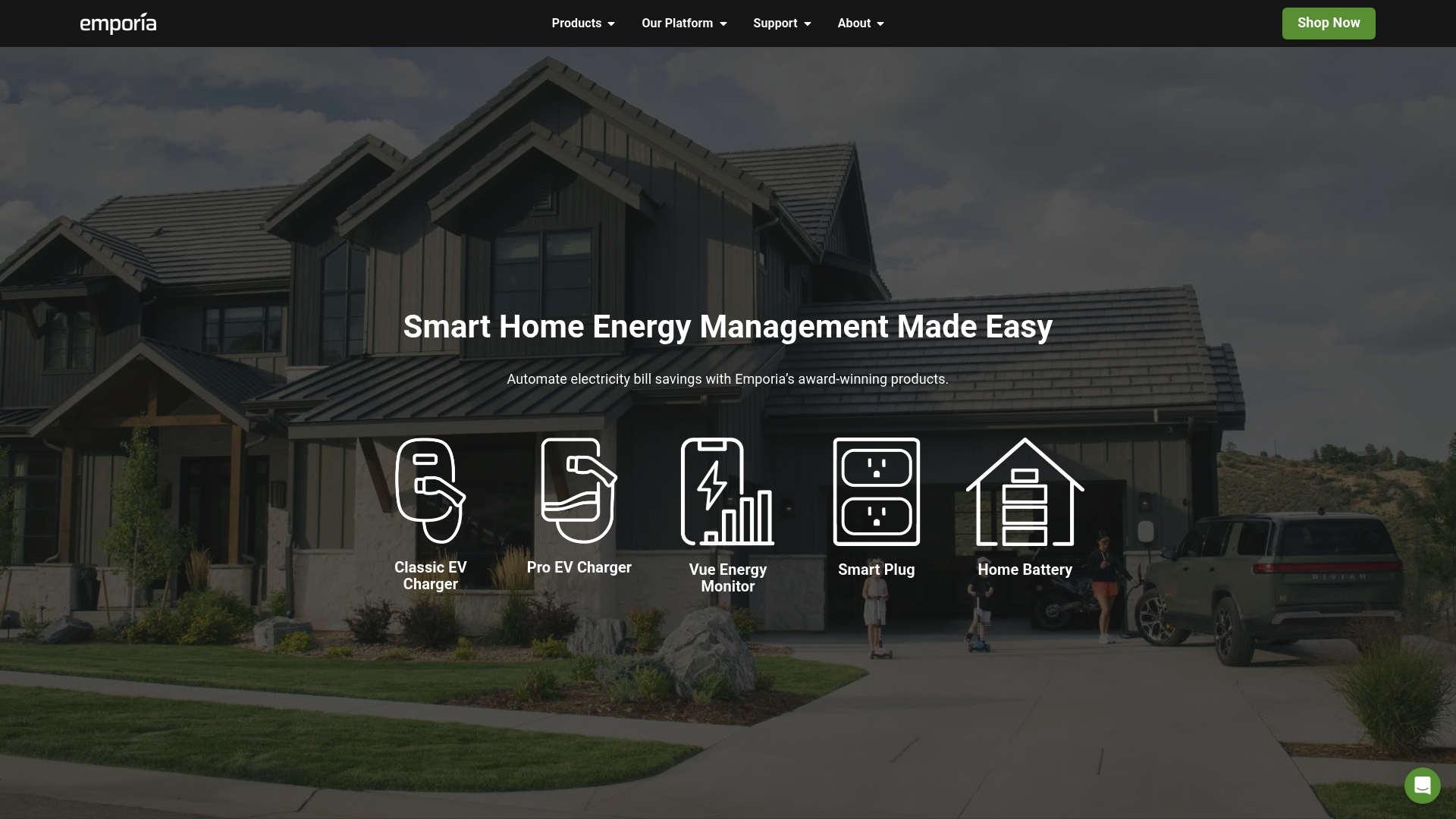
Circuit-level real-time monitoring tied to automated device control lets Emporia shift household loads and prioritize excess solar without daily micromanagement. The platform runs in the background and exposes data in mobile and web apps so you can act on savings opportunities.
Core Features
Real-time energy monitoring of home circuits and appliances for visibility at the outlet level.
Automated control that schedules devices and shifts loads to reduce bills and manage peaks.
Peak demand management tools designed to limit costly spikes on time of use tariffs.
Smart scheduling and automation for appliances and EV charging to match solar production.
Solar window support to route excess solar to loads or storage and maximise self consumption.
Key Differentiator
Emporia combines fine grained energy telemetry with rule based automation so decisions happen automatically rather than relying on manual timers. That tight loop between measurement and control is the main difference versus meter only solutions.
Pros
Provides detailed energy data that makes it simple to find high draw circuits and quantify savings opportunities.
The automated adjustments remove routine decisions from your day so loads shift to cheaper or solar rich hours.
Good support for solar integration including excess solar management which helps households use more of their own generation.
Compatibility with batteries and EV chargers makes the platform useful for owners building a small integrated home energy system.
Mobile and web app controls are straightforward which lowers the barrier for non technical homeowners.
Cons
Limited third-party review volume means fewer independent accounts to compare user experiences against the vendor claims.
Public documentation on wider device compatibility is thin so installers may need to verify specific hardware pairings before purchase.
The product data does not include detailed performance benchmarks or long term case studies that some buyers ask for.
When It May Not Fit
If you need vendor audited performance numbers or a long list of certified third-party integrations then Emporia may feel light on independent validation. Also skip this platform if you require an exhaustive compatibility matrix before any procurement decision.
Who It’s For
Homeowners in Europe who want to reduce bills, integrate rooftop solar, and automate EV charging or appliances without running complex energy software. It suits owner occupiers who want measurable control rather than a bare meter readout.
Real World Use Case
A homeowner uses Emporia to spot a high draw heater circuit. They create an automation to defer the dryer and schedule EV charging into midday solar. Peak demand events drop and more home generation is consumed locally rather than exported.
Pricing
The product data supplied is informational only and does not list prices. The vendor materials referenced here do not publish a clear retail price in the dataset provided so contact Emporia or an installer for current hardware and service costs.
Website: https://emporiaenergy.com
SPAN
At a Glance
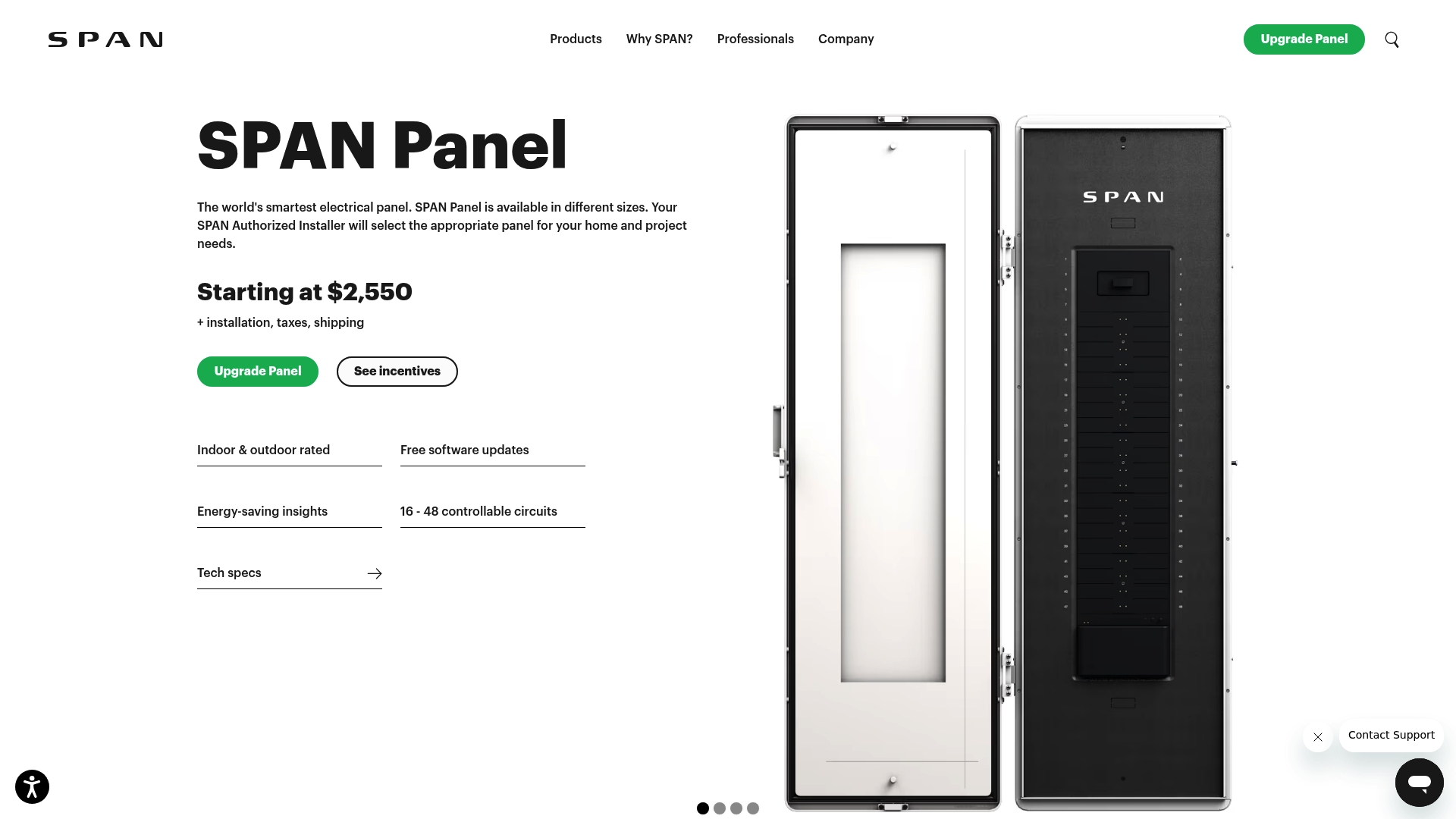
Starting at approximately $2,550 for the panel, SPAN sells an integrated, app-controlled electrical panel that delivers circuit-level control, backup readiness, and clear upgrade paths for solar and batteries. The product targets US residential projects and aims at homeowners, builders, and certified installers.
Core Features
Smart, controllable electrical panels with per-circuit switching and monitoring for immediate load control and selective backup.
Home energy management app included with every install for monitoring, scheduling, and remote circuit control from a phone or tablet.
Compatibility with a range of battery storage options and renewable energy systems for staged electrification.
Product lines and installation workflows designed for both new construction and retrofit upgrades.
Support for EV chargers, heat pumps, and other electrification appliances to centralize home energy control.
Key Differentiator
SPAN’s main edge is a single hardware device that replaces a conventional breaker panel and ties every circuit into an app. That integration makes circuit-level automation and backup management straightforward. Compared with firms that sell separate EMS layers and inverters, SPAN concentrates the control plane inside the home’s electrical panel.
Pros
The panel lets you turn circuits on and off remotely, which is a practical way to prioritize backup power during outages rather than guessing which circuits to shed.
App-driven scheduling and per-circuit timers give visible, actionable control that helps reduce wasteful standby loads.
Designed for staged expansion: you can add batteries or PV later without swapping the panel, so future upgrades are lower friction.
Installer-focused documentation and product packaging make it easier for electricians and builders to spec SPAN into projects.
The product portfolio covers both new builds and retrofits, which shortens the procurement path for developers and renovators.
Cons
The upfront hardware cost is higher than a traditional breaker panel, which puts SPAN out of reach for tight budgets.
Independent third-party reviews and long-term field performance data are limited, making risk assessment harder for cautious buyers.
Ongoing cloud or subscription fees are a potential concern for homeowners who prefer fully local control.
Installation complexity generally requires certified professionals, adding labor cost and coordination time compared with simple panel swaps.
When It May Not Fit
If your home is outside the US, SPAN’s regional support and regulatory focus make it a poor match. Budget-sensitive projects that need the lowest upfront cost will find traditional panels cheaper. If you want a strictly local, cloudless solution, SPAN’s app-centric model may clash with that preference.
Who It’s For
Tech-savvy homeowners, property developers, and professional installers who plan staged electrification and value circuit-level control. Buyers who want a panel that doubles as an expansion hub for batteries, solar, and EV charging will appreciate SPAN’s product focus.
Real World Use Case
A homeowner planning an all-electric refit hires a certified electrician to swap a legacy panel for a SPAN unit. After install, the homeowner uses the app to schedule EV charging overnight, remotely disable high-draw circuits during peak prices, and reserve specific circuits for battery backup during outages.
Pricing
Panels start at approximately $2,550, plus installation, taxes, and shipping. Final cost depends on system size, the number of circuits, retrofit complexity, and whether you add battery or PV integration at install.
Website: https://span.io/panel
Energy Sentry

At a Glance
The vendor advertises an industry-leading 25-year warranty with lifetime support on its panel-mounted demand controllers. Energy Sentry sells flat national packages starting at $15,000 for a single AC circuit and up to $20,000 for six circuits, all installed and programmed by certified technicians.
Core Features
Real-time demand monitoring and automated load shedding that targets large thermal loads at the electrical panel.
Professional installation with custom programming to match specific utility demand-rate schedules and homeowner priorities.
Compatibility with solar PV and battery storage and a modular design that expands to additional AC units and water heaters.
Key Differentiator
The vendor advertises a 45-plus year track record in residential demand control and positions reliability as the core claim. That history and the device focus mean Energy Sentry emphasizes hardware durability and field-proven control logic rather than app-first smart home features.
Pros
The vendor reports a less than 1% failure rate across thousands of installations, which supports long-term uptime expectations for a hardware device.
Autonomous operation maintains comfort while preventing demand spikes, so homeowners do not need to manually manage cycles or schedules.
Works with a wide range of demand-based rate plans, letting households capture savings where utility tariffs penalize peak demand.
Flat pricing bundles include hardware, installation, and long-term support, simplifying financial planning for an expensive capital purchase.
Cons
Tailored to demand-based tariffs; homeowners on flat energy-only rates will not see meaningful value from this system.
Requires professional installation and commissioning, which adds logistics and upfront scheduling compared with plug-and-play devices.
Controls only large thermal storage loads; it does not manage small plug-in devices, lighting, or appliance-level smart plugs.
When It May Not Fit
If you rent your home or move frequently, the high upfront capital and professional install make it a poor match. Homes served by time-of-use or flat rates without demand charges will likely recover cost much more slowly.
If your load profile is dominated by small, intermittent devices rather than several high-load AC units or water heaters, this system will not capture those savings.
Who It’s For
Homeowners in states with demand-based electricity pricing who own multiple high-load appliances and often face peak demand charges. Owners with solar or battery systems who want integrated demand control and prefer long warranties and US-made hardware will find the product aligned with their priorities.
Real World Use Case
A solar-equipped homeowner with three AC units hires a certified installer to set priorities for comfort circuits and EV charging. The controller cycles thermal loads only when aggregate demand threatens the utility threshold, and the homeowner notices lower demand line items on successive bills while comfort remains intact.
Pricing
Energy Sentry uses flat national pricing: packages start at $15,000 for one AC system with professional installation and scale to about $20,000 for control of six AC systems. All packages include hardware and are backed by the warranty above.
Website: https://energysentry.net
Loxone Energy Management System
At a Glance
Automatic balancing of generation, storage, and demand is built into the platform as a core behavior rather than an add-on. The system ties real‑time monitoring to building functions and automates shading, hot water, and climate to reduce wasted energy.
Core Features
Real-time energy flow monitoring across generation, storage, and loads for immediate visibility.
Automatic generation, storage, and demand balancing that can prioritise self consumption and reduce grid draw.
Integration with PV systems, battery storage, heat pumps, and meters to coordinate devices.
Automated shading and climate control to shift loads and cut heating or cooling demand.
Load and hot water optimization routines to schedule high consumption when generation is available.
Key Differentiator
Loxone connects energy logic directly to broader building automation so lights, blinds, heating, and storage act as one system. That makes it narrower than Belinus, which couples EMS to specific PV, battery, and EV product stacks; Loxone focuses on building control as the energy optimization mechanism.
Pros
Platform stability and scale are praised by implementers, which translates to fewer surprises during multiroom deployments.
Strong cross domain control reduces manual coordination between services like shading, HVAC, and storage.
Energy savings routines for hot water and load shifting provide measurable operational savings in buildings with solar.
Flexible automation rules let installers tune behavior for seasonal and occupant patterns without extensive scripting.
Suitable for projects that want energy management embedded inside the building automation platform rather than bolted on.
Cons
The platform can depend on third‑party cloud services or apps, introducing external dependencies for some integrations.
Multiple reports describe actuator control issues; actuators that misbehave increase installation time and service calls.
High per‑actuator costs become visible when clients ask for extra functions beyond the basic configuration.
Hardware reliability concerns reported by users raise the prospect of higher maintenance budgets over time.
When It May Not Fit
If your site has legacy devices that lack clear compatibility, Loxone may require hardware replacement to perform as advertised. Also avoid it if your priority is a strictly hardware-first EMS that bundles specific PV or battery brands rather than building automation logic.
Who It’s For
Building automation professionals, property managers, energy managers, and architects who want energy logic embedded in control systems. Best when an experienced integrator can map existing HVAC and shading actuators into the platform and tune automation rules.
Real World Use Case
An apartment complex uses Loxone to monitor PV output, direct battery charging, and stagger hot water heating across apartments. Automated shading reduces peak cooling loads, and daily self consumption rises as the system shifts flexible loads to solar hours.
Pricing
No public list price is provided. Pricing depends on project scope, number of actuators, and integration complexity, so installers and resellers typically provide quotes after a site survey.
Comparative Analysis of Residential Energy Management Systems
Residential energy management has evolved significantly, offering consumers advanced tools for optimizing energy usage, integrating renewable sources, and reducing costs. Among the reviewed systems, notable differences in feature sets, operational approaches, and pricing are apparent.
Energy Ecosystem Integration
Belinus Energy and SPAN emphasize ecosystem support, but with distinct strategies. Belinus focuses on integrating solar photovoltaics, next-generation storage systems (including lithium-free options), and AI-driven management into a whole. This is advantageous for users seeking a unified solution from a single vendor. SPAN, in turn, distinguishes itself with app-controlled smart panels providing per-circuit automation and future-proof expandability for residential setups. While SPAN excels in granular home automation, Belinus’s offer includes complete ownership of energy generation and management assets.
Regional Suitability and Installation Specifics
For region-specific solutions, Emporia and Energy Sentry stand apart. Emporia delivers cost-efficient real-time monitoring and control tools well-suited to the European market, emphasizing energy autonomy for flat-rate energy tariffs. Conversely, Energy Sentry tailors its offerings to U.S.-based residences with demand-based billing structures, focusing on high-load appliances and long-term hardware stability. This makes it a favored choice in markets with significant peak-time demand penalties yet less relevant for flat-rate geographies.
Best Fit Scenarios
Belinus Energy suits users aiming for a fully integrated energy management ecosystem, from solar installation to advanced dynamic energy pricing optimization.
Span is ideal for tech-savvy homeowners prioritizing per-circuit automation and modular expandability without needing immediate solar or battery integration.
Emporia provides an affordable entry for energy-conscious households seeking real-time monitoring and autonomous load management without requiring extensive configurations.
Energy Sentry appeals to American customers with large-scale high-demand setups and a need for durable, autonomously managed hardware.
Our Pick
Belinus Energy excels in situations where, single-provider solutions are desired, encompassing advanced energy generation, management, and storage. However, users prioritizing modular or highly automatable solutions should explore options like SPAN or Emporia to align with their framework preferences.
Comparison of Residential Energy Management Systems
Deciding which energy management platform aligns with your specific needs involves evaluating features, differentiation, and suitability for various setups.
Product | Core Feature or Use Case | Key Differentiator | Best For | Pricing | Notable Limitation |
Belinus | Energy management with AI for tariff optimization | Combines lithium-free storage with investment options | Homeowners and SMEs seeking integrated solutions | €7,000 | Limited public technical documentation impacts system design clarity. |
Emporia Energy | Real-time monitoring with device automation | Fine-grained telemetry with rule-based automation | Homeowners needing simple solar integration and automation | Not disclosed | Limited independent reviews and performance benchmarks available. |
SPAN | App-controlled electrical panel enabling circuit control | Integration of circuit automation directly through an electrical panel | US homeowners planning staged electrification | $2,550 | Regional availability limited primarily to the United States. |
Energy Sentry | Real-time demand monitoring for load shedding | Emphasis on reliability with proven field performance | Homes opposing peak demand charges with multiple AC units | $15,000+ | Limited compatibility to demand-based tariffs rather than flat-rate or time-of-use setups. |
Loxone | Building automation connecting energy flow and management | Integrates energy logic with building automation for holistic optimization | Large-scale residential or mixed-use properties | Not disclosed | Reliability concerns with actuator installations may raise maintenance costs. |
Discover How Belinus Offers a Top Residential Energy Management Systems Alternative
Choosing the right energy management system can feel daunting when faced with overwhelming choices and the challenge of optimizing your home’s solar, storage, and EV charging. This article highlights the need for intelligent solutions that combine dynamic tariff optimization, lithium-free storage options, and real-time energy management to give you greater control and faster savings.
Belinus stands out by integrating a graphene supercapacitor Energy Wall G1, Solis inverters, and the ETAP Pro EV charger into a centralized EMS that manages 15-minute dynamic tariffs. With flexible hardware plus AI-driven energy arbitrage, you get a system designed just for you. Explore how Belinus’s intelligent platform bundles solar PV, EV charging, and battery storage into seamless control that reduces guesswork and maximizes your energy savings.

Don’t let system complexity hold you back. Visit Belinus now to access detailed product info, get your 25-year financial modeling quotation, and take control of your home energy like never before.
Frequently Asked Questions
What advantages does Belinus offer for energy storage compared to other systems?
Belinus provides flexible energy storage options, including lithium-free approaches like graphene supercapacitors, making it suitable for various household needs. Their storage solutions emphasize rapid response for tariff arbitrage while also enabling higher-capacity units for daily use, catering to diverse homeowner requirements. If you’re considering a tailored energy solution, the flexibility in Belinus’s offerings makes it an appealing choice.
How does Belinus’s warranty compare to other residential energy management systems?
Belinus offers extended warranties, claiming up to 35 years for solar panels and 20 years for energy storage, which significantly reduces replacement risks for homeowners. In contrast, Energy Sentry offers a 25-year warranty on its panel-mounted demand controllers but lacks the same breadth of options offered by Belinus. Homeowners prioritizing long-term reliability may prefer the extended coverage from Belinus.
What is the difference between Belinus and Emporia Energy when it comes to energy management features?
Emporia Energy excels in providing detailed energy data for circuit-level monitoring and automated load control, which streamlines household energy management. Meanwhile, Belinus focuses on integrating AI-driven energy management that optimizes consumption, particularly in dynamic pricing scenarios. Homeowners can choose based on if they value circuit-level granularity or comprehensive AI optimization.
Can Belinus be integrated with other energy systems like EV chargers or solar panels?
Yes, Belinus is designed to work with a variety of hardware, including Solis Inverters and ETAP Pro EV Chargers, as part of a comprehensive residential energy management system. This makes it a strong candidate for homeowners looking to create an interconnected energy setup. When planning your system, consider how well Belinus’s compatibility aligns with your existing or planned devices.
How does Belinus support homeowners in optimizing their energy costs?
Belinus utilizes an AI-powered energy management system that optimizes consumption and supports energy trading, particularly beneficial in markets with variable tariffs. With such technology, homeowners can adjust their energy usage to capitalize on fluctuating rates, making Belinus an effective option for budget-savvy consumers. Exploring this feature could lead to significant savings on energy bills.
Recommended
Comments