What Is Adaptive Energy Systems: A Practical Guide
- 5 hours ago
- 9 min read
TL;DR:
Adaptive energy systems continuously monitor real-time data, automatically adjusting operations for improved efficiency and resilience. They outperform fixed-rule systems by optimizing energy use, extending equipment life, and reducing peak loads within a short ROI period. Adoption involves integrating with existing infrastructure, defining clear objectives, and ongoing human oversight for sustained performance.
Most people assume energy systems simply deliver power from point A to point B. What is adaptive energy systems, then, and why does it matter? Unlike traditional setups that follow fixed rules regardless of conditions, adaptive energy systems continuously read real-time data, learn from it, and adjust their behavior automatically. The practical payoff is significant. Adaptive control delivers ROI within 2 years, with lasting gains in efficiency, resilience, and cost reduction. Whether you manage a home solar setup or a commercial facility, this guide gives you a clear picture of how these systems work and what they can do for you.
Table of Contents
Key Takeaways
Point | Details |
Adaptive systems are dynamic | They adjust in real time using AI, sensors, and live data rather than fixed schedules or static rules. |
ROI arrives faster than expected | Most deployments reach payback in under 2 years through lower energy costs and reduced operational waste. |
Efficiency gains are measurable | Flexible scheduling cuts voltage deviations, power losses, and peak load demand by up to 38%. |
Adoption is simpler than it sounds | Existing SCADA and building automation systems often need only minimal hardware additions to become adaptive. |
Human oversight still matters | The best adaptive systems keep domain experts in the loop for rapid tuning without deep technical retraining. |
What adaptive energy systems are and how they work
An adaptive energy system is a control and management architecture that continuously monitors energy inputs, outputs, and conditions, then adjusts its operation to optimize performance. The word “adaptive” is doing real work here. These systems do not wait for a human to reprogram them. They use sensor data, predictive algorithms, and in some cases AI models to shift behavior in response to changing demand, pricing signals, weather, or equipment status.
There are three main categories worth understanding:
Building Energy Management Systems (BEMS): These monitor and control HVAC, lighting, and electrical loads inside a building. An adaptive BEMS learns occupancy patterns and weather forecasts to pre-cool or pre-heat spaces before peak tariff windows.
Hybrid Energy Systems: These combine multiple sources such as solar, wind, battery storage, and grid supply. AI-based adaptive algorithms are essential here because the intermittent nature of renewables demands constant recalibration.
Adaptive Control Systems for Microgrids: These manage distributed energy resources across a defined grid zone, balancing generation and load while maintaining stability even if one source drops out.
The core mechanism running beneath all three is a feedback loop. Sensors feed data to a central controller. The controller runs predictive models to forecast demand and generation. It then dispatches commands: charge the battery now, export to the grid, reduce HVAC load by 10%. After each action, the system measures the outcome and updates its model.
Modern adaptive systems also support what researchers call “human-in-the-loop” control. Domain experts can update model behavior in minutes without extensive data science resources, which is critical for operators who need to respond to new fault types or site-specific conditions quickly.
Pro Tip: If you are evaluating adaptive energy management platforms, ask vendors specifically how long it takes for the system to incorporate new operational rules after a site change. The answer should be minutes, not weeks.
Benefits of adaptive energy systems for homes and businesses
The performance numbers from recent research are hard to ignore. Flexible energy scheduling reduces voltage deviations by 24.4%, cuts power losses by 32.8%, and lowers peak load capacity requirements by 38.3%. For a business paying demand charges based on peak consumption, that last figure alone can translate into thousands of dollars in annual savings.

Battery longevity is another area where adaptive management outperforms static charging schedules. Adaptive battery charging systems reduce battery aging by approximately 24.67% and extend cycle life by 23%. For a commercial fleet operator or a facility running large-scale storage, that means significantly deferred capital replacement costs.
The benefits span several dimensions:
Cost reduction: Dynamic tariff optimization means the system charges storage when electricity is cheap and dispatches it during expensive peak periods.
Renewable integration: Adaptive systems absorb the variability of solar and wind far more effectively than fixed-rule controllers, reducing curtailment and wasted generation.
Grid resilience: In microgrid configurations, adaptive controls can isolate faults and reroute power flows automatically, keeping critical loads running.
Cluster-level coordination: Coordinating storage across building clusters yields up to 15% additional energy savings compared to managing each building individually.
For homeowners, the clearest benefit is lower bills with less manual intervention. For businesses, it is the combination of operational savings, equipment longevity, and the ability to participate in grid services markets that makes the investment compelling. You can explore how real-time adaptive management delivers those savings in practice.
Adaptive versus traditional fixed-rule systems
Traditional energy management relies on fixed schedules and threshold-based rules. The system charges the battery between midnight and 6 AM because that was programmed during installation. It doesn’t know that the grid tariff changed, that tomorrow will be cloudy, or that a heat wave is arriving. It just follows its script.
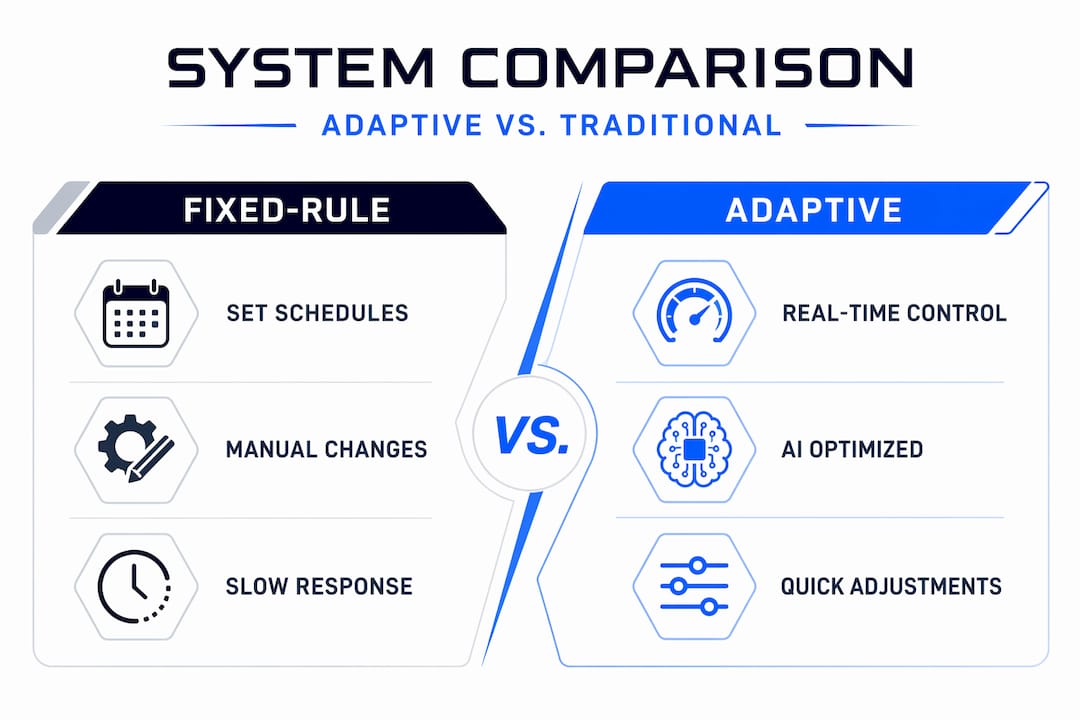
Adaptive systems replace the script with a continuously updated model. The contrast in performance is striking.
Feature | Traditional fixed-rule systems | Adaptive energy systems |
Response to tariff changes | Manual reprogramming required | Automatic adjustment in real time |
Renewable variability handling | Limited, causes curtailment | Predictive algorithms absorb fluctuation |
Fault response | Alarm and shutdown | Rerouting and load balancing |
Battery management | Fixed charge/discharge cycles | Optimized cycles extend battery life |
Energy savings potential | Baseline efficiency only | Up to 38% reduction in peak load |
Operator update speed | Hours to days | Minutes via human-in-the-loop tools |
Shifting from fixed logical controls to adaptive AI is described by researchers as critical to managing renewable generation variability effectively. The stochastic nature of solar and wind output simply overwhelms rule-based systems over time. Adaptive algorithms treat that variability as a solvable optimization problem, not an inconvenience.
Hybrid energy configurations illustrate the gap most clearly. A fixed-rule hybrid system might prioritize battery charging from solar during daylight hours. An adaptive hybrid system weighs solar forecast, grid price forecast, upcoming demand peaks, battery state of health, and temperature, then decides the optimal combination for the next 15-minute interval. The advantages of adaptive control in hybrid systems come from exactly that multi-variable optimization.
Pro Tip: When comparing energy management platforms, ask for a live demonstration of how the system responds to a simulated price spike or generation drop. A fixed-rule system will do nothing. An adaptive system will visibly respond within seconds.
Real-world applications and latest innovations
Adaptive energy systems are no longer theoretical. They are running in military reservation microgrids, smart commercial buildings, EV charging networks, and large-scale utility installations today.
Military and critical infrastructure microgrids: The Adaptive Control for Energy Systems (ACES) project at Arizona State University demonstrated that adaptive controls integrate into existing microgrid infrastructure with minimal hardware additions. The primary challenge was legacy system interoperability, not hardware cost.
Smart commercial buildings: Adaptive modular hybrid modeling in complex multi-energy buildings estimates energy consumption with an error below 7.5% and can recover accurate performance modeling in under 30 minutes after an operational disruption.
EV adaptive charging: Real-time adaptive management prevents demand peaks during simultaneous charging events. Systems monitor fleet schedules, grid pricing, and available solar generation to sequence charging intelligently.
One of the most significant recent developments is in adaptive AI architecture. Traditional machine learning models require retraining cycles that can take days or weeks. New adaptive AI systems recognize new fault types from just a few examples and align with updated field priorities in minutes.
“The biggest bottleneck in operational AI is not accuracy but fast alignment with field priorities. Adaptive AI closes that gap with response times in minutes.”
Looking further ahead, researchers at institutions like Syracuse University’s BioInspired Institute are developing adaptive energy materials that self-regulate energy and heat flows at the microstructural level. These materials blur the line between the physical structure of a building and its energy system, pointing toward a future where the building itself participates in energy management. You can see how these trends connect to managing multiple energy technologies in today’s grid.
Getting started with adaptive energy systems
Adopting adaptive energy systems does not require a full infrastructure overhaul. The practical path forward is incremental and starts with an honest assessment of what you already have.
Audit your current infrastructure. Identify whether your facility has SCADA, a building automation system, or smart meters already in place. Adaptive controls are designed to integrate with pre-existing systems, so your starting point determines the integration path, not the destination.
Define your primary objective. Cost reduction, renewable maximization, battery longevity, and grid service participation each require different optimization priorities. Clarity here shapes the software configuration.
Address data communication gaps. The most common implementation barrier is not hardware cost but legacy system interoperability. Confirm that your existing equipment can communicate via standard protocols before selecting a platform.
Choose a platform with human-in-the-loop capability. Your operations team needs to be able to update rules and priorities without filing a support ticket with a vendor’s data science team.
Plan for continuous tuning. Adaptive systems improve with use, but they need qualified operators reviewing performance and adjusting parameters as your energy profile evolves seasonally.
Pro Tip: Start with a single building or zone as a pilot. Measure baseline performance for 30 days, then activate adaptive control and compare. The data from that pilot will justify broader rollout far more convincingly than any vendor case study.
My take on where adaptive energy is heading
I’ve spent years watching building owners and facility managers layer new technologies onto fundamentally static control philosophies and wonder why their bills don’t drop. The technology wasn’t the problem. The architecture was.
What strikes me about adaptive energy systems is that they finally match the actual complexity of how energy flows. A solar array, a battery, a grid tariff, a changing weather pattern, and 50 employees arriving at different times each morning are not a fixed-rule problem. They are a continuous optimization problem. Adaptive systems treat them that way.
The operational challenge I see most often is the assumption that deploying an adaptive system is a one-time event. It isn’t. The human-in-the-loop requirement is real. Teams that invest in training operators to interpret system outputs and tune model behavior see dramatically better results than those who treat it as a set-and-forget appliance.
What most people miss about the scalability of adaptive solutions is that the same core architecture runs from a 16 kWh home battery to a multi-megawatt utility installation. The modularity is not a marketing claim. It is a structural feature. That means organizations can pilot small, prove ROI, and scale with confidence rather than committing to a full overhaul upfront.
The sustainability upside is real and compound. Better battery management extends equipment life. Better renewable integration reduces curtailment. Better peak management reduces the need for fossil peaker plants on the grid. Each benefit reinforces the others.
— Marc
How Belinus can help you get there

Belinus has built its entire product architecture around the adaptive energy management principles covered in this article. The Belinus EMS runs on 15-minute dynamic tariff optimization, manages battery arbitrage in real time, and supports multiple storage technologies including graphene supercapacitors and LFP chemistry through a single platform. The system connects via RESTful API to third-party devices and delivers full visibility through a native mobile app and web dashboard.
Whether you are a homeowner exploring the Energy Wall G1 storage solution, a business managing an EV fleet with the ETAP Pro charger, or a commercial operator building toward utility-scale capacity, Belinus provides the adaptive intelligence layer that makes each component work harder. Explore the full range of adaptive energy solutions and see how Belinus positions your operation for long-term energy independence.
FAQ
What is an adaptive energy system in simple terms?
An adaptive energy system is a control platform that monitors real-time data from energy sources, storage, and demand, then automatically adjusts how energy is generated, stored, and consumed to optimize efficiency and cost.
How long does it take to see ROI from adaptive energy systems?
Most adaptive control deployments reach return on investment within 2 years, driven by lower energy bills, reduced peak demand charges, and extended battery life.
Do adaptive energy systems require replacing existing equipment?
Not typically. Adaptive controls are designed to integrate with pre-existing building automation, SCADA, and smart meter infrastructure. The main implementation challenge is ensuring data communication compatibility between legacy systems.
What is the difference between an energy management system and an adaptive energy system?
A standard energy management system follows pre-programmed rules and schedules. An adaptive energy system continuously updates its behavior based on real-time data, forecasts, and AI-driven optimization, delivering significantly better performance as conditions change.
Can adaptive energy systems improve battery performance?
Yes. Adaptive battery charging reduces battery aging by approximately 24.67% and extends cycle life by 23%, which meaningfully lowers the total cost of ownership for storage assets over their operational lifetime.
Recommended
Comments