What is battery cycling? Energy storage guide for 2026
- Mar 21
- 7 min read

Most homeowners believe battery cycling means draining your battery completely and recharging it to 100%. That’s only part of the story. Battery cycling is the process of repeatedly charging and discharging a battery, where one cycle equals 100% of the battery’s rated capacity throughput, which can be accumulated from multiple partial discharges. Understanding how cycling really works helps you maximize your energy storage investment, reduce replacement costs, and support Europe’s sustainable energy transition. This guide explains battery cycling mechanics, degradation factors, chemistry comparisons, and European regulatory context to help you optimize your home or commercial energy system.
Table of Contents
Key Takeaways
Point | Details |
Cycle basics | Battery cycling is the repeated charging and discharging of a battery, and one cycle equals using 100 percent of its rated capacity, even if energy is delivered through partial discharges. |
Partial cycling counts | Partial discharges accumulate toward the total cycle count, so shallow cycling still contributes to wear and should be managed rather than ignored. |
Charge range limit | Configure daily cycling to stay roughly between twenty and eighty percent to extend battery life and reserve full capacity for backup use. |
DoD impact | A shallower depth of discharge extends cycle life, and operating between twenty and eighty percent can reliably double cycles versus a hundred percent depth. |
Temperature effects | Temperature strongly affects aging, with temperatures above 25 Celsius accelerating chemical degradation and temperatures below 0 Celsius reducing capacity and increasing resistance. |
Understanding the basics of battery cycling
Battery cycling represents the fundamental operating pattern of any energy storage system. Each time your battery charges and discharges, it completes a portion of its total cycle life. The critical insight most people miss is that partial cycles accumulate toward your total count.
If you discharge your battery 40% today and 60% tomorrow, you’ve completed one full cycle even though you never emptied it completely. This matters tremendously for battery storage setup because shallow cycling typically extends battery lifespan compared to deep discharges.
Here’s what you need to know about cycle counting:
Two 50% discharges equal one complete cycle
Four 25% discharges equal one complete cycle
Partial cycling doesn’t reset or reduce total cycle count
Modern battery management systems track cumulative throughput automatically
The misconception that only full 0-100% cycles count leads homeowners to mismanage their systems. You might think keeping your battery between 20-80% means you’re not cycling it, but you’re actually completing cycles at a slower, healthier rate. This approach preserves battery chemistry and extends operational life, which translates directly to better return on your energy storage investment.
Pro Tip: Configure your energy management system to limit charge ranges between 20-80% for daily cycling. Reserve full capacity only for backup power scenarios or grid outages.
Key factors affecting battery cycle life and degradation
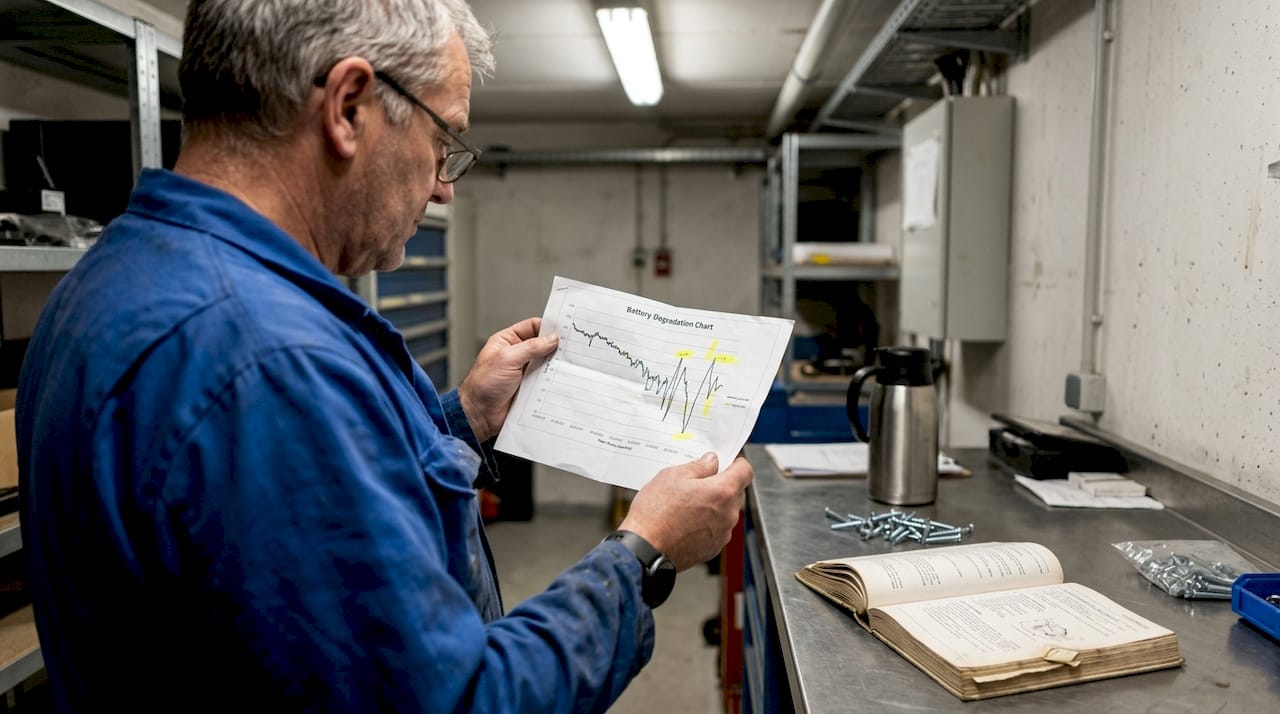
Battery degradation follows predictable patterns based on how you operate your system. Mechanics involve Depth of Discharge (DoD), C-rate, temperature, and State of Charge (SoC) ranges; shallower DoD (e.g., 20-80%) extends cycle life. Each factor influences chemical reactions inside your battery cells, accelerating or slowing the aging process.
Depth of Discharge directly impacts how many cycles your battery delivers. A battery cycled between 20-80% (60% DoD) can last twice as long as one cycled from 0-100%. The chemical stress on electrodes increases exponentially at extreme charge states, causing faster degradation at the margins.
C-rate measures how quickly you charge or discharge relative to battery capacity. A 1C rate means fully charging or discharging in one hour. Higher C-rates generate more heat and mechanical stress, reducing cycle life. For home energy storage, typical C-rates range from 0.2C to 0.5C, balancing performance with longevity.
Temperature creates the most dramatic impact on battery aging. Operating above 25°C accelerates chemical degradation, while temperatures below 0°C reduce available capacity and increase internal resistance. European climates generally favor battery longevity, but installations in poorly ventilated spaces or direct sunlight face accelerated aging.
Degradation mechanisms: Cycle aging (SEI growth, Li plating, electrode cracking) vs. calendar aging (time-based at high/low SoC). Cycle aging occurs from repeated charge-discharge operations, while calendar aging happens simply from time passing, especially when batteries sit at extreme charge states.
Implementing energy storage best practices means managing all these factors simultaneously. Your battery management system should optimize charge rates, maintain moderate temperatures, and avoid extreme SoC ranges during normal operation.
Key degradation factors:
Depth of discharge: Shallower cycles preserve capacity longer
Charge/discharge rate: Lower C-rates reduce mechanical stress
Operating temperature: 15-25°C range optimizes longevity
State of charge storage: Avoid storing batteries at 100% or 0% for extended periods
Pro Tip: Install batteries in temperature-controlled environments and configure your EMS to maintain 50% SoC during extended non-use periods. This simple step can add years to your system’s operational life.
Comparing battery chemistries: cycle life standards and performance
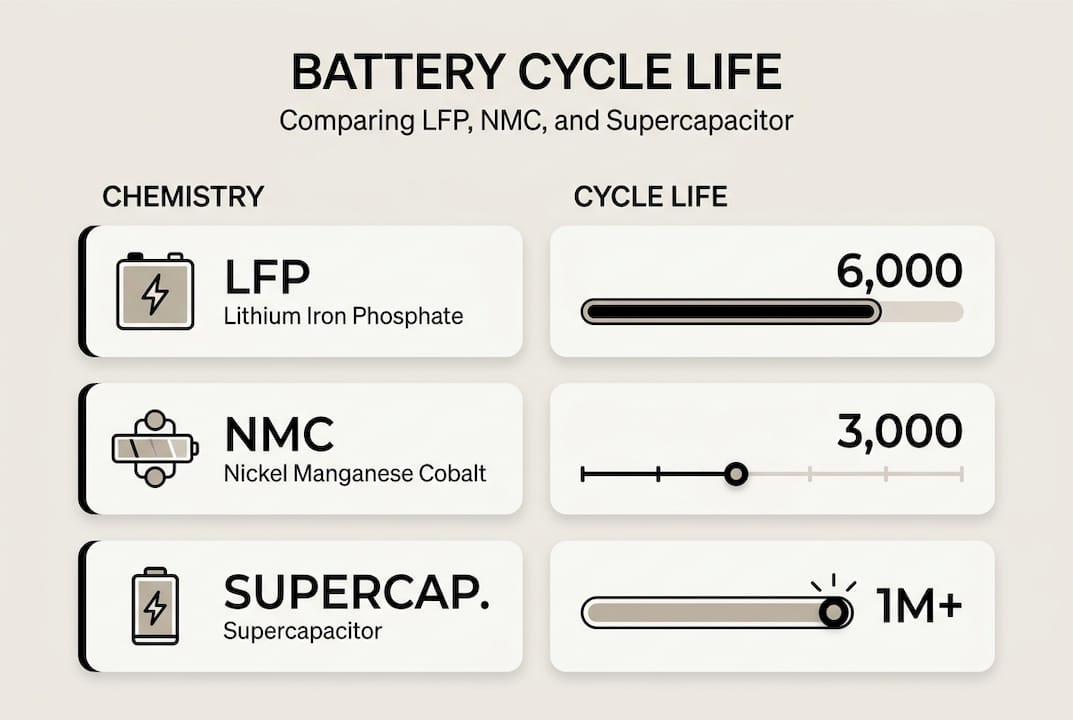
Different battery chemistries deliver vastly different cycle life performance. Empirical benchmarks for home ESS: LFP 3,000-6,000+ cycles to 80% capacity; NMC 1,000-3,000 cycles. This performance gap directly impacts total cost of ownership and replacement planning for your energy storage investment.
Chemistry | Typical cycle life | Capacity retention | Best applications |
LFP (Lithium Iron Phosphate) | 3,000-6,000+ cycles | 80% at end of life | Daily cycling, grid services, long-term residential |
NMC (Nickel Manganese Cobalt) | 1,000-3,000 cycles | 80% at end of life | Backup power, occasional cycling, high energy density needs |
Graphene supercapacitor | 1,000,000+ cycles | Minimal degradation | High-frequency cycling, power quality, fast response |
LFP chemistry dominates residential and commercial installations because of superior cycle life and thermal stability. The iron phosphate cathode structure remains stable through thousands of cycles, making it ideal for daily solar self-consumption and grid arbitrage applications.
NMC batteries offer higher energy density, fitting more capacity into smaller spaces. This advantage matters for applications where physical size constraints outweigh longevity concerns. However, the shorter cycle life means more frequent replacements in daily-cycling scenarios.
Graphene supercapacitors represent emerging technology with virtually unlimited cycling capability. Belinus’s Energy Wall G1 uses this technology to deliver 16 kWh capacity with minimal degradation over decades of operation. The €7,000 price point reflects the premium for this extended lifespan.
Choosing the right battery technology types depends on your specific use case. Daily solar cycling favors LFP chemistry, while backup-focused systems might accept NMC’s shorter life for better energy density. Commercial installations with frequent cycling increasingly specify LFP or advanced supercapacitor technology.
Pro Tip: Calculate total cost per cycle, not just upfront cost per kWh. An LFP battery costing 20% more but delivering twice the cycles costs 40% less per cycle over its lifetime.
Battery cycling in the European context: standards and energy management
Europe leads global battery regulation with comprehensive frameworks for tracking, performance, and end-of-life management. Europe context: Battery passports track cycle data, performance standards for stationary storage; second-life for ESS encouraged. These regulations create transparency and support circular economy principles that extend battery value beyond first-life applications.
Battery passports document complete lifecycle information including manufacturing origin, cycle history, capacity degradation, and chemical composition. This data enables accurate valuation for second-life applications and ensures proper recycling at end of life. Starting in 2026, all batteries above 2 kWh capacity sold in Europe require digital passports.
European performance standards specify minimum cycle life and safety requirements for stationary energy storage. These benchmarks protect consumers and ensure grid-connected systems meet reliability thresholds. Residential systems typically must demonstrate 3,000+ cycles to 70% capacity retention under standard test conditions.
Second-life battery applications extend value by repurposing EV batteries or first-life storage systems into less demanding roles. A battery degraded to 70% capacity remains useful for backup power or low-frequency cycling applications. This cascading use model reduces waste and improves overall system economics.
Complying with European battery regulations involves these steps:
Select batteries with digital passport capability and certified cycle life data
Implement monitoring systems that track cumulative cycles and capacity degradation
Maintain documentation for warranty claims and second-life qualification
Plan for end-of-life recycling through approved collection networks
Consider grid service programs that monetize cycling capability while maintaining battery health
The future energy storage Europe landscape emphasizes integration between first-life and second-life applications. Your residential battery might eventually power a small commercial backup system, then provide grid stabilization services before final recycling. This circular approach maximizes resource utilization and reduces environmental impact.
European energy management systems increasingly optimize cycling patterns based on dynamic tariffs and grid signals. Belinus’s centralized EMS performs 15-minute tariff optimization, cycling batteries when price differentials justify the capacity throughput. This intelligent cycling balances financial returns against battery degradation costs.
Discover Belinus solutions for your battery storage needs
Optimizing battery cycling requires more than understanding the theory. You need integrated systems that automatically manage charge patterns, temperature, and cycling frequency based on your energy goals and battery chemistry. Belinus delivers comprehensive energy solutions combining advanced battery technology with intelligent management systems.

Our Energy Wall G1 graphene supercapacitor system eliminates cycling concerns with 1,000,000+ cycle capability, while our LFP-based solutions offer proven performance for daily solar self-consumption. The centralized EMS optimizes every charge and discharge decision, extending battery life while maximizing your energy savings. Explore how Belinus can transform your energy storage strategy with technology designed for European markets and sustainable energy futures.
Frequently asked questions
What is battery cycling?
Battery cycling is the repeated process of charging and discharging a battery through its operational life. One complete cycle represents 100% of the battery’s rated capacity moving in and out, which can accumulate from multiple partial charges and discharges rather than requiring a full 0-100% swing.
How do partial cycles count towards total battery life?
Partial cycles accumulate proportionally toward your total cycle count. If you discharge 30% of capacity three times, you’ve completed 90% of one cycle. Modern battery management systems track cumulative throughput automatically, so two 50% discharges equal exactly one full cycle regardless of timing or sequence.
Why does battery cycling affect lifespan?
Each cycle causes incremental chemical and mechanical changes inside battery cells, including electrode degradation, electrolyte decomposition, and internal resistance growth. These changes gradually reduce capacity and performance. Shallower cycles and moderate temperatures slow this degradation, extending the total number of cycles before replacement becomes necessary.
How can homeowners monitor battery cycling effectively?
Most modern energy storage systems include monitoring apps or web dashboards showing cumulative cycles, current capacity, and degradation trends. Check your battery management system for cycle count, state of health percentage, and temperature logs. These metrics help you verify warranty compliance and plan for eventual replacement based on actual usage patterns.
Why do cycling profiles matter for energy management?
Different cycling patterns create vastly different battery lifespans and economic returns. Daily shallow cycling for solar self-consumption optimizes both energy savings and battery longevity. Deep cycling for backup power reduces total cycle life but provides critical resilience. Your energy management system should balance cycling frequency, depth, and rate to match your priorities while preserving battery health.
Recommended
Comments