What Is Connected Energy? A 2026 Guide for Europe
- 1 hour ago
- 9 min read

TL;DR:
Connected energy involves digitally coordinated systems where distributed assets like solar panels, batteries, and EV chargers work together under active control to optimize electricity flow. EU regulation mandates active monitoring and control, enabling virtual power plants that aggregate resources to provide grid services, savings, and resilience. Success relies on integrated management systems; early enrollment in programs allows participants to maximize benefits and help shape Europe’s energy future.
Most people think connected energy just means plugging a solar panel into the grid or buying a smart thermostat. That framing misses the point entirely. What is connected energy, really? At its core, it describes a digitally coordinated system where distributed energy assets like solar panels, batteries, EV chargers, and flexible loads work together under active control to optimize how electricity flows. In Europe, this concept is increasingly formalized through regulation and technology, and understanding it matters whether you own a home, manage a factory, or invest in renewables.
Table of Contents
Key Takeaways
Point | Details |
Connected energy is a system, not a device | It coordinates multiple distributed assets through digital control, not just individual gadgets. |
EU regulation defines the framework | Smart grid rules under EU Regulation 2022/869 require active monitoring and control of all connected users. |
Virtual Power Plants make it practical | VPPs aggregate homes and businesses into a collective resource that acts like a single power plant. |
Benefits go beyond bill savings | Grid stability, renewable integration, and community resilience are equally significant outcomes. |
Enrollment unlocks full value | Owning connected devices only delivers maximum returns when enrolled in flexibility and orchestration programs. |
What is connected energy and how the EU defines it
The connected energy definition in European policy goes further than most people expect. Under EU Regulation 2022/869, smart electricity grids must enable cost-efficient, secure integration of renewable sources while ensuring active digital monitoring and control of all connected users, including prosumers who both produce and consume electricity. That last part matters. Connected energy is not passive. Grid operators are expected to see, measure, and act on what every connected asset is doing in near real time.
The industry term that sits at the center of this is smart grid. Connected energy is the broader concept describing the coordinated ecosystem, while smart grids are the physical and digital infrastructure making that coordination possible. Think of it this way: connected energy is the strategy, and smart grids are the operating system.
“Connected energy isn’t just about adding assets. It’s about grid operators digitally monitoring and controlling users to achieve sustainability and efficiency at scale.” — EU Smart Grid Framework
A key model bringing this to life is the Virtual Power Plant, or VPP. VPPs aggregate distributed energy resources — batteries, solar installations, EV chargers, flexible industrial loads — and coordinate them to provide grid services that were once only possible with large fossil fuel plants. A neighborhood of homes with solar and battery storage, an office park with smart EV chargers, and a factory that can shift its demand on command can all behave, together, like a single controllable power station.
What makes this relevant for European households and businesses right now:
Prosumer participation is now recognized by EU regulation, meaning you have a legal framework to both produce and sell flexibility.
Distributed energy resources (DERs) are defined components of national energy systems, not fringe add-ons.
Grid operators across Europe are required to offer access to connected users and manage them actively, opening doors for individuals and companies to earn from their assets.
Connected energy technologies and real-world examples
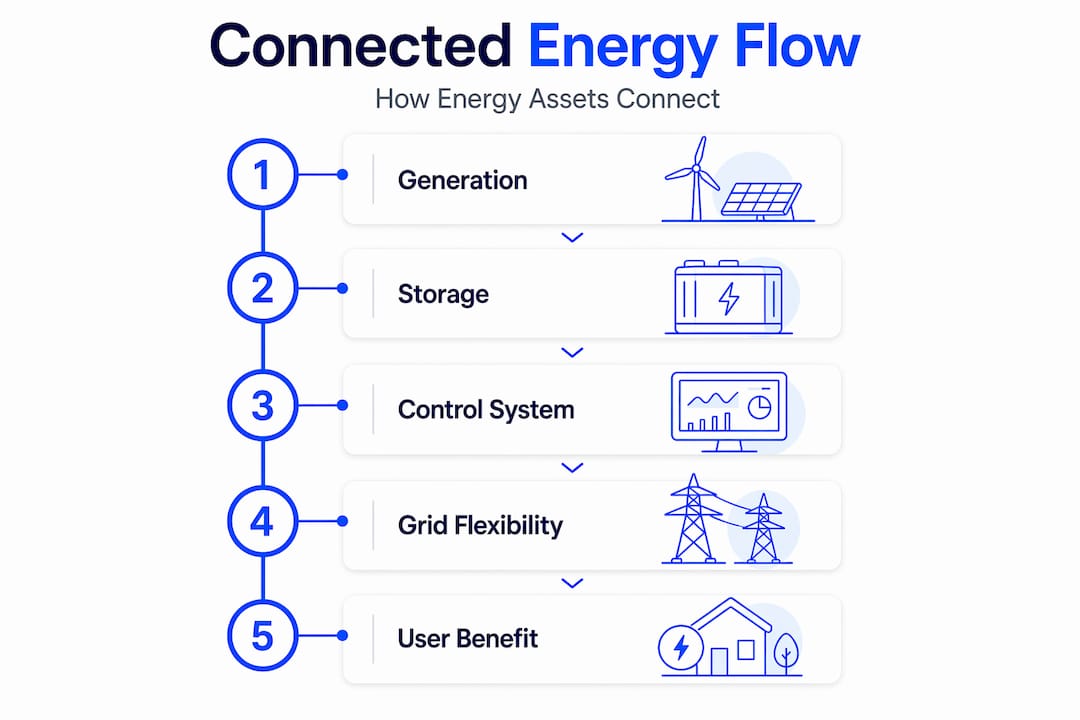
The technologies behind how connected energy works are more accessible than the jargon suggests. The building blocks fall into three categories: generation, storage, and control.
On the generation side, rooftop solar photovoltaic systems are the most common entry point across Europe. A residential 10 kW system producing more than the household consumes during the day becomes a connected energy asset the moment it feeds back into the grid. Scale that up to a commercial installation and the role of distributed energy grows significantly.
Storage is where the real flexibility comes from. Battery energy storage systems, ranging from home-scale units to utility-scale deployments, allow energy to be charged when prices are low or generation is high, then discharged when the grid needs it. An interesting development gaining traction in Europe is the use of second-life EV batteries repurposed for commercial or grid-scale storage. These batteries, retired from vehicles but still holding significant capacity, lower the cost of storage while keeping materials in use longer.
EV chargers are increasingly active participants too. A fleet of company vehicles plugged in overnight represents a significant battery bank. With smart EV charging, that fleet can charge during cheap off-peak hours, pause during grid stress, or even discharge back into the building or grid under certain conditions.
Here is a snapshot of connected energy asset types and their roles:
Asset type | Primary function | Grid service provided |
Rooftop solar PV | Local generation | Feed-in, frequency support |
Battery storage (home/commercial) | Energy shifting | Arbitrage, balancing, reserves |
EV chargers (smart/V2G) | Flexible load or discharge | Demand response, peak shaving |
Flexible industrial loads | Demand adjustment | Frequency regulation, load shifting |
Second-life EV batteries | Low-cost stationary storage | Grid balancing, arbitrage |
The control layer ties everything together. Software platforms, energy management systems, and APIs communicate with each asset in real time, scheduling charge and discharge cycles, responding to price signals, and coordinating across hundreds or thousands of devices simultaneously. Software coordination enables small, distributed resources to act collectively like a central power plant, which is something none of them could do alone.
Pro Tip: If you are evaluating connected energy technologies, prioritize systems with open APIs and compatibility with your country’s grid operator protocols. Proprietary platforms can lock you out of flexibility programs and limit your long-term earning potential.
Benefits of connected energy and the challenges you should know
The benefits of connected energy span both economic and environmental dimensions, and they compound when assets are well coordinated.
For individuals and households, the clearest wins are:
Lower energy bills through arbitrage: buying cheap, selling or avoiding expensive peak electricity.
Revenue from grid services: participating in demand response or VPP programs pays real incentives.
Energy independence: stored solar power covers consumption during outages or price spikes.
Carbon footprint reduction: shifting load to times when renewables dominate the grid cuts emissions without changing behavior.
For businesses, the impact of connected energy scales quickly. A company with a 500 kWh battery system and a fleet of EV chargers can generate meaningful income from grid balancing services while cutting its energy procurement costs. DERs provide localized grid services that maintain voltage limits and frequency regulation in ways central plants simply cannot reach, which is why grid operators across Europe are paying for this capability.
Community energy projects and VPPs extend these benefits further. When aggregated, households and small businesses collectively deliver grid stability and earn shared rewards. This is where connected energy shifts from a personal financial decision to a community resilience strategy.

The challenges are real, though. High initial costs, complex storage integration, and the need for advanced management technology remain the main barriers. Coordinating multiple assets across different vendors, grid tariff structures, and regulatory environments requires both capital and technical expertise. Many European SMEs find this coordination burden more daunting than the hardware cost itself.
Pro Tip: Work with a provider that offers an integrated Energy Management System rather than buying hardware and software separately. Managing connected energy assets through a single platform with 15-minute tariff optimization cuts both the complexity and the time it takes to start generating returns.
How connected energy works in practice across Europe
Understanding the theory is one thing. Seeing how it plays out for a real participant is what makes it click.
Enrollment in a connected energy program typically follows a straightforward sequence:
Asset registration: Your battery, solar system, or EV charger is registered with an aggregator or utility program, with technical specifications logged.
Connectivity setup: The asset is connected to a central management platform via API or IoT protocol, giving the operator visibility and control.
Program enrollment: You agree to a flexibility contract specifying when and how the operator can adjust your asset’s behavior, and what you receive in return.
Dispatch and scheduling: The platform schedules charge and discharge events around grid constraints, price signals, and renewable availability, automatically.
Settlement and payment: Your contribution to grid services is metered and you receive your agreed incentive, whether that is a bill credit, feed-in payment, or direct revenue.
Customers enrolled in VPP programs receive incentives beyond the standard benefits of asset ownership, compensating them for the control rights they grant. This is an important distinction: you are not just being rewarded for having solar or a battery. You are being paid for making it available to the grid’s needs on demand.
Third-party aggregators play a major role here, particularly for smaller participants. A residential customer with a single 10 kWh battery has no meaningful leverage with a grid operator alone. But an aggregator representing 2,000 such homes in Belgium or Germany becomes a significant flexibility provider that can negotiate grid contracts and share the proceeds. Grid flexibility programs across Europe are expanding to accommodate exactly this model.
Consider a mid-sized logistics company in the Netherlands. It installs 200 kWh of battery storage, adds smart chargers for its delivery fleet, and connects a rooftop solar system. Through an aggregator, the entire system is enrolled in a demand response program. During a grid stress event on a Tuesday afternoon, the platform automatically delays fleet charging by 90 minutes and discharges 80 kWh from the battery to the grid. The company notices nothing operationally. Its monthly settlement shows €340 in grid service revenue on top of the energy cost savings.
That is connected energy working exactly as designed.
My honest take on connected energy’s potential in Europe
I’ve spent years working alongside European energy projects, and the single biggest mistake I see from newcomers is treating connected energy as a product purchase rather than a system they join. Buying a battery is not the same as participating in connected energy. Owning devices without enrollment in orchestration workflows leaves most of the financial and grid value untouched.
What I find genuinely underappreciated is how dramatically small resources scale up when aggregated. A single household battery is a rounding error for a grid operator. Ten thousand of them, coordinated by software, rival a gas peaker plant in responsiveness and capacity. Europe is at the early stages of that aggregation curve, which means the participants who enroll now will set the terms that latecomers inherit.
My advice to anyone exploring this space: do not wait for the perfect technology moment. The regulatory framework is already in place. The incentive structures are being built. The transition to smart energy is happening whether individual actors participate or not. The only question is whether you capture value from it or simply pay for it through your utility bill.
— Marc
How Belinus helps you connect to the energy future
Belinus designs energy systems specifically for the connected energy model, whether you are a homeowner looking to maximize solar and storage returns or a business managing a large fleet and commercial-scale battery assets. The Belinus Energy Management System runs 15-minute dynamic tariff optimization across your solar, storage, and EV charging assets, coordinating them as a single intelligent unit. Its RESTful API connects to third-party aggregators and grid operator platforms, so your assets are always enrollment-ready for VPP and demand response programs.
For businesses, the Belinus flexible energy solutions cover everything from custom CNI installations to utility-scale storage. For households, the Energy Wall G1 and Solis inverter lineup integrate directly with the Belinus EMS for full connected energy participation. Explore the full range at Belinus and see how your assets can start working for the grid and for you.
FAQ
What is the connected energy definition in simple terms?
Connected energy describes a system where distributed assets like solar panels, batteries, and EV chargers are digitally monitored and coordinated by a central platform to optimize electricity use and provide grid services. It is the integration of generation, storage, and control across many locations.
How does connected energy work for homeowners?
Homeowners enroll their solar, battery, or EV charger in a flexibility program managed by an aggregator or utility. The platform automatically schedules when assets charge or discharge based on grid signals and energy prices, and homeowners receive financial incentives in return.
What are the main benefits of connected energy for businesses?
Businesses benefit from reduced energy procurement costs through arbitrage, direct revenue from grid balancing services, and improved energy resilience. Localized grid services from DERs also position businesses as active participants in Europe’s energy transition.
What connected energy technologies do I need to participate?
The core technologies are a solar PV system, a battery storage unit, or a smart EV charger, combined with an energy management system that connects to grid operator or aggregator platforms via digital protocols. Smart grid integration is the enabling layer that makes participation possible.
Are there challenges to adopting connected energy?
Yes. High upfront investment and integration complexity are the main barriers, alongside the need for software platforms that can coordinate assets across different vendor ecosystems and regulatory environments. Working with a single integrated provider significantly reduces this burden.
Recommended
Comments