What is energy asset monitoring? A guide for Europe
- 12 hours ago
- 9 min read

TL;DR:
Energy asset monitoring involves continuous collection and analysis of performance data to prevent issues and optimize asset lifespan. It is essential for real-time decision-making, fault detection, and ensuring regulatory data access, especially under European standards. Implementing integrated monitoring workflows and automation transforms data into actionable insights, maximizing energy efficiency and cost savings.
Most people assume energy asset monitoring begins and ends with installation: put up solar panels, plug in a battery, mount an EV charger, and you’re done. That’s the hardware. What actually protects your investment is what comes after: the continuous, data-driven process of energy asset monitoring. It means collecting performance data in real time, spotting problems before they cost you money, and turning raw numbers into decisions that lower bills and extend the life of every asset you own. Whether you manage a home solar setup or a commercial facility across multiple sites, this guide gives you the full picture.
Table of Contents
How energy monitoring systems work for buildings and facilities
Making monitoring actionable: beyond dashboards to maintenance and optimization
Comparing energy asset monitoring approaches and getting started
Why continuous, integrated monitoring is a game changer for energy asset management
Explore Belinus solutions for seamless energy asset monitoring
What is energy asset monitoring and why does it matter?
Energy asset monitoring generally refers to continuously collecting data from energy-related assets and using that data to track performance, detect anomalies, and support maintenance and optimization decisions over time. It is not a one-time configuration. It is an ongoing process that runs in the background every minute your solar panels are generating, your battery is cycling, or your EV charger is drawing current from the grid.
Think about what that means in practice. A solar panel that underperforms by 15% due to a faulty connection might not trigger any obvious alarm. But energy asset tracking software will flag the deviation automatically because it knows what normal output looks like for that panel on that day in those weather conditions. Without monitoring, you could lose months of generation before anyone notices.
The core elements of energy asset monitoring include:
Real-time data collection via IoT sensors and smart meters at the asset level
Performance benchmarking that compares actual output against expected thresholds
Anomaly detection that flags deviations before they become failures
Maintenance triggers that convert data signals into service actions
Historical reporting that supports audit trails and financial planning
“Energy asset monitoring generally refers to continuously collecting data from energy-related assets and using that data to track performance, detect anomalies, and support maintenance and optimization decisions over time.” — IBM
The importance of energy monitoring becomes very tangible when you consider asset lifecycles. A well-monitored lithium iron phosphate battery loses significantly less capacity over ten years than one that cycles without any data oversight. Understanding energy management explained is the foundation for seeing why monitoring is not optional, it is the mechanism that keeps your investment performing as promised.
European data regulations shaping energy monitoring access

Before you can monitor energy assets effectively, you need reliable access to your own consumption data. In Europe, that access is now a legal right, not a courtesy from your utility provider.
EU Regulation 2023/1162 sets interoperability requirements and procedures for access to electricity metering and consumption data by final customers and eligible parties, covering both historical and near-real-time data. In plain terms: your energy data belongs to you, and the systems that hold it must make it accessible in formats that work across different platforms and monitoring tools.
For homeowners and facility managers, this regulation matters in three direct ways:
Near-real-time access means monitoring software can pull data from your meter at short intervals rather than waiting for monthly bills
Interoperability requirements ensure your monitoring platform can speak to your meter regardless of who your supplier is
Historical data access supports performance comparisons, financial modeling, and verification after system changes
This is particularly relevant if you are managing industrial energy monitoring across multiple buildings or a campus environment, where data standardization across dozens of meters can otherwise become a serious technical obstacle. The regulation removes that barrier and puts data control firmly in your hands.
How energy monitoring systems work for buildings and facilities
For commercial and residential buildings, energy performance monitoring is typically delivered through a Building Energy Management System, or BEMS. Think of a BEMS as the central nervous system for your energy infrastructure. It collects interval data from utility meters, submeters, and environmental sensors, then organizes everything into a single view.
In facility contexts, energy monitoring platforms pull interval data from meters and sensors into a single platform for constant monitoring, alerts, KPI visibility, and measurement and verification after changes. The “measurement and verification” step is often overlooked but critically important. It means that after you upgrade insulation, replace an inefficient HVAC unit, or add battery storage, your system actually confirms the energy savings in the data rather than estimating them on paper.
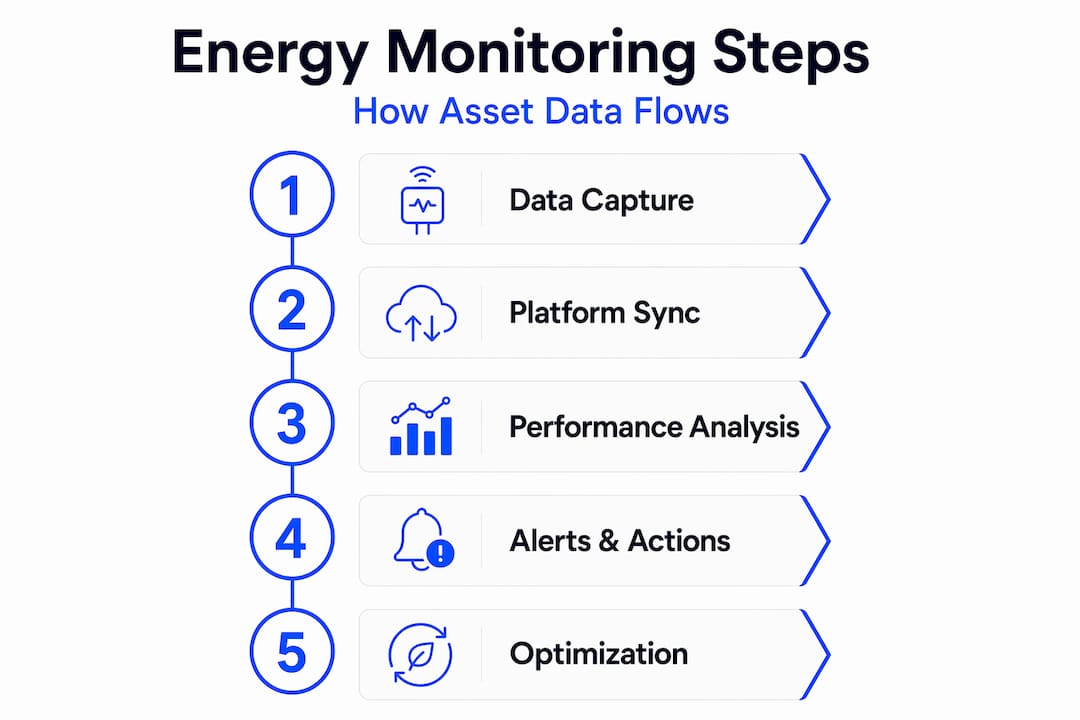
Here is how a typical BEMS workflow looks in practice:
Layer | What it does | Example |
Data collection | Pulls readings from meters and sensors | Smart meter, inverter telemetry |
Aggregation | Combines multiple data streams | Solar + grid + battery data |
KPI reporting | Tracks performance against targets | kWh per square meter per month |
Alerts | Flags anomalies or threshold breaches | Battery not charging as expected |
M&V | Confirms savings after changes | Post-upgrade consumption comparison |
Energy efficiency monitoring at the building level also supports your energy asset lifecycle management, helping you make informed decisions about when to repair, upgrade, or replace aging equipment. For a deeper look at that process, energy asset lifecycle management explains how data-driven decisions extend asset value over time.
Pro Tip: Set up submeters for each major load in your building from day one. Utility-level data tells you how much energy you used. Submeters tell you where it went, which is the only information that actually drives cost reduction.
Making monitoring actionable: beyond dashboards to maintenance and optimization
A dashboard showing you live solar output is satisfying. But it does not fix a degrading string of panels on its own. The real value of energy asset analytics comes from what the system does when it finds a problem.
Monitoring that only provides dashboards often under-delivers unless it supports alerting and action workflows, like turning anomalies into work orders and verifying savings. The gap between “we saw a problem” and “we fixed a problem” is where most energy value is lost. Bridging that gap requires automated workflows, not just better charts.
The evolution from passive dashboards to proactive management is happening fast. AI agents now use continuous data to detect faults, generate work orders, and verify fixes in solar energy operations, moving from passive monitoring to proactive management. What used to require a technician reviewing data manually can now happen automatically within minutes of a fault event.
Here is how to build a genuinely actionable monitoring workflow for your assets:
Establish baseline performance profiles for each asset so deviations are measurable, not subjective
Set tiered alerts that distinguish minor inefficiencies from urgent faults requiring immediate action
Connect alerts to workflows so a triggered alert automatically creates a task or service request
Assign resolution ownership so alerts do not sit in an inbox unactioned
Run post-repair verification to confirm that the fix actually restored expected performance
Review trend data monthly to catch gradual degradation that point-in-time alerts miss
Pro Tip: Verification after a repair is as important as the repair itself. If your solar output does not recover to the pre-fault baseline, the root cause may not have been addressed fully. Monitoring proves it either way. Explore how real-time energy management can drive measurable savings when monitoring is paired with action.
“AI agents use continuous data to detect faults, generate work orders, and verify fixes in solar energy operations, moving from passive monitoring to proactive management.” — Energy Central
Comparing energy asset monitoring approaches and getting started
Not all monitoring solutions are built for the same situation. A homeowner with a 6 kWp solar system and a single battery has different needs than a facility manager overseeing 500 kW of rooftop generation and a fleet of EV chargers. Understanding the options helps you choose the right level of investment.
Advanced anomaly detection can generate around $1,000 per MW per year in avoided downtime and improved energy capture. At scale, that makes premium monitoring pay for itself quickly. At the residential level, the math is different, but the principle holds: catching a fault early is always cheaper than discovering it on your next bill.
Approach | Best for | Key features | Typical cost |
Basic smart meter + app | Single-home solar setup | Real-time consumption, export tracking | Low, often included |
BEMS with submetering | Commercial buildings | KPI tracking, M&V, alerts, multi-meter | Medium to high |
AI-driven asset platform | Large solar, storage, EV fleets | Predictive maintenance, work order automation | Premium |
Integrated EMS with API | Multi-asset sites, arbitrage | Dynamic tariff response, grid services | Varies by provider |
How to start with energy efficiency monitoring without getting overwhelmed:
Begin with your utility meter and inverter data feeds, which are usually available at no extra cost
Add submeters at circuit level for your highest-consumption loads or assets
Use your EMS dashboard to establish performance baselines in the first 30 days
Layer in alerting and reporting once baselines are confirmed
Review your energy asset analytics quarterly to identify optimization opportunities
For a practical overview of how these pieces work together across solar, storage, and EV charging, the guide on energy management for solar storage and EVs is a useful starting point.
Why continuous, integrated monitoring is a game changer for energy asset management
Here is the uncomfortable truth about most energy monitoring deployments: the dashboard gets checked for the first two weeks, then forgotten. The system keeps running, the data keeps accumulating, and nobody looks at it until something obviously breaks. That is not monitoring. That is expensive data storage.
The legacy view treats monitoring as a reporting tool, something that generates charts for an annual review. But effective energy asset monitoring should be understood as an ongoing feedback loop: monitor, detect, decide, maintain and optimize. That cycle needs to run continuously, and it needs to be connected to people and workflows who can act on what it finds.
The facilities and homes that get the most from their energy assets are not the ones with the fanciest dashboards. They are the ones where monitoring is integrated into daily operations. An alert triggers a check. A check confirms a fault. A fault triggers a fix. A fix gets verified. That loop, repeated consistently, is what separates assets that degrade slowly and quietly from ones that perform at capacity year after year.
AI and automation are accelerating this shift. But the underlying logic does not require cutting-edge technology. It requires commitment to closing the loop between data and action. A homeowner who checks their inverter data every week and acts on anomalies will outperform a facility that has a premium BEMS but no one assigned to respond to its alerts. Start with top tips to cut costs to see how actionable monitoring translates directly into euros saved.
The asset management in the energy sector is moving toward integrated, continuous intelligence. The homeowners and facility managers who embrace that model now will be in a much stronger position when grid tariffs shift, energy prices spike, or their assets hit the middle years of their lifecycle.
Explore Belinus solutions for seamless energy asset monitoring
Understanding how energy asset monitoring works is the first step. Putting it into practice is where Belinus comes in. Whether you are managing a home solar and battery setup or a commercial site with EV charging infrastructure, Belinus builds energy solutions that give you real-time visibility and the tools to act on what you see.

The Belinus platform integrates solar PV, battery storage such as the Energy Wall G1, and EV chargers from Evonity into a single Energy Management System with 15-minute dynamic tariff optimization. You get a native mobile app and web dashboard, RESTful API for third-party integrations, and IoT-ready fleet management for facilities running company car charging. Belinus also supports EU data interoperability standards, so your monitoring setup is regulation-ready from day one. If you are serious about maximizing what your energy assets deliver, Belinus gives you the infrastructure to make it happen.
Frequently asked questions
What devices are typically monitored in energy asset monitoring?
Energy asset monitoring commonly includes solar panels, inverters, battery storage systems, and electric vehicle charging stations to track performance and detect issues early. Smart meters and environmental sensors are also standard components in most monitoring setups.
How does EU regulation affect my access to energy consumption data?
EU Regulation 2023/1162 ensures you can access your electricity consumption data, including near-real-time readings, in a secure and interoperable format to support better energy management decisions. This means monitoring platforms can legally pull your data from utility systems without relying on the provider’s goodwill.
Can energy asset monitoring help reduce my energy costs?
Yes. By continuously tracking performance and identifying inefficiencies or faults early, energy asset monitoring helps you act before small problems become expensive ones. Effective energy asset management reduces costs, improves sustainability, and extends the operational life of your infrastructure.
What is the difference between BEMS and BMS?
A BEMS focuses on energy insights and KPIs, turning data into trends and optimization opportunities, while a BMS focuses on controlling physical building systems like HVAC for comfort and operational reliability. In practice, modern facilities often use both in combination.
Recommended
Comments