Why Modular Battery Systems Matter for Energy Savings
- Feb 18
- 7 min read

Finding practical ways to adapt energy infrastructure can feel challenging for property developers and energy managers across Central Europe. The quest for scalable modular battery systems is driven by real needs for greater efficiency and cost control in residential and commercial projects. With innovations in modular battery technologies, this article uncovers how flexible solutions are reshaping energy storage, giving decision-makers tools to future-proof their investments while navigating regulatory and financial complexities.
Table of Contents
Key Takeaways
Point | Details |
Flexibility of Modular Systems | Modular battery systems provide adaptability, allowing for customized energy solutions tailored to specific needs and enabling future reconfigurations. |
Economic Incentives in Central Europe | Regulatory frameworks in Central Europe are driving investments in modular battery technologies, aligning with sustainability goals and opening up economic opportunities. |
Integration with Energy Platforms | These systems enhance the interoperability of solar, grid, and electric vehicle connections, fostering efficient energy management and dynamic load balancing. |
Financial Risks and Strategic Planning | Understanding financial dynamics and risks associated with modular battery investments is crucial for making informed decisions and optimizing long-term benefits. |
What Modular Battery Systems Mean Today
Modular battery systems represent a revolutionary approach to energy storage, transforming how businesses and property developers manage electrical infrastructure. These systems offer unprecedented flexibility, allowing energy managers to customize power solutions precisely to their specific requirements. Unlike traditional monolithic battery setups, modular designs enable incremental expansion and rapid reconfiguration.
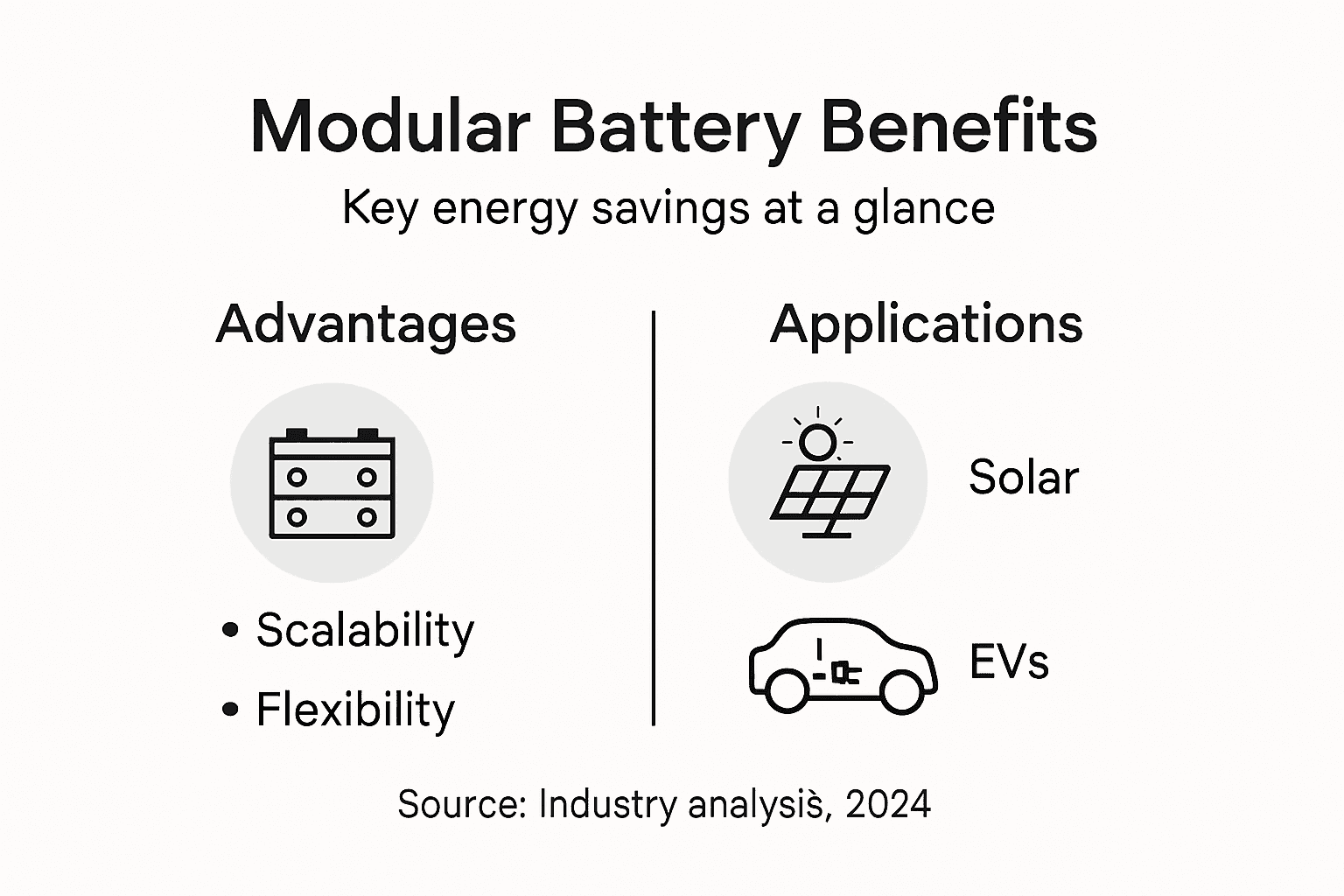
The core advantage of modular battery systems lies in their adaptable architecture. Next-generation multifunctional battery systems are engineered to enhance efficiency across multiple applications, from electric vehicles to stationary storage solutions. Key features include:
Scalable power capacity
Enhanced system reliability
Simplified maintenance and replacement
Reduced overall system complexity
Improved energy density
Engineering teams now recognize modular designs as critical for meeting evolving energy demands. Advanced cost modeling frameworks demonstrate that modular systems can significantly reduce long-term operational expenses by enabling targeted upgrades and minimizing total replacement costs.
Power Flexibility Matters. Modern energy infrastructure requires solutions that can adapt quickly. Modular battery systems allow property developers to future-proof their electrical systems, creating infrastructure that can seamlessly evolve with technological advancements and changing energy requirements.
Pro tip: When designing energy storage solutions, prioritize modular systems that offer seamless integration and scalable performance capabilities.
Leading Modular Technologies and Variations
Modular battery technologies are rapidly evolving, transforming energy storage capabilities across multiple sectors. Battery 2030+ roadmap innovations highlight several groundbreaking approaches that are reshaping how we conceptualize energy storage systems. These technological variations enable more flexible, efficient, and adaptable power solutions for diverse applications.
The primary modular battery technologies currently emerging include:
Solid-state batteries: Enhanced safety and energy density
Hybrid energy storage systems: Multiple energy source integration
Multifunctional battery packs: Adaptive performance across different use cases
Graphene-enhanced modules: Improved conductivity and thermal management
Modular lithium iron phosphate (LFP) configurations: Enhanced longevity and stability
Marine hybrid battery systems demonstrate the practical versatility of modular technologies. These advanced configurations combine different energy converters and sources, showcasing how modular designs can optimize performance, safety, and operational efficiency across specialized domains.
Engineers are now developing increasingly sophisticated modular battery technologies that can dynamically adapt to changing energy requirements. Smart modularity means systems can be easily expanded, upgraded, or reconfigured without complete infrastructure replacement. This approach significantly reduces long-term investment costs and provides unprecedented flexibility for energy managers.

Here’s how key modular battery technologies differ in attributes and use cases:
Technology Type | Main Benefit | Common Application | Integration Challenge |
Solid-state batteries | High safety & energy density | Electric vehicles | Cost of manufacturing |
Hybrid energy storage systems | Flexible energy sourcing | Marine & industrial settings | System complexity |
Graphene-enhanced modules | Improved conductivity | High-performance electronics | Thermal management demands |
Modular lithium iron phosphate | Longevity & stability | Grid storage, renewables | Lower energy density |
Multifunctional battery packs | Adaptive performance | Multi-sector deployments | Optimization for all scenarios |
Pro tip: When evaluating modular battery technologies, prioritize systems with proven scalability and comprehensive integration capabilities.
Integrating With Solar, Grid, and EV Platforms
Next-generation modular battery systems are revolutionizing energy integration across multiple platforms, creating unprecedented opportunities for seamless power management. These advanced technologies enable sophisticated connections between solar generation, electric grids, and electric vehicle infrastructures, transforming how energy is produced, stored, and consumed.
The key integration strategies for modular battery systems include:
Solar PV synchronization: Direct energy capture and storage
Grid-interactive capabilities: Real-time power balancing
Electric vehicle charging optimization: Bidirectional energy flow
Intelligent energy management systems: Dynamic load distribution
Renewable energy arbitrage: Maximizing economic value
Flexible battery system innovations are particularly critical for enabling comprehensive energy ecosystem integration. These technologies support advanced interoperability, allowing different energy platforms to communicate and optimize power utilization dynamically. By creating adaptive interfaces between solar arrays, grid networks, and electric vehicle charging infrastructure, modular battery systems can significantly enhance overall energy efficiency.
The most sophisticated modular battery platforms now offer intelligent cross-platform compatibility. This means energy can be seamlessly transferred between solar generation, grid storage, and electric vehicle charging systems, creating a more responsive and adaptable energy environment. Property developers and energy managers can now design holistic power solutions that adapt in real-time to changing consumption patterns and generation capabilities.
Pro tip: Select modular battery systems with open communication protocols to ensure maximum integration flexibility across different energy platforms.
Economic and Regulatory Drivers in Central Europe
EU industrial battery policy is driving transformative changes in the energy storage landscape across Central Europe, establishing a comprehensive framework for sustainable battery development and deployment. These regulatory mechanisms are creating powerful economic incentives for property developers and energy managers to invest in advanced modular battery technologies that align with broader European Green Deal objectives.
The key economic and regulatory drivers shaping modular battery adoption include:
Decarbonization targets: Mandated emissions reduction goals
Investment incentives: Tax credits and financial support programs
Renewable energy integration: Simplified grid connection policies
Carbon pricing mechanisms: Economic penalties for high-emission technologies
Research and development funding: Grants for innovative battery solutions
Central European countries are implementing sophisticated policy frameworks that transform modular battery systems from optional technology to strategic infrastructure. Regulatory harmonization across the European Union is creating a unified approach that simplifies cross-border energy management, reduces investment risks, and accelerates technological innovation in battery storage solutions.
Economic strategies now explicitly recognize modular battery systems as critical infrastructure for achieving national and regional energy transition goals. By providing flexible, scalable energy storage solutions, these technologies enable more dynamic and responsive power networks that can efficiently integrate renewable energy sources and optimize grid performance.
Pro tip: Conduct a comprehensive regulatory compliance assessment before implementing modular battery systems to maximize available economic incentives.
Financial Impact, Risk, and Common Pitfalls
Cost modeling frameworks reveal complex financial dynamics surrounding modular battery systems that property developers and energy managers must carefully navigate. Understanding these economic intricacies is crucial for making informed investment decisions that balance potential returns with inherent technological risks.
The primary financial risks and common pitfalls in modular battery investments include:
Initial capital expenditure: High upfront technology costs
Performance uncertainty: Variability in energy storage efficiency
Technology obsolescence: Rapid innovation rendering systems outdated
Integration complexity: Unexpected system compatibility challenges
Maintenance and replacement expenses: Long-term operational costs
Battery system sustainability strategies emphasize the importance of comprehensive risk assessment and proactive management. Strategic financial planning requires developers to look beyond immediate installation expenses and consider long-term economic implications, including potential revenue streams from grid services, energy arbitrage, and innovative battery lifecycle management.
Sophisticated investors are now recognizing that modular battery systems represent more than just infrastructure investments. These technologies are dynamic financial assets that can generate value through multiple channels, including energy optimization, grid stabilization services, and potential second-life battery applications. By understanding the nuanced economic ecosystem, property developers can transform potential risks into strategic opportunities.
This summary highlights financial risks and opportunities for modular battery systems:
Risk Factor | Long-Term Impact | Opportunity Created |
High upfront cost | Delayed ROI | Scalable upgrades |
Performance variation | Unpredictable performance | Customizable optimization |
Obsolescence | Increased replacement cycles | Rapid tech adoption |
Maintenance expenses | Ongoing operational burden | Targeted replacements |
Integration issues | Compatibility delays | Flexible system upgrades |
Pro tip: Conduct thorough techno-economic modeling that accounts for technological evolution and multiple revenue generation scenarios before finalizing modular battery system investments.
Unlock Energy Savings with Flexible Modular Battery Solutions
The article highlights the challenge of balancing energy demands with cost efficiency while navigating complex integration and rapid technological changes. If you are looking to overcome high upfront costs, performance uncertainties, and future-proof your energy infrastructure, modular battery systems designed for scalability, intelligent integration, and long-term savings are essential. Concepts like battery arbitrage, solar PV synchronization, and dynamic tariff optimization directly align with solutions that maximize energy flexibility and economic benefits.
At Belinus, we specialize in delivering these exact benefits through our comprehensive energy solutions. Our Centralized EMS dynamically optimizes tariffs every 15 minutes to increase your returns. With scalable Utility Storage modules exceeding 400 kWh and an integrated Energy Management System that supports graphene supercapacitors and LFP technologies, you gain unmatched adaptability and control. Seamlessly integrate with solar generation and EV platforms using our ETAP Pro EV Charger and enjoy real-time energy management designed for your commercial or residential needs.

Discover how to turn modular battery investments into lasting financial wins. Visit Belinus now to explore customized modular battery storage and smart integration solutions built to empower your energy future. Don’t wait to future-proof your energy infrastructure and start saving today.
Frequently Asked Questions
What are the main advantages of modular battery systems?
Modular battery systems offer scalable power capacity, enhanced reliability, simplified maintenance, reduced system complexity, and improved energy density, allowing businesses to customize solutions to their specific needs.
How do modular battery systems help in reducing long-term operational costs?
By enabling targeted upgrades and minimizing total replacement costs, modular systems allow for more efficient management of energy storage, leading to significant long-term savings.
Can modular battery systems be integrated with renewable energy sources?
Yes, modular battery systems can seamlessly integrate with solar generation, electric grids, and electric vehicle infrastructures, optimizing energy management and enhancing overall efficiency.
What key factors should be considered when choosing modular battery technologies?
When evaluating modular battery technologies, it’s essential to consider scalability, integration capabilities, performance adaptability, and the specific application for which the system will be used.
Recommended
Comments