Commercial Solar Explained: Cutting Costs and Emissions
- steve39584
- 7 hours ago
- 7 min read

Every month, more Central European companies are rethinking how they manage rising energy costs and stricter environmental targets. For sustainability officers and energy managers, the push for resilient and efficient operations is shaping new decisions. Commercial solar power delivers more than just clean energy. It offers a strategic route to lower expenses, energy security, and alignment with the European Green Deal. Explore the smart solutions transforming business energy use into a competitive advantage.
Table of Contents
Key Takeaways
Point | Details |
Financial Transformation | Commercial solar power reduces operational costs by generating electricity on-site, offering long-term financial stability. |
Sustainability Compliance | Implementing solar technologies helps businesses meet corporate sustainability requirements and reduce carbon emissions. |
Tech Integration | Combining solar energy with battery storage systems enhances energy management and resilience against market fluctuations. |
Regulatory Awareness | Understanding local regulations is essential for successful solar investment and maximizing available financial incentives. |
What Commercial Solar Power Means for Business
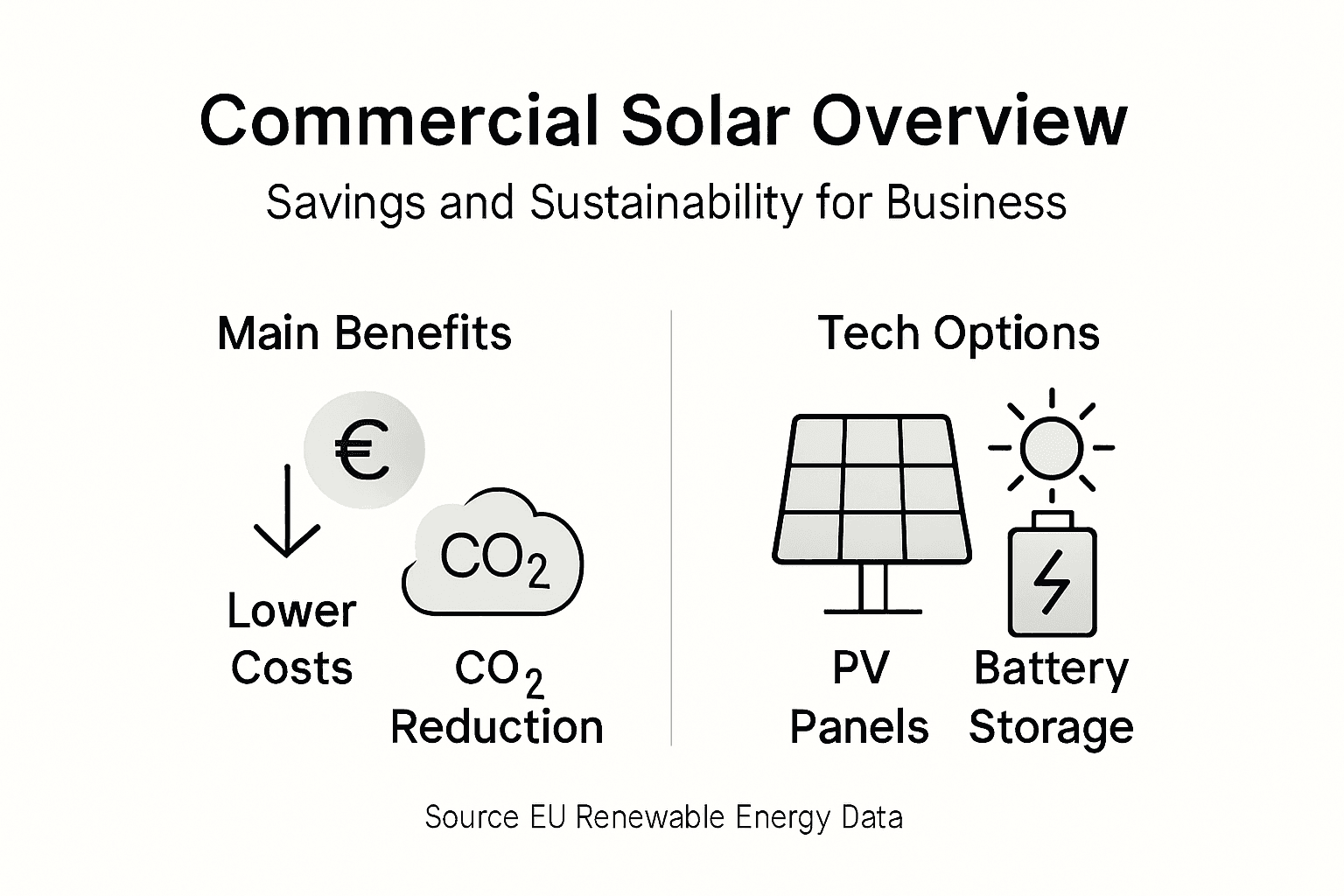
For Central European businesses, commercial solar power represents far more than an environmental initiative. It’s a strategic financial and operational transformation that addresses rising energy costs, operational resilience, and sustainability mandates. Emerging solar technologies are enabling companies to fundamentally redesign their energy infrastructure.
Commercial solar solutions offer businesses multiple strategic advantages. First, they provide direct operational cost reductions by generating electricity on-site, dramatically lowering monthly utility expenses. Companies can typically offset 40-70% of their electricity consumption through rooftop or ground-mounted solar installations. Second, solar investments create predictable energy pricing, protecting businesses from volatile market fluctuations and providing long-term financial stability.
Beyond financial benefits, solar power enables businesses to meet increasingly stringent corporate sustainability requirements. Solar PV systems support corporate ESG commitments by directly reducing carbon emissions and demonstrating environmental leadership. Many European regulations now require companies to transparently report and reduce their carbon footprint, making solar an essential strategic asset for compliance and reputation management.
Pro tip: Conduct a comprehensive energy audit before solar installation to maximize system design efficiency and financial returns.
Types of Commercial Solar and Key Technologies
Commercial solar technologies have evolved significantly, offering businesses multiple options for generating clean, sustainable energy. Photovoltaic (PV) systems represent the most prevalent technology, enabling direct electricity generation through solar panels installed on rooftops, ground-mounted arrays, or integrated building structures. These systems convert sunlight into electrical current, providing businesses with a flexible and scalable renewable energy solution.

Beyond traditional PV panels, commercial solar technologies include diverse applications such as solar thermal systems and concentrated solar power (CSP). Solar thermal panels generate heat for industrial processes, water heating, and building climate control, offering an additional pathway for energy efficiency. Concentrated solar power technologies use advanced mirror configurations to concentrate sunlight, generating high-temperature steam that drives turbines for electricity production, though these systems are less common in commercial settings.
The commercial solar landscape continues to advance through innovative integration strategies. Modern solar technologies now incorporate intelligent energy management systems, enabling businesses to optimize energy production, storage, and consumption. Advanced solar applications increasingly feature smart inverters, battery storage solutions, and grid-interactive capabilities that transform solar from a simple generation technology into a comprehensive energy management platform.
Pro tip: Consult with solar engineering specialists to design a custom system that matches your specific energy consumption patterns and infrastructure constraints.
Here’s a summary of key commercial solar technologies and their business applications:
Technology Type | Main Business Use | Unique Benefit |
Photovoltaic (PV) | On-site electricity generation | Reduces utility expenses |
Solar Thermal | Heating and industrial processes | Lowers heating costs |
Concentrated Solar Power (CSP) | Large-scale power production | High energy output |
Hybrid Storage Systems | Optimizing energy management | Enhanced energy resilience |
Integrating Battery Storage and Energy Management Systems
Battery energy storage systems (BESS) are transforming how commercial enterprises manage solar power generation and consumption. Battery storage technologies provide businesses with unprecedented flexibility in energy management, enabling them to store excess solar production, reduce peak demand charges, and create more resilient power infrastructure. These systems allow companies to strategically shift energy consumption, taking advantage of lower electricity rates during off-peak hours and maximizing the economic benefits of solar investments.
Modern energy management systems integrate battery storage with sophisticated software platforms that enable real-time monitoring, predictive analytics, and automated energy optimization. Businesses can now precisely control their energy consumption, balancing solar generation, battery storage, and grid interactions through intelligent algorithms. This approach not only reduces operational costs but also supports broader grid stability and renewable energy integration. Companies can participate in demand response programs, sell excess energy back to the grid, and maintain critical operations during power interruptions.
Advanced hybrid storage solutions are emerging that combine multiple battery technologies, creating more robust and adaptable energy systems. These configurations might include lithium-ion batteries for short-term storage, graphene supercapacitors for rapid charge/discharge, and long-duration storage technologies to provide comprehensive energy management capabilities. By leveraging these integrated systems, businesses can achieve greater energy independence, lower carbon emissions, and create more predictable operational expenses.
Pro tip: Conduct a comprehensive energy audit and load analysis before implementing battery storage to ensure your system is precisely tailored to your specific operational requirements.
Legal, Regulatory, and Compliance Landscape in Central Europe
The commercial solar landscape in Central Europe is increasingly shaped by complex legal and regulatory frameworks designed to accelerate renewable energy adoption. Renewable energy directives have established ambitious targets that require businesses to navigate intricate compliance mechanisms. These regulations encompass permitting processes, environmental impact assessments, grid interconnection standards, and financial incentive structures that directly influence solar project feasibility and implementation.
Central European countries have developed nuanced approaches to supporting commercial solar development. Germany, for instance, has implemented streamlined permitting protocols, while Romania has introduced targeted financial incentives for solar investments. Renewable energy acceleration measures now emphasize balancing rapid renewable expansion with environmental preservation and community engagement. Businesses must carefully understand local regulations, which can vary significantly between countries and even between regional jurisdictions.
Key compliance considerations include meeting Renewable Energy Directive targets, adhering to state aid rules, navigating net metering policies, and understanding taxation implications for solar investments. Companies must also prepare detailed environmental impact assessments and demonstrate how their solar installations contribute to broader decarbonization goals. Technical standards, grid connection requirements, and ongoing reporting obligations add additional layers of complexity to commercial solar projects in the region.
Pro tip: Engage local legal and regulatory experts specializing in renewable energy to ensure comprehensive compliance and maximize available incentives for your specific solar project.
Financial Impact, ROI, and Common Pitfalls
Commercial solar investments represent a complex financial strategy with significant potential for long-term economic benefits. Solar investment economics reveal that typical return on investment (ROI) timelines for commercial solar projects range between 3 to 7 years, depending on critical factors like system design, local energy prices, and self-consumption rates. Businesses must carefully analyze their specific energy consumption patterns, local electricity tariffs, and available financial incentives to maximize their solar investment potential.
The financial landscape for commercial solar is influenced by multiple interconnected variables, including initial capital expenditure, ongoing operational costs, potential revenue from energy trading, and evolving regulatory frameworks. Critical considerations include understanding government incentive programs, assessing potential tax credits, and evaluating the impact of energy storage integration. Companies should develop comprehensive financial models that account for potential fluctuations in energy prices, maintenance costs, and technological advancements that could affect long-term performance.
Common pitfalls in commercial solar investments often stem from inadequate initial planning and unrealistic expectations. Businesses frequently underestimate system complexity, overlooking critical factors such as roof structural integrity, grid connection requirements, and potential shading issues that can significantly impact solar performance. Technical due diligence, precise energy consumption analysis, and consultation with experienced solar engineering professionals are essential to mitigate these risks and ensure optimal financial outcomes.
This table highlights common financial factors and pitfalls when investing in commercial solar:
Financial Factor | Positive Impact | Common Pitfall |
Government Incentives | Lowers upfront investment | Overestimating availability |
Energy Price Volatility | Long-term cost savings | Ignoring future fluctuations |
System Design Quality | Maximizes ROI | Overlooking site challenges |
Integration with Storage | Boosts economic benefits | Underestimating complexity |
Pro tip: Develop a detailed financial model that includes multiple scenario analyses, accounting for potential variations in energy prices, technological advancements, and regulatory changes to ensure a robust solar investment strategy.
Unlock the Full Potential of Commercial Solar for Your Business
Rising energy costs and complex regulatory demands present serious challenges for Central European businesses striving to cut operational expenses and meet sustainability goals. The article explains how integrating photovoltaic systems with advanced battery storage and smart energy management transforms solar investments into dependable cost savings and emission reductions. If your company is looking to optimize energy use, reduce volatility, and align with evolving legal frameworks, addressing these pain points is critical now.
Discover how Belinus offers comprehensive commercial solar solutions tailored to your specific needs. From scalable utility storage modules and grid-integrated services to custom-designed installations coupled with a centralized Energy Management System, our offerings empower you to maximize return on investment and operational resilience. Take advantage of our expertise in developing hybrid solar-battery systems integrated with intelligent software to gain predictable energy costs while reducing your carbon footprint. Explore our commercial solutions to start designing your smart solar energy future today.
Frequently Asked Questions
What are the financial benefits of commercial solar power?
Commercial solar power offers significant financial advantages, including direct cost reductions on electricity bills, predictable energy pricing, and potential long-term savings. Businesses can offset 40-70% of their electricity consumption through solar installations, leading to lower monthly utility expenses and enhanced financial stability.
How do commercial solar technologies differ from each other?
Commercial solar technologies include photovoltaic (PV) systems, solar thermal systems, and concentrated solar power (CSP). PV systems generate electricity using solar panels, solar thermal systems provide heat for processes and building climate control, while CSP uses mirrors to produce steam for electricity. Each technology has unique applications and benefits based on specific operational needs.
What role do battery storage systems play in commercial solar installations?
Battery energy storage systems (BESS) allow businesses to store excess solar energy, manage peak demand, and enhance overall energy resilience. They enable companies to optimize their energy usage by storing energy produced during the day and utilizing it during peak hours or outages, thus maximizing the economic benefits of solar investments.
What compliance and regulatory issues should businesses consider before installing solar power?
Businesses must navigate a variety of legal and regulatory frameworks when implementing commercial solar projects. This includes complying with renewable energy directives, understanding permitting processes, financial incentive structures, and adhering to environmental impact assessments. Engaging legal experts in renewable energy can help ensure comprehensive compliance and maximize available incentives.
Recommended