Energy asset lifecycle management for optimized performance

TL;DR:
Managing the entire asset lifecycle strategically reduces costs and enhances ROI in energy projects.
European examples like Heat4Cool demonstrate significant energy savings and quick payback through lifecycle evaluation.
Most energy professionals know their assets well on a technical level, but treating each piece of equipment as an isolated purchase rather than part of a continuous strategic process costs far more than most organizations realize. Asset lifecycle management (ALM) is the end-to-end sequence of stages an energy-related physical asset goes through, from procurement and design all the way to decommissioning and replacement. When you manage that full sequence deliberately, every decision compounds in your favor. This guide walks you through each stage, the cost analysis tools that make or break ROI, and the practical frameworks European professionals use to stay ahead.
Table of Contents
Key Takeaways
Point | Details |
Lifecycle is holistic | Managing energy assets is more than operations—it begins at planning and ends with decommissioning. |
Cost analysis drives decisions | Lifecycle cost evaluation tools help you choose the best repair, replace, or retrofit options. |
Early planning saves money | Anticipating end-of-life pathways from the start lowers costs and risks later on. |
Data enables optimization | Real-time and health data support smarter management, efficiency, and compliance. |
European retrofits show value | Retrofit case studies prove lifecycle thinking boosts both energy savings and business returns. |
What is the energy asset lifecycle?
An energy asset lifecycle covers every phase a physical asset passes through from the moment it is conceived to the moment it is retired. ALM is the structured practice of managing all those phases as a connected whole rather than a series of unrelated tasks. That distinction matters enormously. When each stage is managed in isolation, critical handoff information is lost, maintenance windows are missed, and decommissioning costs catch finance teams off guard.
“The energy asset lifecycle is the end-to-end sequence of stages an energy-related physical asset goes through — from planning/procurement, through design, installation, commissioning, operation and maintenance, and finally decommissioning, refurbishment, disposal, or replacement.”
The lifecycle framework applies to a wide range of multi-technology energy systems that European professionals deploy today.
Typical assets with defined lifecycles include:
Solar PV panels (25 to 30 year technical life)
Battery storage systems, including LFP and graphene supercapacitors (10 to 20 year cycles)
HVAC and heat pump systems (15 to 25 years)
EV charging infrastructure (8 to 15 years depending on connector standards)
Industrial switchgear and transformers (20 to 40 years)
Building energy management systems and sensors (5 to 12 years before obsolescence)
The table below maps each lifecycle stage to its core focus and typical activities:
Lifecycle stage | Core focus | Typical activities |
Planning and procurement | Financial and technical feasibility | Site assessment, vendor selection, budget modeling |
Design | System architecture | Load analysis, technology selection, safety planning |
Installation | Physical deployment | Civil works, equipment mounting, wiring |
Commissioning | Verified performance | Testing, calibration, integration checks |
Operations and maintenance | Sustained output | Monitoring, servicing, performance optimization |
Decommissioning or refurbishment | End-of-life transition | Asset recovery, disposal, or upgrade planning |
The key takeaway here is that lifecycle management is holistic. It is not simply an end-of-life task or a maintenance checklist. Every decision made in planning ripples forward through decades of operational cost and eventual disposal. Organizations that skip early rigor pay for it repeatedly.
Breaking down the lifecycle: Key stages and activities
Understanding the names of lifecycle stages is a starting point. Understanding what actually happens within each stage, and who is responsible, is where ALM converts from a concept into a cost management tool.
Lifecycle stages in sequence:
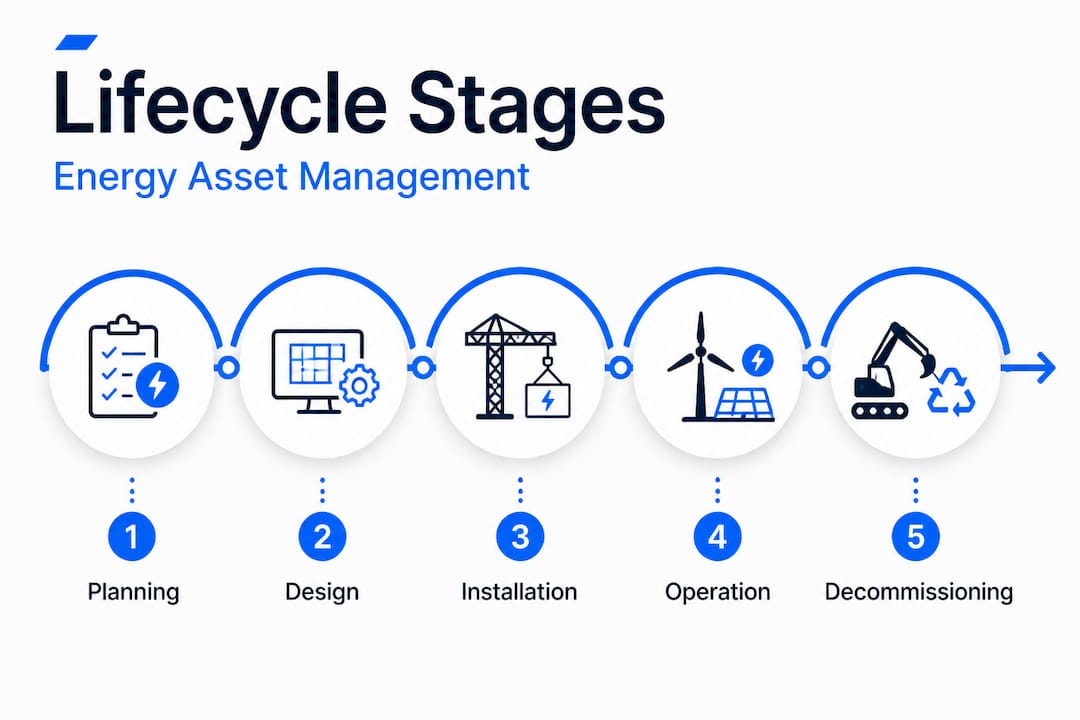
Planning and procurement. Define the business case, performance targets, and budget. Evaluate vendors against total lifecycle fit, not just initial price. Lock in contractual terms that address future servicing and end-of-life obligations.
Design. Translate requirements into a detailed system architecture. Select technologies for long-term compatibility. At this stage, integrating energy management system tips into the design brief pays off substantially in operational efficiency.
Installation. Execute civil and electrical works. Rigorous documentation here is non-negotiable. Every deviation from design must be recorded because this data feeds directly into maintenance schedules.
Commissioning. Verify that the system performs to specification under real load conditions. This is also the moment to confirm that monitoring infrastructure and alarms are calibrated correctly.
Operations and maintenance. The longest and most cost-intensive stage. For assets like smart home energy essentials installations or commercial battery storage, predictive maintenance routines and real-time monitoring are what separate high-performing portfolios from underperforming ones.
Decommissioning, refurbishment, or replacement. The logical endpoint of every asset. Whether you recycle, repurpose, or simply remove a system, this stage requires capital planning and regulatory compliance that must be anticipated years in advance.
The table below maps key activities and responsible roles to each phase:
Phase | Key activity | Responsible role |
Planning | Financial modeling and vendor evaluation | Asset manager, procurement |
Design | Technology selection and safety planning | Engineer, project manager |
Installation | Equipment deployment and documentation | Site contractor, project manager |
Commissioning | Performance verification and calibration | Commissioning engineer |
O&M | Monitoring, fault response, optimization | Operations team, EMS platform |
Decommissioning | Asset recovery, regulatory compliance | Asset manager, facility director |
Pro Tip: Start decommissioning planning no later than the midpoint of your expected asset life. By the time a battery system or solar array shows clear signs of degradation, the financial planning window for replacement has already narrowed significantly.
The role of lifecycle cost analysis and decision support
Every repair-versus-replace decision your team faces comes down to numbers. Lifecycle cost evaluation (LCE) and total cost of ownership (TCO) are the two frameworks that give those numbers structure. LCE compares project alternatives using present value and annuity calculations across the full asset life. TCO aggregates every cost associated with owning and operating an asset, including costs that are invisible at purchase time.
Key factors in a robust lifecycle cost evaluation:
Purchase and installation costs. The initial CAPEX including civil works, logistics, and commissioning.
Energy costs. The ongoing cost of electricity consumed by the asset, which is especially significant for HVAC and EV charging infrastructure.
Operating and maintenance costs. Scheduled servicing, replacement parts, and labor.
Downtime and performance degradation losses. Revenue lost or penalties incurred during outages or below-spec operation.
End-of-life costs and residual value. Disposal, recycling, regulatory compliance, and any recoverable value from materials or repurposed components.
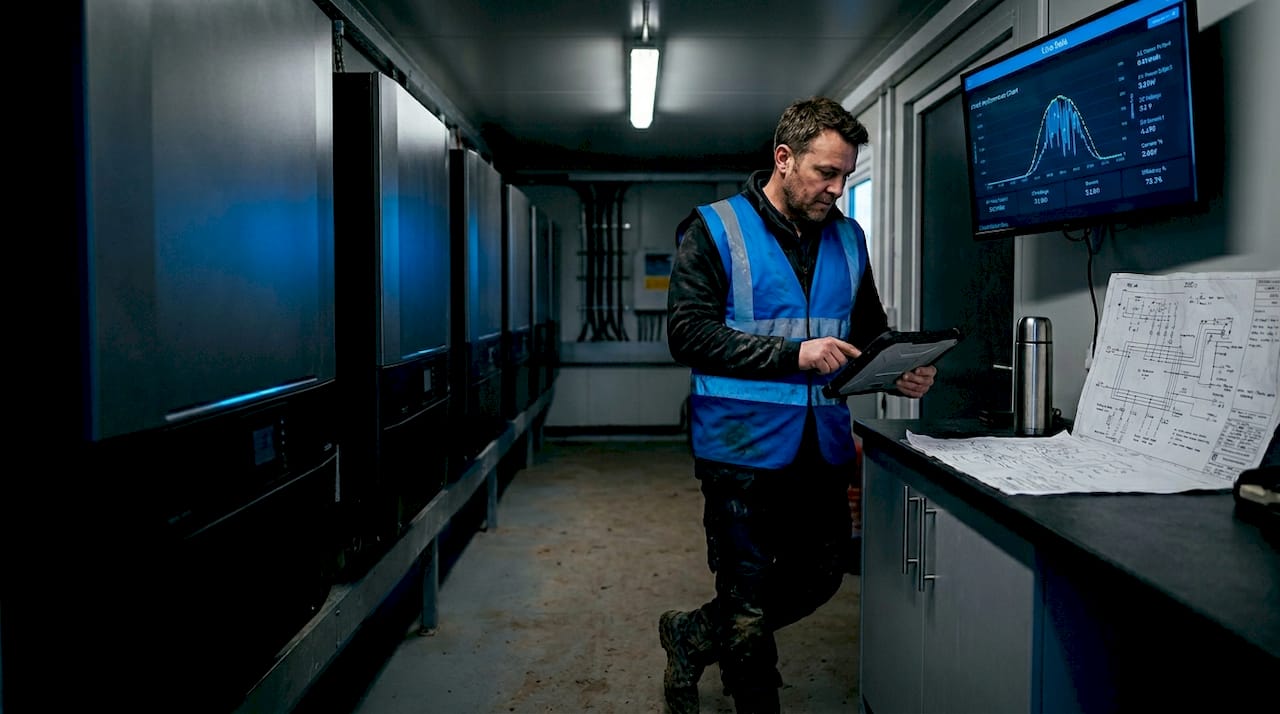
Real-time data is what makes LCE actionable rather than theoretical. Evidence from real-time asset monitoring implementations shows that connected monitoring tools reduce unplanned downtime significantly while giving asset managers the performance baselines they need to model replacement timing accurately.
The practical case for LCE is compelling. When evaluating solar and storage ROI across a commercial property portfolio, the difference between selecting a system purely on capital cost versus selecting on LCE basis can shift the payback period by several years.
Pro Tip: Longevity is not always efficiency. An older battery system that is technically operational but operating at 70% of rated capacity costs you in energy arbitrage losses every single day. Sometimes retiring an asset two years earlier than its rated life is the financially superior decision.
Lifecycle thinking in Europe’s residential and commercial energy assets
Europe’s building sector provides some of the richest real-world examples of lifecycle thinking applied at scale. The combination of aging building stock, rising energy prices, and ambitious national efficiency targets has pushed lifecycle cost evaluation into mainstream project planning across residential, commercial, and industrial segments.
The EU-backed Heat4Cool project is a strong illustration. Heat4Cool demonstrated at least 20% energy consumption reduction and a return on investment of eight years across four distinct European climates, achieved by applying structured lifecycle cost evaluation to heating and cooling retrofit decisions.
“Heat4Cool demonstrates at least 20% energy consumption reduction and a return on investment of 8 years in four European climates, using lifecycle cost evaluation as the decision framework for retrofit selection.”
Steps for evaluating and implementing retrofits with lifecycle tools:
Conduct an asset condition audit to establish current performance baselines across the portfolio.
Run a lifecycle cost model comparing the status quo against two or three retrofit scenarios using LCE methodology.
Prioritize retrofits by the ratio of energy savings to upfront cost, adjusted for local climate and tariff structures.
Confirm technology compatibility with existing building management or energy monitoring systems.
Set measurable performance milestones for the first year post-installation to validate the LCE assumptions.
Plan the next decision point, typically five years out, where you reassess whether further upgrades or full replacement makes more economic sense.
The growth of distributed energy in Europe adds another layer of complexity to lifecycle decisions. When an asset participates in grid services, virtual power plant programs, or energy arbitrage, its economic lifetime extends beyond the physical degradation curve. That dynamic changes both the LCE calculation and the decommissioning timing substantially.
For European decision-makers, the practical implication is clear: lifecycle thinking is not an abstract financial exercise. It is the mechanism by which retrofit investments are justified, approved, and tracked against real performance outcomes.
The end-of-life stage: Why preparation begins early
Decommissioning is the most consistently underplanned phase of the energy asset lifecycle. The common assumption is that end-of-life planning is a task for the last few years of an asset’s operational period. That assumption is expensive.
Decommissioning as a lifecycle process includes preparation during the operational lifetime, a late-life phase, and the actual decommissioning and handover for demolition or sale. Effective decommissioning is built into asset strategy from commissioning onward, not retrofitted into planning in year eighteen of a twenty-year asset life.
“Operational and financial preparation for decommissioning, carried out throughout the asset’s working life, is the foundation for a safe and cost-efficient transition at end-of-life.”
Steps for effective decommissioning preparation:
Set a decommissioning provision at commissioning. Establish a financial reserve, calculated as part of the original LCE model, that grows over the operational period.
Track asset health continuously. Use real-time lifecycle management tools to monitor degradation trends. When performance drops below a defined threshold, trigger the formal end-of-life review.
Review end-of-life pathways at mid-life. At the midpoint of expected asset life, formally assess whether the trajectory points toward refurbishment, technology upgrade, or full replacement.
Engage regulatory and waste management partners early. Battery disposal and solar panel recycling carry regulatory obligations in Europe. Leaving these to the last year creates compliance risk and cost overruns.
Document operational data for the successor asset. The performance record of the retiring asset is the most valuable input for right-sizing and specifying its replacement accurately.
Execute the handover with a clear chain of custody. Whether the site transitions to a new owner, a demolition contractor, or a fresh installation team, complete documentation ensures accountability and reduces liability.
Neglecting these steps compounds risk in multiple directions. Regulatory penalties, unplanned capital calls, and project delays at replacement all become more likely when end-of-life preparation is deferred. The organizations that manage this well treat decommissioning not as a cost to delay but as a recoverable investment in their next asset cycle.
Why early planning is the real lever for lifecycle success
The most expensive mistake in energy asset management is treating end-of-life as a future problem. We have seen it repeatedly: an organization makes a technology choice at procurement based on the lowest capital cost, installs it efficiently, runs it well for a decade, and then discovers that decommissioning, data migration, or regulatory compliance at end-of-life costs more than the original capital outlay. That is not bad luck. It is predictable.
Early-stage decisions, specifically the CAPEX model, the technology selection, and the contractual terms negotiated at procurement, set the boundaries within which every subsequent decision is made. If you select a battery chemistry without considering its recycling pathway, you inherit that liability for the next fifteen years. If you sign a supply contract without a clear end-of-life obligation on the vendor, that obligation defaults to your organization.
The practical framework we recommend is straightforward. Before any acquisition, run three end-of-life scenarios: full replacement at rated end of life, early replacement triggered by performance degradation, and refurbishment at mid-life. Model the financial impact of each against the original LCE. This exercise takes hours, not days, and it has a direct bearing on which technology you select, how you structure contracts, and what monitoring infrastructure you invest in from day one.
Lifecycle strategies with multi-technology assets are particularly sensitive to this kind of early scenario planning because different storage chemistries and generation technologies have materially different end-of-life cost profiles. Getting that analysis right at the planning stage is what separates the organizations that hit their twenty-year ROI targets from those that don’t.
The biggest opportunity in lifecycle management is not in the operations phase, where most attention and tooling is concentrated. It is in the three to six months of planning and procurement where the strategic boundaries of the entire lifecycle are set.
Optimize your energy asset lifecycle with Belinus
Putting lifecycle thinking into practice requires the right tools and the right technology stack. The principles in this guide, from LCE modeling at procurement to real-time decommissioning preparation, only deliver their full value when your assets are connected to a platform that can see, analyze, and act across the full lifecycle.

Belinus brings together solar PV, battery storage, EV charging, and a centralized Energy Management System designed specifically for professionals who need lifecycle visibility, not just operational dashboards. Our EMS runs 15-minute dynamic tariff optimization, supports multi-technology storage architectures including LFP and graphene supercapacitors, and integrates with third-party platforms through a RESTful API. Whether you are managing a single commercial site or a distributed European portfolio, Belinus energy solutions give you the decision-support layer that turns lifecycle theory into measurable financial performance. Explore our full resource library to build your next asset strategy on solid foundations.
Frequently asked questions
What stages are included in an energy asset lifecycle?
Planning, design, installation, commissioning, operation and maintenance, and decommissioning or replacement are all included in a complete energy asset lifecycle.
Why is lifecycle cost analysis critical in asset management?
Lifecycle cost evaluation compares project alternatives using present value and annuity across purchase, energy, and operating costs so you can make financially grounded repair, replace, and upgrade decisions.
How does preparation for decommissioning affect asset value?
Early operational and financial planning reduces unplanned capital calls and compliance costs, preserving both financial and reputational value. Decommissioning preparation that begins during the operational lifetime leads to safer, more cost-efficient transitions.
What benefits does lifecycle thinking offer to European building retrofits?
It supports selecting retrofit options that deliver measurable energy reductions and viable return on investment. Heat4Cool demonstrated at least 20% energy consumption reduction and an eight-year ROI across four European climates using exactly this approach.
Recommended
Comments