Energy Controller Explained: What You Need to Know
- 5 hours ago
- 8 min read

TL;DR:
An energy controller manages voltage, current, and power flow to optimize system efficiency and protect equipment. Proper sizing, configuration, and integration are crucial to maximize savings and extend battery life, especially when supporting solar, storage, and EVs. Utilizing advanced energy management systems like Belinus EMS enables real-time optimization, grid independence, and significant long-term cost reductions.
An energy controller is a device or system that regulates voltage, current, and power flow to protect equipment and maximize energy efficiency across solar, storage, and grid-connected systems. Whether you are a homeowner with rooftop solar or a facility manager overseeing a commercial building, the controller is the decision-making core of your energy setup. It determines when to charge batteries, when to draw from the grid, and how to distribute power across loads. Understanding how these systems work is the first step toward getting real value from any energy investment.
Energy controller explained: the core function
An energy controller sits between your energy sources and your loads, continuously measuring inputs and outputs and making real-time adjustments. Think of it as a traffic controller for electricity. Without it, power flows wherever resistance is lowest, which often means wasted energy, overcharged batteries, or tripped breakers.

In solar power systems, the most common form is the solar charge controller. Its primary job is to prevent batteries from being overcharged during the day and from discharging too deeply at night. Two dominant technologies handle this task: PWM (Pulse Width Modulation) and MPPT (Maximum Power Point Tracking). PWM controllers are simpler and less expensive, but they connect the panel directly to the battery, which means panel voltage must closely match battery voltage to avoid energy loss.
MPPT controllers operate as DC-to-DC converters, finding the panel’s maximum power point and converting that power to the correct battery charging voltage. This approach allows higher-voltage panel strings to charge lower-voltage battery banks without waste. The practical result is that MPPT controllers reach 98 to 99% efficiency and harvest 10 to 30% more energy than PWM equivalents. For any system larger than a small off-grid cabin, MPPT is the standard choice.
Charging stages every controller manages
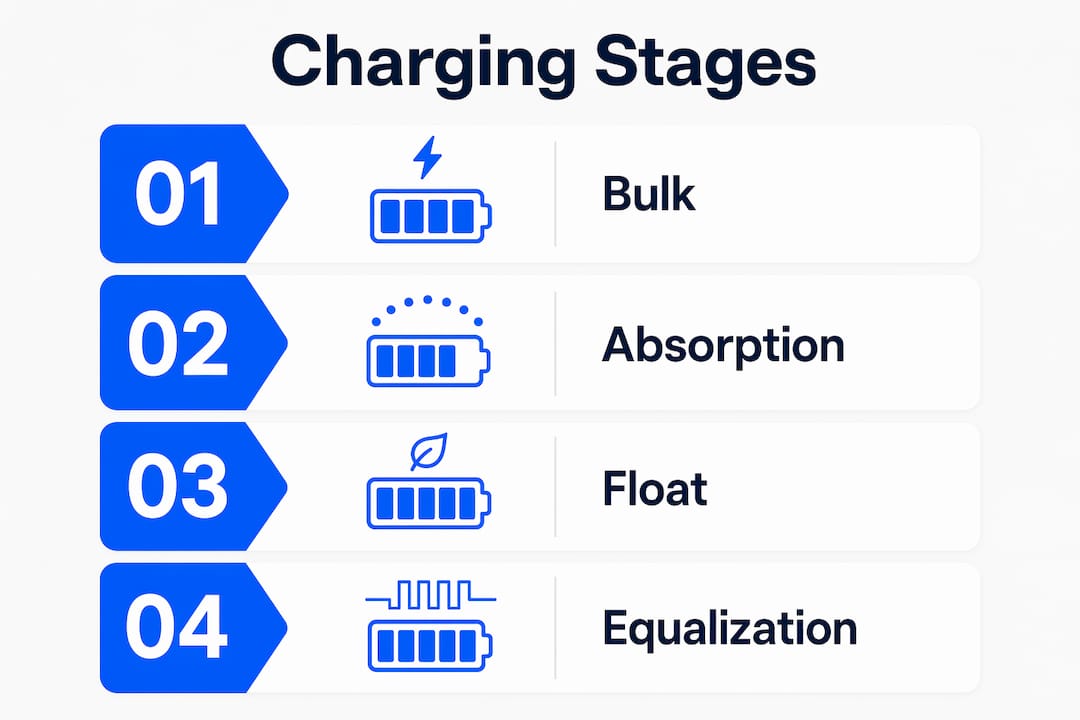
A well-configured solar charge controller moves batteries through three distinct stages. The bulk stage delivers maximum current until the battery reaches a set voltage threshold. The absorption stage holds that voltage while current tapers off, fully saturating the cells. The float stage drops voltage slightly to maintain charge without stressing the battery. Each stage protects battery chemistry and extends service life, which is why controller configuration matters as much as controller selection.
What are the different types of energy controllers?
Beyond solar charge controllers, the term covers a much broader category of hardware and software systems. An Energy Management System (EnMS) is the enterprise-level equivalent: a structured set of practices and technologies designed to monitor, control, and continuously improve energy use across a facility or organization. The U.S. Department of Energy’s 50001 Ready program supports companies in adopting EnMS frameworks aligned with ISO 50001 standards, and organizations using these systems report roughly 4% annual energy savings year over year. That figure compounds: a facility saving 4% annually cuts its baseline consumption by nearly 20% over five years without any major capital investment.
Modern energy controllers for homes and businesses typically combine several components:
Real-time monitoring hardware: Smart meters, current transformers, and IoT sensors that feed live data to the controller.
Control software: Algorithms that compare actual consumption against targets and trigger automated responses.
Communication interfaces: RESTful APIs, Modbus, or proprietary protocols that connect the controller to inverters, batteries, EV chargers, and grid meters.
User dashboards: Mobile apps and web portals that translate raw data into decisions you can act on.
A practical example is the Enphase IQ System Controller, which coordinates grid, solar, and battery operation including islanding during outages, all managed through a single app. This kind of system controller is what separates a collection of individual components from a genuinely integrated energy system. For a deeper look at how these systems compare across solar, storage, and EV applications, Belinus has reviewed top energy management systems across all three categories.
Controller type | Primary application | Key function |
PWM solar charge controller | Small off-grid systems | Simple battery charge regulation |
MPPT solar charge controller | Residential and commercial solar | Maximum power extraction and voltage conversion |
System controller (e.g., Enphase IQ) | Home energy storage systems | Coordinates solar, battery, grid, and loads |
EnMS platform | Commercial and industrial facilities | Monitors and optimizes facility-wide energy use |
Belinus EMS | Residential to utility-scale | Dynamic tariff optimization, battery arbitrage, EV integration |
How to select and size an energy controller for your setup
Choosing the wrong controller is one of the most common and costly mistakes in solar installations. The sizing formula for an MPPT controller is straightforward: divide your total solar array wattage by your battery bank’s charging voltage, then multiply by 1.25 to add a safety margin. A 2,000-watt array charging a 48-volt battery bank requires a controller rated for at least 52 amps. Getting this wrong causes the controller to fault at peak production, exactly when you need it most.
Voltage rating is equally critical. Cold weather increases open-circuit voltage on solar panels significantly, sometimes by 15 to 25% above the standard test condition rating. A controller with a maximum input voltage of 100V connected to a string producing 95V under standard conditions can easily exceed its limit on a cold morning. Always calculate worst-case open-circuit voltage, not nominal voltage.
Battery chemistry adds another layer of complexity. Lithium batteries require precise CC/CV charging profiles with specific absorption and float voltage settings. Using a controller configured for lead-acid on a lithium bank causes either undercharging or cell damage over time. Temperature compensation, which is useful for lead-acid, must be disabled entirely for lithium. Controllers from brands that support lithium-specific profiles, such as those integrated with the Belinus EMS, handle this automatically.
Here is a practical selection process:
Calculate your array’s total wattage and identify your battery bank voltage.
Apply the sizing formula: (Array Watts ÷ Charging Voltage) × 1.25.
Check the controller’s maximum input voltage against your worst-case open-circuit voltage in cold conditions.
Confirm the controller supports your battery chemistry with the correct charge profile.
Verify communication compatibility with any inverter, monitoring platform, or EMS you plan to use.
Pro Tip: Never size a controller based on nominal battery voltage. Use the actual charging voltage, which is higher. For a 48V lithium bank, the charging voltage is typically 54 to 58V, not 48V. Using 48V in your calculation will oversize the required current and may lead you to select an undersized controller.
What are the benefits of using energy controllers?
The case for energy controllers goes well beyond protecting batteries. The benefits of energy management systems documented by the U.S. DOE include energy cost savings, improved energy security, and measurable productivity gains for organizations that adopt them. These are not theoretical outcomes. They result from the controller doing three things consistently: measuring what is actually happening, comparing it to what should be happening, and correcting the difference automatically.
For homeowners, the most immediate benefit is battery longevity. A properly configured controller can double the usable life of a battery bank by preventing the two most damaging conditions: overcharge and deep discharge. For businesses, real-time energy management creates the data visibility needed to identify waste, shift loads to cheaper tariff windows, and reduce peak demand charges.
Key benefits across both residential and commercial applications include:
Extended equipment life: Controlled charging cycles reduce battery degradation and protect inverters from voltage spikes.
Renewable energy integration: Controllers manage the variability of solar and wind output, making storage systems viable.
Grid independence: System controllers enable islanding, keeping critical loads running during outages.
Cost reduction: Dynamic tariff optimization, a feature in platforms like the Belinus EMS, charges batteries when electricity is cheapest and discharges when it is most expensive.
Data-driven decisions: Live dashboards and historical reports reveal patterns that manual monitoring never would.
“Sustained energy savings depend on evolving a continual-improvement culture, not just one-time optimization.” — U.S. Department of Energy
This insight from the DOE captures why a controller is not a set-and-forget device. The hardware creates the capability. The ongoing monitoring and adjustment create the results. For homeowners looking to build that habit, Belinus has published a practical guide on energy monitoring for homeowners that covers the tools and routines that make a real difference.
Key takeaways
An energy controller is the operational core of any efficient energy system, and selecting, sizing, and configuring it correctly determines whether your solar, storage, or building energy investment performs as designed.
Point | Details |
MPPT outperforms PWM | MPPT controllers reach 98 to 99% efficiency and harvest up to 30% more energy than PWM alternatives. |
Sizing requires a safety margin | Calculate controller amps as (Array Watts ÷ Charging Voltage) × 1.25, then verify maximum input voltage for cold weather. |
Battery chemistry dictates configuration | Lithium batteries require specific CC/CV profiles; temperature compensation must be disabled to prevent damage. |
EnMS delivers compounding savings | Organizations using structured energy management systems report roughly 4% annual savings that compound over time. |
Controllers enable grid independence | System controllers like the Belinus EMS coordinate solar, storage, and grid to keep critical loads running and costs down. |
Why most energy controller installations underperform
After working with energy systems across residential and commercial installations, the pattern I see most often is not bad hardware. It is good hardware configured for the wrong conditions. A homeowner installs an MPPT controller, sets it to the default lead-acid profile, and then wonders why their lithium battery bank degrades in 18 months. A facility manager deploys an EnMS platform, reviews the dashboard once at commissioning, and never touches it again. The 4% annual savings the DOE cites are real, but they require someone to actually act on the data.
The other underappreciated challenge is conflicting telemetry inputs in multi-vendor systems. When a solar inverter, a battery management system, and a grid meter are all reporting slightly different values, the controller has to arbitrate between them. If it does not do that conservatively, it will misallocate surplus energy or issue commands that damage equipment. I have seen this happen with home automation setups that looked impressive on paper but produced erratic charging behavior in practice. The fix is not always more hardware. It is better logic and a controller platform designed to handle disagreement between data sources gracefully.
The direction the industry is moving is toward multi-vendor data fusion and dynamic load management, where the controller does not just respond to current conditions but anticipates them using tariff forecasts and consumption patterns. That is exactly the architecture Belinus has built into its EMS, and it is the reason I think integrated platforms will outperform standalone controllers for anyone running solar, storage, and EV charging together.
— Marc
How Belinus can optimize your energy setup
Belinus designs energy management systems that connect solar generation, battery storage, and EV charging into a single controlled platform. The Belinus EMS runs 15-minute dynamic tariff optimization, manages battery arbitrage in real time, and supports everything from residential Solis inverters to utility-scale storage modules exceeding 400 kWh.

If you are evaluating energy controllers for a home or business installation, Belinus offers tailored energy management solutions built around your specific load profile, battery chemistry, and grid tariff structure. The platform integrates with third-party hardware through a RESTful API and delivers live data through a native mobile app and web dashboard. Explore the Belinus site to see how the EMS handles the full complexity of modern energy systems, from a single residential battery to a multi-site commercial fleet.
FAQ
What is an energy controller?
An energy controller is a device or software system that regulates voltage, current, and power flow between energy sources, storage, and loads. Its core function is to maximize efficiency and protect equipment from overcharge, deep discharge, and voltage spikes.
How does an MPPT controller differ from a PWM controller?
MPPT controllers operate as DC-to-DC converters that find the panel’s maximum power point and convert it to the correct battery voltage, reaching 98 to 99% efficiency. PWM controllers connect panels directly to batteries and are simpler but less efficient, making them suitable only for small off-grid systems.
What size MPPT controller do I need?
Divide your total solar array wattage by your battery charging voltage, then multiply by 1.25. Also verify that the controller’s maximum input voltage exceeds your panels’ worst-case open-circuit voltage in cold weather conditions.
Can one controller manage solar, batteries, and EV charging together?
Yes. System-level energy management platforms, including the Belinus EMS, coordinate solar generation, battery storage, and EV chargers through a centralized controller that optimizes across all three based on real-time tariffs and consumption data.
How much can an energy management system save?
Organizations implementing structured energy management systems aligned with ISO 50001 report roughly 4% annual energy savings year over year, which compounds significantly over a five to ten year period.
Recommended
Comments