Energy management guide: maximize solar, storage & EV savings
- 4 days ago
- 8 min read
TL;DR:
Integrated solar, battery, and EV management systems can boost self-consumption to 70-85% and save up to 20% on energy costs.
Proper system sizing and avoiding oversizing or outdated technology are crucial for maximizing payback and efficiency.
Smart energy management and load shifting, especially for EVs and flexible loads, significantly reduce bills and enhance grid independence.
Energy costs in the Netherlands and Belgium have swung wildly over the past few years, and grid operators are tightening rules around feed-in limits, peak demand charges, and prosumer tariffs. For homeowners and small business owners, that combination creates real financial pressure. The good news: an integrated approach to solar PV, battery storage, and EV charging, coordinated by a smart Energy Management System (EMS), can dramatically cut your bills and reduce your reliance on the grid. This guide walks you through every step, from understanding core concepts to sizing your system, managing loads, and avoiding the mistakes that quietly kill your return on investment.
Table of Contents
Key Takeaways
Point | Details |
Boost self-consumption | A smart EMS can raise your solar self-consumption from 30% to 60–70% for greater cost savings. |
Size systems carefully | Matching your PV and battery to your real needs avoids wasted capacity and maximizes payback. |
Leverage flexible loads | Smart scheduling of EV charging and major appliances delivers up to 30% extra savings. |
Avoid regional pitfalls | Understanding tariffs and local policies can help you sidestep penalties and optimize ROI. |
Think long-term | Integrated, future-proof energy management outperforms quick upgrades every time. |
Understanding the basics of energy management
Before you spend a single euro on hardware, it pays to understand how the pieces fit together. Here are the core terms you need:
Solar PV (photovoltaic): panels that convert sunlight into direct current (DC) electricity
Battery storage: a rechargeable system that stores surplus solar energy for later use
EV charging: infrastructure that powers electric vehicles, ideally scheduled around solar production
EMS (Energy Management System): software that coordinates all of the above in real time
Dynamic tariffs: electricity prices that change every 15 minutes or hourly, tracking wholesale market rates
An EMS is the brain of the operation. Basic, rule-based systems follow fixed schedules, for example, charge the battery from noon to 2 PM. AI-driven systems go further: they read weather forecasts, live grid prices, and your consumption history to make decisions that a human simply could not replicate manually.
Why does integration matter so much? Because each component alone leaves money on the table. A solar panel without storage exports cheap midday power to the grid. A battery without solar just shifts grid power from one time to another. Together, and orchestrated by an EMS, they work as a system. A well-designed setup can boost self-consumption from 30% to 60-70% and reduce energy costs by 15-20%.
To put that in perspective for a typical Belgian or Dutch property:
System configuration | Self-consumption rate | Annual savings estimate (avg. home) | Grid independence level |
Solar only | 25-35% | €300-€500 | Low |
Solar + battery | 55-70% | €700-€1,100 | Medium |
Solar + battery + EMS + EV | 70-85% | €1,200-€1,800 | High |
These numbers shift depending on your actual consumption pattern, but the direction is consistent: every layer of integration compounds the benefit. Start by learning energy management basics before committing to any particular hardware brand or configuration.
How to determine your solar and battery requirements
Sizing your system correctly is arguably the most important decision you will make. Get it wrong in either direction and you pay for it for decades.
Here is a practical four-step process:
Pull your last 12 months of meter data. Your energy supplier’s portal will show hourly or daily consumption. Look for seasonal peaks and the ratio of day to night usage.
Add future loads. If you plan to add a heat pump or an EV within the next three years, factor that in now. A typical household uses 3,500-5,500 kWh per year, so add 20-30% for each major new load.
Size your PV array first. A rule of thumb for the Netherlands and Belgium is 0.8-1.0 kWp of panels per 1,000 kWh of annual consumption, adjusted for your roof orientation and shading.
Size your battery second, based on your evening load. Not your peak PV output. A battery that can cover your 6 PM to midnight consumption is far more valuable than one sized to swallow a summer midday surplus.
On battery chemistry, the market has settled heavily on LFP (lithium iron phosphate) for residential use because of its safety profile and long cycle life. LFP batteries cost €800-1,200 per kWh and deliver around 4,000 charge cycles, which translates to 10-15 years of daily use.

Battery type | Cost per kWh | Life cycles | Best use case |
LFP | €800-€1,200 | 4,000+ | Daily home cycling |
Pre-lithiated LFP | €1,000-€1,400 | 5,000+ | High-cycle commercial |
Lead-acid | €200-€350 | 500-800 | Budget, infrequent cycling |
HUC (hybrid ultracapacitor) | €1,500+ | 1M+ | Peak shaving, rapid cycling |
For a deeper breakdown, check out residential battery storage comparison and home energy storage options before you buy.
Pro tip: Always buy modular. A system that accepts additional battery modules later means you invest only in what you need today and scale when your EV arrives or your family grows. Fixed-capacity systems often force a costly full replacement.
You can also explore solar panel essentials for a solid overview of panel selection before diving into the storage side.
integrating EV charging and load management
Once you know your baseline, the biggest untapped opportunity for most households and small businesses is load management, and the EV is the single largest flexible load you own.
Here is why that matters: your EV battery typically holds 40-80 kWh. That is four to eight times the size of your home battery. Even shifting 10 kWh of EV charging from a peak-price evening to a solar-abundant midday cuts a meaningful slice from your bill. Smart scheduling during solar peaks or low-price periods reduces bills by 20-30%, which on an average annual charging cost of €600-€900 is €120-€270 back in your pocket per year.
An EMS coordinates far more than just the EV. Other loads that respond well to flexible scheduling include:
Heat pumps: shift heating or cooling cycles to solar production hours
Electric boilers and water heaters: run midday when PV output peaks
Pool pumps and irrigation systems: ideal candidates for solar-hour scheduling
Commercial refrigeration: pre-cool during cheap periods, coast during expensive ones
Industrial machinery: SMEs can shift non-critical processes to avoid peak demand charges
For small businesses, the calculus is slightly different. Where a homeowner cares mainly about the electricity price per kWh, an SME with a demand-metered connection also pays for peak kilowatts. Load shaping, flattening your peak demand curve, can reduce that capacity charge by 30-40% alone.
“V2H (vehicle-to-home) and V2G (vehicle-to-grid) readiness is worth prioritizing now, even if you are not using it yet. Grid operators in Belgium and the Netherlands are actively building the regulatory framework, and bidirectional chargers will unlock significant additional revenue streams within the next two years.”
For practical advice on integrating solar and storage and solar optimization strategies, both resources go deeper on the technical side of load coordination.
avoiding pitfalls and maximizing payback
Even a well-intentioned energy investment can underperform if you stumble into a few common traps.
Here are the mistakes we see most often:
Over-sizing the PV system without accounting for export penalties. In the prosumer tariff in Belgium, particularly in the Netherlands and certain Belgian regions, you may face charges or reduced compensation for excess grid injection. More panels are not always better.
Getting locked into static tariffs. Dynamic tariff contracts let an EMS exploit low or even negative wholesale prices. Without one, your EMS has no price signal to work with and defaults to simple scheduling.
Installing outdated inverter technology. String inverters without power optimizers or microinverters are not EMS-friendly and limit your ability to do DC-coupled storage later.
Under-sizing battery for evening demand. As mentioned above: size for your evening load, not your peak midday generation.
Real-world results show what is possible when these mistakes are avoided. A 1.5 MW PV and 3.4 MWh battery installation at an agricultural cooperative achieved a 20% cost reduction and a 5-7 year payback, while another commercial deployment reached 44% renewable coverage and €37,000 in annual savings.
Negative wholesale prices are another variable that catches owners off guard. During peak solar days in summer, spot prices on the European energy exchange, or negative prices, can drop below zero. Without automated curtailment rules in your EMS, you could end up paying to inject power into the grid. A properly configured system automatically reduces panel output or diverts surplus to water heating instead.
“One of the most actionable smart energy tips for SMEs is to get a proper energy audit before sizing anything. The audit often reveals demand peaks that are easy to flatten, which changes the sizing logic entirely.”
Why strategic energy management beats quick fixes
Here is an uncomfortable truth: a lot of homeowners buy solar panels first, then a battery second, then a charger third, each time from a different vendor, each time without a coherent plan. Every component works in isolation. The result is three systems that barely talk to each other and a total efficiency that falls far short of what an integrated approach would deliver.
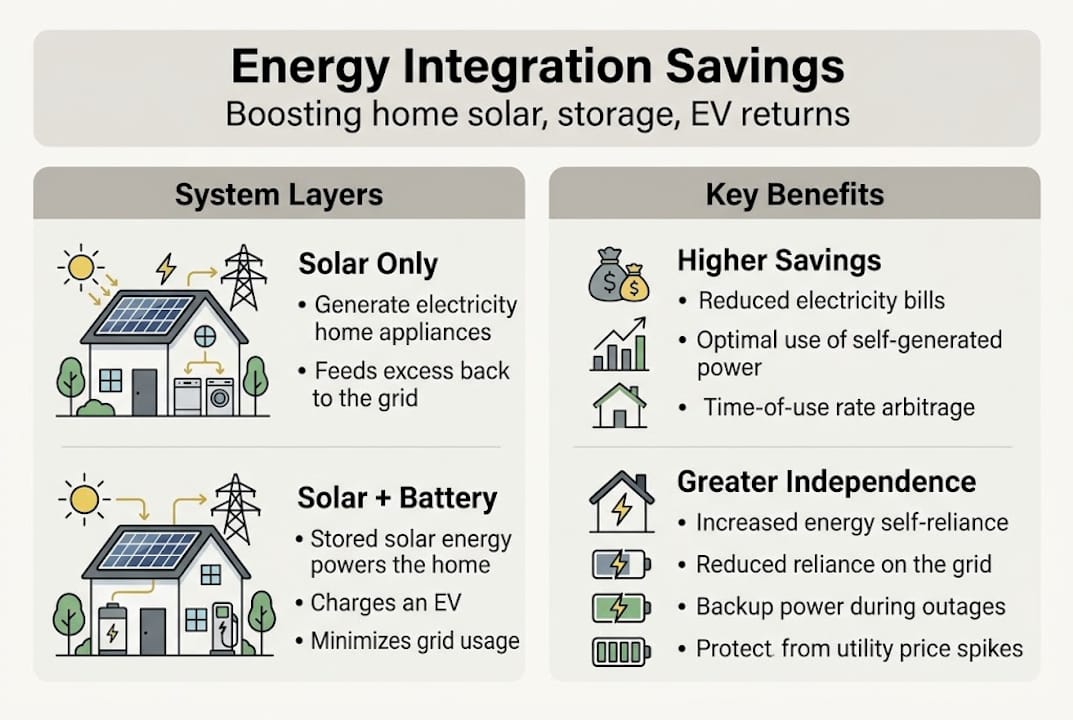
The smarter move is to start with the EMS architecture and build outward. DC-coupled systems with AI-driven EMS reach over 95% efficiency, compared to 85-88% for loosely integrated AC-coupled setups. That gap compounds over 25 years.
Cost is the usual objection. But consider that a more efficient system with a lower self-consumption loss reaches payback faster, even if the upfront price is higher. The real cost of a cheap, disconnected setup is years of missed savings and a harder retrofit job later. We also see modular storage and AI-driven optimizers as the non-negotiables for futureproofing, especially as V2G regulation and time-of-use tariffs mature across the region. Energy independence with storage is not just about resilience today; it is about positioning yourself for the grid of 2028 and beyond.
Ready to transform your energy future?
Taking your energy setup from scattered components to a fully integrated, optimized system is a significant step, and it starts with understanding exactly where you stand today.

At energy management solutions, we help homeowners and small business owners in the Netherlands, Belgium, and Luxembourg design systems that actually work together. From initial sizing and 25-year financial modeling to full installation and EMS configuration, our team provides the kind of tailored support that online calculators simply cannot. If you are serious about cutting costs and building real energy independence, speak with a local expert who knows the specific tariff structures, subsidy landscape, and grid connection rules in your region. Your next step is a personalized assessment.
frequently asked questions
How much can I really save with energy management systems in the Netherlands and Belgium?
A smart EMS typically delivers 15-20% cost savings and pushes solar self-consumption up to 60-70%, depending on your system size and usage pattern.
What size battery do most homes in the Netherlands and Belgium need?
Most homes fall in the 5-15 kWh range, with 10-15 kWh being the most practical choice for households planning to add an EV or heat pump.
Are there risks with oversizing my solar or battery system?
Yes. Over-sizing increases costs and can expose you to export penalties or prosumer tariff charges that erode payback significantly.
How does integrating EV charging impact my savings?
Scheduling EV charging around solar production or low-price windows delivers 20-30% lower bills on EV-related energy costs, without any hardware change beyond a smart charger.
What is the typical payback time for a full home energy management setup?
For high-consumption homes or SMEs, integrated solar, battery, and load management typically achieves a 5-7 year payback, based on real commercial cases in Belgium and the Netherlands.
Recommended
Comments