What is energy resiliency? How to protect your power in Benelux
- 6 days ago
- 8 min read

TL;DR:
True energy resiliency involves anticipating, responding to, and recovering from disruptions, unlike reliability.
Integrating solar, batteries, EMS, and EVs enhances resilience by enabling backup power and load management.
Strategic resilience, focusing on protecting critical loads rather than full independence, offers optimal value.
Having solar panels on your roof feels like a smart move. But when a grid fault cuts power to your street, most solar installations shut down automatically to protect line workers. That’s the gap between having renewable energy and having true energy resiliency. Energy resiliency is the ability of an energy system to anticipate, prepare for, adapt to, withstand, respond to, and rapidly recover from disruptions while providing stable supply. For Benelux homeowners and businesses, understanding this distinction is the difference between feeling prepared and actually being prepared. This article walks you through the key concepts, real-world examples, and practical steps to build genuine resilience.
Table of Contents
Key Takeaways
Point | Details |
Energy resiliency defined | It means your energy system can withstand disruptions and recover quickly to keep you powered. |
Benelux-specific challenges | Grid congestion and high renewable uptake make advanced resiliency crucial in the region. |
Integrated solutions work best | Combining solar, storage, EVs, and energy management delivers the greatest resilience. |
Customization is key | True resilience requires the right mix of technology and strategies for your unique needs. |
What is energy resiliency?
True energy resiliency goes far beyond keeping the lights on during routine outages. It’s a layered capability that covers six distinct actions: anticipating threats before they happen, preparing systems in advance, adapting operations in real time, withstanding disruptions without collapsing, responding effectively when problems hit, and recovering quickly afterward.
This is fundamentally different from energy reliability, which focuses on avoiding interruptions under normal operating conditions. Reliability is about routine performance. Resiliency is about surviving the unexpected. And it’s different from sustainability, which is about reducing emissions and long-term environmental impact. A system can be sustainable without being resilient, and vice versa.
“Energy resiliency is the ability of an energy system to anticipate, prepare for, adapt to, withstand, respond to, and rapidly recover from disruptions while providing sufficient and stable energy supply.” — ScienceDirect, 2025
In Benelux, three forces are pushing grid flexibility and cost savings to the top of the agenda. First, grid congestion is worsening as electricity demand outpaces infrastructure upgrades. Second, the rapid growth of rooftop solar and wind is creating supply volatility that older grids weren’t designed to handle. Third, EV adoption is accelerating, adding unpredictable load spikes to residential and commercial connections.
A truly resilient energy system has these characteristics:
Redundancy: Multiple energy sources so no single failure causes a blackout
Flexibility: The ability to shift loads, store energy, and respond to price signals
Visibility: Real-time monitoring so you know exactly what your system is doing
Recovery speed: Fast restoration of critical functions after any disruption
Adaptability: Systems that learn and adjust to changing conditions over time
Understanding these dimensions helps you move from vague goals like “going green” to a concrete plan that actually protects your home or business.
Why energy resiliency matters in Benelux
With a clear definition in hand, it’s important to understand why energy resiliency is especially critical in the Benelux context. This region has one of the highest energy densities in Europe, meaning a lot of demand packed into a relatively small geographic area. That creates specific vulnerabilities.
Grid congestion is the most pressing issue right now. 3TWh of renewable energy was curtailed in the Netherlands in 2023 alone because the grid couldn’t absorb it. That’s clean energy going to waste while consumers still pay full grid rates. For businesses with solar installations, this means your panels may be producing nothing during peak generation hours.
Real Benelux companies are already responding. Dutch logistics firm E. Van Wijk deployed a 1.5MW solar array combined with a 4.3MWh battery and EMS for its EV fleet, covering 50% of its energy demand despite severe grid constraints. Van der Spek and Arvesta have pursued similar integrated approaches, combining solar and storage efficiency with active demand management to reduce grid dependency.
Company | Solar capacity | Battery storage | EV integration | Key result |
E. Van Wijk | 1.5 MW | 4.3 MWh | Yes, fleet | 50% self-supply |
Van der Spek | ~500 kW | ~1 MWh | Partial | Reduced peak demand |
Arvesta | ~800 kW | ~2 MWh | Yes | Grid cost reduction |
For businesses handling constrained grids, the financial case is compelling. Avoiding peak tariffs, reducing grid connection fees, and maintaining operations during outages all translate directly to the bottom line.
Factors driving the need for resiliency in Benelux right now:
Increasing frequency of grid congestion notifications from Tennet and Elia
Rising electricity prices and dynamic tariff volatility
EV fleet charging creating new load management challenges
Stricter corporate sustainability reporting requirements
Insurance and business continuity pressures from prolonged outages
How energy resiliency works: Tech, strategies, and metrics
So how can Benelux homes and businesses move from vulnerability to genuine resilience? Here’s how leading technologies deliver real benefits.
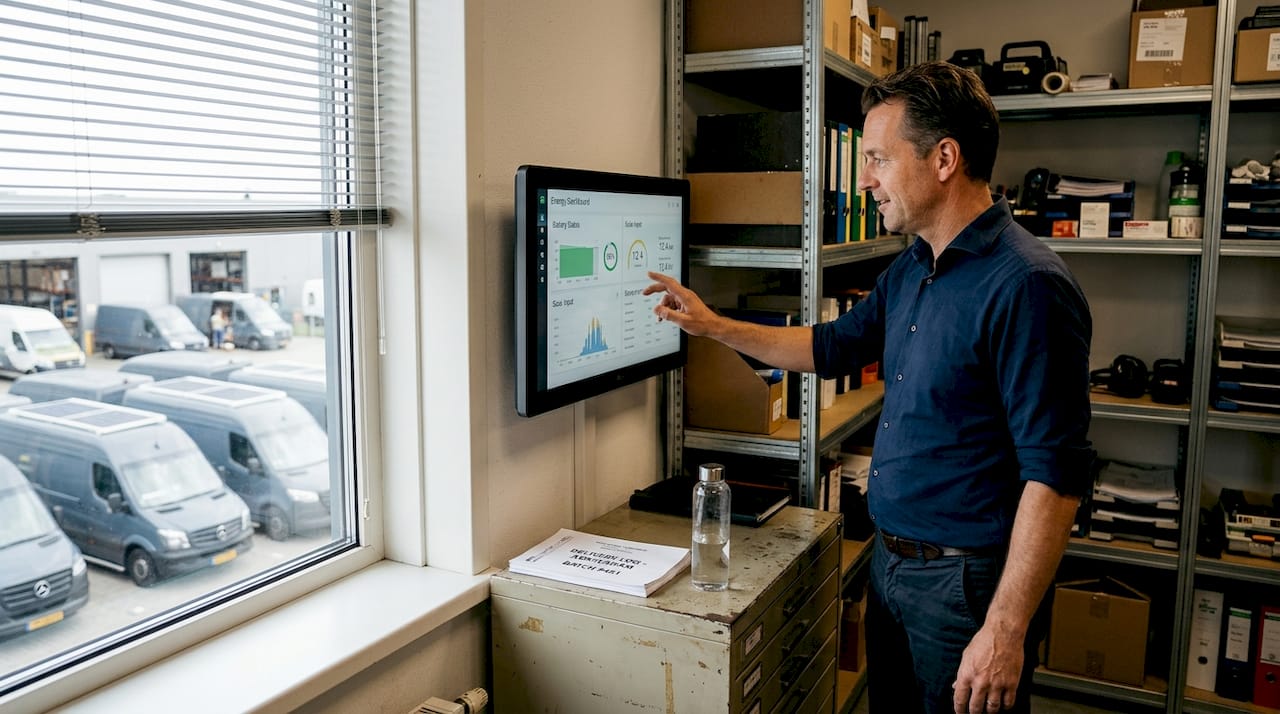
The foundation is integration. Solar panels alone generate power but can’t store it or manage it intelligently. Add a battery and you gain storage. Add an Energy Management System (EMS) and you gain control. Add EV charging and you gain a mobile energy asset. Each layer multiplies the value of the others.
Solar and battery integration can provide backup for 51% of essential household needs on average, with self-consumption rates improving from 30% to 60% when an EMS is added. For businesses, peak demand reductions of 29% have been documented in real-world cases. These aren’t theoretical numbers. They come from actual deployments.
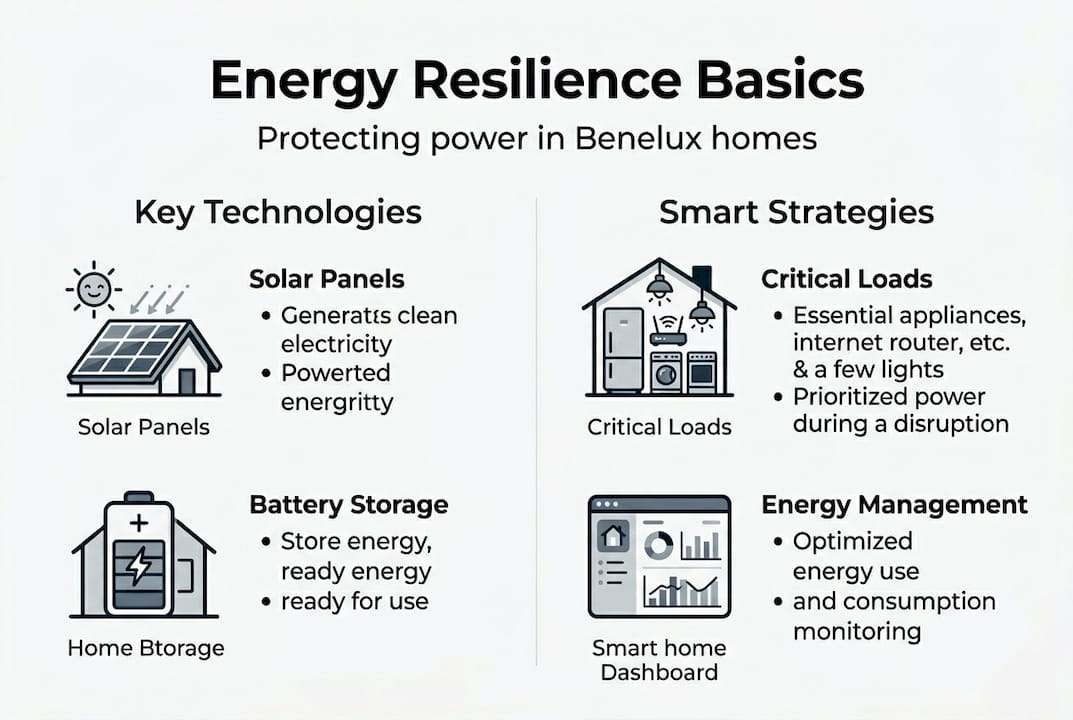
Technology | Resiliency benefit | Best for |
Solar PV | Reduces grid dependency during daylight | Homes and businesses |
Battery storage | Covers outages and peak shaving | All applications |
EMS | Optimizes all assets in real time | Complex systems |
EV charging (V2G/V2H) | Mobile backup power source | EV owners |
For solar plus storage and industrial battery solutions, the technical architecture matters too. Grid-forming inverters enhance microgrid stability compared to grid-following inverters during faults, meaning your system keeps running cleanly even when the grid is unstable.
Steps to build a resilient energy system in Benelux:
Audit your critical loads and identify what must stay on during any outage
Size your solar and battery system to cover those critical loads for at least 12 hours
Install an EMS with dynamic tariff optimization to manage costs in real time
Integrate EV charging with smart scheduling to avoid peak demand spikes
Monitor performance monthly and adjust settings as your usage changes
Pro Tip: Use the VOR123 framework to prioritize your loads. Tier 1 (100% uptime): medical equipment, security systems, refrigeration. Tier 2 (80% uptime): lighting, heating, key workstations. Tier 3 (25% uptime): non-essential comfort loads. This framework helps you size your battery correctly without overspending.
Edge cases, expert nuance, and policy debates
Every solution has limits and trade-offs. Let’s dig into the real-world challenges and ongoing debates faced by Benelux energy pros.
One underappreciated issue is timing. A solar-plus-battery system performs very differently depending on when an outage starts and what season you’re in. Prolonged outages depend heavily on outage start time, season (heating and cooling loads vary dramatically), and solar variability. A battery that covers 12 hours in July may only cover 6 hours in January when heating demand is high and solar generation is low.
EVs are emerging as an important backup source. Vehicle-to-home (V2H) technology lets a parked EV power your home during an outage, with a typical 60 kWh battery covering 12 hours at moderate load. Utrecht has active V2G pilot programs where EVs feed energy back to the grid during peak demand, earning revenue for owners while stabilizing local supply.
Practical considerations for ensuring true resilience:
Confirm your inverter is grid-forming, not just grid-following, for island mode operation
Size battery storage based on winter heating loads, not summer averages
Ensure your EMS can operate autonomously without internet connectivity
Test your backup system at least once per year with a simulated outage
The policy debate is also worth understanding. Some experts and regulators push for system-wide metrics like Expected Energy Not Served (EENS) as the true measure of resiliency, while prosumers and businesses focus on self-sufficiency ratios. Policy in Belgium and the Netherlands currently favors distributed flexibility over centralized solutions, but this is actively debated.
“Contrasting views persist: some emphasize system-wide metrics and performance deterioration indicators, while prosumers focus on self-sufficiency; policy pushes diversification versus decentralized flexibility depending on the jurisdiction.” — arXiv, 2025
For advanced energy management at the business level, understanding this policy landscape helps you position your system to benefit from grid services revenue, not just cost avoidance.
Pro Tip: Ask your installer specifically whether your inverter supports island mode operation. Many standard inverters do not. This single technical detail determines whether your system works during a grid outage or shuts down entirely.
A fresh perspective: Energy resiliency isn’t one-size-fits-all
Here’s a view that doesn’t get enough attention: maximum self-sufficiency is not the same as maximum resiliency, and chasing full grid independence often leads to poor investment decisions.
Going fully off-grid in Benelux is expensive, technically complex, and frequently unnecessary. The grid, even with its congestion issues, remains a valuable resource for balancing seasonal variability. The real goal is strategic resilience, not total independence.
The most effective approach we see is matching your investment to your actual risk profile. A homeowner whose biggest concern is a 4-hour winter outage needs a very different solution than a logistics company whose operations stop completely without power. Understanding solar system components and how they interact with your specific building and grid connection is where real resilience is built.
Focus your investment on three things: protecting your most critical loads first, installing an EMS that optimizes in real time, and integrating your EV if you have one. That combination delivers the highest resilience per euro spent. Everything beyond that is incremental improvement, not a step change.
Ready to boost your energy resiliency?
Understanding is only the first step. If you’re ready to improve your own energy resiliency, here’s where to go next.
At Belinus, we design integrated solar, battery, and EV charging systems built specifically for Benelux conditions. Whether you’re a homeowner looking to protect critical loads or a business managing an EV fleet under grid constraints, our EMS-driven approach gives you real control. Explore our energy efficiency strategies to see how solar, storage, and smart management work together in practice. Our team can help you move from understanding the concepts to having a system that actually performs when it matters most.
Frequently asked questions
What is the difference between energy resiliency and energy reliability?
Energy reliability is about keeping power on under normal conditions, while resiliency covers rapid recovery and adaptation during unexpected disruptions that reliability planning doesn’t anticipate.
Can solar panels alone make my home or business energy resilient?
No. Most grid-tied solar systems shut down during outages for safety reasons. 51% backup coverage of essential needs requires combining solar with battery storage and an EMS.
How can electric vehicles improve energy resiliency?
EVs equipped with V2H capability can power your home during outages, with a typical 60 kWh battery providing roughly 12 hours of backup. They also help balance grid demand through V2G programs.
What is the typical payback period for resilience upgrades in Benelux?
For integrated solar, battery, and EMS systems in Benelux, payback runs 5-7 years, depending on your energy usage profile, local tariffs, and available subsidies.
Recommended
Comments