Top 3 Energy Solutions for Fleet Charging Alternatives 2026
- 3 hours ago
- 10 min read

Choosing an energy solution that lowers fleet charging costs without locking into a single technology remains difficult for businesses and public authorities. Many solutions bundle management with hardware but lack modular storage or restrict integration, leaving buyers stuck with limited flexibility and operational savings. This comparison covers hardware mix, management features, and integration support so fleet operators and businesses can match one offering to their charging and expansion plans.
Table of Contents
belinus

At a Glance
Belinus reports Energy Wall G1 is a 16 kWh graphene supercapacitor priced at €7,000 per unit and scheduled for Q1 2026. The product line mixes lithium-free storage and traditional LFP choices for different site needs. This setup targets homeowners and commercial fleets that need integrated charging and storage.
Core Features
The residential stack pairs high-efficiency photovoltaic modules with the Solis Inverters range. The company advertises Solis Inverters available in 5–25 kW sizes. Belinus also offers the ETAP Pro EV Charger and, according to the company, a quotation tool launching in January 2026 that provides automated 25-year financial modeling.
Belinus markets commercial and utility hardware including utility storage built from 400+ kWh modules that scale to MW capacity. The vendor advertises Belinus-branded PCS for CNI applications with a two-week delivery target. Grid-integrated services cover energy trading and arbitrage plus custom system design from small CNI to utility scale.
The technical architecture centers on a centralized EMS. The company reports a centralized EMS with 15-minute dynamic tariff optimization and real-time battery arbitrage. Multi-technology support covers graphene supercap, LFP, pre-lithiated LFP, and HUC, while a RESTful API, native app, and IoT fleet features handle monitoring and control.
Key Differentiator
Belinus pairs Belgian engineering with AI-driven energy management to control charging, generation, and storage from one EMS. The EMS runs short-interval tariff optimization and real-time arbitrage to move charging windows and reduce peak grid draw. That integration ties hardware selection directly to operational savings potential for fleets.
Pros
Belinus emphasizes environmentally friendly storage including lithium-free graphene supercapacitors and multiple LFP chemistries. The portfolio covers residential inverters to utility-scale storage, which lets you pick a hardware mix that fits site constraints. Long manufacturer warranties and a native mobile app with RESTful API simplify maintenance and third-party telemetry for fleet charging operations.
Cons
Distribution and service options outside Belgium are limited, which may slow commissioning and spare-parts support for international fleets.
Who It’s For
Fleet operators who want a single vendor for solar, storage, and charging hardware will find Belinus relevant. The offering also suits eco-conscious homeowners and small-to-medium enterprises that plan on integrating EV charging with on-site generation. Energy project developers and industrial planners seeking modular, scalable systems will also benefit.
Unique Value Proposition
The centralized EMS with 15-minute tariff optimization lets you schedule EV charging to lower-cost windows and use stored energy during peaks. That short-interval control reduces grid demand charges and creates arbitrage opportunities for fleets with predictable duty cycles. Coupled with hardware choices from supercaps to LFP, the EMS turns component selection into measurable operational savings.
Real World Use Case
A homeowner or small fleet installs Belinus solar modules, a storage stack, and the ETAP Pro charger. The EMS shifts vehicle charging to low-tariff windows and runs battery arbitrage overnight. The result is lower utility bills and a more reliable on-site green supply backed by Belgian engineering and long warranties.
Pricing
Pricing is project specific and not listed publicly. Systems appear tailored per site and quoted after a site survey. For the Energy Wall G1, Belinus reports the unit price as €7,000 and provides quoting through its January 2026 quotation software.
Website: https://belinus.com
SBRS
At a Glance
A logistics customer scaled SBRS PowerHub 500 chargers from two to six charge points during a staged rollout. That example shows the platform can grow with fleet needs while using the same hardware family. The deployment paired chargers with SBRS energy management software to shift schedules and reduce peak demand.
Core Features
SBRS combines modular DC fast chargers for heavy duty vehicles with an energy management platform that schedules loads and reduces depot peak power. The company also offers design, engineering, and ongoing maintenance services for complex fleet sites. A partnership with Shell supports networked site access and larger ecosystem integration.
Key Differentiator
SBRS pairs purpose built modular chargers with fleet oriented energy management to handle heavy duty vehicle charging at scale. The combined hardware and software focus is tuned for trucks, buses, and ferries rather than mixed passenger parking. That narrow focus guides site engineering, service contracts, and safety protocols.
Pros
SBRS supplies scalable, purpose built charging hardware designed for heavy duty fleets. The company delivers end to end packages that include on site engineering, installation, and maintenance services, which reduces coordination across vendors. A clear emphasis on lowering fleet total cost of ownership drives operational features in the energy management platform and long term service offers.
Cons
Focused on heavy duty fleets, not passenger cars or light commercial vehicles. This excludes operators who need mixed vehicle charging.
Solutions are often tailored and complex, requiring specialist engineering during site design and commissioning. Smaller teams may need external consultants.
Deployment emphasis is regional, with priority given to European markets. Global rollouts may face longer lead times.
Initial capital outlay can be higher than simple AC chargers, which may deter smaller operators on tight budgets.
When It May Not Fit
If your fleet is mainly passenger vans or light duty vehicles, SBRS hardware will not match vehicle power profiles. Operators outside Europe should expect longer procurement timelines and limited local support. Smaller operators with constrained capital will find the modular chargers more costly upfront than basic alternatives.
Who It’s For
Large fleet operators, public transport agencies, and marine port authorities that run trucks, buses, or electric ferries will benefit most. Companies planning depot level electrification and phased scaling prefer SBRS because site engineering and service come bundled. Logistics groups aiming to reduce depot peak demand will use the energy management features directly.
Real World Use Case
A logistics operator installed two PowerHub 500 charge points and later expanded to six as fleet electrification accelerated. SBRS software scheduled overnight charging and shifted loads away from utility peaks. The project reduced operational interruptions and smoothed depot power demand during growth.
Pricing
Pricing is project based and varies by hardware count, site complexity, and service level. PowerHub 500 chargers are modular and tailored to client needs, and SBRS provides detailed quotes on request. There is no fixed list price publicly listed.
Website: https://sbrs.com
EO Charging
At a Glance
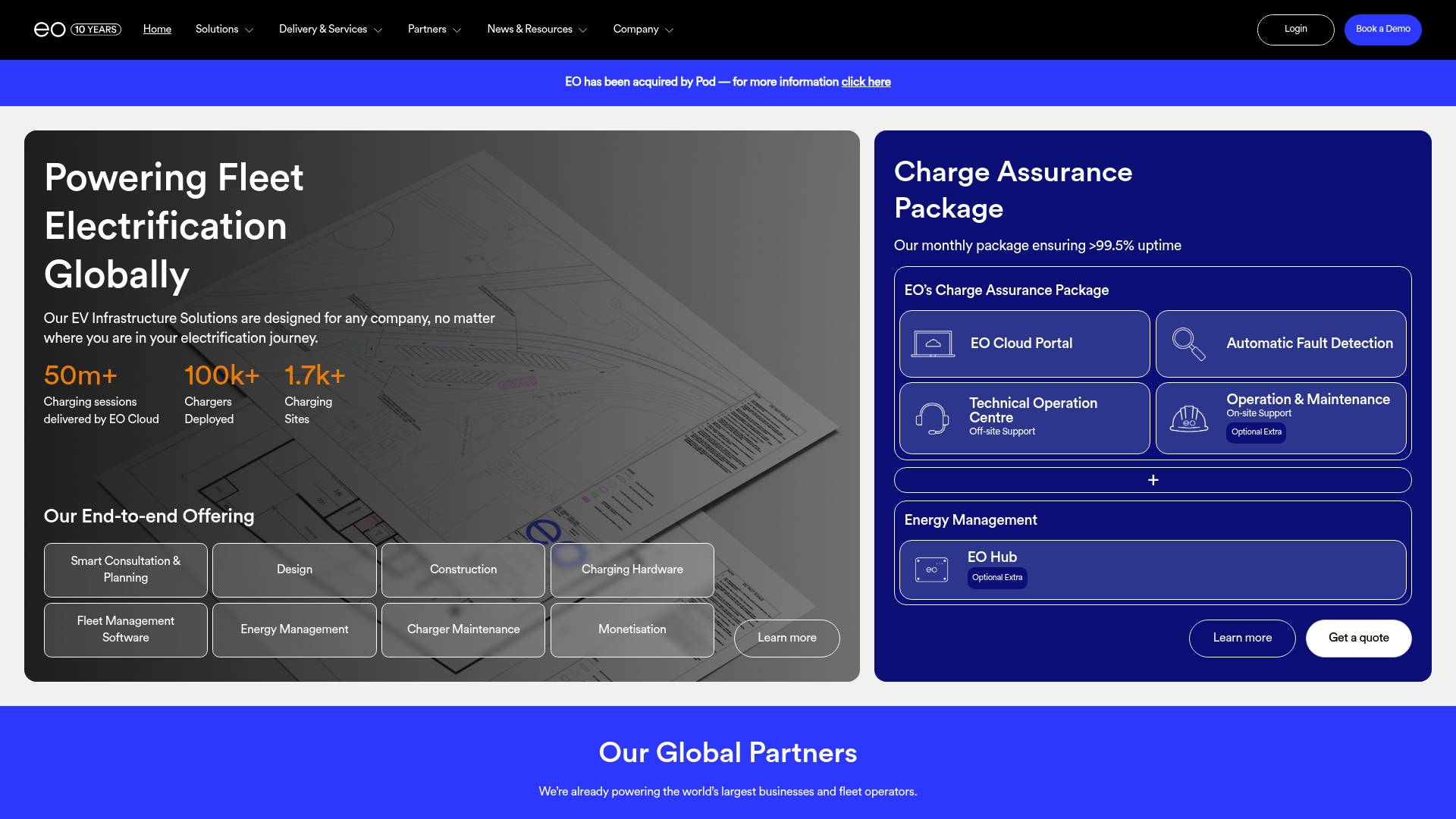
Offers 24/7 support and maintenance services. The company pairs physical chargers with cloud based management for depot and public sites. EO Charging operates globally and targets fleet, municipal, and commercial deployments.
Core Features
EO Charging combines AC and DC chargers with a cloud based management platform that connects hardware to remote monitoring and reporting. The offering supports scalable rollouts from a single charger to large networks and includes 24/7 support and maintenance services. The vendor also exposes APIs and works through partnerships to integrate third party management systems.
Key Differentiator
The standout is tight integration between on site chargers and a cloud management system supported by a wide partner network. That integration simplifies firmware updates, session reporting, and centralized control across multiple sites. The model suits fleet that need hardware and management under one coordinating partner.
Pros
Flexible hardware options let you pick AC chargers for workplace use and DC chargers for fast depot charging, matching vehicle and duty cycle needs. Strong emphasis on integration and software management reduces manual reconciliation and gives centralized visibility of charge sessions. Partnerships with numerous management providers increase interoperability and make it easier to slot chargers into existing backend systems. Global reach and local support help with multi‑site rollouts and regional compliance work.
Cons
Website and product pages currently inaccessible, limiting immediate access to technical specs or user manuals.
Pricing transparency is limited; public price lists or clear product options are not available.
No explicit mention of certifications or compliance standards appears on the available materials.
Limited details on international shipping or local deployment constraints reduce clarity for cross border projects.
When It May Not Fit
If your procurement requires public, line item pricing, EO Charging is a poor match because quotes appear to be custom only. Buyers needing published certification documents for procurement boards will find the documentation gap problematic. Organizations that require guaranteed local stock or clear international logistics should verify availability before committing.
Notable Integrations
Fuuse EV
Everty
GOTO-U
Greenflux
Monta
Tap Electric
Wevo
Stemy
Who It’s For
Businesses and fleet operators that want integrated charging hardware paired with centralized management benefit most. Public authorities and property owners who plan multi site rollouts will gain from the partner network and maintenance offering. Organizations that accept custom quotes and need vendor support for deployment will find this a natural fit.
Real World Use Case
A logistics company partners with EO Charging to design, install, and manage chargers across multiple depots. The deployment uses EO Cloud for real time monitoring and fault alerts, which reduces on site troubleshooting time. Centralized reporting also simplifies monthly energy reconciliation across depots.
Pricing
Pricing is not published. The vendor asks prospects to contact sales for custom quotes and site surveys. Expect site specific pricing based on charger mix, installation complexity, and management contract.
Website: https://eocharging.com
Comparison of alternatives
Choosing the right energy solutions for fleet charging involves assessing various dimensions including hardware flexibility, energy management, and regional support. Here, we compare three key providers—Belinus, SBRS, and EO Charging—highlighting their unique strengths and limitations.
Integrated energy management and hardware scalability
Belinus offers a centralized EMS that dynamically optimizes charging schedules and energy storage, leveraging 15-minute intervals to minimize costs during peak hours. This feature allows fleets with predictable schedules to achieve significant savings on energy expenditures. In contrast, EO Charging’s cloud platform integrates with numerous third-party systems, offering a unified interface for managing AC and DC chargers across multiple sites. This interoperability supports organizations requiring extensive integrations, although availability of certain documentation remains unclear. SBRS stands out by tailoring its hardware and software solutions specifically to the heavy-duty vehicle segment, ensuring operational effectiveness and compatibility for denser fleet infrastructure. However, this focus may limit versatility for mixed-vehicle environments or smaller-scale fleets.
Eco-conscious and regional focus
Belinus emphasizes environmentally conscious storage solutions, utilizing lithium-free graphene supercapacitors in its Energy Wall G1 product. This innovation appeals to operators aiming to align with sustainability goals. SBRS excels in offering installation and maintenance packages, albeit primarily within European markets. EO Charging’s global reach and network of partnerships facilitate deployment across multinational operations, supporting diverse geographic needs though specifics on international logistics are less detailed.
Best fit
Operators requiring eco-friendly storage options alongside AI-optimized energy management will benefit most from Belinus’s product lineup and EMS integration.
Fleet managers focusing heavily on heavy-duty electric vehicle charging can rely on SBRS for their modular and scalable hardware systems tailored to this specific segment.
Organizations with distributed sites across multiple regions seeking integrated partner solutions can find value in EO Charging’s API support and global network partnerships.
Our pick
Belinus distinguishes itself by integrating advanced energy management with flexible hardware configurations. The capability to optimize energy usage based on high-resolution dynamic tariffs makes it particularly suitable for fleets looking for measurable operational savings. However, those with requirements for heavy-duty vehicle specialization may consider SBRS as an alternative. Belinus’s focus on forward-thinking sustainability and long-term efficiency positions it as the recommended choice for diverse fleet operators aiming to align energy solutions with operational and environmental priorities.
Choosing the optimal energy solution for fleet charging involves evaluating the integration of energy management systems, hardware compatibility, and scalability.
Product | Core Feature | Key Differentiator | Best For | Notable Limitation |
Belinus | Energy Wall G1, graphene supercapacitor | AI-driven EMS optimizing tariffs for integrated energy solutions | Fleet managers needing centralized EMS | Limited service availability outside of Belgium |
SBRS | Modular DC fast chargers | Hardware and software tailored for heavy-duty electric fleets | Operators managing buses or trucks | High initial cost and focus on heavy-duty vehicles only |
EO Charging | AC and DC chargers with cloud platform | Centralized management through integrations with multiple third-party APIs | Companies planning global multi-site rollouts | Custom quotes only, limited specification details available publicly |
How Can You Simplify Energy Solutions for Fleet Charging in 2026?
Managing energy for fleet charging presents challenges like balancing charging schedules, reducing peak grid demand, and integrating multiple hardware types. Belinus addresses these needs with a centralized EMS that supports 15-minute tariff optimization and real-time battery arbitrage. Their solution combines lithium-free graphene supercapacitors, LFP batteries, and scalable solar PV modules to offer choices fitting residential and commercial fleets.
Belinus helps fleet operators and eco-conscious homeowners control costs and carbon footprint. They provide complete integration with the ETAP Pro EV Charger and intuitive software tools launching in early 2026 for financial planning and system sizing. Learn how Belinus solutions align with your goals for efficient, flexible, and scalable energy management.
Explore Belinus energy solutions and see how their EMS and hardware can reduce your energy costs and simplify fleet charging management. Take the next step by reviewing their Energy Wall G1 supercapacitor and get ready for the 2026 launch.
FAQ
How does Belinus optimize energy costs for fleet charging?
Belinus uses a centralized energy management system (EMS) with 15-minute dynamic tariff optimization. This feature helps schedule EV charging during lower-cost windows, reducing overall energy expenses for fleet operators. The EMS’s real-time battery arbitrage also maximizes energy usage efficiency, which can lead to significant operational savings on utility bills. Fleet operators should consider implementing Belinus to unlock these cost-saving benefits.
What is the difference between SBRS and Belinus in charging capabilities?
SBRS offers modular DC fast chargers specifically designed for heavy duty vehicles, which are effective for large fleets seeking robust infrastructure. These chargers are paired with an energy management platform that reduces depot peak power. Belinus, on the other hand, provides a mix of residential and commercial solutions, including graphene supercapacitors alongside lithium-free and traditional LFP options, which cater to a broader range of use cases including both homes and businesses. Fleet operators can choose Belinus for a more diverse charging solution that adapts to various site needs.
What features make the ETAP Pro Charger appealing in the Belinus lineup?
The ETAP Pro Charger provides an integrated charging solution that aligns with Belinus’s energy management system, ensuring efficient operation during fleet charging cycles. This charger supports high-efficiency photovoltaic modules to optimize energy usage. For users looking for a comprehensive approach to charging and energy management, the ETAP Pro Charger enhances the entire system’s performance.
Which energy solution is best for small-to-medium enterprises integrating EV charging?
Belinus specifically targets eco-conscious homeowners and small-to-medium enterprises, making it a suitable choice for companies planning to integrate EV charging with on-site energy generation. The offered systems include customizable components that cater to diverse energy needs. Considering Belinus will equip such enterprises with dedicated energy solutions tailored to their operational scope.
Can I expect competitive pricing from Belinus for their Energy Wall G1?
Belinus states that the Energy Wall G1 is priced at €7,000 per unit, making it a competitive option in the energy storage market. This pricing aligns with its features and performance, especially for users focused on long-term investments in energy sustainability. Businesses looking for effective energy storage solutions should evaluate whether this pricing fits their budget.
Recommended
Comments