Energy Wall Explained: Smarter Storage for European Homes
- 1 day ago
- 9 min read
TL;DR:
The term “energy wall” is a marketing label representing various products, primarily wall-mounted home batteries for energy storage. Clarifying details like battery chemistry, capacity, grid connection, and compatibility is essential before purchasing to avoid mismatched systems. Understanding the different types and proper integration of energy walls enables homeowners to optimize their energy management and avoid costly mistakes.
You’ve searched “energy wall,” and now you’re drowning in results that seem to be talking about completely different things. Some pages show sleek wall-mounted battery packs. Others describe ventilation systems. A few reference modular power units for commercial buildings. This confusion is real, widespread, and costly if it leads you to buy the wrong system. This guide cuts through the noise and gives you a clear, practical framework for understanding what an energy wall is, what types exist, how they connect to your home’s energy system, and exactly what to ask before you spend a single euro.
Table of Contents
Key Takeaways
Point | Details |
Define ‘energy wall’ | Always clarify whether the term refers to a home battery, ERV system, or another energy-related device. |
Prioritize compatibility | Match your energy wall storage system with inverter, voltage, and EU grid connection requirements. |
Compare types and rigor | Evaluate different technologies, sizes, and certifications—not all ‘energy wall’ products are equal. |
Ask critical questions | Request technical specs and independent proof of compliance before committing to installation. |
Plan for the future | Opt for modular, flexible systems that can grow with your energy needs. |
What does ‘energy wall’ actually mean?
The phrase “energy wall” is not a standardized technical term. It’s marketing language, and different companies use it however they see fit. That’s the root of the confusion, and it’s important to accept that upfront rather than assume one definition is universal.
For most European homeowners researching solar and storage, “energy wall” typically refers to a wall-mounted home battery system designed to store electricity from solar panels or the grid. You charge it when energy is cheap or abundant, and you draw from it when it isn’t. Simple concept, big impact on your electricity bill.
But here’s where it gets tricky. Some companies use “Energy Wall” as their own product or company name, yet their products have nothing to do with residential battery storage. Some refer to energy recovery ventilation units, insulation panels, or modular thermal barriers. The name sounds relevant but points to an entirely different technology category.
“Energy wall” as a term is essentially unlicensed. Any manufacturer can apply it to any product, so the label alone tells you almost nothing about what you’re actually buying.
This matters because a homeowner who calls an installer asking for an “energy wall” might get quoted on a ventilation system when they want a battery, or vice versa. To protect yourself, always clarify with specific questions before any quote progresses. You can also read more about energy wall technology explained to build a stronger foundation before talking to any vendor.
Key things to clarify immediately:
Is this a battery storage system or something else entirely?
What is the battery chemistry (lithium iron phosphate, graphene supercapacitor, lead-acid)?
What is the usable capacity in kilowatt-hours?
Is it grid-connected or off-grid only?
What inverter does it require or include?
Getting clear answers to these five questions immediately filters out mismatched products and salespeople who are unclear on their own offerings.
Types of ‘energy wall’ solutions for homes
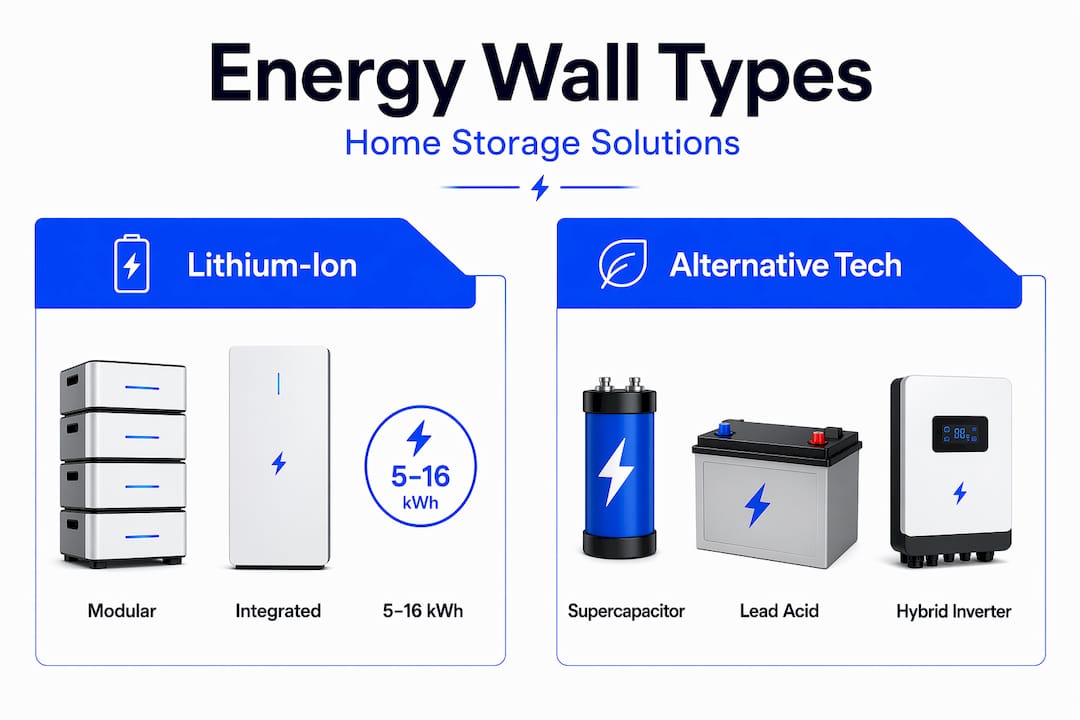
Once you understand that the term is broad, the next step is knowing which category of product you’re actually looking for. For European homeowners, there are three main types worth understanding.
Lithium-ion wall batteries are the most common. These are modular, scalable systems typically mounted in a garage, utility room, or on an external wall. They store energy in lithium-based cells and connect to a hybrid inverter or a dedicated battery inverter. Most modern units are AC-coupled, which means they can work with almost any existing solar installation without requiring a full system replacement. Capacity usually ranges from 5 kWh to 20+ kWh depending on the number of modules installed.
Hybrid inverter systems combine the inverter and battery storage into one integrated unit. These are attractive because they reduce cabling complexity and often come pre-configured for grid interaction. If you’re installing solar and storage simultaneously on a new build or doing a full retrofit, a hybrid system is often the most cost-effective path.
Alternative technologies include supercapacitor-based units, pre-lithiated lithium cells, and older lead-acid battery walls. These are less common in residential settings but are gaining traction as next-generation products enter the market. Supercapacitors, for instance, offer faster charge and discharge cycles with longer operational lifespans, though the cost per kWh is still higher than standard lithium-ion options. Genuine home energy storage options vary more than most homeowners realize, so comparing multiple technology types before committing is always worthwhile.
Here’s a quick comparison to orient your thinking:
System type | Typical capacity | Key advantage | Main consideration |
Lithium-ion wall battery | 5 to 20+ kWh | Wide availability, modular | Requires compatible inverter |
Hybrid inverter system | 5 to 15 kWh | All-in-one, simpler install | Less flexible for upgrades |
Supercapacitor unit | 10 to 20 kWh | Long cycle life, fast response | Higher upfront cost |
Lead-acid wall battery | 4 to 12 kWh | Lower cost | Heavier, shorter lifespan |
A strong example of modularity in practice comes from established manufacturers. Viessmann’s Vitocharge VX3 can be wall mounted or floor installed indoors, uses modular 5 kWh battery blocks, and integrates directly with hybrid inverter configurations. That kind of flexibility matters because your energy needs today are not your energy needs in five years, especially if you’re planning to add an EV charger or expand solar capacity.
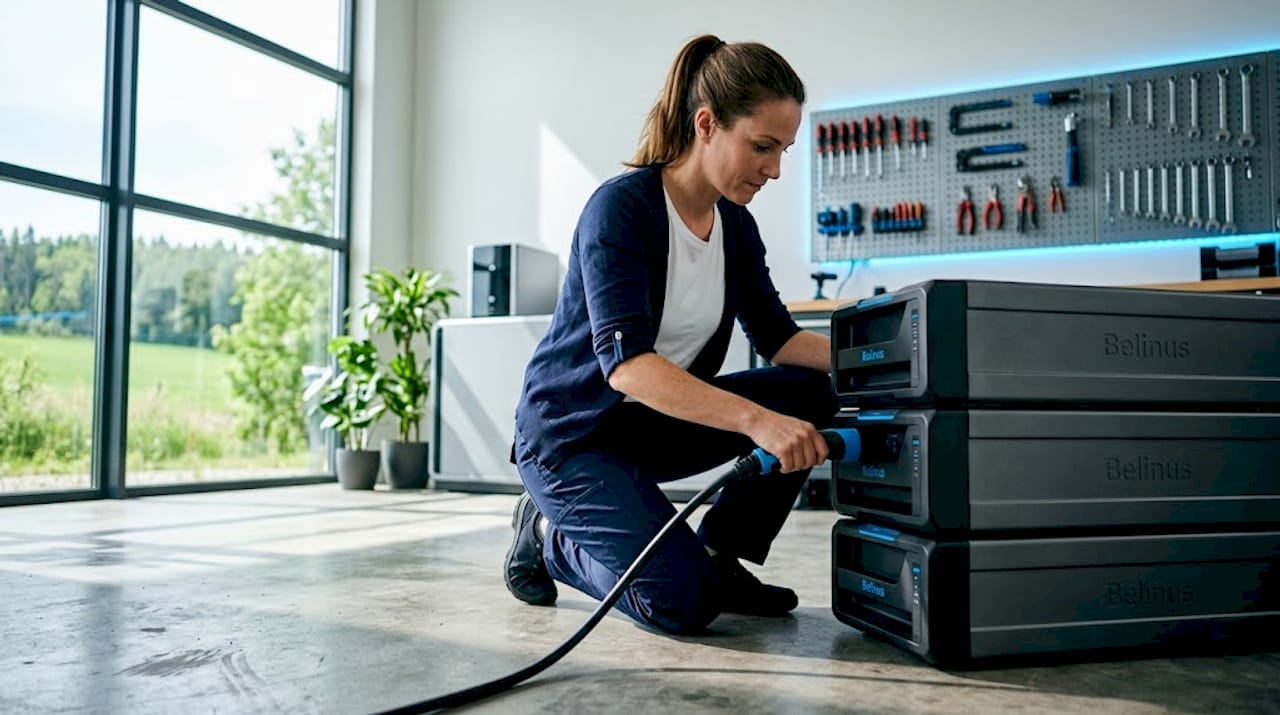
Pro Tip: When reviewing modular systems, always ask what the minimum and maximum configuration is. A system that tops out at 10 kWh may not future-proof your home if EV charging or expanded appliances increase your demand significantly. Compare options through types of residential storage to understand the full range before locking in.
How energy walls integrate with your home’s energy system
Choosing the right product is only half the work. Integration is where things either come together smoothly or create expensive headaches. A battery sitting on your wall does nothing useful unless it’s correctly wired, configured, and certified to interact with your home grid and your local utility network.
Here’s a practical sequence for understanding integration:
Match voltage and chemistry to your inverter. Not every battery works with every inverter. DC-coupled batteries must match the inverter’s input voltage window. AC-coupled batteries are more flexible but still need configuration. Confirm compatibility in writing before purchase.
Check inverter communication protocols. Modern energy management systems rely on data flowing between the battery, inverter, and grid meter. Common protocols include Modbus, CAN bus, and SunSpec. If your chosen battery doesn’t speak the same language as your inverter, you lose real-time optimization.
Verify EU grid connection certification. In Europe, grid-connected storage must meet specific standards, including VDE-AR-N 4105 in Germany, RfG in the broader EU framework, and national variants. Confirming EU grid certification before installation is not optional. Installing an uncertified system can result in grid disconnection orders and insurance complications.
Understand your backup configuration. If whole-home backup is your goal, you’ll need a transfer switch or an inverter with backup capability. Partial backup (selected circuits only) is cheaper and often sufficient for most European households.
It’s also worth knowing that not all wall energy storage products are the same electrically or architecturally. Some are AC-ready with hybrid inverters, some are DC-coupled supercapacitor concepts, and some use entirely different battery chemistries. Knowing which category you’re dealing with determines every step of the integration process.
Did you know? A properly integrated solar-plus-storage system can increase your solar self-consumption rate from around 30% (without storage) to over 70% in a typical European household. That jump directly reduces your dependence on grid imports and shrinks your electricity bill regardless of seasonal tariff changes.
For homeowners with existing solar, integrating solar with storage is a well-documented path with clear steps. If you’re planning a new system from scratch, looking at grid-connected battery storage guidance for Central Europe provides useful context on regulatory and technical requirements that differ by country.
What to consider before installing an energy wall
This is where good intentions meet hard decisions. Skipping these questions leads to systems that underperform, cost more than expected, or require expensive modifications later.
Clarify your primary goal first. Are you installing for emergency backup? For daily solar self-consumption? For grid cost arbitrage using dynamic tariffs? Or to future-proof your home for an EV? Each goal changes the ideal system size, chemistry, and configuration. A system optimized for backup behaves differently from one optimized for arbitrage, and confusing the two costs money.
Demand full documentation before signing anything:
Battery chemistry and cycle life rating
Usable versus nominal capacity (they are often different)
Round-trip efficiency percentage
Inverter compatibility list
Warranty terms including degradation guarantees
Proof of EU grid compliance certificates
Pro Tip: Ask specifically whether the quoted warranty covers capacity degradation. Many batteries guarantee against manufacturing defects but say nothing about capacity loss. A battery that degrades to 70% capacity in six years has effectively lost almost a third of its value. A warranty that covers degradation below 80% capacity over 10 years is far more meaningful.
Check your wall and space constraints. Battery systems can be surprisingly heavy. A 10 kWh lithium-ion unit may weigh 100 kg or more. Not every wall or utility room can handle that load, particularly in older European homes with thinner masonry or timber framing. Request the installation drawings and confirm structural suitability before proceeding.
Always get all-in installed costs, not just hardware prices. Installation labor, electrical upgrades, grid connection fees, permitting, and commissioning can add 20 to 40 percent on top of the hardware price. A battery quoted at €5,000 can easily become a €7,000 installed cost. Knowing how to choose energy storage well means comparing total project costs, not just product sticker prices. Reviewing energy storage best practices before engaging installers gives you a strong negotiating baseline.
A fresh perspective: Why ‘energy wall’ can empower smart homeowners or trip up the unwary
Here’s something the mainstream guides rarely say bluntly: most of the confusion around energy walls is deliberately sustained by marketing departments, not inadvertently created by technical complexity.
The technology itself is not that complicated. Batteries store energy, inverters convert it, and a management system optimizes when you charge and discharge. The complexity that homeowners experience comes from terminology being used inconsistently across sales materials, installation quotes, and product brochures. That inconsistency is not accidental. Vague language creates perceived differentiation and makes it harder for you to do apples-to-apples comparisons.
Because the term is used in multiple ways across industries, homeowners need to draw a firm line between wall-mounted lithium battery ESS for home backup and self-consumption on one side, and products that simply carry the “energy wall” label for branding reasons on the other. The two categories have almost nothing in common beyond the name.
The smartest homeowners we see in this market do one thing consistently: they define their goal before they talk to any vendor. Not “I want an energy wall.” Instead: “I want to store 10 kWh of solar energy daily, achieve 75% self-consumption, and have backup capability for my critical circuits during grid outages. Show me exactly how your product delivers that, and give me the certification documents.” That level of specificity immediately separates serious installers from order-takers.
The future of home energy storage is firmly in the direction of modular, integrated, intelligent systems. A battery alone is becoming less relevant than a battery paired with a dynamic energy management system that responds to 15-minute tariff intervals, feeds data to your EV charger, and predicts consumption patterns from your appliance behavior. Knowing the residential energy storage basics is your starting point, but the real value comes from understanding the full system, not just the storage unit on your wall.
Don’t let clever branding make a simple decision feel impossible. Ask direct questions, demand written answers, and treat vague responses as a red flag.
Connect with trusted experts for your energy wall solution
Navigating the energy wall market is much easier when you have a knowledgeable partner who can translate your goals into a properly specified system. At Belinus, we work with European homeowners to design storage solutions that go beyond a single battery unit, integrating solar, storage, EV charging, and intelligent energy management into one cohesive system.
Our Energy Wall G1, launching Q1 2026, delivers 16 kWh of graphene supercapacitor storage for €7,000, backed by an EMS that optimizes charging and discharging every 15 minutes based on real-time tariffs. Whether you’re comparing technologies, planning a new installation, or upgrading an existing system, discover energy wall solutions and get guidance tailored specifically to your home and goals. We believe every homeowner deserves clear answers and a system that actually performs as promised.
Frequently asked questions
Does ‘energy wall’ always mean a home battery system?
No. Some companies use “Energy Wall” as a brand name for products like ventilation or thermal systems, so always verify the specific technology category before comparing prices or requesting quotes.
Are all energy wall battery systems compatible with European home grids?
Not all. You must confirm EU grid certification and inverter compatibility for every system you consider, since electrical architecture and certification standards vary significantly between products and manufacturers.
Can a wall-mounted battery provide full backup during a power outage?
Yes, but only if the battery is sized to cover your home’s actual load, paired with an inverter that has backup functionality, and wired through a proper transfer switch to your critical circuits.
What does modularity mean with modern energy wall systems?
Modularity means you can add battery modules incrementally over time, scaling your total storage capacity up or down to match changes in your energy consumption, solar production, or budget without replacing the entire system.
Recommended
Comments