EV Charging Basics: What Homeowners and Businesses Need to Know
- May 23
- 9 min read

TL;DR:
Most first-time EV buyers often assume charging is straightforward, but installation costs and limitations can be costly without proper knowledge. Understanding the differences between charging levels, managing installation costs, and utilizing smart charging practices optimize long-term operation and battery health. Proper planning and load management are essential to avoid unexpected expenses and maximize the efficiency of residential or commercial EV infrastructure.
Most people buying their first EV assume charging is simple. Plug in, charge up, drive away. Then reality hits: a Level 2 charger costs more to install than expected, a DC fast charger at a commercial property triggers demand charges that balloon the utility bill, and nobody told them that charging past 80% slows to a crawl. EV charging basics aren’t complicated, but the gaps in common knowledge are expensive. This guide covers what actually matters, from understanding EV charging levels to installation costs and smart operational practices, for both homeowners and business operators.
Table of Contents
Key Takeaways
Point | Details |
Three charging levels exist | Level 1, Level 2, and DC Fast Charging differ significantly in speed, cost, and typical use case. |
Home installation costs vary widely | Residential Level 2 installation runs $200 to over $3,500 depending on electrical complexity. |
Commercial costs are far higher | Commercial DC fast charger installs can reach $180,000+ per port, making planning critical. |
Smart charging cuts operating costs | Load management software can reduce commercial demand charges by 40 to 60 percent. |
The 20-80 rule protects battery life | Keeping charge levels between 20% and 80% preserves long-term battery health and daily efficiency. |
EV charging basics: levels, speeds, and what they mean
Understanding EV charging starts with understanding the three levels. They are not arbitrary marketing categories. Each one reflects a real difference in voltage, power delivery, and practical application.
EV charging is categorized into Level 1 (120V AC), Level 2 (240V AC), and DC Fast Charging (480V and above). Level 1 uses a standard household outlet. No special equipment is needed. You plug in and get roughly 2 to 4 miles of range per hour. That works fine if you drive under 40 miles a day and charge overnight, but it is painfully slow for anything more demanding.
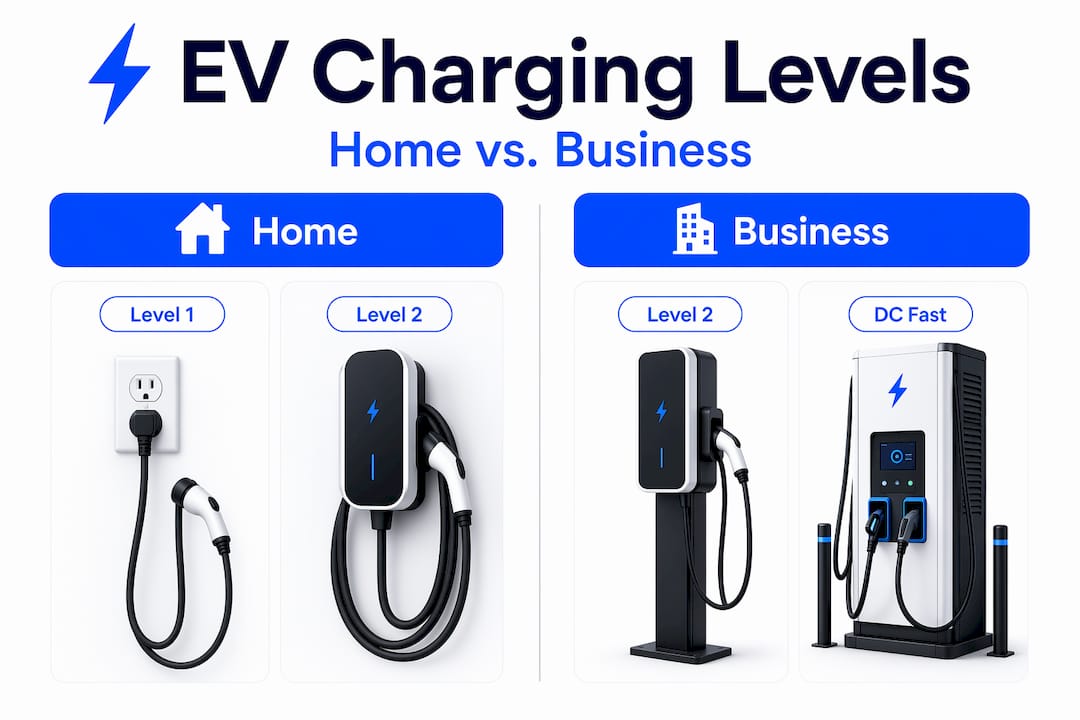
Level 2 is where most residential and workplace charging happens. At 240V, a Level 2 charger adds 12 to 40 miles of range per hour depending on the charger’s power output and the vehicle’s onboard charger capacity. A full charge overnight is realistic for most EV models. For businesses offering employee or customer charging, Level 2 is the workhorse.
DC Fast Charging operates on a completely different principle. Rather than converting AC power inside the vehicle, DC power goes directly to the battery. That is why speeds reach 100 to 250+ miles of range in 20 to 30 minutes. It is the highway stop, the fleet depot quick-turn solution. But there is a catch most people miss.
Pro Tip: Charging slows significantly above 80% state of charge to protect battery chemistry. If you are using a DC fast charger, plan to unplug at 80% and keep moving. Sitting from 80% to 100% takes nearly as long as 20% to 80%.
Here is a quick comparison to make this concrete:
Level | Voltage | Typical speed | Best use case |
Level 1 | 120V AC | 2 to 4 miles/hr | Overnight home charging, low-mileage drivers |
Level 2 | 240V AC | 12 to 40 miles/hr | Home, workplace, retail, multi-family |
DC Fast Charging | 480V+ DC | 100 to 250+ miles in 20 to 30 min | Highway corridors, fleet depots, retail hubs |
One misconception worth killing: a faster charger does not always mean faster charging. Charging speed depends on battery temperature, current state of charge, and the vehicle’s onboard charger capacity. A 19.2 kW Level 2 charger connected to a car with an 11 kW onboard charger will only deliver 11 kW. The charger is not the only bottleneck.
Residential installation: costs, circuits, and code requirements
For most homeowners, the question is not whether to install a Level 2 charger. It is how much it will cost and what is involved. The honest answer: it depends heavily on what your electrical panel can support and how far the charger will be from it.

Residential Level 2 installation costs a median of $1,100 to $1,400, but the range runs from $200 for a simple garage install near the panel up to $3,500 or more if trenching, a panel upgrade, or long wire runs are needed.
The electrical requirements are not optional. NEC 2023 mandates that EV chargers above 16A and 120V require dedicated circuits sized at 125% of the charger’s continuous load. A 48A charger needs a 60A dedicated circuit. Hardwired units require a lockable disconnect. These are not suggestions. They are code, and skipping them creates real safety risk.
What typically drives cost higher:
Panel upgrades. Many older homes have 100A or 150A service panels with no room for a 60A circuit. Adding a sub-panel or upgrading to 200A service adds $1,500 to $4,000+.
Conduit runs. If your panel is in the house and the charger is in a detached garage, expect conduit and wire costs to climb.
Permit fees. Most jurisdictions require a permit and inspection for hardwired EV charger installs. Budget $100 to $300 and factor in scheduling time.
Charger hardware. A quality Level 2 EVSE (Electric Vehicle Supply Equipment) runs $300 to $800 before installation.
On the good side, the federal 30C tax credit covers 30% of installation costs up to $1,000. That alone can offset a significant portion of a standard install. Ask your electrician to itemize labor and hardware separately so you can document the credit correctly.
Pro Tip: Even if you are not buying an EV for another year, consider having your electrician rough in the conduit and circuit now while they are on-site for other work. Adding the wire and outlet later costs a fraction of what a separate mobilization would run.
Commercial EV charging: what the costs actually look like
Commercial charging is a different category entirely, and treating it like a scaled-up home install is one of the most expensive mistakes a property owner can make.
Commercial Level 2 installations run $4,000 to $12,000 per port. DC fast chargers jump to $60,000 to $180,000 or more per port when you factor in electrical service upgrades, trenching, transformer requirements, permits, network commissioning, and the equipment itself. A parking lot with four DC fast chargers is realistically a $400,000 to $700,000+ project before any incentives.
Here is where it gets operationally complex. DC fast chargers pull massive amounts of power in short bursts. Most utility rate structures include demand charges, which are based on peak power draw in any given 15-minute window. An unmanaged DC fast charger can spike that window and drive up the monthly bill substantially, even if actual charging time is modest.
Smart load management can reduce those demand charges by 40 to 60 percent by throttling charger output dynamically and spreading load across vehicles. This is not a nice-to-have. For a commercial operator running multiple DC fast chargers, it is the difference between a profitable service and one that bleeds money on utility costs. Integrating smart energy management into your charging infrastructure from day one pays off every month thereafter.
Cost factor | Level 2 (per port) | DC fast charging (per port) |
Equipment | $500 to $3,000 | $15,000 to $50,000 |
Electrical work and trenching | $2,000 to $6,000 | $30,000 to $80,000 |
Permits and commissioning | $500 to $1,500 | $5,000 to $20,000 |
Potential transformer upgrade | Often not needed | $20,000 to $50,000+ |
On the incentive side, the federal 30% tax credit applies to commercial EV charging equipment costs up to $100,000 per property. Projects meeting prevailing wage and apprenticeship requirements qualify for the full credit. That is a meaningful offset for Level 2 arrays in particular. Layer on state incentives and utility rebate programs, and the net cost of a well-planned commercial install can drop significantly.
Pro Tip: Plan conduit and wiring capacity for double your intended number of chargers, even if you only install half that now. Electrical infrastructure is the expensive part. Adding charger hardware later is cheap by comparison.
Smart charging and battery health
Charging an EV efficiently is not just about picking the right hardware. How you charge matters as much as what you charge with.
The 20-80 charging rule is the single most impactful habit for battery longevity. Lithium-ion batteries degrade faster when regularly charged to 100% or drained below 20%. Most modern EVs let you set a charge limit in the vehicle software. Set it to 80% for daily driving. Reserve 100% for long trips where you need the range.
Beyond the charging limit, battery temperature and state of charge directly influence how fast your car will actually accept power. A cold battery in winter will charge more slowly regardless of charger output. The vehicle’s battery management system adjusts charge rates to protect cell health. You cannot override it, and you should not want to.
For both homes and businesses, scheduling charges during off-peak utility hours is one of the easiest cost-reduction moves available. Off-peak rates can run 30 to 50% lower than peak rates in many markets. Most smart chargers and EVs support scheduled charging natively. If yours does not, a connected charger with a smart charging strategy will more than pay for itself in reduced electricity costs over two to three years.
For businesses, managing peak demand through dynamic load balancing avoids expensive transformer upgrades and keeps utility bills predictable. The software does the work. You set the parameters, and the system distributes available power across connected vehicles without triggering demand charge spikes.
My honest take after years in energy infrastructure
I’ve watched too many property owners and homeowners approach EV charging the same way they approached their last appliance purchase: find the cheapest option, install it fast, figure out the rest later. That approach works fine for a dishwasher. It creates real problems with EV infrastructure.
What I’ve consistently seen is that the upfront planning conversation, the one about panel capacity, load management, and phased deployment, is the conversation that saves money. The cost of running an extra conduit while the electrician is already on-site is negligible. The cost of tearing out finished parking lot paving two years later to add infrastructure is not.
I’ve also noticed that businesses consistently underestimate how demand charges will affect their operating costs. They focus on the install cost and ignore the monthly bill. A 150 kW DC fast charger that charges rarely but spikes demand when it does can add hundreds of dollars per month to a utility bill without generating proportional revenue. Smart load management is not optional at that scale. It is table stakes.
The other thing I tell everyone: stop worrying so much about Level 3 charging at home. You do not need it. Level 2 overnight charging handles 95% of real driving patterns. DC fast charging is for travel days and fleet operations. Matching the charger to the actual use case eliminates most of the confusion and most of the unnecessary spending.
— Marc
How Belinus helps you charge smarter
Whether you are installing a home charger or planning a multi-port commercial deployment, getting the energy infrastructure right from the start makes every subsequent decision easier and cheaper. Belinus works with both residential and commercial clients to design EV charging setups that integrate with solar PV, battery storage, and intelligent energy management.

Through Evonity, the EV charging arm of the Belinus group, clients get hardware selection, installation support, and access to the Belinus Energy Management System for real-time load optimization. For homeowners exploring the intersection of solar, storage, and EV charging, the Belinus energy management guide is a practical starting point. For businesses evaluating commercial charging infrastructure and operational cost control, visit belinus.com to talk through your specific setup.
FAQ
What is EV charging and how does it work?
EV charging uses electrical supply equipment (EVSE) to transfer power from the grid to a vehicle’s battery. The charger level determines voltage and speed, ranging from standard 120V household current up to 480V+ DC fast charging.
How long does it take to fully charge an electric vehicle?
Charge time depends on battery size, charger level, and starting charge level. Level 1 may take 24 to 40 hours for a full charge, Level 2 typically takes 4 to 12 hours, and DC fast charging can reach 80% in 20 to 30 minutes.
What are the main types of electric vehicle chargers?
The three types are Level 1 (120V, standard outlet), Level 2 (240V, dedicated circuit), and DC Fast Charging (480V+). Level 2 is the most common choice for residential and commercial installations due to its balance of speed and cost.
How much does it cost to install an EV charger at home?
Residential Level 2 installation typically costs between $1,100 and $1,400 for median projects, with a range from $200 to over $3,500 based on panel capacity, wire run length, and permit requirements.
What EV charging safety guidelines should I follow?
Always use certified EVSE equipment and have hardwired units installed by a licensed electrician to meet NEC code requirements. Never use extension cords with Level 2 chargers, and inspect charging cables regularly for wear or damage.
Recommended
Comments