How to plan home electrification: your step-by-step guide
- May 10
- 10 min read

TL;DR:
Systematic home electrification, including insulation, solar, batteries, and EV charging, can significantly reduce energy costs and emissions. Proper planning involves assessing electrical capacity, prioritizing upgrades, and phased implementation to optimize savings and comply with regulations. Monitoring, smart controls, and avoiding common pitfalls ensure long-term efficiency and a successful transition to sustainable home energy use.
Rising electricity costs are squeezing European households, and outdated wiring simply cannot keep up with heat pumps, electric vehicles, and the rest of the modern home. The good news is that a systematic approach to home electrification, one that layers solar panels, battery storage, and EV charging in the right order, can cut your bills by half or more while future-proofing your property for decades. A small home needs roughly 10-12 solar panels to cover around 3,800 kWh per year, but getting there without a solid plan first is how people waste money. This guide walks you through every step.
Table of Contents
Key Takeaways
Point | Details |
Start with insulation | Improving insulation first lowers costs and sizes for all later electrification upgrades. |
Right-size solar and batteries | Tailor solar panels and batteries to your home’s usage for maximum savings and emission cuts. |
Upgrade your panel | Most homes need an electrical panel upgrade to safely handle heat pumps, EVs, and more. |
Use smart energy management | Integrate automation for optimal scheduling, compliance, and savings across all systems. |
Plan for regulations | Expect delays and extra costs for advanced setups like vehicle-to-grid; handle permits early. |
Assessing your home’s electrification potential
Before you spend a single euro on hardware, you need an honest look at what your home can actually support today. Most guides skip this part and jump straight to panel counts. That is a mistake.
Start with four core checks:
Roof space and orientation. South-facing roofs in Western Europe with minimal shading produce the most output. Even a partially shaded roof can work with micro-inverters, but you need to know what you are working with before sizing a system.
Insulation status. Poor insulation means a heat pump or any heating upgrade has to work far harder. Fixing insulation first reduces your total energy demand, which means you can install smaller (cheaper) solar and battery systems later.
Electrical panel capacity. This is the most overlooked item. A standard 40-amp panel cannot support simultaneous loads from a heat pump, EV charger, and household appliances. Load-balancing controls help, but many homes will still need a panel upgrade.
Current annual consumption. Pull your last 12 months of electricity bills and add up the kilowatt-hours. This single number drives almost every sizing decision downstream.
Check item | What to look for | Red flag |
Roof orientation | South or southwest facing | Heavy shading or north-facing |
Insulation (walls, loft) | U-value below 0.3 W/m²K | Single-layer brick, no loft insulation |
Electrical panel | 3-phase or upgraded single-phase | 40A single-phase, old fuse board |
Annual consumption | Baseline kWh before new loads | No data available |
Sunlight hours | 1,000+ hours/year at location | Dense urban canyon shading |
A qualified installer will also flag wiring age. Homes built before the 1980s often carry aluminum wiring that interacts poorly with modern high-current loads, and upgrading it is far cheaper to do now than after new systems are in place. For broader context on electrical protection strategies for modern homes, it is worth reviewing what climate adaptation means for your electrical infrastructure.
The biggest planning error we see is homeowners who size solar for their current consumption, then add an EV charger six months later and wonder why breakers trip. Always plan for future loads from day one.
Looking at home energy efficiency solutions for your region gives you a concrete benchmark for what well-performing European homes achieve before any renewable generation is added.
Planning upgrades: insulation, solar PV, and battery storage
With your baseline established, here is the upgrade sequence that actually works. Skipping steps feels like saving money. It almost never is.
The proven retrofit sequence is: insulation first, then heat pump, then solar PV, then battery storage, then EV charging. Doing it in this order can deliver 50 to 70 percent reductions in both energy costs and carbon emissions compared to doing nothing. Each upgrade makes the next one more effective and less expensive.
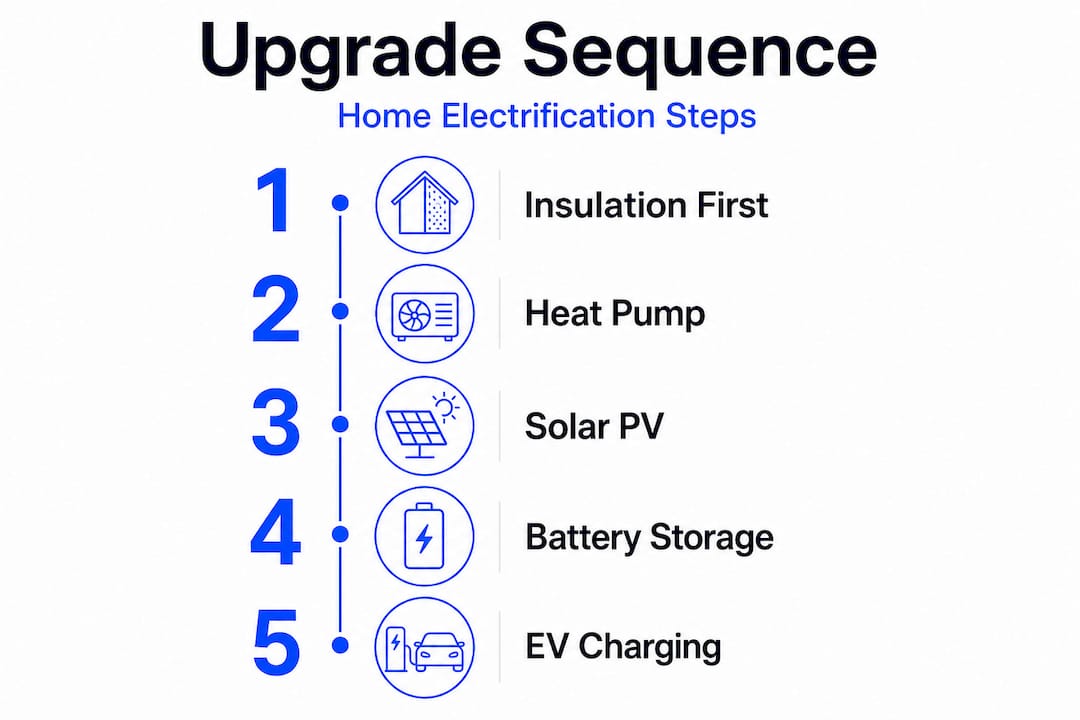
Step 1: Insulation. Reducing heat loss means your heat pump runs fewer hours and your home’s overall kWh demand drops. This directly shrinks the solar system you need, saving you thousands on panels and inverter capacity.

Step 2: Heat pump. Once the envelope is tight, a heat pump delivers 3 to 4 units of heat for every unit of electricity consumed. That efficiency ratio is why it belongs before solar, not after.
Step 3: Solar PV sizing. Now you size panels against a realistic demand figure, not an inflated one.
Home size | Typical annual demand | Panels needed | Estimated output |
Small (2-3 bed) | ~3,800 kWh/year | 10-12 panels | 3,500-4,200 kWh |
Medium (4-5 bed) | ~6,800-8,500 kWh/year | 20-25 panels | 7,000-9,000 kWh |
Large or with EV | 10,000+ kWh/year | 28-35 panels | 10,000+ kWh |
Use a hybrid inverter from the start. Hybrid inverters manage both solar output and battery storage simultaneously, and adding battery later to a string-only inverter often means replacing the inverter entirely. Our guide to solar with battery storage explains the inverter decision in detail.
Step 4: Battery storage. A battery sized between 5 and 20 kWh stores surplus midday solar for evening use. Battery storage costs typically run from £3,000 to £18,000 depending on capacity and chemistry. For most European homes adding EV charging, a 10 to 15 kWh battery hits the sweet spot between cost and overnight charging coverage.
Pro Tip: Do not over-size your battery just because prices have dropped. A battery that regularly cycles to near zero degrades faster. Aim for a daily cycle depth of 70 to 80 percent maximum for longest lifespan.
The solar plus storage integration guide covers real scenarios for Belgian and Dutch households that show exactly how payback periods shift when you do the sequence correctly versus jumping straight to panels.
For a side-by-side look at battery chemistries available to European homeowners today, the home energy storage options comparison breaks down LFP, NMC, and newer graphene-enhanced technologies in plain language.
EV charging integration and smart controls
You have solar generating power and a battery storing it. Now you need your EV charger to play nicely with both, rather than simply drawing maximum grid power every time you plug in.
The key hardware piece is a CT clamp (current transformer). This small sensor wraps around your main electrical feed and reports real-time import and export data to your energy management system. With that data, solar-aware EV charging becomes possible: the charger automatically pulls from solar first, supplements with battery second, and only draws grid power when neither source can meet demand. The priority chain looks like this:
Home loads (lighting, heating, appliances) always first
Battery charging when solar is surplus
EV charging from solar and battery before grid
Grid as last resort, with grid overload protection active
Without this logic, a 7.4 kW EV charger simply overwhelms a modest solar system and pulls everything from the grid, erasing the savings you planned for.
HEMS: the brain of the operation. A Home Energy Management System (HEMS) ties every device together. A well-implemented HEMS using open protocols like Modbus and MQTT can forecast solar output using weather data, pre-charge batteries overnight at low-tariff rates, and adjust EV charging speed in real time based on grid prices. These are not futuristic features. They are available today through integrated platforms that combine inverter, battery, and charger control.
Why this matters financially: Dynamic electricity tariffs are rolling out across Europe. A HEMS that reacts every 15 minutes to price signals can cut your effective import cost by 20 to 35 percent compared to a system that charges at flat rates.
For practical energy optimization tips that apply directly to integrated home systems, our detailed guide covers the programming logic behind real-world tariff response.
Grid compliance. In many EU countries, once your solar system exceeds certain thresholds (3.68 kW AC output in the UK, similar levels across Europe), you must notify your grid operator (called a DNO in the UK) and comply with standards like G98 or G99. EV charging stations that communicate with the grid are increasingly part of this compliance picture. Check local requirements before commissioning any system above the standard threshold.
Common pitfalls and maximizing results
Even a well-designed system can underperform if installation shortcuts are taken or the post-installation verification step is skipped entirely. Here are the most costly mistakes and what to do instead.
Panel undersizing for future loads. Install solar capacity for what your home will need in three to five years, including an EV and potentially a second one, not just what you consume today. Roof space and inverter capacity added now is cheap. Adding it later often means additional scaffolding costs and partial system redesign.
Skipping insulation. Running a heat pump in a leaky house inflates your electricity demand by 30 to 50 percent. That directly increases the solar and battery size you need. Insulate first and you may find you need 20 percent fewer panels.
Wrong upgrade sequence. Installing EV charging before battery storage means you are drawing grid power for evening charging every day, paying peak rates when you could be using stored solar.
No post-installation verification. Once your system is live, log your import and export data for at least 30 days. Compare against the projections your installer modeled. Discrepancies above 15 percent need investigation before you assume the system is working correctly.
Ignoring grid congestion. In parts of the Netherlands, Belgium, and Germany, local grid congestion is already limiting how much solar energy homeowners can export. Smart controls that shift consumption to solar-production hours, rather than exporting, protect your return on investment regardless of grid constraints.
On V2H and V2G costs. Vehicle-to-home (V2H) and vehicle-to-grid (V2G) technologies let your EV battery feed power back to your house or the grid. The technology is genuinely useful but not yet seamless everywhere. Regulatory hurdles for V2H and V2G in several EU countries add between €2,000 and €5,000 in compliance costs and can delay commissioning by 4 to 12 weeks. Factor that into your timeline before committing to a V2G-capable charger.
Ongoing monitoring is not optional. Your energy profile changes every season, and your children grow up and leave or come back with their own EVs. A system tuned perfectly for 2026 may need reconfiguring by 2028. Build the monitoring habit from day one by checking your solar, storage, and EV optimization dashboard at least monthly.
What most electrification guides miss and what to do differently
Most guides present home electrification as a purely technical exercise. Pick the right panel count, buy the right battery, done. That picture is incomplete in ways that cost homeowners real money.
The biggest blind spot is permitting and grid registration. Across Europe, the paperwork for connecting a battery above a certain capacity, or for enabling bidirectional charging, can take two to four months in some jurisdictions. Starting the permitting process on the day your installer quotes you is not early enough. Start it the moment you have a system design in principle, even before you finalize equipment choices.
The second blind spot is treating electrification as a single event rather than a phased program. We have seen homeowners spend €30,000 in one go on a solar and battery and EV charging installation, only to find three months later that their aging 60-amp panel is throttling the whole system. A phased approach, starting with insulation and panel upgrade, then solar, then battery and EV charging over 18 to 24 months, lets you verify each stage and course-correct cheaply.
Efficiency first is not just advice. It is financial logic. A home that consumes 20 percent less energy before you install a single solar panel needs a 20 percent smaller system to achieve the same result. That is not a marginal difference. On a €25,000 system, it is €5,000 in equipment you never had to buy.
The third blind spot is legacy wiring inside the home. Rewiring distribution boards and sub-panels is not glamorous, but older wiring limits the safe current you can route to new loads. Do it during a renovation phase when walls are open, not as an emergency fix after your new heat pump keeps tripping a breaker.
If you want a single resource that covers the financial and technical case for phasing your upgrades, the top clean energy solutions overview for European homes offers a practical framework grounded in regional data.
Ready to electrify your home? Start your journey
Planning a full home electrification project is genuinely complex, but you do not have to figure it out alone. The pathway from insulation assessment to live solar, battery, and EV charging takes most households 12 to 24 months when done in phases, and the financial returns compound over a 25-year system lifetime.

At Belinus, our integrated approach connects solar PV through Solarimex, professional installation via SolarPlus, and smart EV charging from Evonity, all managed through our centralized Energy Management System with 15-minute dynamic tariff optimization. Whether you are sizing your first solar array or adding bidirectional EV charging to an existing setup, our home electrification experts can model a 25-year financial projection for your specific home before you commit to a single component. Talk to us about where your home is today and where you want it to be.
Frequently asked questions
What is the optimal sequence for home electrification upgrades?
First improve insulation, then install a heat pump, followed by solar panels, battery storage, and finally EV charging. This proven retrofit sequence consistently delivers 50 to 70 percent reductions in both costs and emissions.
How many solar panels does the average European home need?
A small home typically needs 10-12 solar panels covering around 3,800 kWh per year, while a medium home requires 20 to 25 panels for 6,800 to 8,500 kWh annually.
Do I always need to upgrade my electrical panel for electrification?
Upgrading is often necessary because a standard 40-amp panel cannot safely handle simultaneous loads from a heat pump, EV charger, and household appliances without tripping or overheating.
Why add battery storage to a solar home?
Batteries let you store excess solar for evening EV charging and reduce grid reliance during expensive peak-rate hours, dramatically improving your return on the solar investment.
What are the main regulatory challenges for advanced electrification systems?
V2H and V2G installations can add €2,000 to €5,000 in compliance costs and cause delays of 4 to 12 weeks in several EU countries, so build permitting time into your project timeline from the start.
Recommended
Comments