Practical energy management tips to maximize solar and cut costs
- 3 hours ago
- 10 min read

TL;DR:
Integrating solar, battery storage, and EV charging through an intelligent energy management system optimizes costs and supports grid flexibility. Prioritizing home loads, then battery use, and finally grid export maximizes savings amid evolving tariffs and policies. Regular system review and adaptive strategies are essential for long-term energy cost reduction and efficient management.
Your electricity bill arrives and somehow it’s higher than last month, even though your solar panels were running all day. Sound familiar? This scenario plays out constantly for homeowners and businesses across Europe who have invested in solar but haven’t yet connected all the pieces into a working system. Solar panels, battery storage, and EV charging are each valuable on their own, but together, managed intelligently, they create something far more powerful: a system that actively works to keep your costs down while supporting the grid. This guide walks you through exactly how to make that happen.
Table of Contents
Key Takeaways
Point | Details |
Integrated setup needed | Combine solar panels, home batteries, and a smart EV charger for maximum control and flexibility. |
Prioritize energy flow | Serve home loads first, then charge batteries and EVs, and export only when most beneficial. |
Avoid common pitfalls | Synchronize charging schedules and always monitor time-of-use tariffs to maximize savings. |
Monitor and adapt | Track performance and update your strategy in response to tariff or policy changes. |
Long-term optimization | The most successful systems evolve, leveraging new tech and incentives for sustained efficiency. |
What you need to get started with energy management
Before you can optimize anything, you need the right components in place. Think of this as building your foundation. Each piece has a specific role, and missing one creates a gap that limits the whole system’s potential.
The core components you’ll need include:
Solar PV panels to generate on-site electricity during daylight hours
A compatible inverter that can communicate with your battery and energy management system
A home or commercial battery to store excess generation for later use
A smart EV charger that supports scheduled and dynamic charging rather than just plugging in and going
A smart meter capable of real-time data reporting to your energy management system
An energy management system (EMS) to coordinate all of the above automatically
The communication layer is often overlooked but it’s critical. Your components need to “talk” to each other using standard protocols. Without this, you’re running separate systems that don’t know what each other is doing. According to a European Parliament study769347_EN.pdf), demand flexibility and integrated, flexible energy systems are becoming essential for EU grid integration. This isn’t future thinking; it’s the current baseline for getting real results.
Here’s a quick comparison of system setups based on what components you currently have:
Setup | Monthly savings potential | Optimization capability |
Solar only | Low to moderate | Basic self-consumption |
Solar + battery | Moderate | Peak shifting, overnight use |
Solar + battery + smart EV charger | High | Full demand coordination |
All of the above + EMS | Very high | Dynamic tariff optimization |
Pro Tip: When choosing a battery, check that it supports the same communication protocol as your inverter. Mismatched systems often require expensive adapters or simply won’t integrate at all. Belinus Solis inverters, for instance, are built for direct EMS integration, which removes this headache entirely.
For a broader view of component compatibility and what to prioritize, the energy management guide covers selection criteria in more detail. You can also explore the smart solutions overview to see how modern systems connect in practice.
Step-by-step: How to coordinate solar, battery, and EV charging
With your components in place, it’s time to put them to work using a proven process. This isn’t about setting everything once and walking away. Effective coordination requires a clear priority hierarchy and a few scheduling habits that become second nature quickly.
Follow this process for best results:
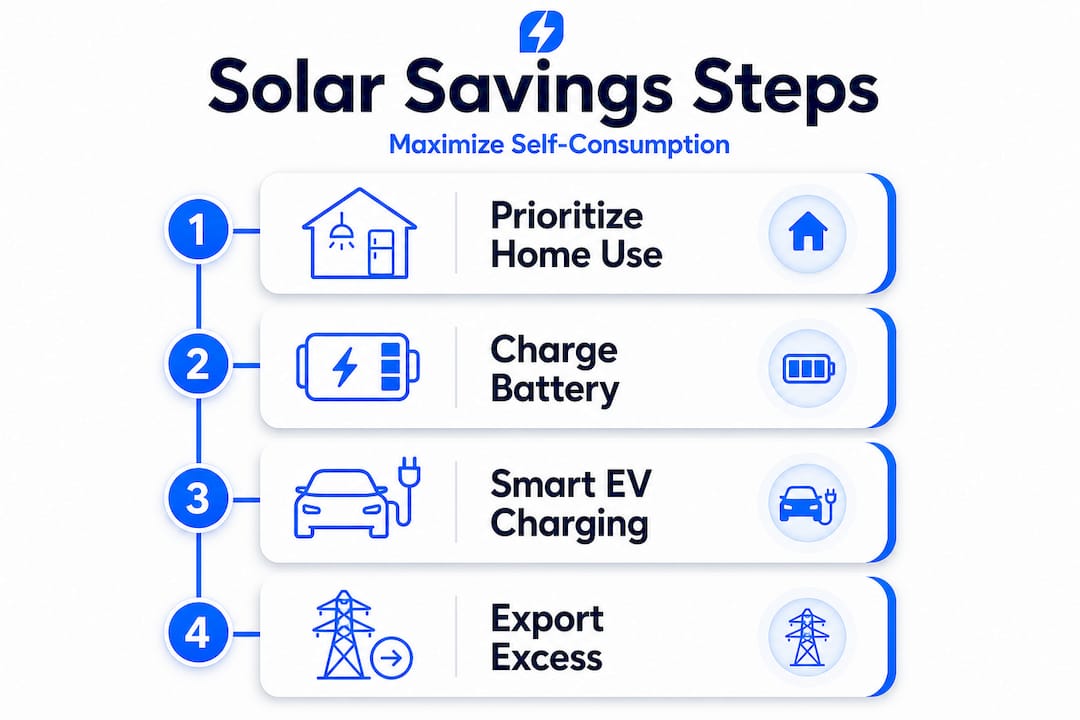
Set your home load as the first priority. Your lights, appliances, and heating should always pull from solar first, before anything else draws from the panels.
Direct surplus solar into your battery. Once home loads are covered, excess generation charges the battery. Aim to reach at least 80 to 90% charge during peak solar hours.
Schedule EV charging during off-peak hours or when the battery is full. If your EV charger is smart enough to communicate with the EMS, it can automatically start charging when conditions are ideal. Avoid charging your EV directly from the grid during peak price windows.
Use stored battery power during peak tariff hours. In many European markets, peak pricing runs from roughly 5 PM to 9 PM. Discharging your battery during this window can cut your grid draw significantly.
Export to the grid only when home loads, battery, and EV are adequately served. Export last, not first.
As research from EV Home Guide confirms, cost reductions are best achieved by prioritizing home loads, then battery storage, then EV charging, with grid export treated as the final step. This hierarchy is not obvious to most new system owners, which is why many leave significant savings unrealized.
Here’s a practical example of what this coordination can look like over a typical weekday:
Time of day | Solar output | System action | Grid interaction |
7 AM to 12 PM | High | Covers home load, charges battery | Minimal draw |
12 PM to 5 PM | Moderate to high | Battery reaches full, EV begins charging | None or minimal |
5 PM to 9 PM | Low or none | Battery discharges for home load | Minimal or none |
9 PM to 7 AM | None | EV charges at off-peak rates if needed | Low-cost grid import |
A well-coordinated system like this can reduce your grid dependency during peak hours by 60% or more, depending on your battery capacity and local tariff structure. For deeper guidance on how to set up your EV charging schedules, the smart EV charging resource covers specific configurations. The battery storage best practices guide is also worth reading before you lock in your settings.

Pro Tip: If your tariff uses 15-minute intervals (common in many EU markets), set your EMS to update decisions every 15 minutes. This is exactly how the Belinus EMS operates, giving you dynamic optimization rather than a static daily schedule.
Troubleshooting and common mistakes in energy management
Even with a good setup and process, mistakes and suboptimal settings can erode your savings. The good news is that most issues come down to a few recurring patterns that are straightforward to fix once you know what to look for.
Common mistakes and how to fix them:
Misaligned charging schedules: Your EV starts charging at 6 PM right when grid prices peak because you never updated the schedule after getting a new tariff. Fix: review and update your charging windows whenever your tariff changes, at minimum once per season.
Excessive battery cycling: Discharging your battery to near-zero every day dramatically reduces its lifespan. Keep your daily minimum above 15 to 20% unless you’re in a genuine grid emergency situation.
Ignoring export tariff rules: Some European utilities have changed their export compensation rules, capping payback rates or the volume you can export. If you’re still optimizing for maximum export under old assumptions, you may be overworking your system for diminishing returns.
No backup load limit setting: During a power outage, if your system isn’t configured with load limits, it may try to power everything in your building from the battery alone, draining it in hours rather than days.
“Optimization requires careful shifting and coordination, not seeking full independence from the grid; misalignment between your system settings and current tariffs reduces value significantly.” — EV Home Guide 2025
This is worth absorbing. The goal is not to become entirely off-grid. The goal is to use the grid strategically, buying when prices are low and drawing on stored energy when they’re high. Any setup optimized purely around grid independence will likely underperform financially.
Pro Tip: Download your energy app’s usage logs monthly and scan for any days where grid draw spiked unexpectedly. These anomalies almost always point to a scheduling conflict or a component that went offline temporarily.
For a forward-looking look at how to avoid systemic inefficiencies, check out smarter solutions for 2026 and the case study on real-time energy savings to see what properly configured systems actually deliver.
How to measure success and adapt your strategy
After you’ve resolved common issues, monitoring and iterating will ensure you maximize long-term benefits. Getting the system right is a process, not a one-time event. Tariffs change, your household or business load profile shifts, and new export incentives emerge. A static strategy in a dynamic market is a slow way to leave money on the table.
Follow this approach to track and improve over time:
Establish a cost baseline. Record your average monthly grid spend before any changes. This gives you a real comparison point, not just an estimate.
Track weekly self-consumption rates. Your EMS or smart meter app should show what percentage of your energy use was covered by solar and stored energy. Aim to increase this progressively.
Monitor battery state-of-health over time. A battery losing capacity faster than expected signals either a settings issue or a hardware concern. Catching it early saves money.
Review your tariff every quarter. European energy markets are shifting quickly. What was optimal six months ago may not be now.
Adjust export strategy based on market signals. If your utility starts offering higher peak export rates seasonally, update your system to take advantage.
The difference between an adaptive and a static strategy compounds over time:
Strategy type | Year 1 savings | Year 5 savings (estimated) | System complexity |
Static (set and forget) | Moderate | Declining | Low |
Adaptive (quarterly review) | Moderate to high | Growing | Medium |
Dynamic EMS-driven | High | Consistently high | Low (automated) |
As the Evision Eurelectric Report 2025 points out, flexibility value is limited by incentives, interoperability, and policy harmonization, meaning consumers who monitor evolving opportunities and adapt accordingly will extract far more value from their systems than those who don’t.
The practical implication: schedule a 30-minute system review every three months. Look at your cost data, check for tariff updates, and confirm your scheduling settings still reflect reality. It’s a small time investment that pays back consistently.
For guidance on participating in grid flexibility programs, unlock grid flexibility is a useful next step. The energy management system reviews resource can help you compare platforms if you’re considering an upgrade.
Why conventional solar optimization misses the mark: what really works in 2026
Most optimization guides focus on maximizing solar export. You see it everywhere: “Send your surplus back to the grid and watch the savings roll in.” That approach made sense when feed-in tariffs were generous and batteries were expensive. In 2026, it’s often the wrong metric to chase.
Here’s the uncomfortable reality: export rates in most EU markets are now well below the retail electricity price. You might receive €0.06 per kWh for power you export while paying €0.28 per kWh to import. Optimizing for export in that environment means you’re essentially selling low and buying high.
What actually works now is maximizing self-consumption, not export. Every kilowatt-hour you consume from your own solar or stored battery rather than importing from the grid saves you the full retail price. That’s four to five times more valuable than export in many markets.
The second shift worth making is policy awareness. As the European Parliament study769347_EN.pdf) highlights, demand response, smart energy management, and system flexibility are becoming more important than ever in modern energy markets. Programs that pay you to reduce or shift consumption during grid stress events are becoming available across Europe. These aren’t hypothetical future benefits. They’re live programs in several countries right now, and systems with a capable EMS can participate automatically.
The third and most underappreciated shift is thinking about your EV as an active part of your energy system rather than just a load. A vehicle that charges intelligently during off-peak hours and potentially returns power during peak events changes the financial math significantly. It transforms a cost center into a flexible asset.
Rigid, export-focused strategies built around yesterday’s tariffs will increasingly underperform. The future of residential and commercial energy management belongs to systems that are comprehensively integrated, responsive to real-time signals, and built to evolve alongside policy. That’s the standard worth building toward now.
Take your energy management further with Belinus
The steps in this guide give you a solid framework, but applying them to your specific property, tariff structure, and goals is where expert support makes a real difference.

Belinus brings together solar PV, battery storage, and EV charging through an intelligent EMS designed to handle the coordination automatically. Whether you need a residential setup with the Energy Wall G1 battery and Solis inverter, or a commercial system scaled to MW capacity, the Belinus group has the components and the expertise to make it work. Visit belinus.com to explore your options, model your 25-year financial outcomes with the automated quotation software, and connect with a specialist who can assess your exact situation and design a system around your energy goals.
Frequently asked questions
How does energy storage help reduce electricity bills?
Battery storage lets you use solar energy you generated earlier when grid prices are highest, directly replacing expensive peak-hour imports. Energy storage and demand flexibility769347_EN.pdf) also enable off-peak EV charging and grid export during price spikes.
Should I always export excess solar to the grid?
Not necessarily. Self-consumption almost always delivers more value per kilowatt-hour than export at current European feed-in rates. Export should be prioritized last after home loads, battery charging, and EV charging are covered.
How can I use my EV to support the energy grid?
With bidirectional (V2G) charging, your EV battery can return power to the grid during peak demand hours, helping balance the grid and potentially earning you credits or payments. EVs charged at off-peak hours769347_EN.pdf) can also be used for grid export when prices peak.
What role do tariffs and policy changes play in energy management?
Tariffs directly determine when it’s cheapest to import, when to discharge your battery, and when exporting is worth doing. As the Evision Eurelectric Report 2025 notes, flexibility value depends on incentives, market design, and policy harmonization, so staying current is essential.
Do I need a smart meter for optimal energy management?
Yes, a smart meter is strongly recommended. It provides the real-time data your EMS needs to make intelligent decisions, and it’s typically required to participate in dynamic tariff programs or grid flexibility incentives.
Recommended
Comments