Hybrid Battery Systems: Powering Smarter Energy Use

Optimizing energy management in complex commercial facilities often means facing unpredictable spikes in demand and the need for flexible solutions. Central European businesses are turning to hybrid battery systems to solve these challenges, blending the strengths of multiple energy storage technologies for greater efficiency and reliability. Facility managers and energy consultants will discover how integrating batteries, supercapacitors, and smart controls enhances power delivery, minimizes costs, and supports a stable, future-ready energy infrastructure.
Table of Contents
Key Takeaways
Point | Details |
Hybrid Battery Systems Optimize Power Delivery | These systems combine various battery technologies to enhance performance and efficiency for commercial and industrial applications. |
Diverse Battery Chemistries Enhance Flexibility | By integrating chemistries like Lithium-Ion and Sodium-Ion, hybrid systems address complex energy management challenges. |
EMS Integration Maximizes Energy Management | Energy Management Systems play a crucial role in optimizing hybrid battery operations through real-time data analysis and predictive algorithms. |
EU Regulations Drive Sustainability | Upcoming EU compliance requirements emphasize safety, transparency, and sustainable sourcing in battery production and lifecycle management. |
Hybrid Battery Systems Defined and Debunked
Hybrid battery systems represent an innovative approach to energy storage that combines multiple battery technologies to optimize power delivery and efficiency. These advanced systems leverage the complementary strengths of different energy storage technologies, creating a more flexible and responsive power solution for commercial and industrial applications.
At their core, hybrid battery systems integrate different energy storage technologies - typically combining batteries with supercapacitors or multiple battery chemistries - to achieve superior performance characteristics. Complex battery management architectures enable dynamic energy regulation, allowing these systems to balance high energy content with rapid power output.
Key characteristics of hybrid battery systems include:
Ability to manage multiple energy sources simultaneously
Enhanced power density compared to traditional battery solutions
Improved system reliability through technology integration
Reduced installation footprint by consolidating storage components
Greater flexibility in energy management and grid services
By combining technologies like lithium-ion batteries, graphene supercapacitors, and advanced power conversion systems, these hybrid solutions address critical challenges in energy storage. Renewable energy integration strategies demonstrate how hybrid systems can smooth intermittent power generation, providing more stable and sustainable energy infrastructure.
Pro tip: Conduct a comprehensive energy audit before implementing a hybrid battery system to identify specific performance requirements and optimize technology selection.
Main Hybrid Battery Types and Chemistries
Hybrid battery systems leverage diverse chemical compositions to create more versatile and efficient energy storage solutions. These innovative technologies combine multiple battery chemistries to optimize performance, addressing complex energy management challenges across commercial and industrial applications.
The current landscape of battery technologies includes several key chemistries that enable hybrid system development. European battery technology roadmaps highlight critical advancements in lithium-ion variants like Nickel Manganese Cobalt (NMC) and Lithium Iron Phosphate (LFP) batteries, which form the foundation of many hybrid systems.
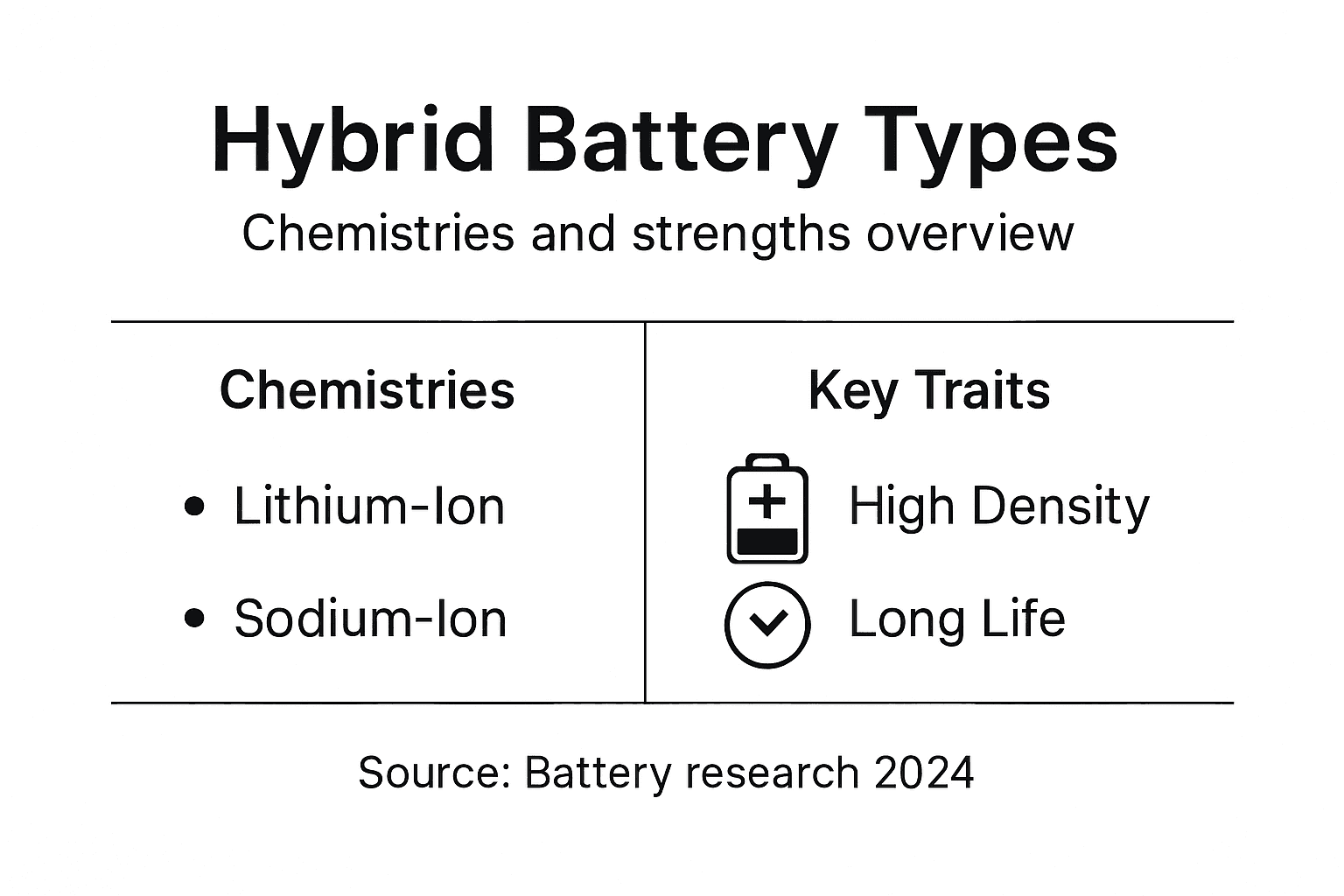
Primary hybrid battery chemistry types include:
Lithium-Ion Hybrid Systems
NMC (Nickel Manganese Cobalt) batteries
LFP (Lithium Iron Phosphate) batteries
Silicon-anode lithium variants
Post-Lithium Technologies
Sodium-ion batteries
Solid-state electrolyte systems
Zinc-based battery chemistries
Advanced Composite Systems
Supercapacitor-battery hybrid configurations
Metal-air battery integrations
Redox-flow battery combinations
Battery chemistry-neutral research approaches demonstrate the potential for ultra-high-performance systems that balance sustainability, reliability, and technological innovation. These strategies aim to create more adaptable energy storage solutions that can meet diverse performance requirements across different applications.
Pro tip: Evaluate hybrid battery system performance through comprehensive testing of energy density, cycle life, and efficiency metrics to ensure optimal technology selection.
Here’s a summary comparing major hybrid battery chemistries for commercial use:
Chemistry Type | Typical Strength | Limitations | Common Application |
Lithium-ion (NMC/LFP) | High energy density | Cost, resource sourcing | Grid stabilization |
Sodium-ion | Abundant materials | Lower energy density | Renewable integration |
Supercapacitor Hybrid | Fast discharge | Short energy duration | Power quality support |
Metal-air | Lightweight design | Limited lifecycle | Emergency backup |
Redox-flow | Long cycle life | Bulkiness, cost | Large-scale storage |
How Hybrid Batteries Integrate With EMS
Energy Management Systems (EMS) serve as the critical intelligence behind hybrid battery technologies, orchestrating complex energy distribution and optimization strategies. These sophisticated platforms enable seamless communication and control across multiple energy storage technologies, transforming how commercial and industrial facilities manage power resources.

Advanced EMS integration strategies leverage predictive algorithms and real-time data analysis to dynamically balance energy flow between different battery chemistries. By continuously monitoring performance metrics, these systems can adjust power distribution instantaneously, maximizing efficiency and extending the operational lifespan of hybrid battery configurations.
Key integration mechanisms for hybrid battery EMS include:
Real-Time Performance Monitoring
Continuous battery chemistry tracking
Dynamic power allocation algorithms
Instantaneous load balancing
Predictive Energy Management
Anticipatory power distribution
Degradation prediction models
Intelligent charging optimization
Multi-Technology Communication
Cross-platform battery data integration
Standardized communication protocols
Seamless system interoperability
Hybrid power plant integration approaches demonstrate how comprehensive EMS can transform energy infrastructure, creating more resilient and adaptable power management ecosystems that respond dynamically to changing operational requirements.
Pro tip: Implement comprehensive sensor networks and data logging systems to enable granular performance tracking and predictive maintenance for hybrid battery installations.
Below is a quick guide to EMS integration benefits in hybrid battery systems:
EMS Functionality | Business Value | Example Outcome |
Real-time optimization | Maximizes efficiency | Reduces peak power costs |
Predictive management | Extends battery life | Fewer replacements needed |
Multi-tech control | Increases flexibility | Supports mixed chemistries |
Fault detection | Minimizes downtime | Quick failure isolation |
Key EU Safety and Compliance Requirements 2026
The European Union is implementing comprehensive regulatory frameworks that fundamentally transform battery technology standards, placing unprecedented emphasis on safety, sustainability, and transparency. These evolving regulations represent a critical shift in how battery manufacturers, importers, and energy storage providers must approach product development and lifecycle management.
New EU Battery Regulation requirements mandate significant changes across multiple dimensions of battery production and management. The regulatory landscape introduces stringent protocols covering everything from raw material sourcing to end-of-life recycling, with CE marking and digital battery passports becoming mandatory compliance mechanisms.
Key compliance requirements for 2026 include:
Sustainable Sourcing Obligations
Traceable raw material procurement
Mandatory carbon footprint declarations
Ethical supply chain documentation
Safety and Performance Standards
Removable battery designs
Durability certification processes
Comprehensive safety testing protocols
Transparency and Reporting
Digital battery passport implementation
Lifecycle data documentation
State of health reporting requirements
Comprehensive compliance strategies will require manufacturers to develop robust due diligence processes, ensuring full transparency throughout battery production and deployment. These regulations aim to create a more sustainable, accountable energy storage ecosystem that prioritizes environmental responsibility and technological innovation.
Pro tip: Develop a comprehensive compliance tracking system that anticipates regulatory changes and maintains real-time documentation of battery lifecycle characteristics.
Benefits, Costs, and Common Pitfalls for CNI
Hybrid battery systems represent a transformative technology for critical national infrastructure (CNI), offering sophisticated solutions to complex energy management challenges. These advanced systems provide strategic advantages in grid stability, renewable energy integration, and operational resilience for high-stakes industrial environments.
Battery Energy Storage Systems analysis reveals critical economic and operational benefits that extend far beyond traditional power infrastructure capabilities. By enabling dynamic energy arbitrage and supporting grid services, these systems can deliver substantial financial and operational advantages for complex infrastructure networks.
Key benefits and considerations include:
Financial Advantages
Reduced energy procurement costs
Deferred infrastructure upgrade expenses
Enhanced revenue through grid services
Operational Resilience
Improved grid stability
Renewable energy integration
Reduced greenhouse gas emissions
Strategic Risks
High initial capital expenditures
Technology integration complexities
Potential regulatory uncertainties
Strategic infrastructure battery challenges highlight the importance of comprehensive planning to mitigate potential vulnerabilities. Successful implementation requires strategic diversification of battery technologies and robust risk management approaches.
Pro tip: Conduct a comprehensive multi-year total cost of ownership analysis that accounts for potential technology evolution and regulatory changes before implementing hybrid battery systems.
Unlock Smarter Energy Management with Hybrid Battery Solutions
The article highlights the challenge of integrating multiple battery chemistries and balancing complex energy flows for improved power delivery and operational resilience. If you are looking to overcome these hurdles and embrace the future of energy storage, Belinus offers tailored solutions that align perfectly with cutting-edge hybrid battery technology concepts like graphene supercapacitors, lithium iron phosphate (LFP) batteries, and advanced Energy Management Systems (EMS).
Experience real-time power optimization, dynamic tariff responses, and seamless multi-technology integration through our centralized EMS platform. Whether you need scalable commercial systems or innovative residential storage, Belinus anticipates your storage needs with smart design and robust performance validated for demanding applications. Discover how our Utility Storage and Energy Wall G1 empower you to maximize efficiency, reduce costs, and future-proof your infrastructure against evolving EU regulatory standards.

Ready to transform your energy landscape with a hybrid battery system engineered for reliability and sustainability? Visit Belinus today to connect with our experts and explore customized solutions that put smarter energy use within your reach. Take control now and lead your facility into the new era of intelligent power management.
Frequently Asked Questions
What are hybrid battery systems and how do they work?
Hybrid battery systems combine multiple battery technologies to optimize energy storage and efficiency, integrating different chemistries, such as lithium-ion and supercapacitors, to ensure superior performance and energy management.
What are the main types of hybrid battery chemistries available?
The main types of hybrid battery chemistries include lithium-ion (NMC and LFP), sodium-ion, supercapacitor-battery hybrids, metal-air batteries, and redox-flow batteries, each offering distinct strengths and applications.
How do hybrid battery systems improve energy management?
Hybrid battery systems enhance energy management through advanced Energy Management Systems (EMS) that enable real-time performance monitoring, predictive energy management, and seamless communication between different energy storage technologies, maximizing efficiency and reliability.
What are the key benefits of using hybrid battery systems?
The key benefits of hybrid battery systems include reduced energy procurement costs, improved grid stability, enhanced revenue from grid services, operational resilience, and a smaller installation footprint compared to traditional battery solutions.
Recommended
Comments