Real-time energy management: 36% savings unlocked
- Apr 2
- 8 min read

Most homeowners assume that installing a smart thermostat or checking an energy app now and then counts as “energy management.” It does not. Basic monitoring tools typically deliver 2-7% cost savings, while a properly configured real-time energy management system (EMS) can cut your energy bill by 15-36%. That gap is not a rounding error. It represents hundreds of euros per year for a typical Benelux household. This article breaks down exactly how real-time EMS works, what it can realistically do for your home or property, and where the genuine trade-offs lie.
Table of Contents
Key Takeaways
Point | Details |
Dramatic cost savings | Real-time energy management systems can cut energy costs by 15-36% for Benelux homeowners and property managers. |
Greater energy independence | Using batteries and EMS together boosts self-consumption and cuts peak grid use by up to 55%. |
Advanced automation matters | AI and smart controls are key for maximizing benefits, but success depends on careful system design and user involvement. |
Be mindful of trade-offs | Upfront costs, grid peak risks, and privacy concerns mean EMS upgrades should be thoughtfully planned. |
What is real-time energy management? How it works
A lot of people hear “energy management” and picture a dashboard showing how much electricity they used last Tuesday. That is monitoring. Real-time energy management is something entirely different. It is an automated system that continuously reads signals from the grid, your solar panels, your battery, your appliances, and even weather forecasts, then acts on that data without waiting for you to press a button.
Think of it like a skilled conductor. Your solar panels, battery storage, EV charger, heat pump, and grid connection are the instruments. The EMS is the conductor, making sure every component plays at exactly the right moment to minimize cost and waste.
The core components of a real-time EMS include:
Sensors and smart meters that track consumption and production at the circuit level
A control unit that processes incoming data and executes commands in real time
Automation rules and pricing integrations that respond to dynamic tariffs from the grid
A software platform accessible via a mobile app or web dashboard
APIs that connect third-party devices like EV chargers or heat pumps
The critical distinction is action versus observation. As smart home energy explained, real-time EMS means continuous system automation, not just feedback. A feedback-only tool tells you that your washing machine ran at peak tariff hours. A real-time EMS would have already scheduled that load to run during the cheapest window, automatically.
In the Benelux context, this matters enormously. Dynamic electricity pricing is increasingly common in Belgium, the Netherlands, and Luxembourg. Prices can swing by a factor of five or more within a single day. A system that reacts to those swings in real time, rather than waiting for your manual input, captures savings that would otherwise vanish.
“The value of real-time EMS is not in the data it shows you. It is in the decisions it makes for you, faster and more consistently than any human could.”
For a deeper look at what is real-time energy management and how the underlying logic works, the concept becomes even clearer once you see it applied to a specific home setup.
Major benefits: Cost savings, efficiency, and sustainability
Now that the mechanics are clear, the numbers become meaningful. Real-time EMS delivers savings across three distinct channels, and they stack.
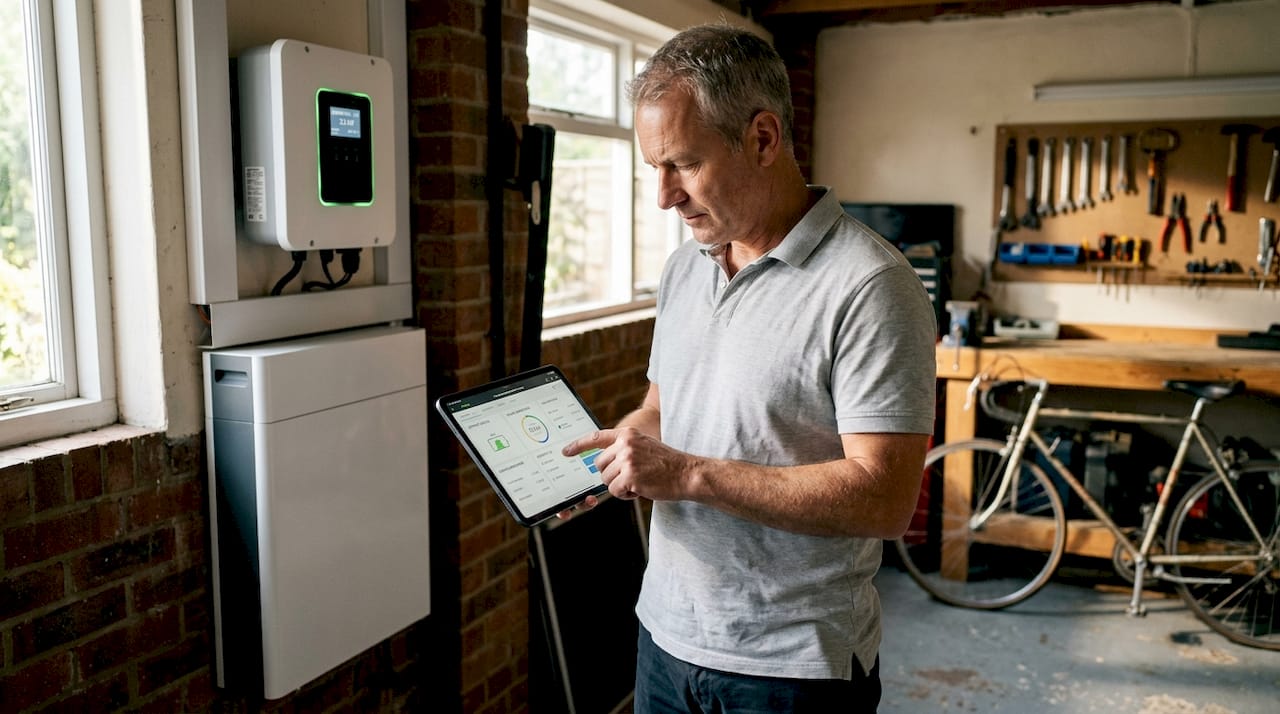
Dynamic tariff optimization alone can reduce your electricity costs by up to 15%. By shifting flexible loads like EV charging, dishwashers, and water heaters to off-peak hours, you pay less per kilowatt-hour without changing your lifestyle. HVAC management through smart scheduling and occupancy sensing can cut heating and cooling costs by up to 30%. And when you combine solar, storage, and full-system automation, total cost savings of 15-36% become achievable for Benelux households.
Solar self-consumption is another major win. Without storage or smart control, most homes only use 30-40% of the solar energy they generate. The rest gets exported at low feed-in rates. With battery integration and EMS, self-consumption rises to 60-70%, meaning you use more of what you produce and buy less from the grid.
Metric | Traditional setup | Real-time EMS setup |
Electricity cost savings | 2-7% | 15-36% |
Solar self-consumption | 30-40% | 60-70% |
HVAC efficiency gain | Minimal | Up to 30% |
Grid dependency | High | Significantly reduced |
Carbon footprint | Baseline | Reduced by 20-40% |
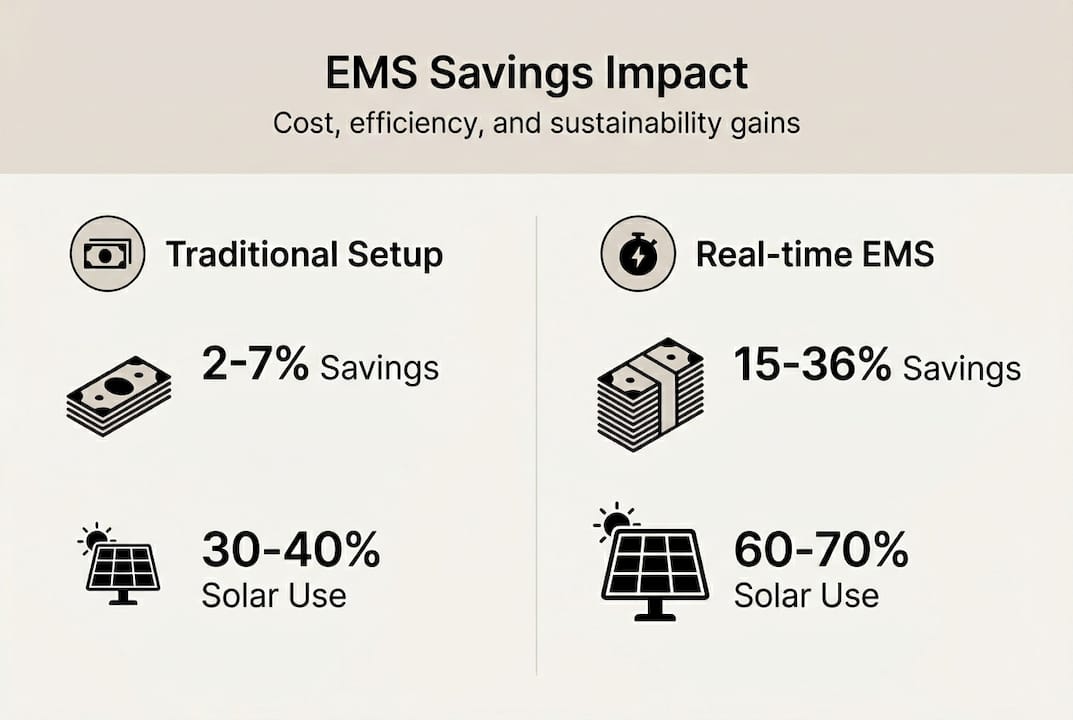
The environmental impact is real too. Using more of your own solar energy and drawing from the grid only during low-carbon periods means your household’s carbon footprint drops alongside your bill. These are not separate goals. The EMS pursues both simultaneously.
Pro Tip: Adding a battery like the Belinus Energy Wall G1 to your EMS setup is the single fastest way to move from the lower end of the savings range to the upper end. Storage is what turns a reactive system into a proactive one. Learn more about integrating solar with storage and what a battery storage setup looks like in practice.
How advanced EMS technologies multiply value
Basic automation is impressive. But the next generation of EMS technology pushes the results further, and it is already available.
Artificial intelligence, specifically Deep Reinforcement Learning, allows an EMS to learn from patterns in your home’s consumption, local weather, and grid pricing. Rather than following fixed rules, a DRL-optimized EMS adapts continuously. It handles the unpredictability of solar generation and volatile spot prices in ways that static rule-based systems simply cannot.
EMS type | How it works | Savings potential |
Classic feedback | Shows data, no automation | 2-7% |
Rule-based automation | Fixed schedules and triggers | 10-20% |
DRL-optimized EMS | Learns and adapts in real time | 20-36%+ |
Here is how a smart EMS optimization cycle typically works in a Benelux home:
Morning forecast pull: The system checks tomorrow’s grid prices and weather data before you wake up.
Solar prediction: Based on cloud cover forecasts, it estimates how much solar energy you will generate.
Load scheduling: Flexible appliances are scheduled to run during the cheapest or most solar-rich windows.
Battery dispatch: The battery charges from solar or cheap grid power and discharges during expensive peak hours.
Real-time adjustment: If prices shift unexpectedly, the system recalculates and adjusts within minutes.
Performance logging: Every decision is recorded so the system can improve its predictions over time.
Battery storage is the amplifier in this process. With battery storage plus EMS, grid load during peaks can drop by 35-55%. That benefits not just your bill but also grid stability in your neighborhood. Understanding how battery modules work and following energy storage best practices will help you get the most from this combination.
For those curious about the academic side, recent DRL energy scheduling research confirms that adaptive AI-driven systems consistently outperform static approaches in real-world residential settings.
Pro Tip: Set your EMS to prioritize battery charging during the cheapest off-peak window each night, even on days with good solar forecast. This gives you a full buffer for the morning peak before solar generation kicks in.
Nuances and potential challenges: What to consider
Real-time EMS is not a plug-in-and-forget solution. Understanding the trade-offs upfront will save you frustration later.
Upfront costs are the most common barrier. A full system including inverter, battery, and EMS software can run from €8,000 to €20,000 depending on scale. Payback periods in the Benelux region typically range from 5 to 10 years, depending on your energy use and local tariffs. That is a meaningful investment, and it deserves careful financial modeling before you commit.
Grid congestion is a less obvious issue. Real-time pricing combined with automation can cause uncoordinated grid peaks exceeding 30% load increases when many homes respond to the same price signal simultaneously. A well-configured EMS with staggered scheduling can mitigate this, but it is worth knowing that automation at scale has grid-level consequences.
Data privacy and system reliability also deserve attention. Your EMS collects detailed data about your daily routines. Choose providers with clear data policies and local data storage options where possible. Also, any automated system can fail. Having manual overrides and alert notifications is not optional.
“Savings vary depending on your baseline usage and system setup. A home using 8,000 kWh per year will see very different results than one using 3,500 kWh.”
Homes and properties that benefit most from real-time EMS include:
High-energy households (above 5,000 kWh per year)
Properties with existing or planned solar PV systems
Homes with electric vehicles or heat pumps
Multi-unit residential buildings with shared infrastructure
Property managers overseeing several buildings simultaneously
For a detailed breakdown of the decision factors, why choose energy management walks through the key considerations in plain terms.
Our perspective: What most energy management guides miss
Most articles about real-time EMS focus on the technology. Sensors, algorithms, battery chemistry. That is understandable, but it misses the point for most homeowners.
The technology is not the hard part. The hard part is matching the system to your actual lifestyle and then staying engaged with it over time. We have seen households with premium EMS setups underperform because nobody adjusted the schedules after the family’s routine changed. And we have seen modest systems outperform expectations simply because the homeowner checked in quarterly and fine-tuned the settings.
Real savings are not a one-time event. They are the result of continuous small optimizations. Seasonal changes in solar generation, shifting electricity tariffs, new appliances, and changes in occupancy all affect what the optimal configuration looks like. A system set up in spring needs a review in autumn.
This is especially relevant for hybrid battery systems where the interaction between grid, solar, and storage creates dozens of optimization variables. The homeowners who get the most value are the ones who treat their EMS as a living tool, not a finished installation.
Pro Tip: Schedule a 30-minute EMS review every season. Check your self-consumption rate, your peak shaving performance, and whether your load schedules still reflect how your household actually operates.
Ready to optimize your energy management?
If the savings potential in this article resonates with you, the logical next step is to see what a real-time EMS would look like for your specific home or property portfolio.
At Belinus, we design integrated energy solutions that combine solar PV, battery storage, EV charging, and a centralized EMS built for the Benelux market. Our systems use 15-minute dynamic tariff optimization and are accessible through a native mobile app and web dashboard. Whether you are managing a single home or a portfolio of properties, we can model the financial case with 25-year projections so you know exactly what to expect before you invest. Reach out to explore what the right setup looks like for you.
Frequently asked questions
How much can I really save with real-time energy management?
Benelux homes can see 15-36% cost reduction depending on system setup and usage patterns, with higher-energy households and solar users typically landing at the upper end of that range.
Is a battery required to benefit from real-time EMS?
No, but adding battery storage can push self-consumption from 30-40% to 60-70%, which significantly amplifies the financial and environmental benefits of your EMS.
Are there risks or downsides with real-time pricing and EMS?
Yes. Real-time pricing with automation can increase grid peaks by over 30% when many homes respond simultaneously, and upfront system costs can delay the break-even point.
Who will benefit most from upgrading to real-time EMS?
Homes and properties with high energy consumption, solar panels, or electric vehicles gain the greatest value, as confirmed by savings patterns tied to baseline use across real-world studies.
Recommended
Comments