What is real-time energy management? Unlock efficiency
- Apr 16
- 8 min read

TL;DR:
Most Europeans miss up to 36% of energy savings due to outdated, reactive practices.
RTEM actively monitors and adjusts energy use in real time for cost, efficiency, and sustainability benefits.
Adoption challenges include hardware limits, data security, sensor quality, and system interoperability.
Most homes and businesses in Europe are leaving serious money on the table. Not because of bad habits, but because they rely on outdated, reactive energy practices that simply cannot keep pace with today’s volatile tariffs, dynamic grids, and growing renewable capacity. In fact, up to 36% in savings are being missed by households that haven’t adopted real-time energy management. This article walks you through exactly what real-time energy management is, how it works under the hood, how it compares to conventional approaches, what challenges you’ll face, and the practical steps to get started.
Table of Contents
Key Takeaways
Point | Details |
RTEM enables active optimization | Real-time energy management lets you adjust energy use instantly for efficiency and savings. |
AI and edge control drive results | Advanced algorithms and local processing handle uncertainty and maximize performance. |
Adoption faces practical hurdles | Barriers like device limitations, privacy concerns, and integration challenges must be addressed for success. |
Best for dynamic tariffs and renewables | RTEM shines in environments with variable pricing and distributed energy sources. |
Early adopters reap long-term rewards | Homes and businesses that implement RTEM sooner enjoy greater resilience and flexibility. |
What is real-time energy management?
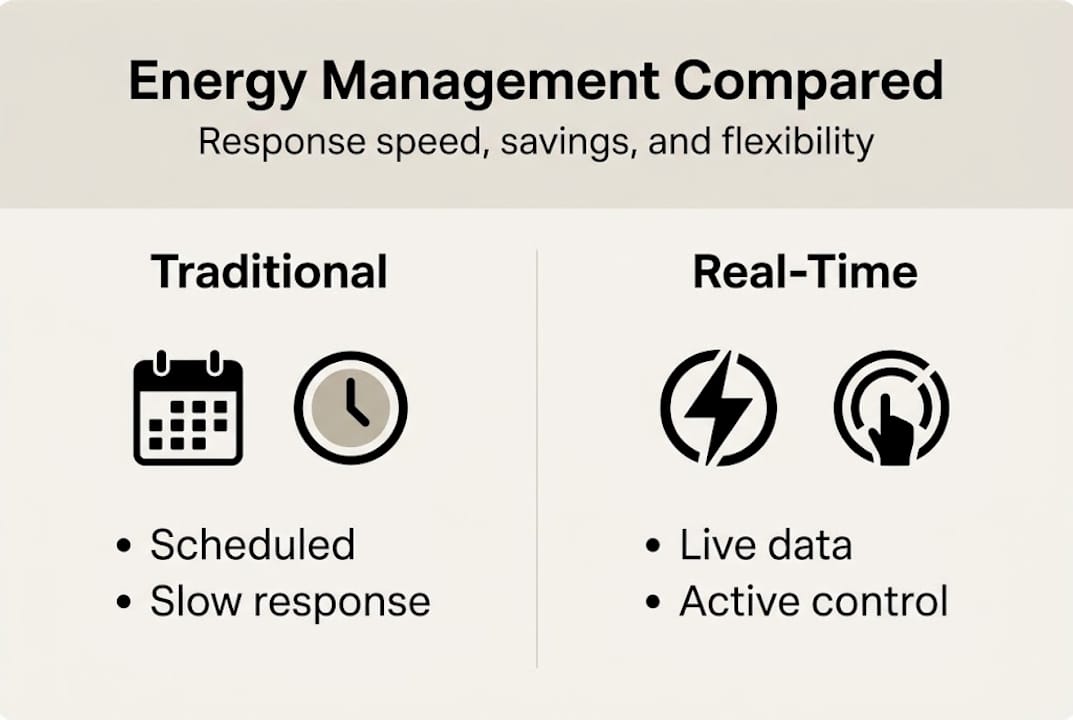
Real-time energy management, often called RTEM, is not just another term for a smart meter or an energy dashboard. It is a fundamentally different way of interacting with energy. While traditional monitoring tells you what you used after the fact, RTEM acts in the moment, adjusting consumption and generation continuously based on live data.
By definition, RTEM is continuous monitoring and immediate adjustment using real-time data to optimize efficiency, reduce costs, and enhance sustainability. That means the system isn’t waiting for your monthly bill to flag a problem. It’s making micro-decisions every few seconds or minutes to keep your energy use optimized.
The practical benefits are significant:
Cost reduction: By responding to live price signals, RTEM shifts loads away from expensive peak periods automatically.
Efficiency gains: Wasted energy is flagged and corrected before it compounds into high bills.
Sustainability: Renewables like solar are prioritized when available, reducing grid dependency.
Grid resilience: RTEM enables your system to support grid services, which opens up revenue opportunities for larger installations.
Understanding the real-time energy management basics helps clarify why this is different from simply watching a usage graph. Traditional energy monitoring is passive. RTEM is active. It’s the difference between a security camera and a security guard.
RTEM is supported by a combination of smart meters, IoT-connected sensors, and edge or cloud processors. These components form a closed feedback loop: measure, analyze, decide, act. For businesses with multiple energy assets, this loop runs constantly across all systems simultaneously. You can explore advanced RTEM solutions that illustrate just how far this technology has evolved.

Pro Tip: The earlier you adopt RTEM, the more historical data you accumulate, and the smarter your system’s optimization becomes over time. Early adopters in Europe are already locking in advantages as dynamic tariff structures become the norm.
How does real-time energy management work?
Now that you know what RTEM is, let’s look at how these systems actually operate. The inner workings explain why RTEM consistently delivers results that manual or scheduled approaches simply can’t match.
The process follows four sequential steps:
Data acquisition: Sensors and IoT devices capture live data on consumption, generation, grid prices, weather, and equipment status.
Processing: Edge devices or cloud servers analyze this data stream, filtering noise and building a real-time picture of your energy environment.
Optimization: Algorithms calculate the best possible action, whether that’s charging a battery, shifting a load, or exporting to the grid.
Feedback adjustment: The system implements its decision and immediately monitors the outcome, looping back to step one.
The core mechanics involve data acquisition, dynamic load balancing, and optimization of distributed energy resources (DERs) like solar panels and battery storage. The speed of this loop is what separates RTEM from older approaches.
The algorithms driving RTEM range from simple rule-based logic to sophisticated AI and Model Predictive Control (MPC). MPC, for instance, forecasts future conditions and solves optimization problems across a time horizon, not just the present moment. Hybrid AI and MPC algorithms at the edge handle uncertainty and volatility more effectively, with safety constraints critical for grid stability.
A key architectural debate in RTEM is edge vs. cloud processing. Edge processing happens locally on your site, reducing latency and keeping sensitive data private. Cloud processing offers more compute power but introduces delays and privacy trade-offs. Edge intelligence in smart grids consistently outperforms centralized cloud models on response time and data security.
Feature | Traditional scheduled | Real-time (RTEM) |
Response speed | Hours to days | Seconds to minutes |
Tariff adaptability | Fixed schedule | Dynamic, live pricing |
Renewable integration | Manual or static | Automated, continuous |
Data privacy | Centralized | Edge-local option |
Optimization depth | Basic load shifting | Full DER orchestration |
For homeowners interested in how this translates practically, the smart home workflow optimization process illustrates how RTEM turns a passive home into an active energy asset. For larger facilities, industrial energy monitoring shows the same principles at commercial scale.
Comparing real-time and traditional energy management
To put RTEM in context, it helps to see how it stacks up against older, more reactive energy strategies. Traditional approaches include scheduled load control, time-of-use (TOU) pricing responses, and critical peak pricing (CPP) programs. Each has its place, but each also has hard limits.
The most important insight from independent research: RTEM is superior for dynamic pricing and renewable integration, but current household adoption remains low in several European markets. The barrier isn’t performance. It’s awareness, upfront cost, and system complexity.
Who benefits most from RTEM right now?
Homes with solar PV and battery storage already installed
Businesses operating across multiple tariff periods daily
Properties in markets with dynamic or spot-price-linked electricity contracts
EV fleet operators managing charging costs across multiple vehicles
Any site connected to grid services or frequency response programs
Interestingly, research shows RTEM achieves similar peak demand reduction to simpler TOU or CPP schemes. The real differentiation isn’t in peak shaving alone. It’s in the breadth of optimization: better use of renewables, smarter battery cycling, and the ability to respond to events that fixed schedules can’t anticipate.
Approach | Strength | Weakness | Best for |
Scheduled/TOU | Low complexity, predictable | Cannot adapt to live prices | Simple residential use |
CPP programs | Good peak reduction | Reactive, limited signals | Demand response programs |
RTEM | Full dynamic optimization | Higher upfront complexity | Solar, storage, EVs, businesses |
For European homeowners and businesses, the transition to dynamic tariffs is already underway. Connecting RTEM to grid flexibility and savings strategies creates compounding value. Pair that with battery storage for cost reduction and the financial case becomes very compelling.
Challenges, risks, and practical tips for RTEM adoption
While RTEM promises impressive benefits, there are real-world obstacles worth addressing before you invest. Understanding these barriers upfront helps you plan a smarter, more resilient rollout.
The most common challenges include:
Limited edge device computing power: Not all hardware can handle the processing demands of real-time algorithms locally.
Data privacy and security: Continuous data streams create cybersecurity exposure if not properly encrypted and segmented.
Sensor noise and data quality: Inaccurate readings from low-quality sensors corrupt optimization decisions downstream.
High latency in older networks: Slow data transfer undermines the real-time advantage entirely.
Interoperability issues: Many legacy systems don’t communicate with modern RTEM platforms without custom integration work.
These RTEM edge challenges and risks are well documented, and they’re solvable. The key is phased implementation rather than trying to deploy a fully optimized system on day one.
Practical steps for successful RTEM adoption:
Start with quality sensors and a reliable mobile energy management app to build baseline visibility.
Integrate solar and storage first, since these assets offer the clearest optimization gains.
Use your solar optimization guide to understand where the biggest inefficiencies currently sit.
Gradually connect edge processing hardware as your confidence and data quality improve.
Audit cybersecurity practices before exposing any system to external grid signals.
For a broader roadmap, optimizing home energy use provides a practical framework that applies whether you’re a homeowner or managing a commercial facility.
Pro Tip: Don’t try to automate everything at once. Start with one controllable asset, like a battery or EV charger, and prove the value before expanding. Complexity introduced too fast leads to configuration errors that erase the savings you’re chasing.
Our perspective: The uncomfortable truth about real-time energy management
Most guides focus on the technology stack: sensors, algorithms, edge vs. cloud. But after working through real deployments, the biggest obstacle to RTEM adoption isn’t technical. It’s mindset.
Homeowners and facility managers are conditioned to think about energy reactively. You receive a bill, you react. A guide like this can change that framing, but the real shift happens when you start treating your energy system as a dynamic, manageable asset rather than a utility you pay after the fact.
Prioritizing proactivity is essential for Europe’s distributed energy growth, grid stability, and long-term sustainability goals.
The people who get the most from RTEM are not necessarily those with the most sophisticated hardware. They’re the ones who engage with their data, trust the system to act, and plan ahead for tariff changes and grid evolution. Our multi-technology systems guide shows how combining different storage and generation technologies multiplies the value of real-time control. RTEM isn’t just a tech upgrade. It’s a transformation of how you relate to energy, and that shift unlocks value that reactive models will never reach.
Next steps: Unlock your energy savings and sustainability
You now have a clear picture of what RTEM is, how it works, and how to navigate the path to adoption. The next step is connecting that knowledge to real solutions built for European homes and businesses.

At Belinus, we develop integrated solar, battery storage, and EV charging solutions built around an intelligent Energy Management System that runs exactly the kind of real-time optimization this article describes. Whether you’re a homeowner exploring your first battery installation or a business looking to scale to commercial storage, our team offers tailored guidance, expert tools, and automated financial modeling to make the decision straightforward. Explore the RTEM savings potential in detail and take the first step toward proactive energy control.
Frequently asked questions
What is real-time energy management and how does it differ from traditional monitoring?
Real-time energy management continuously monitors and actively adjusts energy use, while traditional monitoring simply records consumption for later review. RTEM acts in the moment; traditional systems act after the fact.
Are real-time energy management systems worth the investment for homes?
For homes with solar, storage, or dynamic tariff contracts, RTEM delivers substantial savings and flexibility that quickly offset the upfront cost. Simpler setups without these assets see smaller but still measurable gains.
What technical challenges do businesses face when adopting RTEM systems?
The main obstacles are sensor accuracy, data privacy, limited edge computing power, and cybersecurity exposure from continuous grid-connected data streams.
Does real-time energy management achieve better peak reduction than simpler time-of-use rates?
RTEM and simpler TOU schemes achieve similar peak reduction, but RTEM outperforms across the full range of optimization including renewable integration, battery cycling, and dynamic pricing response.
How can I start implementing real-time energy management in my home or business?
Begin with quality smart sensors and an energy monitoring app to establish a baseline, then scale to edge processing and advanced optimization algorithms as your data quality and confidence grow.
Recommended
Comments