What Is Automated Energy Modeling for Buildings?
- Jun 8
- 9 min read

TL;DR:
Automated energy modeling enables rapid, reproducible building energy simulations by ingesting data and generating calibrated models with minimal manual input. It utilizes AI, scripting, and semantic frameworks to support compliance, retrofit analysis, and large-scale urban planning, improving efficiency and transparency. Proper validation and understanding of data quality are essential to ensure reliable results at all scales.
Automated energy modeling is the process of generating, calibrating, and running validated building energy simulation models through software workflows that ingest building data with minimal manual input. The industry term for this practice is Building Energy Modeling (BEM) automation, and it covers everything from data extraction to scenario simulation. For energy planners and building designers in Europe, this workflow is no longer a research curiosity. It is the practical foundation for meeting EPBD compliance targets, evaluating retrofit options at scale, and producing defensible energy performance certificates faster than traditional manual methods allow.
What is automated energy modeling and how does it work?
Automated energy modeling is defined as a pipeline that takes raw building descriptors, such as geometry, construction materials, occupancy schedules, and HVAC specifications, and converts them into simulation-ready input files without requiring an engineer to manually configure each parameter. The dominant simulation engine behind most workflows is EnergyPlus, developed by the U.S. Department of Energy, which accepts structured input files and returns hourly or sub-hourly energy demand profiles. ORNL’s AutoBEM platform is the most documented large-scale implementation of this concept, ingesting multiple data sources to create EnergyPlus models and simulate energy consumption across weather scenarios and building types.

The core value of automation is reproducibility. A manually built EnergyPlus model for a single commercial building can take an experienced modeler two to four days. An automated pipeline running the same workflow takes minutes, and every parameter choice is logged, version-controlled, and auditable. That shift matters enormously when you are evaluating 50 retrofit scenarios for a district heating project or preparing compliance documentation for a portfolio of mixed-use buildings under the EU Energy Performance of Buildings Directive.
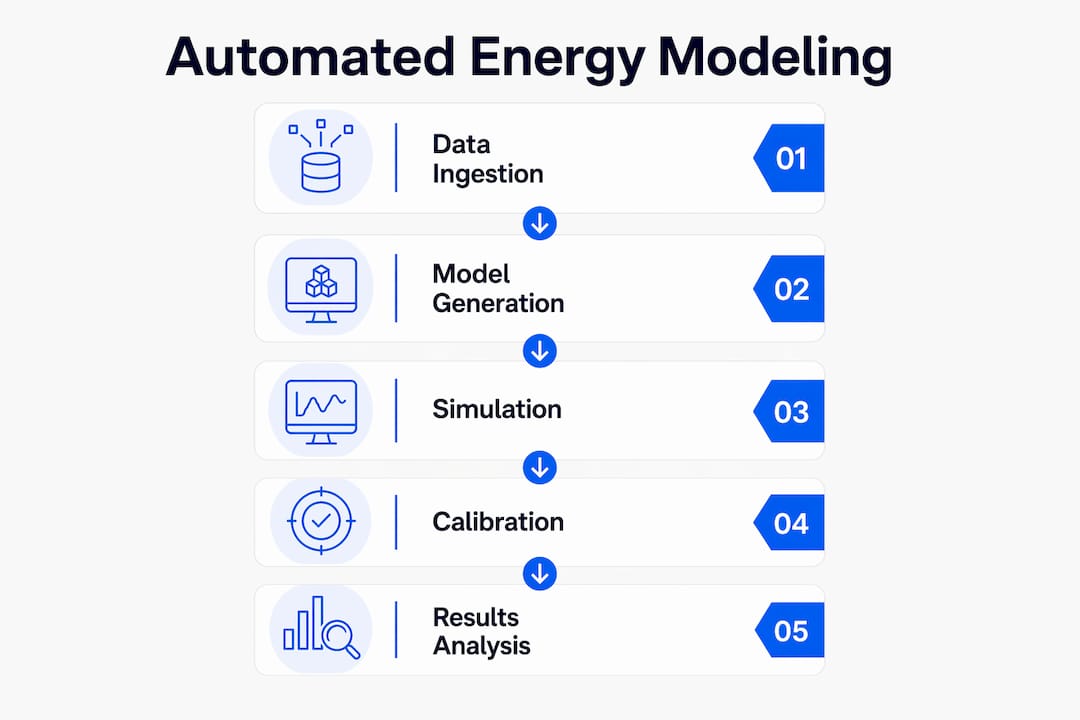
The workflow typically moves through four stages: data ingestion, model generation, simulation execution, and results post-processing. Each stage can be scripted, parallelized, and connected to live data feeds from building management systems or BIM platforms. The result is a living model that updates as real operational data arrives, rather than a static snapshot produced once during the design phase.
How do AI and scripting automate the model generation process?
The technical architecture of a modern automated BEM workflow combines three layers: data preparation, model construction, and calibration. Understanding each layer helps you choose the right approach for your project.
Data preparation pulls building descriptors from sources including BIM files, utility bills, sensor feeds, GIS databases, and energy audit reports. The quality of this input data determines the accuracy ceiling of every simulation that follows. Garbage in, garbage out applies here with particular force, because errors in geometry or occupancy schedules propagate through thousands of scenario runs.
Model construction is where AI has made the most dramatic recent impact. A 2025 OSTI study demonstrates that an LLM agentic workflow outperforms both manual modeling and naive prompt engineering in accuracy, reliability, and efficiency for generating error-free EnergyPlus input files. The key insight from that research is that effective AI automation requires decomposed multi-agent workflows with dedicated debugging and validation steps, not a single prompt asking a language model to “write an IDF file.” Each agent handles a specific subtask: object extraction, schedule generation, geometry encoding, and error checking.
Calibration closes the loop between simulated and measured performance. Ontology-based semantic frameworks enable automatic simulation model generation combined with Bayesian parameter estimation, producing probabilistic prediction intervals rather than single-point estimates. This matters for compliance work, where regulators increasingly expect uncertainty quantification alongside headline energy figures.
Scripting approaches using modular JSON configurations and Python libraries like Eppy automate EnergyPlus input file generation and batch scenario runs. A 2025 MDPI study using this JSON-Python pipeline demonstrated scalable automation for hotel energy use modeling, including machine learning post-processing for consumption prediction. The modular structure means you can swap out one building component, such as a new glazing specification, and regenerate the full simulation set in minutes.
Pro Tip: Before selecting an automation framework, audit your available data sources. An LLM-based workflow delivers its full advantage only when input data is structured and complete. If your building descriptors are fragmented across PDF audit reports and legacy CAD files, invest in data normalization first.
How do automated modeling approaches compare?
Choosing between AI-driven, scripting-based, and ontology-calibrated frameworks depends on your project scale, data maturity, and compliance requirements. The table below summarizes the key trade-offs.
Approach | Best for | Accuracy | Scalability | Compliance fit |
LLM agentic workflow | Complex, data-rich buildings | High with validation steps | Medium | Strong with audit trail |
JSON-Python scripting | Batch scenario analysis | High with calibration | Very high | Strong with version control |
Ontology-based framework | Calibration and uncertainty | Highest (probabilistic) | Medium | Strongest for SRI/EPBD |
Manual EnergyPlus modeling | Single bespoke projects | Variable | Very low | Depends on modeler |
The LLM agentic approach excels when building descriptions are complex and heterogeneous, because the language model can interpret unstructured text and extract parameters that a rigid script would miss. The trade-off is computational cost and the need for rigorous validation. A multi-agent debugging layer is not optional. It is the difference between a workflow that produces reliable IDF files and one that generates plausible-looking files with silent parameter errors.
Scripting-based pipelines using JSON and Python are the workhorse of urban-scale energy analysis. They are deterministic, fast, and easy to audit. Their weakness is brittleness: a building type outside the template library requires manual extension of the configuration schema. Ontology-based frameworks address this by encoding building knowledge semantically, allowing the system to reason about novel building configurations and generate calibrated models with explicit uncertainty bounds.
For European designers working under EPBD and national building codes, the ontology-calibrated approach offers the most defensible output because it produces prediction intervals rather than single numbers. Regulators and auditors can see not just the modeled energy intensity, but the confidence range around that figure.
How does automated modeling support European compliance requirements?
European energy planners face a specific regulatory context that shapes how automated energy modeling techniques must be configured. The EPBD’s Smart Readiness Indicator (SRI) requires floor-level calculations that account for smart building technologies, dynamic tariff response, and demand flexibility. Manual calculation of SRI scores across a building portfolio is prohibitively time-consuming. Automation changes that equation entirely.
An “Active BIM” methodology uses semantic enrichment and JSON exchanges to automate floor-level SRI calculations aligned with EPBD standards. This approach treats the BIM model not as a static drawing archive but as a live data source that feeds compliance calculations automatically whenever the design changes. For a designer working on a mixed-use development in Germany or the Netherlands, this means SRI scores update in real time as you revise the HVAC specification or add battery storage.
Retrofit analysis is the other major compliance application. The SABER tool automates EnergyPlus model creation, calibration, and optimization for retrofit scenario analysis using utility data and cost function constraints. SABER generates calibrated models from utility bills alone, without requiring a full BIM dataset, which makes it practical for existing building stock where detailed as-built documentation is often unavailable.
Connect your BIM authoring tool (Revit, ArchiCAD, or IFC-compliant platforms) to an automated BEM pipeline via IFC export or direct API.
Configure the ontology or JSON schema to map BIM objects to EnergyPlus construction and system types relevant to your national building code.
Run baseline simulations and calibrate against 12 months of utility meter data using Bayesian or least-squares methods.
Generate scenario sets for retrofit measures: insulation upgrades, heat pump replacement, PV and battery addition, and demand response enrollment.
Export compliance documentation with prediction intervals for submission to national energy agencies or building permit authorities.
Pro Tip: When preparing EPBD compliance documentation, use an ontology-based framework that outputs probabilistic prediction intervals. Point estimates alone are increasingly insufficient for national energy agency submissions in Germany, France, and the Netherlands.
What does automated energy modeling look like at city and national scale?
The most striking demonstration of automated energy modeling’s scalability comes from ORNL’s AutoBEM platform. AutoBEM modeled over 122 million U.S. buildings using High Performance Computing simulation, covering 98% of the national building stock. That figure reframes what “building energy analysis” means. It is no longer a project-by-project activity. It is a national infrastructure capability.
For European urban planners, the equivalent application is district-scale or city-scale energy modeling to support municipal climate action plans, heat network feasibility studies, and national renovation wave targets under the European Green Deal. Semantic 3D city models, such as those built on the CityGML standard used widely in German and Dutch municipalities, provide the geometric and attribute data that automated pipelines need to generate building-level EnergyPlus models at neighborhood scale.
“Transitioning from manual building-by-building modeling to automated data ingestion and model generation pipelines enables scalable ‘what-if’ analyses at urban and larger scales.” — ORNL AutoBEM research team
Model orchestration protocols are the enabling layer for professional use at this scale. The Model Context Protocol (MCP) allows AI workflows to call EnergyPlus tools with visible tool invocations, so every simulation run is traceable. An MCP-enabled workflow shortened model inspection and adjustment from one to two hours down to under 15 minutes while preserving the engineer’s decision-making authority. That is not a marginal efficiency gain. It changes the economics of energy consulting for medium-sized practices that cannot afford dedicated HPC infrastructure.
The practical implication for city-level energy planners is that automated BEM now makes it feasible to evaluate peak demand reduction strategies, district heating expansion scenarios, and large-scale PV deployment impacts across entire neighborhoods before committing capital. The models are not perfect, but they are calibrated, transparent, and fast enough to support iterative planning cycles.
Key takeaways
Automated energy modeling delivers its full value when AI orchestration, modular scripting, and calibrated uncertainty handling are combined into a single traceable pipeline.
Point | Details |
Core workflow definition | Automated BEM ingests building data, generates EnergyPlus models, and runs calibrated simulations with minimal manual input. |
AI adds debugging, not just generation | LLM agentic workflows require dedicated validation steps to produce reliable, error-free simulation input files. |
Ontology frameworks suit compliance work | Bayesian calibration produces prediction intervals that meet EPBD and national energy agency documentation standards. |
Scripting enables urban-scale analysis | JSON-Python pipelines support batch simulation of thousands of buildings with version-controlled, reproducible results. |
MCP preserves professional oversight | Model Context Protocol keeps AI tool calls visible and traceable, protecting engineer sign-off authority at scale. |
Why validation is the part most teams underestimate
I have watched energy consulting teams adopt automated BEM workflows and immediately focus on speed gains. They are right to be excited. Cutting model build time from two days to 20 minutes is genuinely transformative. But the teams that get into trouble are the ones that treat the automation as a black box and skip the validation layer.
The uncomfortable reality is that a well-structured automated pipeline is only as trustworthy as its debugging and calibration steps. An LLM that generates a syntactically valid EnergyPlus IDF file can still embed schedule errors or incorrect construction layer sequences that produce plausible-looking but wrong energy figures. I have seen this happen on real projects, and the consequences for compliance submissions are serious.
The perspective on AI for BEM from leading researchers is clear: key enablers for AI in building energy modeling are data maturity, appropriate tool selection, and benchmarking tailored to practical usage. That last point is the one practitioners most often skip. Benchmarking your automated pipeline against a manually validated reference model for at least one building type in your portfolio is not optional overhead. It is the professional standard that protects your liability and your client’s investment.
For European designers, I would add one more recommendation: learn the multi-technology energy systems context your models feed into. Automated BEM outputs are most valuable when they connect directly to storage sizing, PV yield analysis, and demand response planning. Models that exist in isolation from the broader energy system design miss the most important optimization opportunities.
— Marc
How Belinus supports your energy modeling and management workflow

Belinus integrates automated energy analysis directly into its Energy Management System, giving European energy planners and building designers a practical path from simulation to real-time operational control. The Belinus EMS uses 15-minute dynamic tariff optimization to act on the outputs of energy modeling, translating simulated demand profiles into battery dispatch schedules, PV curtailment decisions, and EV charging coordination. If you are designing a commercial building that needs to demonstrate EPBD compliance and optimize ongoing energy costs, Belinus connects the modeling layer to the hardware layer. Explore how to automate energy management and reduce operational costs, or visit Belinus to discuss a custom energy solution for your project.
FAQ
What is automated energy modeling in simple terms?
Automated energy modeling is a software workflow that takes building data and automatically creates, calibrates, and runs energy simulation models, replacing most of the manual configuration work a human modeler would otherwise perform.
Which simulation engine do most automated BEM workflows use?
EnergyPlus, developed by the U.S. Department of Energy, is the dominant simulation engine in automated BEM pipelines, used by platforms including ORNL’s AutoBEM, SABER, and LLM-based agentic workflows.
How does automated energy modeling help with EPBD compliance in Europe?
Active BIM methodologies use semantic metadata and JSON exchanges to automate floor-level Smart Readiness Indicator calculations aligned with EPBD standards, updating compliance scores automatically as building designs change.
What is the difference between scripting-based and AI-driven BEM automation?
Scripting-based automation uses modular JSON configurations and Python libraries to generate and run EnergyPlus models in batch, while AI-driven workflows use large language models with multi-agent debugging to handle complex, unstructured building descriptions with higher flexibility.
Can automated energy modeling work at city scale?
ORNL’s AutoBEM has demonstrated city and national-scale capability, modeling over 122 million buildings using High Performance Computing, making urban district energy planning and national renovation wave analysis technically feasible.
Recommended
Comments