Energy Trading Platforms: How They Power Modern Markets
- 4 hours ago
- 6 min read

An energy trading platform is a regulated, neutral digital infrastructure that enables the wholesale buying and selling of electricity, gas, and emission allowances. These platforms bring together generators, retailers, industrial consumers, traders, aggregators, and financial institutions in a single rule-based marketplace where bids and offers are pooled, matched, and cleared at a transparent market price. The core goal is efficient price discovery and fair access for every participant, regardless of size.
Key participants on these platforms include:
Generators selling electricity or gas they produce
Retailers and suppliers buying energy to resell to end customers
Industrial consumers purchasing directly at wholesale prices
Traders and aggregators managing portfolios and balancing positions
Financial institutions hedging exposure through derivative contracts
Trading can span every timeframe, from long-dated futures contracts to same-day intraday slots. The platform’s job is to match the lowest-priced supply with the highest-priced demand until the market clears, producing a single reference price that guides production, consumption, and investment decisions across the grid.
What does an energy trading platform actually do?
The functional core of any energy trading platform is order management and trade execution. Participants submit buy or sell orders into a central system; the platform matches them anonymously based on price and time priority, then confirms the trade. Anonymity matters because it prevents large players from gaming the order book by identifying counterparties before a deal closes.
Beyond matching orders, these platforms provide:
Real-time market data including live order books, last-traded prices, and settlement curves
Standardized contracts covering specific delivery periods, volumes, and locations so participants trade apples-to-apples
Multi-timeframe support across day-ahead auctions, intraday continuous trading, and balancing markets
Integration interfaces connecting to transmission system operators, settlement agents, and ETRM systems via APIs
Compliance reporting tools that log every order and trade for regulatory audit purposes
One feature that often surprises new participants is the shift toward shorter trading intervals. Moving to intraday markets with 15-minute delivery slots reduces forecast errors for renewable portfolios and cuts the volume of expensive balancing power needed to keep the grid stable.
Pro Tip: If you operate a solar or battery asset, prioritize platforms that support 15-minute intraday products. Day-ahead prices alone leave too much value on the table when generation swings by 30% between morning and midday.

Which platforms are active in the Central European energy market?
Central Europe is served by several platforms that differ in scope, technology, and market focus.
Nord Pool operates across multiple European countries and offers day-ahead and intraday electricity markets with a single membership giving access to interconnected national price zones. Its auction-based day-ahead market produces the reference prices that most Central European power purchase agreements are indexed to.
EEX Group is the dominant exchange for Central European power and gas. A single membership in the EEX Group provides access to over 20 European markets through one unified trading interface, which removes the operational burden of maintaining separate memberships on each national platform.
Power Ledger takes a different approach, using blockchain technology to enable peer-to-peer energy trading at a more granular level. Its model is particularly relevant as prosumers and small renewable generators seek direct market access without going through a traditional retailer.
Enel X Energy Trading Platform integrates demand response and distributed energy resources into wholesale market participation, connecting commercial and industrial loads to real-time price signals and allowing them to trade flexibility as a product.
The pan-European access model is worth emphasizing for Central European participants. Rather than joining separate Austrian, Czech, German, or Hungarian platforms, membership in a group like EEX provides cross-border liquidity from a single account. That matters when you are trying to arbitrage price differences between neighboring price zones or hedge a portfolio that spans multiple countries.
What are the real benefits of using an energy trading platform?

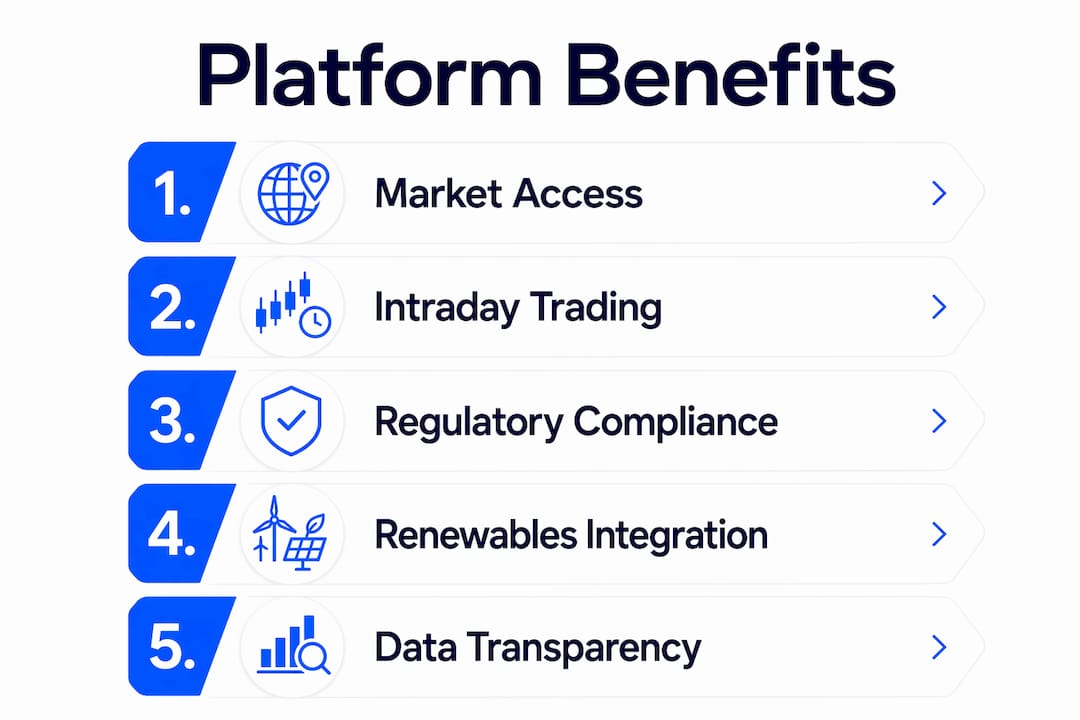
The most direct benefit is price transparency. Because all bids and offers are pooled and matched openly, the resulting market clearing price reflects actual supply and demand rather than a bilateral negotiation where one party has more information than the other. That transparency feeds into better energy cost management for buyers and more predictable revenue for generators.
Other concrete advantages include:
Liquidity pooling that lets participants enter and exit positions without moving the market, especially on liquid hubs like the German THE gas hub or the EPEX SPOT power market
Renewable integration support through intraday and balancing products that absorb the output variability of wind and solar without forcing system operators to curtail generation
Demand response facilitation by exposing industrial consumers and aggregators to real-time price signals, rewarding load shifts that relieve grid stress
Regulatory compliance built into the platform architecture, with automated order book reporting satisfying obligations under frameworks like REMIT 2
Risk reduction through standardized contracts and central counterparty clearing, which eliminates bilateral credit risk between trading parties
Pro Tip: Battery storage assets can capture value on both sides of the market: charge during low-price intraday periods and discharge during peak demand windows. Platforms with 15-minute granularity make that arbitrage far more precise than day-ahead-only access.
As renewable energy integration accelerates across Central Europe, the platforms that support demand response and prosumer participation are becoming the ones that actually move the needle on decarbonization, not just transaction volume.
How does an energy trading platform differ from an ETRM system?
These two systems are frequently confused, and the distinction is worth getting right. An energy trading platform handles execution: order submission, trade matching, and real-time market data. It is the venue where the transaction happens. An ETRM system, by contrast, manages everything that comes after the trade is done.
Specifically:
Trading platforms serve traders and brokers who need fast, reliable access to live markets
ETRM systems serve a wider group including risk managers, finance teams, compliance officers, and settlement desks
Trading platforms do not typically track open positions, calculate mark-to-market exposure, or generate invoices
ETRM systems cover the full trade lifecycle: deal capture, position tracking, credit risk monitoring, settlement, regulatory reporting, and integration with financial accounting systems
The two systems work together rather than compete. A trade executed on Nord Pool or EEX flows automatically into the ETRM, which then tracks the delivery obligation, calculates the P&L impact, and flags any credit limit breaches. Modern energy IT architecture is moving away from monolithic ETRM platforms toward a more modular setup where the ETRM handles audit trails and deal storage while specialized satellite services manage real-time risk modeling, automated balancing, and trade execution.
For a company deploying battery storage or solar generation in Central Europe, the practical implication is clear: you need both. The trading platform gets you into the market; the ETRM keeps you from losing track of what you own and what you owe.
How do energy trading platforms support regulatory compliance and the green transition?
REMIT 2, which came into effect on May 7, 2024, is the regulation that most directly shapes how energy trading platforms operate in Europe. Under REMIT 2, platforms must report all orders and transactions to ACER (the Agency for the Cooperation of Energy Regulators) in near real-time, providing regulators with a complete view of market activity to detect manipulation and insider trading. Energy exchanges are classified as Organized Market Places under REMIT 2, which means the compliance infrastructure is built into the platform itself rather than left to individual participants to arrange.
The green transition adds a second layer of pressure. As wind and solar generation grows across Central Europe, the grid sees more volatility in both supply and demand. Trading platforms respond by extending market access to smaller players: prosumers with rooftop solar, aggregators managing clusters of flexible industrial loads, and battery operators selling frequency response. Peer-to-peer trading models are emerging as a complement to exchange-based markets, letting small generators trade directly with nearby consumers at prices set by the platform rather than a retailer’s margin.
The Energy Traders Europe “Integrate by '28” initiative frames this challenge at a policy level, calling for the completion of the Internal Energy Market by 2028 to remove cross-border barriers and strengthen price signals. For Central European participants, that means platforms will need to handle more granular products, more participants, and more cross-border flows simultaneously. The platforms that invest in 15-minute intraday products, open API connectivity, and prosumer onboarding tools are the ones positioned to carry that load.
Key Takeaways
Energy trading platforms are regulated digital venues that match wholesale energy bids and offers to produce transparent market prices, and their role in Central Europe is expanding rapidly as renewable generation and REMIT 2 compliance reshape market requirements.
Point | Details |
Core function | Platforms pool bids and offers anonymously to produce a market clearing price for electricity, gas, and emission allowances. |
Platform vs. ETRM | Trading platforms handle execution and market data; ETRM systems manage risk, settlement, and the full trade lifecycle after the deal is done. |
Pan-European access | EEX Group membership provides access to over 20 European markets through a single interface, reducing operational complexity for Central European participants. |
REMIT 2 compliance | Effective since May 7, 2024, REMIT 2 requires platforms to report all orders to ACER in near real-time, with exchanges serving as the primary compliance infrastructure. |
Green transition role | Shorter intraday intervals and prosumer access tools are turning trading platforms into active instruments for integrating renewable generation and demand response. |
Recommended