Real-Time Grid Optimization for European Utilities: 2026 Guide
- Jul 7
- 8 min read

TL;DR:
Real-time grid optimization uses AI to coordinate grid assets and improve transmission efficiency amidst rising renewable integration. Building operator trust through co-validation and early regulatory engagement is crucial for successful deployment. Open-source tools and cross-border collaboration enhance capacity gains and reduce congestion costs across European utilities.
Real-time grid optimization is the intelligent orchestration of grid assets, data streams, and AI-driven controls to maximize transmission efficiency and ensure reliable electricity delivery under dynamic conditions. European energy managers face mounting pressure as renewable penetration rises and legacy infrastructure strains under variable loads. AI-orchestrated approaches combining Dynamic Line Rating, Topology Control, and Optimal Power Flow have increased transmission capacity by 20–38% while cutting renewable curtailment by 18–28%. Standards like EN 50491-12 and IEC 62746 define the interoperability baseline every deployment must meet.
What technologies enable real-time grid optimization?
The industry term for this discipline is adaptive grid control, though “real-time grid optimization” captures the operational intent precisely. The technical foundation rests on an AI orchestration layer that coordinates three core functions: Dynamic Line Rating, Topology Control, and Optimal Power Flow. Each function feeds the others, and the orchestration layer resolves conflicts between them in milliseconds.

Physics-calibrated Digital Twins sit at the center of this architecture. A Digital Twin is a live, continuously updated model of the physical grid that reflects actual conductor temperatures, line sag, and load conditions rather than static thermal limits. Digital Twins in energy replace conservative worst-case assumptions with real physics, which is why they unlock capacity that conventional planning leaves stranded.
The AI orchestration layer draws on several data sources simultaneously:
SCADA and EMS telemetry: Substation measurements updated every few seconds provide the ground truth for all optimization decisions.
Weather and environmental feeds: Wind speed, ambient temperature, and solar irradiance directly affect line ratings and renewable output forecasts.
Market and demand signals: Real-time pricing and load forecasts allow the optimizer to anticipate congestion before it forms.
Deep reinforcement learning for topology control: Agents learn switching sequences that relieve congestion without triggering N-1 security violations.
High-performance computing underpins the entire stack. GPU-accelerated solvers and cloud-native platforms like Kubernetes and Kafka handle the parallel workloads that real-time decision cycles demand. TenneT’s ReFlow platform, built on the open-source PowSyBl framework, achieved a tenfold improvement in calculation performance. That speed matters because a grid security check that takes minutes is operationally useless when a fault develops in seconds.
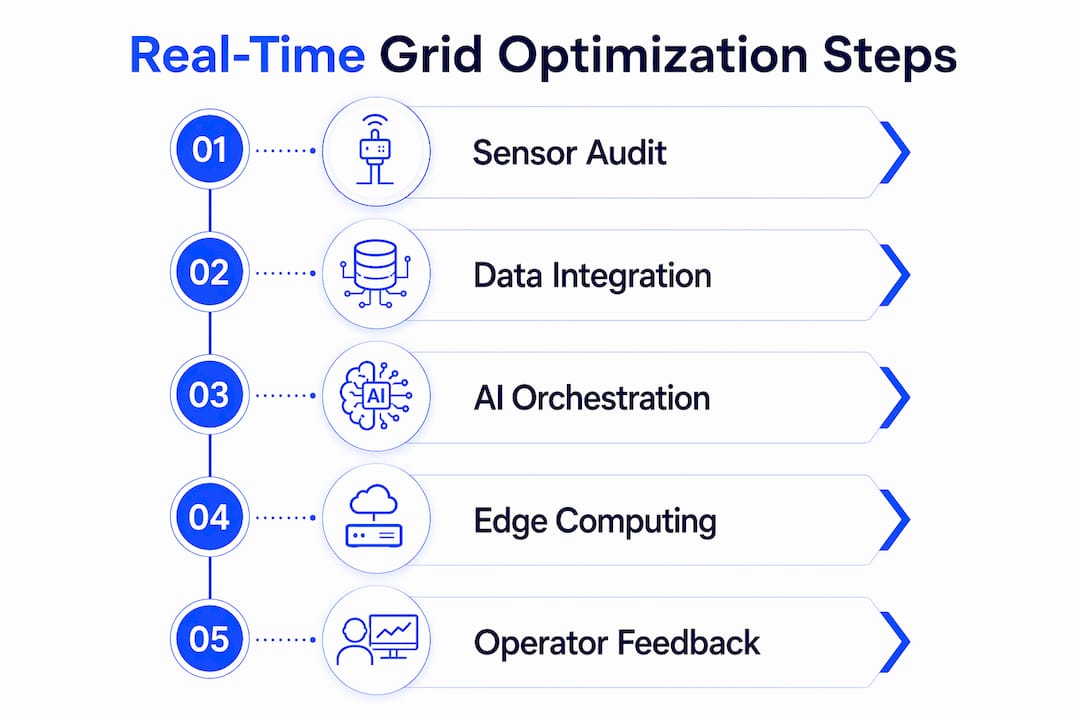
Pro Tip: Deploy edge computing nodes at critical substations alongside your cloud platform. Edge nodes enable fault isolation and local control within milliseconds, which cloud-only architectures cannot match for time-critical switching decisions.
Interoperability standards tie the architecture together. CIM/CGMES 3.0 and DSFM enable seamless data integration between customer energy management systems, aggregator platforms, and transmission-level optimizers. Without these standards, each subsystem becomes a data silo that undermines the whole optimization effort.
How does dynamic grid management improve operational efficiency?
The performance gains from deploying a full AI orchestration stack are measurable and consistent across European deployments. Congestion costs fall by 22–35% when physics-calibrated Digital Twin orchestration replaces static thermal limits. That reduction translates directly into lower redispatch payments and reduced curtailment of wind and solar assets.
Operational benefits extend beyond cost savings:
Forecasting accuracy: AI models trained on historical SCADA data and weather patterns produce load and generation forecasts that outperform conventional statistical methods, reducing reserve requirements.
Outage reduction: Predictive analytics flag equipment stress before failures occur, shifting maintenance from reactive to condition-based scheduling.
Asset life extension: Operating lines closer to their true thermal limits, rather than conservative static ratings, reduces the frequency of emergency overloads that degrade insulation.
Faster congestion response: Automated topology recommendations reach operators in seconds rather than the minutes required for manual analysis.
Operator trust is the factor most deployment plans underestimate. Swissgrid achieved a 71% operator acceptance rate by involving operators in testing from the start and requiring manual validation of AI recommendations before automation. That acceptance rate is not a soft metric. It determines whether the system’s recommendations get acted on or ignored during high-stress grid events.
Building trust requires a phased adoption model. Start with AI recommendations displayed alongside operator decisions, with no automation. Measure how often operators accept the recommendations. Use disagreements as training data to improve the model. Automate only after acceptance rates reach a threshold the operations team defines. This sequence converts skepticism into confidence without exposing the grid to untested automation.
Grid flexibility solutions that integrate battery storage with real-time optimization add another layer of operational control. Batteries can absorb excess renewable generation during curtailment events and discharge during peak demand, directly reducing the congestion that optimization algorithms work to resolve.
What are best practices for deploying grid optimization in European utilities?
Deployment success depends on decisions made before the first line of code runs in production. The four areas that determine outcomes are sensor infrastructure, regulatory engagement, software team structure, and operator integration.
Invest in sensor infrastructure first. AI applications without real-time streaming data are ineffective. Legacy grids lack the sensor density required for high-fidelity Digital Twins. Phasor Measurement Units (PMUs), advanced metering infrastructure, and fiber-connected RTUs must be deployed before optimization software can deliver its full value. Budget for this infrastructure as a prerequisite, not an afterthought.
Engage regulators before procurement. Software-defined grid optimization does not fit neatly into traditional CAPEX categories. Regulatory frameworks often lag behind software-defined investments, and misalignment delays cost recovery approvals by months or years. Early conversations with national regulatory authorities about how to classify and recover these investments prevent costly project stalls.
Adopt open-source frameworks and cross-border data standards. Proprietary platforms create vendor lock-in and interoperability barriers. Open-source tools built on CIM/CGMES 3.0 allow data exchange with neighboring transmission operators and aggregators. Cross-border interoperability is not optional for European utilities operating within interconnected synchronous zones.
Embed software engineering teams within operational units. Embedding engineers directly in business units shortens delivery cycles and keeps development aligned with real operational needs. TenneT’s ReFlow went from project start to production in approximately five months using this model. A separate IT department working from requirements documents cannot match that speed or relevance.
Build operator trust through co-validation. Run AI recommendations in parallel with operator decisions for a defined period. Document where the AI and the operator diverge. Use those cases to refine models and build the evidence base that justifies automation.
Pro Tip: Treat your first deployment as a sensor audit. Map every gap in real-time data coverage before configuring the optimization layer. Gaps you discover in production cost far more to fix than gaps identified during the infrastructure assessment phase.
How can open-source collaboration reduce grid congestion costs?
Cross-border collaboration among European transmission operators represents the most cost-effective path to grid congestion management at scale. The joint initiative between 50Hertz and Elia Group produced ToOp, an open-source grid congestion tool that performs up to one billion load flow calculations per second using GPU-accelerated computing. That calculation throughput allows operators to evaluate billions of switching scenarios in the time it previously took to analyze a handful.
The benefits of shared open-source development compound over time:
Shared development costs: Multiple transmission operators contribute engineering resources, reducing the per-operator investment required to maintain and improve the platform.
Faster defect resolution: A larger contributor base identifies and fixes bugs faster than any single operator’s internal team.
Regulatory credibility: Open-source code is auditable by regulators, which accelerates approval processes compared to black-box proprietary systems.
Alignment with European energy policy: Shared tools support the cross-border coordination that the EU’s clean energy package requires from transmission operators.
The table below summarizes the key performance and collaboration attributes of GPU-accelerated open-source grid congestion platforms compared to conventional calculation approaches.
Attribute | Conventional approach | GPU-accelerated open-source |
Load flow calculations per second | Thousands | Up to one billion |
Scenario coverage | Limited sample | Near-exhaustive sweep |
Development cost model | Single-operator proprietary | Shared across contributors |
Regulatory auditability | Limited (black box) | Full (open code) |
Cross-border interoperability | Manual data exchange | Standards-based integration |
Renewable grid services in the Benelux region illustrate how collaborative frameworks translate into operational practice. Operators sharing congestion data and optimization results across borders can coordinate redispatch actions that no single operator could execute alone, reducing total system costs for all participants.
The energy transition makes this collaboration non-negotiable. As wind and solar generation grows more variable and geographically dispersed, congestion patterns shift faster than any single operator’s internal tools can track. Shared, high-performance platforms that update continuously are the only architecture that scales with the transition.
Key Takeaways
Real-time grid optimization delivers its largest gains when AI orchestration, physics-calibrated Digital Twins, and cross-border open-source collaboration operate as a unified system rather than isolated tools.
Point | Details |
AI orchestration drives capacity gains | Dynamic Line Rating and Topology Control together increase transmission capacity by 20–38%. |
Sensor infrastructure is the prerequisite | High-fidelity real-time data must exist before optimization software can function effectively. |
Operator trust determines adoption | Swissgrid’s 71% acceptance rate shows that co-validation, not automation mandates, builds lasting trust. |
Open-source tools cut congestion costs | GPU-accelerated platforms like ToOp process billions of scenarios per second, enabling decisions no manual process can match. |
Regulatory engagement must start early | Software-defined investments require early dialogue with regulators to avoid cost-recovery delays. |
What I’ve learned about the gap between technical ambition and operational reality
After years of working at the intersection of energy systems and digital infrastructure, the pattern I see repeated most often is this: utilities invest heavily in the AI layer and underinvest in the organizational layer. The algorithm is rarely the problem. The problem is that operators don’t trust it, regulators don’t know how to classify it, and the sensor network feeding it has gaps that nobody mapped before go-live.
The Swissgrid result stands out to me precisely because 71% operator acceptance is honest. It means 29% of recommendations were still being overridden. That is not a failure. That is a realistic starting point for a system that will improve as the gap between AI recommendations and operator judgment narrows through shared experience.
The open-source movement among European transmission operators is the development I find most strategically significant for 2026 and beyond. When 50Hertz and Elia Group release a tool that processes a billion load flow calculations per second and make it freely available, they shift the competitive dynamic entirely. The advantage moves from “who owns the best software” to “who deploys and integrates it most effectively.” That is a race utilities can win through organizational capability rather than procurement budgets.
My practical advice: treat the first 12 months of any grid optimization deployment as a learning investment, not a performance period. Measure operator acceptance, data coverage, and model accuracy. Fix what the data tells you to fix. Automate incrementally. The utilities that will lead European grid management in 2030 are the ones building that learning discipline now, not the ones chasing the most impressive vendor demo.
— Marc
Belinus and real-time energy distribution for utility managers
Belinus builds energy management systems designed for the operational realities that European utility managers face. The Belinus EMS supports 15-minute dynamic tariff optimization, battery arbitrage, and grid services integration through a RESTful API that connects with third-party SCADA and EMS platforms. For utility-scale deployments, Belinus offers storage modules starting at 400+ kWh, scalable to MW capacity, with a Power Conversion System targeting a two-week delivery window for critical national infrastructure applications.

Energy managers evaluating grid-connected battery storage as part of a broader optimization strategy will find that Belinus systems are built for interoperability, not isolation. The platform supports multi-technology configurations including LFP, pre-lithiated LFP, and graphene supercapacitor storage, giving operators the flexibility to match storage chemistry to grid service requirements. Learn more about Belinus utility and commercial solutions at belinus.com.
FAQ
What is real-time grid optimization?
Real-time grid optimization is the continuous, automated adjustment of grid assets using AI, live telemetry, and physics-based models to maximize transmission capacity and minimize congestion. It replaces static thermal limits with dynamically updated operating parameters.
How much can AI-driven grid optimization reduce congestion costs?
AI-orchestrated systems using Digital Twin models reduce congestion costs by 22–35%, according to Eurelectric research. Transmission capacity gains of 20–38% accompany those cost reductions.
What standards govern grid optimization interoperability in Europe?
CIM/CGMES 3.0, DSFM, EN 50491-12, and IEC 62746 define the interoperability requirements for integrating customer, aggregator, and transmission-level energy management systems in European grid deployments.
How long does it take to deploy a grid optimization platform?
TenneT’s ReFlow deployment went from project start to production in approximately five months using an embedded software engineering team and an open-source PowSyBl foundation. Timelines vary based on sensor infrastructure readiness and regulatory approval processes.
Why do operators resist AI recommendations in grid management?
Operators resist AI recommendations when they have not been involved in testing and cannot verify the reasoning behind a decision. Swissgrid’s co-validation approach, which required manual confirmation before automation, raised acceptance rates to 71% by building evidence-based trust rather than demanding compliance.
Recommended
Comments