EV Charger Types Explained: Your 2026 Selection Guide
- Jul 14
- 8 min read
TL;DR:
EV charger types are classified by power, speed, connector standards, and intended use, ranging from Level 1 to DC fast chargers. Proper selection requires understanding vehicle limits, infrastructure, and regulations to ensure compatibility and future growth. Smart technologies like ISO 15118 support advanced features, while regulatory compliance prevents costly delays and upgrades.
EV charger types explained refers to the classification of electric vehicle chargers by power level, charge speed, connector standard, and intended use. Three core categories exist: Level 1 AC, Level 2 AC, and DC fast chargers. Each delivers a different power range, suits a different setting, and requires different infrastructure. Connector standards like Type 2 and CCS Combo 2 determine physical compatibility and charging speed. Whether you are a homeowner adding a wallbox or a business building a fleet charging station, knowing these differences is the first decision you need to make correctly.
How do Level 1 and Level 2 AC chargers work?
AC charging is the most common electric vehicle charging type for homes and workplaces. The charger itself delivers alternating current to the vehicle, and the car’s onboard converter transforms that AC into the DC that the battery stores. That conversion step is what limits speed at this level.
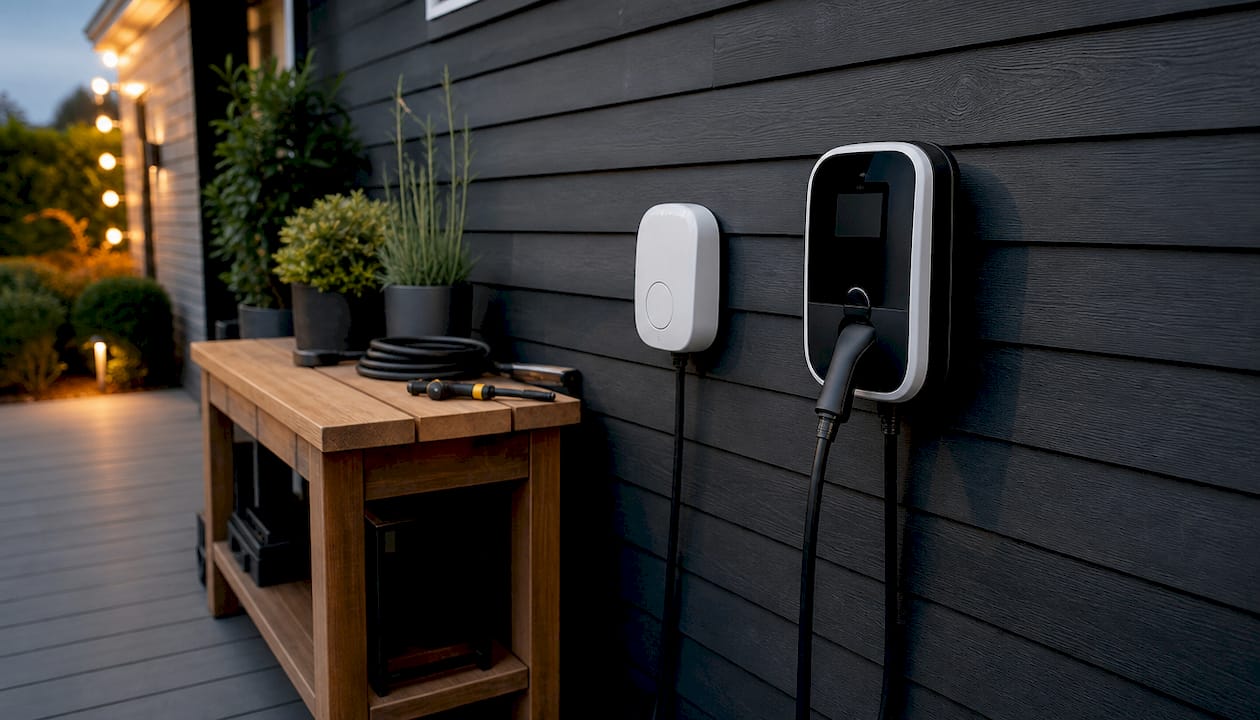
Level 1 uses a standard 120V household outlet in North America or a Schuko socket in Europe. Power output sits between 2.3 and 3.7 kW, which translates to roughly 15–25 km of range per hour of charging. That rate makes Level 1 suitable only for emergencies or drivers who cover very short daily distances.
Level 2 is the practical standard for daily home and workplace charging. A dedicated 240V circuit in North America, or a wallbox on a single or three-phase supply in Europe, delivers 11–22 kW. At that rate, most EVs reach a full charge overnight. Installation costs for a wallbox typically run €1,000–€2,500, depending on site complexity and whether the electrical panel needs an upgrade.
Key differences at a glance:
Level 1: No dedicated hardware required, very slow, best for overnight top-ups on short commutes
Level 2: Requires a wallbox or EVSE unit, 11–22 kW output, covers most daily driving needs
Connector standard: Type 2 is the established European AC standard; J1772 is the North American equivalent
Onboard charger limit: The vehicle’s onboard charger caps AC charging speed regardless of what the wallbox can supply
Pro Tip: Before buying a wallbox, check your vehicle’s maximum AC acceptance rate. A car limited to 7.4 kW onboard charging gains nothing from a 22 kW wallbox.
For a broader look at what homeowners and businesses should evaluate before installation, the EV charging basics guide from Belinus covers site assessment and cost planning in detail.
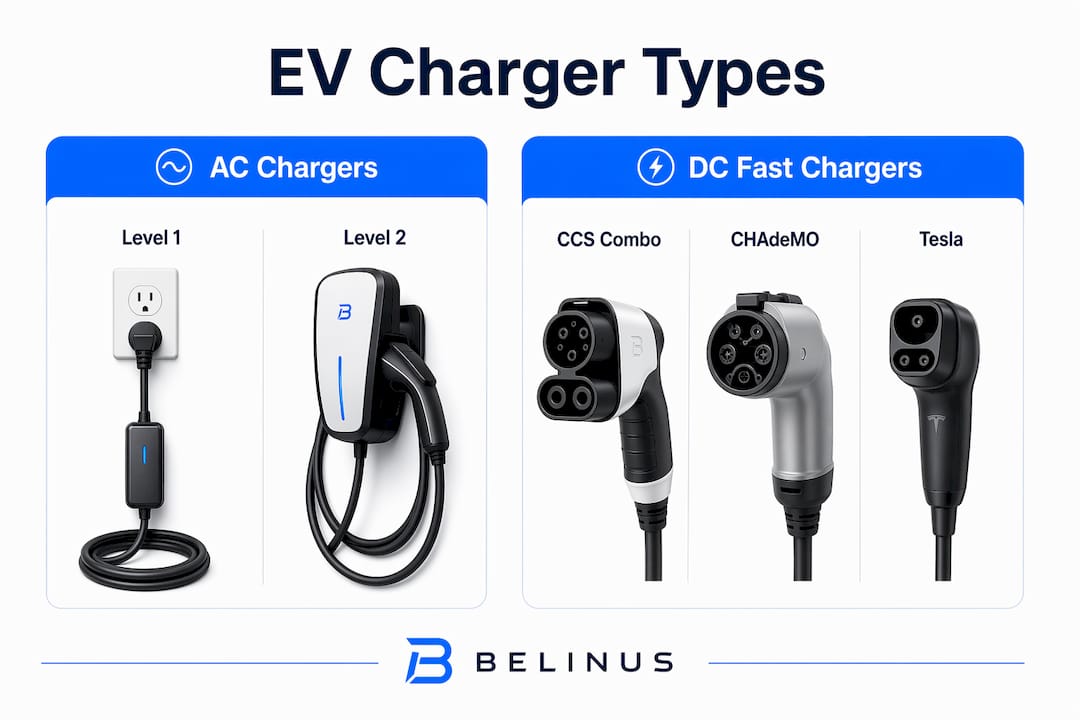
What are DC fast chargers and how do connectors affect speed?
DC fast charging moves the conversion process out of the vehicle and into the charging station. The station converts grid AC to DC directly, then pushes that DC straight into the battery. That shift removes the onboard charger bottleneck entirely, which is why DC charging is station-controlled and far more expensive to build and operate than AC equipment.
Power output ranges from 50 kW at entry-level public stations to 350 kW or more at premium highway sites. At the high end, CCS fast chargers can deliver 300–400 km of range in 20–60 minutes. That speed profile makes DC fast charging the right tool for highway corridors, commercial fleets, and any site where vehicles cannot sit for hours.
Connector standards and compatibility
Connector | Type | Power range | Status in Europe |
CCS Combo 2 | DC fast | 50 kW–350+ kW | Primary standard, EU mandated |
CHAdeMO | DC fast | Up to 100 kW | Legacy, fading from new models |
Type 2 | AC | Up to 22 kW | Standard for AC at all levels |
The connector landscape simplified significantly after EU regulations from 2017 required CCS on all new public DC fast chargers. CHAdeMO now survives mainly on older Japanese models. Modern European EVs use a single CCS port that handles both AC Type 2 and DC fast charging through one integrated socket. Older Japanese EVs often carry dual inlet sockets, one Type 2 and one CHAdeMO, which adds hardware complexity and limits compatible station options.
For businesses planning commercial charging infrastructure, connector standardization matters as much as power output. Installing CCS Combo 2 hardware today means your stations remain compatible with the full current fleet and every new model entering the market.
What emerging technologies are reshaping EV charging in 2026?
Smart charging and bidirectional capability are no longer premium add-ons. They are becoming baseline expectations for any charger worth installing today. Understanding these technologies affects which hardware you buy and how much value you extract from it over time.
ISO 15118 compliance. This communication protocol manages the digital handshake between the EV and the charger, enabling secure authentication, dynamic load management, and advanced features. Any charger lacking ISO 15118 support cannot access these capabilities, regardless of its power rating.
Plug & Charge. Built on ISO 15118, Plug & Charge uses public-key infrastructure to authorize a session the moment you connect the cable. No app, no RFID card, no QR code. The vehicle and station authenticate each other automatically.
Vehicle-to-Grid (V2G). Bidirectional chargers allow energy to flow from the battery back to the building or the grid. A fleet of EVs parked overnight becomes a distributed storage asset. Smart chargers with V2G capability help maintain grid stability and can generate revenue through energy trading when paired with a capable energy management system.
Dynamic load management. When multiple vehicles charge simultaneously, an unmanaged setup can overload the site’s grid connection. Dynamic load management distributes available capacity across active sessions in real time, preventing tripped breakers and avoiding costly grid upgrades.
Pro Tip: If you are installing more than two chargers at a single site, dynamic load management is not optional. Without it, you will either underuse your chargers or overload your connection.
Belinus integrates these capabilities through its centralized Energy Management System, which runs 15-minute dynamic tariff optimization and supports V2G-ready hardware. The smart charging efficiency guide explains how to configure these features for maximum financial return.
What should you consider when choosing and installing EV chargers?
Selecting the right charger type is only half the decision. Installation requirements, grid capacity, and regulatory compliance determine whether your chosen hardware can actually go live on schedule and within budget.
For homeowners:
Confirm your electrical panel supports the additional load before ordering a wallbox
A Level 2 wallbox at 11 kW requires a dedicated circuit; 22 kW three-phase units need a three-phase supply
Check local permit requirements, which vary significantly by municipality and country
Factor in cable management and weatherproofing if the charger sits in an exposed location
For businesses and fleet operators:
Conduct a grid capacity assessment before specifying charger count and power levels
Multi-vehicle sites need load management hardware or software from day one
Connector standardization matters: CCS Combo 2 covers the entire current European passenger fleet
Budget for ongoing compliance costs, not just installation
Regulatory requirements add another layer of complexity. In Austria, OVE-Richtlinie R37 mandates accredited testing for all new charging infrastructure from december 2026 onward. Non-compliant installations risk denial of grid connection and legal liability. Project managers consistently underestimate grid integration and regulatory demands, which leads to expensive rework after installation. Building compliance into the project plan from the start is far cheaper than retrofitting it.
Cleveland homeowners and businesses in North America face their own permit and utility approval requirements. The EV charger installation guide for Cleveland covers local electrical code requirements and utility coordination in detail.
The right charger for a home is almost always a Level 2 wallbox with smart connectivity. The right charger for a commercial site depends on dwell time, vehicle mix, grid capacity, and whether bidirectional capability fits the energy strategy.
Key Takeaways
Choosing the right EV charger requires matching power level, connector standard, and smart capability to your specific site, vehicle, and usage pattern.
Point | Details |
Level 1 is for emergencies only | Standard outlets deliver 2.3–3.7 kW, enough for short top-ups but not daily charging. |
Level 2 covers most daily needs | Wallboxes at 11–22 kW charge most EVs overnight at a cost of €1,000–€2,500 installed. |
CCS Combo 2 is the DC standard | EU mandates CCS for all new public fast chargers; CHAdeMO is obsolete for new vehicles. |
ISO 15118 future-proofs your investment | Without this protocol, chargers cannot support Plug & Charge, V2G, or dynamic load management. |
Compliance is non-negotiable | Regulations like OVE-Richtlinie R37 in Austria require accredited testing before grid connection. |
Why most EV charger decisions go wrong before the first cable is pulled
I have watched businesses spec out a row of 22 kW wallboxes, order the hardware, and then discover their grid connection supports only 40 kW total for the entire site. The chargers sit in boxes for months while an expensive grid upgrade gets negotiated. That scenario is more common than it should be.
The technical specs on a charger data sheet are the easy part. Power output, connector type, and IP rating take five minutes to compare. What takes real work is understanding how that charger interacts with your building’s electrical infrastructure, your utility’s connection agreement, and the communication protocols your vehicles actually support.
My strongest recommendation is this: treat ISO 15118 compliance as a minimum requirement, not a premium feature. A charger without it cannot grow with the technology. V2G, Plug & Charge, and dynamic load management all depend on it. Buying a non-compliant unit to save a few hundred euros today means replacing the hardware in three years.
The other mistake I see constantly is ignoring the onboard charger limit in the vehicle. A fleet manager installs 22 kW three-phase wallboxes across a parking lot, then realizes half the vehicles in the fleet accept only 7.4 kW AC. The extra capacity is wasted. Match the charger to the vehicle, not to the maximum the wallbox can theoretically deliver.
Smart charging, when configured correctly, turns a cost center into a managed energy asset. That shift in thinking is what separates a good installation from a great one.
— Marc
Belinus EV charging solutions for homes and businesses
Belinus designs and deploys EV charging infrastructure for both residential and commercial clients, backed by an integrated Energy Management System that handles load balancing, tariff optimization, and V2G-ready operation.

The Belinus ETAP Pro EV Charger supports fleet management integration for company cars, while the broader Belinus EMS platform coordinates charging schedules with solar generation and battery storage in real time. For businesses managing multiple vehicles or sites, that coordination directly reduces energy costs and grid stress. Whether you need a single home wallbox or a multi-point commercial installation, the Belinus EV charging solutions team provides site assessment, hardware specification, and full installation support to get your infrastructure right the first time.
FAQ
What is the difference between Level 1 and Level 2 charging?
Level 1 uses a standard household outlet and delivers 2.3–3.7 kW, while Level 2 uses a dedicated wallbox and delivers 11–22 kW. Level 2 is the practical standard for daily home and workplace charging.
Which DC fast charging connector is standard in Europe?
CCS Combo 2 is the primary DC fast charging standard in Europe, mandated for all new public fast chargers since 2017. CHAdeMO is now limited to older vehicle models and is no longer used on new European passenger EVs.
What is Plug & Charge and which chargers support it?
Plug & Charge is an ISO 15118 feature that authenticates a charging session automatically when you connect the cable, with no app or card required. Only chargers with ISO 15118 compliance support this function.
How fast can a DC fast charger charge an EV?
A CCS fast charger in the 50–350 kW range can deliver 300–400 km of range in 20–60 minutes, depending on the vehicle’s maximum DC acceptance rate and the station’s output.
Do I need a permit to install a home EV charger?
Permit requirements vary by country, state, and municipality. In Austria, OVE-Richtlinie R37 requires accredited testing for new charging infrastructure from december 2026. North American installations typically require an electrical permit and utility notification before energizing the circuit.
Recommended
Comments