What Is a Power Conversion System? A Clear Guide
- Jul 13
- 9 min read

TL;DR:
A power conversion system is a bidirectional device that manages energy flow between batteries and the grid, essential for reliable energy storage. It offers functionalities beyond a standard inverter, including reactive power control and grid stabilization, and must meet strict grid standards for successful connection. Proper integration of the PCS, considering battery chemistry and communication protocols, is critical to system performance and project success.
A power conversion system (PCS) is a bidirectional power electronics device that converts electrical energy between direct current (DC) and alternating current (AC), managing energy flow between batteries and the grid. Unlike a standard solar inverter, which only pushes power in one direction, a PCS controls both charging and discharging cycles. That bidirectionality makes it the core component in any serious battery energy storage system (BESS). Modern PCS achieve 97–98.7% efficiency, with losses concentrated in the semiconductor switching stage. For professionals designing commercial or utility-scale storage, understanding what a power conversion system does is not optional. It is the foundation of every grid-connected energy decision.
What is a power conversion system and how does it differ from an inverter?
A PCS does everything a standard inverter does, and then some. A conventional PV inverter converts DC from solar panels into AC for the grid. That is a one-way trip. A PCS manages power flow in both directions: AC to DC when charging a battery from the grid, and DC to AC when discharging stored energy back out. That distinction matters enormously in storage applications.

The industry term is “power conversion system,” though you will also see it called a bidirectional inverter or a storage inverter in residential contexts. The PCS label is standard in commercial, industrial, and utility applications where grid services are part of the design brief. Residential systems sometimes blur the line, but the underlying technology is the same.
PCS functions include rectification, inversion, reactive power control, frequency regulation, and grid synchronization. That list makes clear why a PCS is a comprehensive platform rather than a simple inverter. Each function requires its own control logic, and all of them must run simultaneously without conflict.
Belinus develops its own branded PCS for commercial, industrial, and utility (CNI) applications, targeting a two-week delivery window for project-ready units. That kind of vertical integration matters when grid connection timelines are tight.
How do power conversion systems work?
The core process inside a PCS runs in two directions. During charging, the PCS rectifies AC power from the grid into DC and feeds it to the battery. During discharging, it inverts DC from the battery back into AC at the correct voltage and frequency for grid injection. Both processes happen through high-speed semiconductor switches.
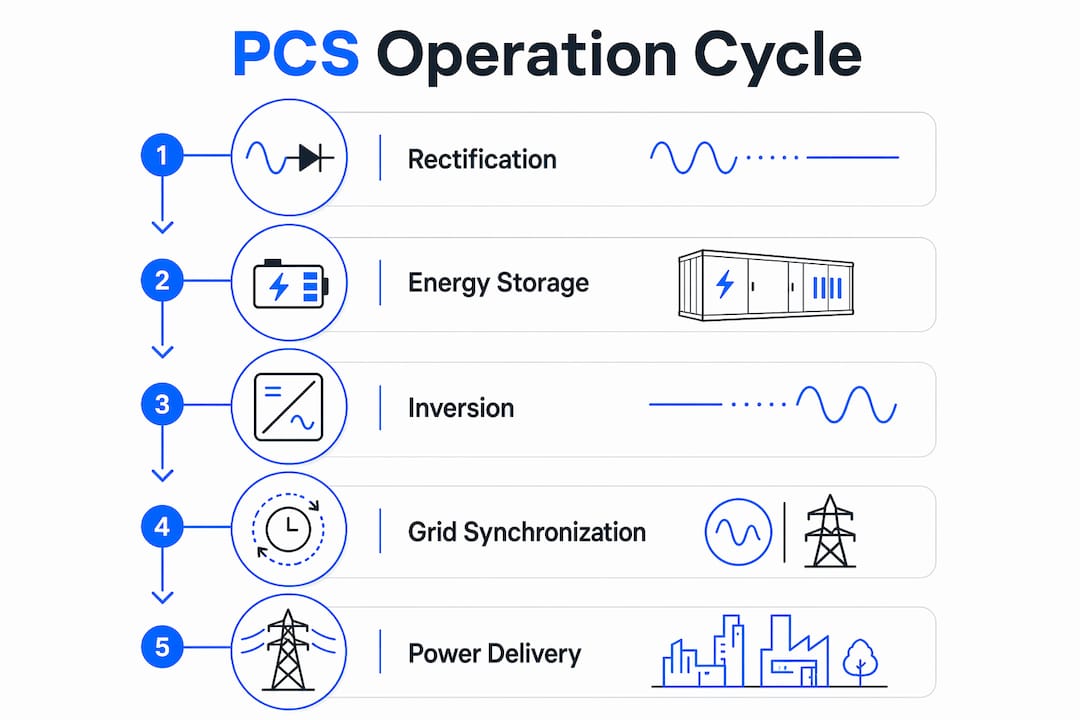
Key components and their roles
The switching elements inside a modern PCS are either IGBTs (insulated-gate bipolar transistors) or SiC-MOSFETs (silicon carbide metal-oxide-semiconductor field-effect transistors). SiC-MOSFETs switch faster and generate less heat, which is why they dominate in high-efficiency designs. The choice of switching technology directly affects the 97–98.7% efficiency range cited above.
The PCS does not operate alone. It works within a three-layer control hierarchy:
Battery Management System (BMS): monitors cell voltage, temperature, and state of charge, and communicates limits to the PCS
Energy Management System (EMS): sets the strategic dispatch schedule, including arbitrage windows and grid service commitments
PCS: executes the physical power conversion based on commands from the EMS, within the safety boundaries set by the BMS
The PCS acts as an execution unit, translating EMS commands into physical power flow. It does not decide when to charge or discharge. It carries out those decisions with precision.
Pro Tip: Communication latency between PCS and EMS is critical. Delays in the millisecond range can cause failures in grid stability tests. Specify your communication protocol and maximum latency before procurement, not after.
The Belinus EMS uses 15-minute dynamic tariff optimization and real-time battery arbitrage, which means the PCS must respond to dispatch commands quickly and accurately. That tight loop between EMS and PCS is what separates a well-integrated system from one that underperforms on paper.
What are the grid standards and support functions a PCS must meet?
Grid connection is where many projects stall. VDE standards require PCS in commercial projects to provide blind power regulation, ramp-rate control, and fault ride-through (FRT) capabilities. Systems without documented configuration for these functions can be denied grid connection outright. That is not a technical failure. It is a paperwork failure with expensive consequences.
The table below compares what modern PCS must provide versus what a legacy unidirectional inverter typically offers.
Feature | Modern PCS | Legacy unidirectional inverter |
Bidirectional power flow | Yes | No |
Reactive power (blind power) control | Yes | Limited or none |
Ramp-rate control | Yes | Rarely |
Fault ride-through (FRT) | Yes | Rarely |
Frequency-power regulation | Yes | No |
Grid-forming capability | Advanced units | No |
Black start capability | Advanced units | No |
Grid-following vs. grid-forming PCS
Most installed PCS units today are grid-following. They synchronize to an existing grid signal and inject power accordingly. Grid-forming PCS provide inertia and stabilize voltage and frequency without relying on an external reference signal. That capability was previously delivered only by large synchronous generators. As renewable penetration increases, grid-forming units become necessary infrastructure, not optional upgrades.
Grid-forming inverters with black start capability can restore electrical islands after an outage. That function is increasingly required in Central European grid codes and will likely become standard across more markets by 2027.
Pro Tip: Request grid code certification documentation from your PCS supplier before signing any contract. Selecting PCS without grid code certification causes costly project rejections at final stages. Blind power provisioning and FRT documentation are the two most commonly missing items.
What are the benefits and applications of power conversion systems?
Power conversion technologies serve a wide range of applications, from residential battery walls to utility-scale frequency regulation contracts. The common thread is that every application depends on the PCS to move energy reliably and efficiently between storage and the grid.
Applications across energy sectors
In battery energy storage systems, the PCS is the interface between the battery and everything else. Without it, stored energy stays stored. With it, that energy becomes a tradeable asset, a grid service, or a backup power source.
For integrating renewables into an energy system, the PCS smooths out the intermittency of solar and wind by charging batteries during surplus periods and discharging during demand peaks. That function alone justifies the investment in commercial projects with time-of-use tariffs.
Key benefits of a well-specified power conversion system include:
Grid stability: reactive power control and frequency regulation keep voltage within safe limits during demand spikes
Flexible energy flow: bidirectional operation lets you charge from the grid, discharge to the grid, or self-consume, depending on price signals
Battery longevity: a PCS that communicates cleanly with the BMS avoids overcharge and deep discharge cycles that degrade cells
Revenue from grid services: frequency regulation and arbitrage contracts require a PCS that can respond within seconds
Efficiency gains: at 97–98.7% conversion efficiency, losses are minimal across thousands of daily cycles
Belinus supports multiple battery chemistries through its EMS, including LFP, pre-lithiated LFP, graphene supercapacitors, and HUC (hybrid ultracapacitor). Each chemistry has different charge and discharge profiles. The PCS must adapt to all of them without compromising safety or performance.
What are the common challenges in integrating a PCS?
The most common integration mistake is selecting a PCS based on power output alone. Evaluating PCS without considering battery chemistry compatibility is a critical oversight that affects system lifetime and safety. LFP cells have different voltage windows than supercapacitors. A PCS calibrated for one will stress the other.
Practical integration challenges
Compatibility between PCS and battery chemistry is critical for system longevity and safety. The BMS enforces hard limits, but the PCS must respect those limits in real time. If the communication link between PCS and BMS drops or lags, the system either shuts down or operates outside safe parameters.
Common pitfalls to address before deployment:
Protocol mismatch: PCS and BMS must share a communication standard (CAN bus, Modbus, or CANopen are typical). Mismatches require custom middleware that adds latency.
Grid code gaps: missing documentation for reactive power or FRT will block grid connection regardless of hardware quality
Single-chemistry design: a PCS designed only for LFP cannot safely manage a graphene supercapacitor without firmware changes
EMS latency: dispatch commands that arrive late cause the PCS to miss frequency regulation windows, which triggers penalties in grid service contracts
Future-proofing: grid codes in Central Europe are moving toward mandatory grid-forming requirements. A PCS that cannot be firmware-updated will need physical replacement.
Pro Tip: Anticipate grid-forming requirements in your region before finalizing PCS specifications. Central European grid operators are already piloting mandatory grid-forming standards. Buying a grid-following-only unit today may mean a full replacement within five years.
Top energy management systems address BMS and PCS compatibility as a design requirement, not an afterthought. The Belinus EMS uses a RESTful API for third-party integrations, which means the PCS communication layer can be validated before hardware arrives on site.
Key Takeaways
A power conversion system is the critical interface between battery storage and the grid, and its performance determines the efficiency, safety, and revenue potential of any energy storage project.
Point | Details |
PCS vs. inverter | A PCS is bidirectional; a standard inverter is not. Only a PCS can charge and discharge a battery. |
Efficiency standard | Modern PCS operate at 97–98.7% efficiency, making conversion losses a minor factor in system economics. |
Grid code compliance | VDE and similar standards require blind power regulation, ramp-rate control, and FRT. Missing documentation blocks grid connection. |
Battery compatibility | Match PCS firmware and communication protocols to your battery chemistry before procurement. |
Grid-forming trend | Grid-forming PCS provide inertia and black start capability. Central European grids are moving toward requiring them. |
Why the PCS is the most underestimated component in energy storage
Most project discussions center on battery capacity and solar yield. The PCS rarely gets the same attention, and that is where projects run into trouble. I have seen well-funded commercial storage projects delayed by months because the PCS supplier could not produce FRT documentation in time for the grid operator’s review. The hardware was fine. The paperwork was not.
The shift from grid-following to grid-forming PCS is not a future concern. It is happening now. Grid-forming PCS are central to the energy transition, providing the inertia that synchronous generators used to deliver. Every new storage project should be evaluated against that trajectory, not just today’s grid code.
What I find most underappreciated is the EMS-PCS communication layer. The power electronics are mature technology. The failure modes I see most often come from latency between the EMS dispatch command and the PCS execution. A 200-millisecond lag that looks acceptable in testing can cause a frequency regulation contract failure in live operation. That is a revenue problem, not just a technical one.
The best PCS procurement decisions I have observed treat the unit as part of a system, not a standalone component. Chemistry compatibility, communication protocol, grid code documentation, and firmware update paths all belong in the specification before the first quote request goes out.
— Marc
Belinus power conversion and energy management solutions
Belinus designs and delivers integrated energy systems where the PCS, EMS, and battery storage work as a single coordinated platform. For CNI projects, Belinus offers its own branded PCS with a two-week delivery target, built to meet current grid code requirements and designed for multi-chemistry battery support across LFP, graphene supercapacitor, and HUC technologies.

The Belinus EMS handles real-time grid optimization including 15-minute dynamic tariff dispatch, battery arbitrage, and grid service management. Whether you are specifying a commercial rooftop system or a utility-scale storage installation, Belinus provides the technical depth and product integration to move from design to grid connection without the delays that come from mismatched components. Visit belinus.com to request a consultation or review available system configurations.
FAQ
What is a power conversion system in simple terms?
A power conversion system is a device that converts electricity between DC and AC in both directions, allowing a battery to charge from the grid and discharge back to it. It is the core component in any battery energy storage system.
How does a PCS differ from a solar inverter?
A solar inverter converts DC from solar panels to AC in one direction only. A PCS is bidirectional, managing both charging (AC to DC) and discharging (DC to AC), which makes it necessary for grid-connected battery storage.
What efficiency should a good PCS achieve?
Modern PCS units achieve 97–98.7% conversion efficiency. That range means energy losses across thousands of daily cycles remain minimal, which directly protects system economics over a 10–20 year project life.
What grid functions must a PCS support?
Under standards like VDE-AR-N 4105, a PCS must support reactive power regulation, ramp-rate control, fault ride-through, and frequency-power regulation. Systems without documented compliance for these functions risk being denied grid connection.
Why does battery chemistry affect PCS selection?
Different battery chemistries, such as LFP, graphene supercapacitors, and HUC, have different voltage windows and charge profiles. A PCS must be configured and firmware-matched to the specific chemistry it manages to avoid premature battery degradation or safety failures.
Recommended
A well-organized collection of printable coloring pages can save time when you need a quick activity for children. This one from PhotoColorify covers anime, holiday, and animal themes, so there’s a good chance you’ll find something suitable for the moment. The A4 PDF downloads are straightforward for home or classroom use, and the built-in online coloring option is a nice alternative when you want to avoid printing. Browse this themed printable selection for your next activity planning.